




Hero Introduction
AI has moved from experimentation to a business necessity. Organizations across industries are using AI to automate workflows, enhance customer experiences, and improve decision-making. However, achieving meaningful AI outcomes requires more than choosing a popular model or platform. The foundation of every successful AI initiative is a well-designed AI tech stack that aligns with business goals and technical requirements.
Executive Summary
An AI tech stack consists of technologies, tools, frameworks, infrastructure, and processes used to build, deploy, and manage AI solutions. From data storage and machine learning frameworks to foundation models, vector databases, and security controls, every layer plays a critical role in determining the performance and scalability of an AI application. This guide explores the essential components of an AI tech stack and provides a practical framework for selecting the right technologies for your business.
What Does an AI Tech Stack include?
An AI tech stack is a collection of technologies that work together to support the development, deployment, monitoring, and maintenance of AI-powered applications. Unlike traditional software stacks, AI systems rely heavily on data pipelines, machine learning models, training environments, and ongoing optimization processes.
A complete AI tech stack typically includes:
- Data collection and management systems
- Machine learning and AI development frameworks
- Foundation models and large language models
- Vector databases and retrieval systems
- Cloud or on-premise infrastructure
- MLOps and deployment tools
- Security, compliance, and governance solutions
Each layer serves a unique purpose, and a weakness in one component can impact the effectiveness of the entire system. Therefore, selecting the right combination of technologies is crucial for building scalable and reliable AI solutions.
Components of an AI Tech Stack
An AI tech stack consists of multiple interconnected layers that work together to collect data, train models, generate insights, and deliver AI-powered experiences. Each component serves a specific purpose, and the effectiveness of the overall system depends on how well these technologies integrate. Understanding these core components helps organizations make informed decisions when building scalable and reliable AI solutions.
Data Layer
The data layer forms the foundation of every AI system. Since AI models rely on data to learn patterns, generate predictions, and produce outputs, the quality and accessibility of data directly influence the success of AI initiatives. Even the most advanced models can underperform if they are trained on inaccurate, incomplete, or poorly structured datasets.
The data layer includes data collection mechanisms, storage systems, processing pipelines, and governance frameworks. Organizations typically gather data from multiple sources such as customer interactions, enterprise applications, IoT devices, websites, social platforms, and third-party providers. This information must then be cleaned, transformed, and organized before it becomes useful for AI applications.
A strong data layer should support both structured data, such as databases and spreadsheets, and unstructured data, including documents, emails, images, videos, and audio files. Businesses must also establish reliable data governance practices to maintain consistency, accuracy, and compliance across their datasets. Features such as data lineage tracking, metadata management, and automated quality checks help ensure that AI systems have access to trustworthy information.
As AI adoption grows, organizations should invest in scalable data architectures capable of handling increasing volumes of information while maintaining performance and reliability.
AI and Machine Learning Frameworks
AI and machine learning frameworks provide the development environment where data scientists and engineers build, train, test, and deploy AI models. These frameworks simplify complex mathematical computations and offer pre-built tools that accelerate model development.
Machine learning frameworks support a wide range of AI applications, including predictive analytics, natural language processing, computer vision, recommendation engines, and autonomous systems.
They provide libraries, APIs, and workflows that reduce development complexity and allow teams to focus on solving business problems rather than building foundational capabilities from scratch.
When evaluating frameworks, organizations should consider factors such as ease of use, community support, performance optimization, compatibility with existing systems, and availability of pre-trained models. The chosen framework should also align with the team’s technical expertise and future development goals.
Scalability is another important consideration. As AI applications expand, frameworks should support distributed training, cloud integration, and efficient deployment across multiple environments. Organizations that choose flexible and widely adopted frameworks often benefit from faster innovation, easier talent acquisition, and access to larger ecosystems of tools and resources.
Foundation Models and LLM Providers
Foundation models have transformed the AI landscape by enabling organizations to build sophisticated applications without training massive models from scratch. These large-scale models are trained on extensive datasets and can perform a variety of tasks, including content generation, summarization, classification, coding assistance, and conversational interactions.
Businesses can choose from a growing ecosystem of commercial and open-source foundation models. Commercial providers offer managed services, enterprise support, scalability, and simplified deployment, while open-source alternatives provide greater flexibility, customization, and control over data and infrastructure.
Selecting the right foundation model requires evaluating several critical factors. Performance remains a primary concern, as different models excel in different tasks. Some models are optimized for reasoning and analytical tasks, while others specialize in creative content generation or multilingual communication.
Cost is another major consideration. Organizations must account not only for model usage fees but also for inference costs, fine-tuning expenses, and infrastructure requirements. Security and privacy requirements may influence whether businesses choose cloud-hosted solutions or self-hosted deployments.
Vector Databases and Knowledge Retrieval
As organizations increasingly adopt generative AI solutions, vector databases have become a critical component of modern AI architectures. Traditional databases store information in structured formats, whereas vector databases are designed to store numerical representations known as embeddings, which capture the semantic meaning of data.
Vector databases enable AI systems to perform similarity searches, allowing them to retrieve relevant information based on context rather than exact keyword matches. This capability is particularly important for RAG, where AI models access external knowledge sources to generate more accurate and context-aware responses.
Knowledge retrieval systems help overcome one of the biggest limitations of foundation models: static knowledge. Since models are trained on historical data, they may lack access to recent information or proprietary organizational knowledge. By integrating vector databases, businesses can provide AI systems with real-time access to documents, policies, product information, and customer records.
When evaluating vector database solutions, organizations should assess search performance, scalability, indexing capabilities, integration support, and security features. The ability to efficiently handle large volumes of embeddings while maintaining low-latency retrieval is essential for delivering responsive AI experiences.
Infrastructure and Compute Resources
Infrastructure serves as the backbone of the AI tech stack, providing the computational power required to train, deploy, and operate AI models. The infrastructure layer directly impacts performance, scalability, reliability, and operational costs.
Organizations can choose from cloud-based, on-premise, hybrid, or edge computing environments depending on their business requirements. Cloud platforms have become a popular choice because they provide flexible access to compute resources without significant upfront investments. Businesses can scale resources on demand, enabling efficient management of fluctuating workloads.
AI workloads typically fall into two categories: training and inference. Training large-scale models requires substantial computational resources, often involving GPUs, TPUs, or specialized AI accelerators. Inference workloads focus on delivering predictions or generated outputs to users quickly and efficiently.
Infrastructure planning should consider factors such as expected traffic volume, latency requirements, geographic distribution, disaster recovery needs, and cost management. Organizations should also evaluate whether they require dedicated hardware for sensitive workloads or can utilize shared cloud environments.
MLOps and AI Operations Tools
Building an AI model is only the beginning of the AI lifecycle. Once deployed, models require continuous monitoring, maintenance, retraining, and optimization. MLOps provides the processes and tools needed to manage AI systems effectively at scale.
MLOps combines software engineering best practices with machine learning workflows to create reliable and repeatable deployment pipelines. It helps organizations automate model development, testing, deployment, monitoring, and governance activities.
One of the primary benefits of MLOps is improved collaboration between data scientists, engineers, and operations teams. Standardized workflows reduce friction between development and production environments, enabling faster releases and more consistent results.
These features allow organizations to identify performance issues early and respond quickly when models begin to degrade.
Model drift is a particularly important challenge in AI systems. As real-world conditions change, model accuracy can decline over time. MLOps tools help organizations monitor model behavior, trigger retraining processes, and maintain optimal performance.
Security and Compliance Layer
Security and compliance form the protective layer of the AI tech stack, ensuring that AI systems operate safely, responsibly, and within regulatory requirements. As organizations increasingly rely on AI to process sensitive information, security considerations must be integrated throughout the entire technology stack.
The security layer encompasses data protection, identity management, access control, threat detection, encryption, auditing, and governance mechanisms. These controls help safeguard confidential information from unauthorized access and cyber threats.
Data privacy has become a major concern for organizations deploying AI solutions. Businesses must ensure that customer information, intellectual property, and proprietary data remain protected during storage, training, and inference processes. Encryption, anonymization, and secure data-sharing practices play a critical role in reducing risks.
Compliance requirements vary by industry and region, but many organizations must adhere to strict regulations governing data usage, retention, transparency, and accountability. AI governance frameworks help businesses establish clear policies for model development, deployment, monitoring, and risk management.
Model security is another emerging priority. AI systems can be vulnerable to adversarial attacks, prompt injection attacks, model theft, and data poisoning attempts. Implementing security controls specifically designed for AI workloads helps mitigate these threats and maintain system integrity.
A Step-by-Step Framework for Choosing the Right AI Tech Stack
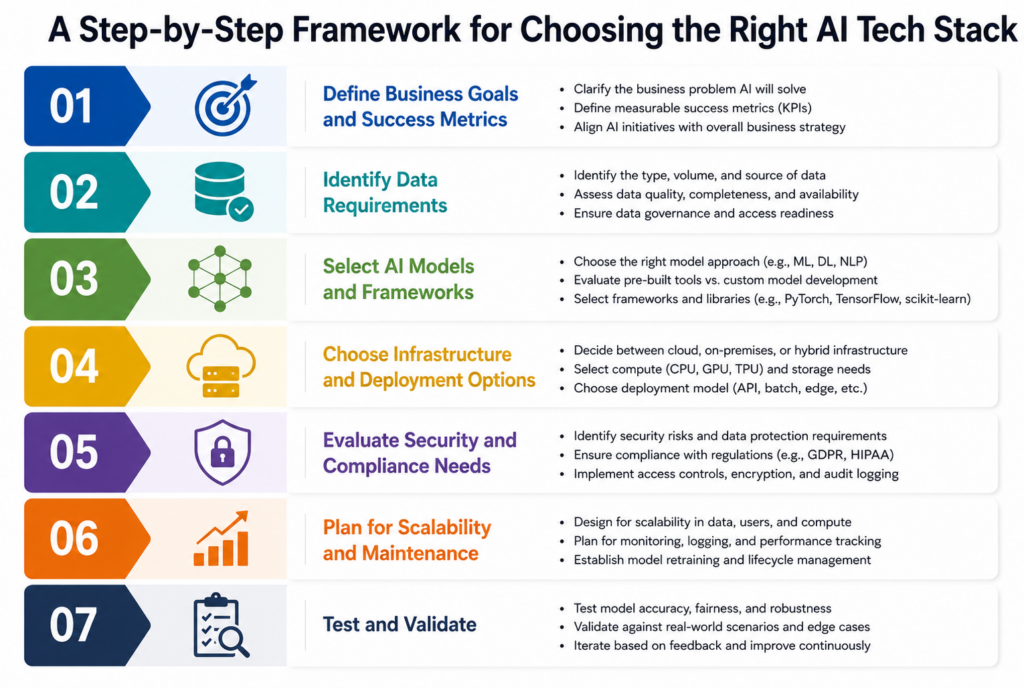
The right stack should align with business objectives, support current and future requirements, integrate with existing systems, and provide a strong foundation for long-term growth. A structured decision-making process helps organizations avoid costly mistakes and ensures that technology investments generate measurable value.
Define Business Goals and Success Metrics
The first step in choosing an AI tech stack is clearly defining what the organization wants to achieve. Many AI projects fail because teams focus on technology before identifying the business problem they are trying to solve. A well-defined objective provides direction and helps narrow down technology choices.
Organizations should begin by asking fundamental questions:
- What challenge are we trying to solve?
- What business outcome do we expect?
- Who will use the AI solution?
- How will the solution fit into existing workflows?
- What level of performance is required?
For example, an AI-powered customer support chatbot has different requirements than a predictive maintenance system or an internal knowledge assistant. Each use case demands a different combination of technologies, infrastructure, and models.
Identify Data Requirements
The first consideration is identifying data sources. AI applications may rely on structured data from databases, unstructured content such as documents and emails, customer interaction records, images, videos, sensor data, or external datasets.
Moreover, data quality should also be evaluated carefully. Inaccurate, inconsistent, or incomplete data can significantly reduce model performance and lead to unreliable outputs. Organizations should assess whether data cleansing, transformation, or labeling processes are required before AI implementation.
Select AI Models and Frameworks
Once business goals and data requirements are clearly defined, organizations can evaluate AI models and development frameworks that best fit their needs. This is often the most visible aspect of AI development, but it should never be approached in isolation.
The selection process begins by determining the type of AI application being built. Different use cases require different model capabilities.
Therefore, several factors should be evaluated when comparing models and frameworks:
- Performance and accuracy
- Customization requirements
- Cost and resource consumption
- Ecosystem and community support
Choose Infrastructure and Deployment Options
Infrastructure decisions determine how AI systems are trained, deployed, and operated. The chosen infrastructure should provide sufficient computational power while balancing performance, flexibility, security, and cost considerations.
Infrastructure planning should also account for training and inference requirements. Training large models often requires GPUs, TPUs, or specialized AI accelerators, while inference environments focus on delivering low-latency responses to users.
Some additional considerations are:
- Availability and uptime requirements
- Geographic distribution of users
- Disaster recovery strategies
- Resource utilization efficiency
- Future workload growth
Evaluate Security and Compliance Needs
Security and compliance considerations should be integrated into the AI technology selection process from the very beginning. Addressing these requirements early reduces risks and prevents expensive redesign efforts later.
Model security is becoming increasingly important as AI adoption grows. Organizations should assess potential threats such as:
- Prompt injection attacks
- Data poisoning attempts
- Model theft
- Unauthorized access
- Adversarial manipulation
Plan for Scalability and Maintenance
Many AI projects begin as pilot initiatives but eventually evolve into business-critical systems. Organizations that fail to plan for growth often encounter performance issues, operational inefficiencies, and rising costs as adoption increases.
Maintenance planning is equally important. AI systems require continuous monitoring, updates, retraining, and optimization to remain effective. Organizations should establish processes for:
- Model performance monitoring
- Data quality management
- Version control
- Retraining workflows
- Incident response
- System upgrades
Test and Validate
Before deploying an AI solution into production, organizations must conduct thorough testing and validation to ensure that the system performs as expected. This stage helps identify weaknesses, reduce risks, and improve overall reliability.
Testing should begin with technical validation, where teams evaluate model accuracy, performance, latency, and resource utilization. Models should be tested against representative datasets to determine how they perform under real-world conditions.
You can conduct the following tests as well:
- Security testing
- User acceptance
- Load testing
Moreover, validation should not end after deployment. Continuous monitoring and performance evaluation allow organizations to identify emerging issues, track business outcomes, and make data-driven improvements over time.
Final Words
Choosing the right AI tech stack requires balancing business objectives, data requirements, model capabilities, infrastructure, security, and long-term scalability. A thoughtful, structured approach helps organizations avoid costly mistakes and build reliable AI solutions. By investing in the right technologies and processes, businesses can maximize AI performance, adaptability, and sustainable growth.