




Hero Introduction
SaaS architecture is the foundation that determines how a software product performs, scales, and evolves. For startup founders, understanding architectural choices is essential for building reliable applications, controlling costs, and supporting future growth. The right architecture can help transform a promising idea into a successful and scalable SaaS business.
Executive Summary
SaaS architecture defines how a cloud-based application is designed, deployed, and managed. It influences performance, security, scalability, and operational efficiency. This guide explains the core components of SaaS architecture, explores common architectural models, compares monolithic and microservices approaches, and highlights key strategies for building scalable SaaS applications.
What is SaaS Architecture?
SaaS architecture refers to the underlying design and structure of a software application delivered through the cloud as a service. It defines how various components interact, how data is stored and processed, and how users access the platform.
Unlike traditional software applications that require installation on individual devices, SaaS applications are hosted in the cloud and accessed through web browsers or mobile applications. This cloud-based delivery model allows businesses to serve thousands or even millions of users from a centralized environment.
The primary goal of SaaS architecture is to provide a framework that supports:
- Scalability
- High availability
- Security
- Performance
- Maintainability
- Cost efficiency
For startup founders, SaaS architecture serves as the foundation upon which future growth depends. A poorly designed architecture may work for a handful of users but struggle under increased demand. Conversely, a well-planned architecture can support rapid scaling while minimizing operational challenges.
Modern SaaS architecture often leverages cloud platforms, containerization technologies, automation tools, and distributed systems to create flexible and resilient applications. As customer expectations continue to evolve, architecture plays a vital role in ensuring a SaaS product remains competitive and reliable.
Components of SaaS Architecture
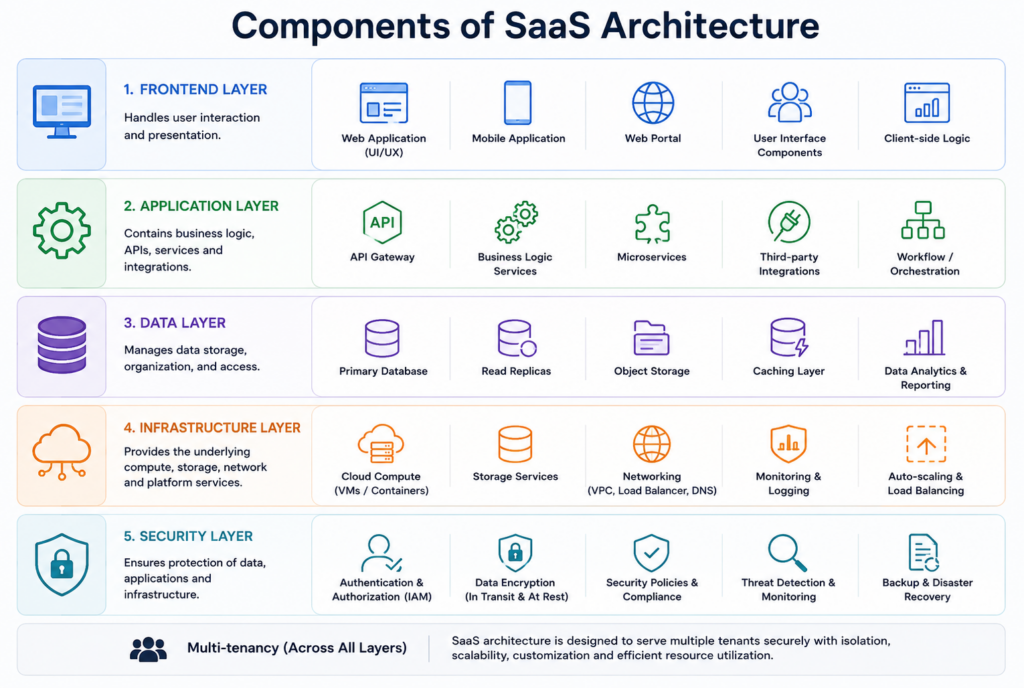
A SaaS application consists of several interconnected layers that work together to deliver services to users. Understanding these components helps founders make better technical and strategic decisions.
Frontend Layer
The frontend layer is the part of the application that users interact with directly. It includes web interfaces, dashboards, mobile applications, and customer-facing portals.
This layer focuses on delivering a seamless user experience while communicating with backend services through APIs. Modern frontend frameworks such as React, Angular, and Vue enable developers to create highly responsive and interactive user interfaces.
A well-designed frontend contributes significantly to customer satisfaction and retention by making the platform easy to use and navigate.
Application Layer
The application layer contains the business logic that powers the SaaS platform. It processes user requests, executes workflows, enforces rules, and coordinates communication between different services.
Examples include:
- User account management
- Subscription handling
- Billing operations
- Workflow automation
- Data processing
This layer is often considered the core of the SaaS application because it directly supports the product’s functionality.
Data Layer
The data layer manages how information is stored, retrieved, and maintained.
Depending on the application requirements, organizations may use:
- Relational databases
- NoSQL databases
- Data warehouses
- Object storage systems
Effective database design ensures consistent performance, reliable data access, and scalability as user activity increases.
Infrastructure Layer
The infrastructure layer provides the computing resources necessary to run the SaaS application.
This includes:
- Cloud servers
- Networking systems
- Storage resources
- Load balancers
- Container orchestration platforms
Cloud providers such as Amazon Web Services, Microsoft Azure, and Google Cloud offer scalable infrastructure that allows startups to expand capacity.
Security Layer
Security is integrated throughout every layer of SaaS architecture.
Some security measures include:
- Authentication systems
- Authorization controls
- Data encryption
- Security monitoring
- Vulnerability management
Because SaaS platforms often handle sensitive customer information, security must be considered from the earliest stages of development.
Types of SaaS Architecture Models
The architecture model determines how resources are allocated, how customer data is managed, how easily the platform can scale, and the overall cost of operations. While there is no one-size-fits-all solution, understanding the most common SaaS architecture models can help founders select an approach that aligns with their business goals and customer requirements.
Single-Tenant Architecture
In a single-tenant architecture, each customer receives a dedicated instance of the application along with separate infrastructure and databases. Every tenant operates in an isolated environment that is not shared with other customers.
This model offers a high degree of customization because businesses can tailor configurations, integrations, and workflows to meet individual customer needs without affecting others. Data isolation is another significant advantage, making single-tenant architecture attractive for organizations operating in highly regulated industries such as healthcare, finance, and government.
From a security perspective, single tenancy reduces the risk of cross-tenant data exposure because customer environments are completely separated. Maintenance activities and upgrades can also be scheduled according to the needs of individual clients rather than being applied universally.
However, these benefits come with trade-offs. Operating separate environments for every customer increases infrastructure costs, requires more administrative effort, and can make scaling more complex. As the customer base grows, managing multiple isolated deployments becomes increasingly resource-intensive.
Single-tenant architecture is often best suited for enterprise SaaS solutions where customers demand extensive customization, strict compliance controls, and dedicated resources.
Multi-Tenant Architecture
Multi-tenant architecture is the most widely adopted model in the SaaS industry. In this approach, multiple customers share the same application infrastructure and resources while their data remains logically separated through software controls.
Most successful SaaS companies choose multi-tenancy because it enables efficient resource utilization and significantly reduces operational costs. Instead of maintaining separate environments for every customer, a single application instance serves multiple tenants simultaneously.
One of the biggest advantages of multi-tenancy is scalability. New customers can be added quickly without requiring dedicated infrastructure. Software updates, security patches, and new features can also be deployed centrally, ensuring all users benefit from improvements immediately.
Multi-tenant systems support rapid business growth because infrastructure costs are spread across many customers. This allows startups to offer competitive pricing while maintaining profit margins.
Despite its advantages, multi-tenancy requires careful planning. Developers must implement strong tenant isolation mechanisms to ensure data privacy and security. Resource-intensive customers can also impact system performance if capacity planning is not handled effectively.
For most startups, especially those targeting SMBs, multi-tenant architecture provides the ideal balance between scalability, efficiency, and cost-effectiveness.
Hybrid Architecture
Hybrid architecture combines elements of both single-tenant and multi-tenant models. It allows SaaS providers to utilize shared infrastructure where appropriate while offering dedicated resources for customers with specialized needs.
This approach provides flexibility that can be particularly valuable as a SaaS business grows and begins serving a broader range of customers. For example, small and mid-sized customers may operate within a shared multi-tenant environment, while enterprise clients receive dedicated databases, infrastructure, or application instances.
Hybrid architecture enables companies to maintain the cost benefits of multi-tenancy while accomodating customers with stricter compliance, performance, or customization requirements. It can also support geographic data residency requirements by allowing specific workloads to run in dedicated environments.
The primary challenge of hybrid architecture is increased operational complexity. Managing both shared and dedicated environments requires more sophisticated monitoring, deployment, and maintenance processes. Development teams must ensure consistency across different deployment models while avoiding unnecessary duplication of effort.
Monolithic vs. Microservices Architecture
One of the most significant architectural decisions startups founders face is choosing between a monolithic architecture and a microservices architecture. This choice influences development speed, scalability, operational complexity, maintenance requirements, and long-term business growth. While both approaches can successfully power SaaS applications, understanding their strengths and limitations is essential for making an informed decision.
Monolithic Architecture
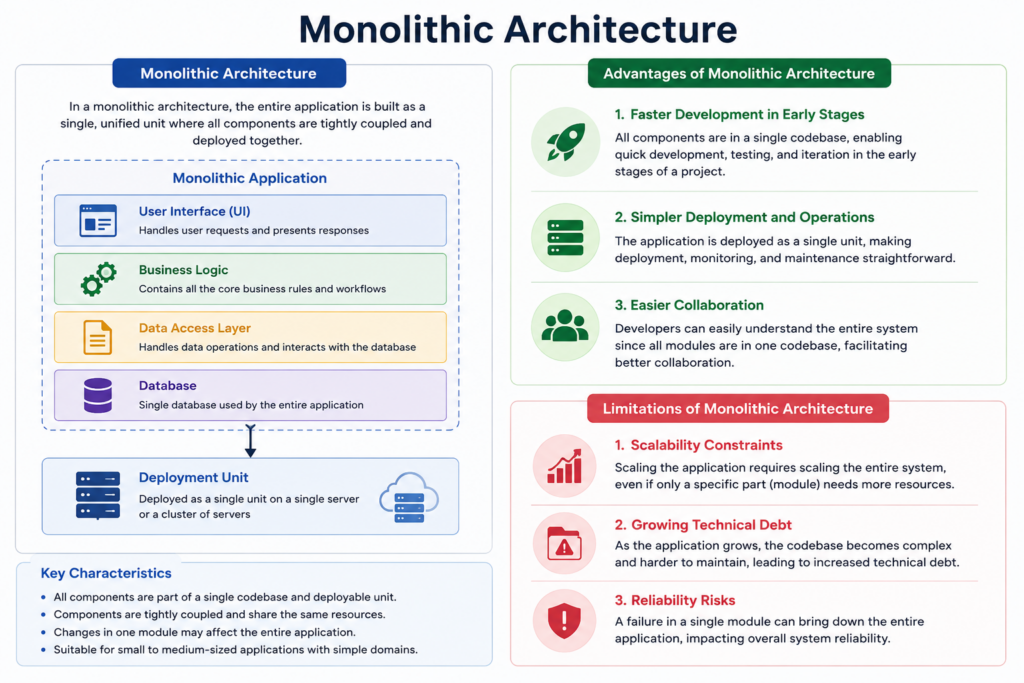
A monolithic architecture is a software design approach where all application components are built and deployed as a single unified system. The user interface, business logic, APIs, authentication mechanisms, and data access layers are tightly integrated into one codebase.
In monolithic application, every feature operates within the same environment. When developers make changes, the entire application is typically tested and deployed together.
Many successful SaaS companies initially launched with a monolithic architecture because it offers simplicity and allows teams to focus on product development rather than infrastructure management.
Advantages of Monolithic Architecture
Faster Development in Early Stages
For startups building their first product, speed is often more important than architectural sophistication. A monolithic structure enables developers to create features quickly because everything exists within a single codebase.
Development teams can:
- Build and test features faster
- Simplify debugging processes
- Reduce initial infrastructure setup
- Accelerate product launches
Simpler Deployment and Operations
Monolithic applications are generally easier to deploy because the entire system is packaged as one unit.
Instead of managing multiple services, teams can:
- Maintain a single deployment pipeline
- Monitor one application environment
- Simplify release management
- Reduce operational overhead
Easier Collaboration
When all functionality resides in a single codebase, developers can easily understand how different components interact. This often improves collaboration among small teams and reduces coordination challenges.
Limitations of Monolithic Architecture
Scalability Constraints
As user demand increases, scaling a monolithic application becomes more challenging. Because all components are bundled together, organizations often have to scale the entire application even when only one feature requires additional resources.
This can lead to:
- Higher infrastructure costs
- Inefficient resource utilization
- Reduced scalability flexibility
Growing Technical Debt
As the application expands, the codebase becomes increasingly complex. New features can introduce dependencies that make development slower and increase the risk of unintended side effects.
Over time, teams may encounter:
- Longer testing cycles
- Slower deployments
- Increased maintenance costs
- Reduced development agility
Reliability Risks
A failure in one component can potentially affect the entire application. Since all services operate within the same environment, issues can have widespread consequences.
Microservices Architecture
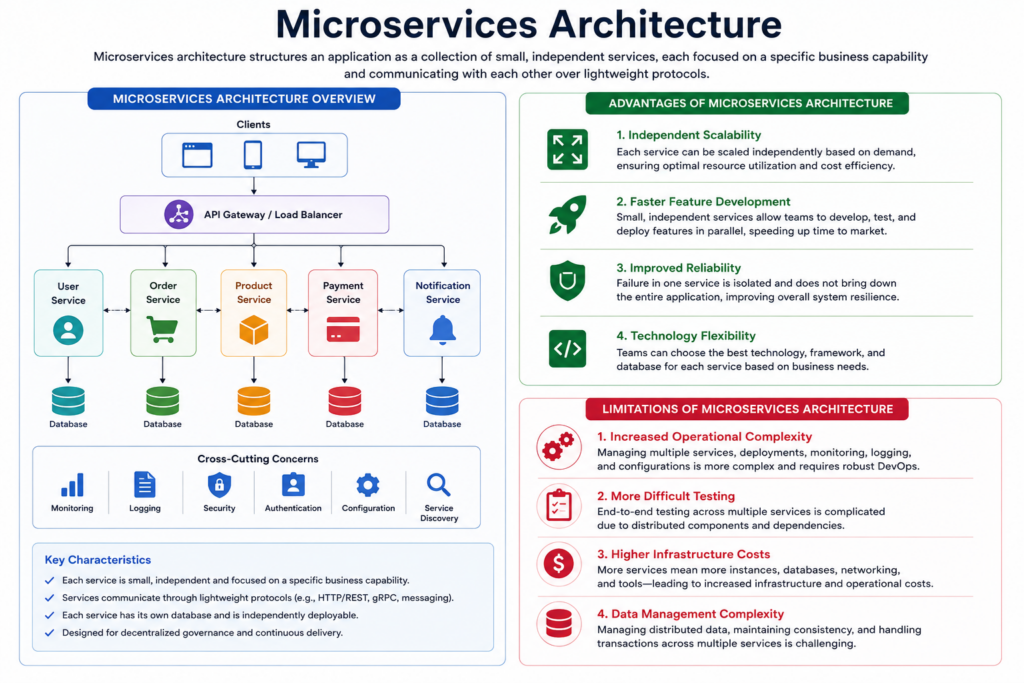
Microservices architecture divides an application into a collection of smaller and independent services. Each service focuses on a specific business function and can be developed, deployed, scaled, and maintained independently.
For example, a SaaS platform may separate the following functions into individual services:
- User authentication
- Billing and subscriptions
- Notifications
- Analytics
- Customer management
- Reporting
Each microservice communicates with others through APIs or messaging systems while maintaining its own logic and, in many cases, its own database.
This architecture has become increasingly popular among fast-growing SaaS companies because it offers greater flexibility and scalability.
Advantages of Microservices Architecture
Independent Scalability
One of the biggest benefits of microservices is the ability to scale individual services based on demand.
For example:
- Billing systems can scale during payment cycles.
- Analytics services can scale when generating reports.
- Authentication services can scale during peak login periods.
Faster Feature Development
Because services operate independently, development teams can work on multiple features simultaneously without interfering with one another.
Benefits include:
- Parallel development workflows
- Faster release cycles
- Reduced development bottlenecks
- Greater team autonomy
Improved Reliability
In a well-designed microservices environment, a failure in one service doesn’t necessarily impact the entire application.
For example, if the notification service experiences an outrage, users may still be able to access dashboards, manage subscriptions, and perform other core tasks.
Technology Flexibility
Different services can use different technologies depending on their requirements.
Teams may choose:
- Node for real-time processing
- Python for machine learning workloads
- Java for enterprise integrations
- Go for high-performance services
Limitations of Microservices Architecture
Increased Operational Complexity
While microservices offer scalability benefits, they introduce significant operational challenges.
Organizations must manage:
- Service communication
- API gateways
- Container orchestration
- Distributed monitoring
- Logging systems
- Service discovery
More Difficult Testing
Testing is a distributed system is inherently more complicated than testing a monolithic application.
Teams must validate:
- Individual services
- API interactions
- Data consistency
- Network reliability
- End-to-end workflows
Higher Infrastructure Costs
Microservices often require additional infrastructure resources, including:
- Containers
- Load balancers
- Monitoring platforms
- Message queues
- Service meshes
Data Management Complexity
Maintaining consistent data across multiple services can be challenging. Distributed systems require careful planning to hide synchronization, transactions, and fault recovery.
Strategies for SaaS Applications
Building a SaaS product is not just about launching features; it’s about ensuring the platform can support growing user demand, maintain consistent performance, deliver a reliable customer experience, and remain cost-effective as the business scales. Without a clear scalability strategy, even a promising SaaS application can encounter performance bottlenecks, downtime, security risks, and rising operational expenses.
Design for Scalability from the Beginning
One of the biggest mistakes SaaS startups make is designing applications solely for current requirements. While this may accelerate initial development, it often leads to costly architectural changes as the customer base grows.
Therefore, founders should consider:
- Expected user growth over the next several years
- Data storage requirements
- Transaction volumes
- Geographic expansion plans
- New feature development
Implement Horizontal Scaling
Horizontal scaling is one of the most effective strategies for SaaS applications.
Rather than increasing the capacity of a single server, horizontal scaling distributes workloads across multiple servers or instances. As demand increases, additional resources can be added automatically.
Its benefits include:
- Improved application availability
- Better fault tolerance
- Increased flexibility
- More efficient resource allocation
Cloud providers make horizontal scaling easier through auto-scaling capabilities that automatically add or remove resources based on traffic patterns.
Optimize Database Performance
As a SaaS platform grows, the database often becomes one of the most critical performance bottlenecks. Slow queries, inefficient indexing, and increasing data volumes can negatively impact user experiences.
Database optimization should be a continuous process that includes:
Database Indexing
Indexes improve query performance by allowing databases to locate information more efficiently. Proper indexing can significantly reduce response times for frequently accessed data.
Database Indexing
Indexes improve query performance by allowing databases to locate information more efficiently. Proper indexing can significantly reduce response times for frequently accessed data.
Database Replication
Replication creates copies of databases across multiple servers, helping distribute read operations and improve availability.
Benefits include:
- Faster data access
- Improved redundancy
- Better disaster recovery capabilities
Database Sharding
Sharding involves splitting large databases into smaller, more manageable segments. This approach distributes workloads and improves performance as data volumes increase.
Final Words
SaaS architecture plays a critical role in determining a product’s scalability, performance, security, and long-term success. By understanding architectural models, choosing the right application structure, and implementing effective scaling strategies, startup founders can build resilient SaaS platforms that support growth, deliver user experiences, and adapt to evolving business demands.