


AI is moving beyond standalone chatbots and assistants into the systems and workflows businesses use every day. For Salesforce customers, Agentforce provides a way to build AI agents around CRM data, business processes, and actions. At the same time, ChatGPT has evolved into a broader enterprise AI workspace that can support research, company knowledge, data analysis, software development, connected tools, and increasingly autonomous workflows.
This creates a more nuanced decision than simply asking which platform has the “better AI.” The real question is where your business data lives, what the AI needs to understand, which actions it must perform, who will use it, how it connects to existing systems, and what governance and ROI requirements apply.
In many cases, Agentforce and ChatGPT are not direct substitutes. Agentforce is generally a stronger fit when AI needs to operate deeply inside Salesforce workflows and take Salesforce-native actions. ChatGPT is generally better suited to broad knowledge work, research, analysis, content, coding, and cross-system AI workflows.
Agentforce vs ChatGPT: The Short Answer
| Requirement | Agentforce | ChatGPT |
|---|---|---|
| Salesforce CRM Workflows | Strong fit | Can connect/integrate |
| Salesforce-Native Actions | Strong fit | Integration dependent |
| General Business Research | Limited/specialized | Strong fit |
| Writing & Content | Supported | Strong fit |
| Data Analysis | Salesforce-centric | Broad |
| Cross-System Work | Supported via integrations | Strong with connected tools |
| Customer-Facing Agents | Strong fit | Requires appropriate implementation |
| Internal Knowledge Work | Strong | Strong |
| CRM Automation | Strong fit | Integration dependent |
| General Employee AI Assistant | More Salesforce-centered | Strong fit |
| Custom AI Workflows | Yes | Yes |
| Best Fit | Salesforce-centric operations | Broad enterprise AI |
What Is Salesforce Agentforce?
Salesforce Agentforce is a platform for creating and deploying AI agents that can retrieve business information, reason about requests, execute actions, interact with workflows and APIs, and work with enterprise data.
The platform is particularly relevant to organizations already using Salesforce because agents can operate in the context of CRM records, metadata, permissions, automation, and established business processes. Salesforce frames its agent architecture around three important elements: data, reasoning, and actions.
In practical terms, an agent might help a sales representative prepare for a customer conversation, qualify a lead, update CRM information, resolve part of a service request, or trigger a defined business process.
Where Agentforce Fits in the Salesforce Ecosystem?
Agentforce sits within a broader Salesforce environment that can include:
- Sales and customer relationship management
- Customer service
- Marketing and commerce
- The Salesforce Platform
- Data 360
- Flow automation
- Apex development
- MuleSoft integrations
This ecosystem matters because an AI agent becomes more useful when it can work with the business logic and systems a company already operates. Organizations can use low-code tooling such as Agent Builder while also extending agents through pro-code APIs, SDKs, CLI tooling, and testing capabilities.
What Is ChatGPT for Business Use?
ChatGPT should no longer be viewed simply as a chatbot that answers prompts. For business users, it can function as a general-purpose AI workspace for research, analysis, writing, coding, document work, company knowledge, and connected workflows.
Research and Knowledge Work
Employees can use ChatGPT to investigate complex topics, synthesize information, compare options, summarize material, and support decision-making. This makes it useful across teams rather than limiting it to a specific operational platform.
Writing and Content
ChatGPT can support drafting, editing, summarization, brainstorming, proposal development, documentation, presentations, and even internal communications.
Data Analysis
Business users can analyze structured information, identify patterns, work with files and datasets, and turn raw information into explanations or useful outputs.
Company Knowledge
With appropriate business configurations and connected knowledge sources, ChatGPT can help employees access internal information without requiring every answer to come from manually searching separate systems.
Agents
ChatGPT’s capabilities increasingly extend beyond generating responses. Agents can support multi-step tasks, use authorized tools, gather information, and complete workflows depending on the implementation and available integrations.
Connected Business Systems
ChatGPT can connect with business applications and data sources through supported connectors, integrations, and custom implementations. This means the comparison with Agentforce is not as simple as saying that one platform can take action while the other can only answer questions.
Custom Workflows
Organizations can build custom AI applications and workflows around OpenAI models and APIs, giving technical teams flexibility to design experiences beyond the standard ChatGPT interface.
Software Development
For engineering organizations, AI-assisted coding is another important consideration. ChatGPT and related OpenAI development capabilities can support code generation, debugging, analysis, documentation, and software engineering workflows.
For enterprise use, the broader value proposition is therefore centralized AI assistance across multiple types of work, not just conversational interaction.
Salesforce Agentforce vs ChatGPT: What’s the Real Difference?
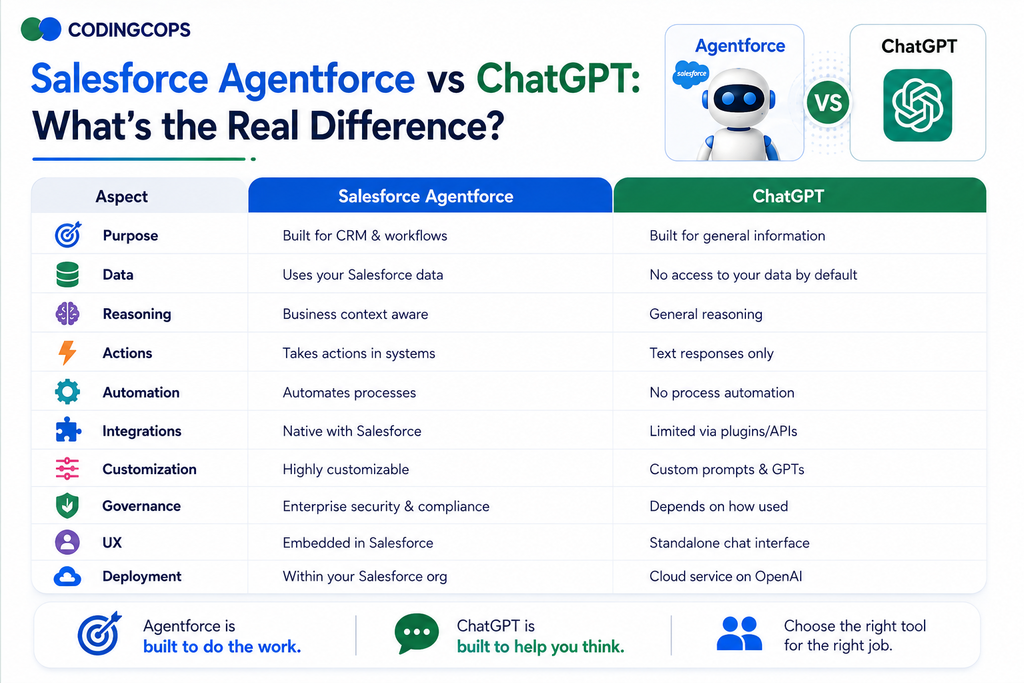
The biggest difference between Agentforce and ChatGPT is not simply the AI model or interface. It is the role each platform is designed to play within an organization. Agentforce is centered on AI agents that understand business context and execute actions, particularly within Salesforce environments. ChatGPT is a broader enterprise AI platform designed to support knowledge work, research, analysis, content creation, coding, and workflows across multiple systems.
Primary Purpose
Agentforce: AI agents embedded around enterprise processes, particularly Salesforce-centric workflows. It’s designed to help agents understand business context, follow defined processes, and take approved actions.
ChatGPT: General-purpose enterprise AI across research, knowledge work, analysis, creation, coding, and connected workflows. Its broader scope makes it useful across teams and business functions.
Business Data
Agentforce is naturally positioned around Salesforce data, including customer records, leads, opportunities, cases, and other CRM information. It can also work with external data through integrations.
ChatGPT can work with documents, company knowledge, uploaded files, connected applications, and external business systems. This makes it particularly useful when important information is distributed across multiple platforms.
Reasoning
Both platforms can interpret requests and determine appropriate responses or next steps. However, Agentforce reasoning is typically more closely connected to defining business processes, Salesforce context, and available actions.
ChatGPT is designed for broader reasoning tasks, including research, problem-solving, analysis, summarization, and open-ended knowledge work.
Actions
Agentforce has a natural advantage when AI needs to perform Salesforce-native actions, such as updating records, managing cases, or triggering existing business processes.
ChatGPT can also support actions through connected tools, plugins, APIs, and custom integrations. The difference is often how directly the required action fits into the platform’s existing architecture.
Automation
Agentforce is particularly suited to turning existing Salesforce workflows, business logic, and processes into agent-driven experiences.
ChatGPT can also support automated and multi-step workflows, especially when connected to external tools. It may be more flexible when automation needs to span several systems rather than primarily operating within Salesforce.
Integrations
Both platforms can connect to external systems. Agentforce benefits from its native connection to the Salesforce ecosystem, including Flow, Apex, MuleSoft, APIs, and enterprise data.
ChatGPT supports connected business applications, company knowledge, APIs, and custom integrations. This can make it a stronger fit for organizations with highly distributed technology environments.
Customization
Agentforce can be customized using low-code and pro-code approaches, allowing businesses to configure agents, actions, topics, workflows, and Salesforce-specific business logic.
ChatGPT can also be customized through enterprise configurations, connected tools, APIs, and custom AI applications. Its flexibility is especially useful when businesses need AI experiences that extend beyond a single enterprise platform.
Governance
Governance should not be treated as an automatic advantage for either platform. Both require clear controls around architecture, permissions, data access, available actions, monitoring, and human oversight.
Agentforce can build on existing Salesforce security, permissions, and governance structures. ChatGPT provides enterprise administration and controls while connected systems continue to enforce their own access permissions.
User Experience
Agentforce is often experienced within Salesforce or a Salesforce-powered customer, sales, or service workflow. This can reduce context switching for users who already spend much of their day inside Salesforce.
ChatGPT provides a more general AI workspace where employees can research, analyze, write, code, and work with connected information across different tasks and teams.
Deployment Model
Agentforce deployments often begin with a specific business process, such as sales assistance, customer service, or CRM automation. The focus is typically on identifying where an agent can access relevant data and take meaningful actions.
ChatGPT deployments can begin more broadly, such as providing an enterprise-wide AI workspace, before expanding into connected tools, specialized agents, and custom workflows.
Where Agentforce Has the Advantage?
Agentforce is particularly valuable when AI needs to operate close to Salesforce data, business processes, and customer interactions. For organizations where Salesforce is central to daily operations, it can provide a more direct path from AI reasoning to governed business actions.
Deep Salesforce Context
Agentforce can work directly with Salesforce business data and metadata, giving agents access to the context behind customer relationships, sales opportunities, service cases, and other CRM processes. This allows AI interactions to be more relevant to the organization’s existing business environment.
Salesforce-Native Actions
Agents can interact with Salesforce automation and business logic rather than simply generating recommendations. Depending on how the agent is configured, it can trigger workflows, update records, invoke approved actions, and support existing Salesforce processes.
CRM Workflow Automation
Agentforce is well-suited to workflows where AI needs to move beyond answering questions and help complete CRM tasks. Strong use cases include:
- Updating records
- Managing and qualifying leads
- Handling service cases
- Supporting sales representatives
- Assisting with customer service
- Triggering and managing CRM workflows
This makes it particularly useful when the AI is expected to become part of an operational process rather than function only as an information assistant.
Salesforce Ecosystem Integration
Agentforce fits naturally into the wider Salesforce ecosystem, including tools such as Sales Cloud, Service Cloud, Flow, Apex, Data 360, and MuleSoft. Organizations can build agents around existing Salesforce capabilities instead of creating an entirely separate AI architecture.
Customer-Facing Agent Use Cases
Agentforce is a strong option for customer-facing experiences where AI needs access to customer context and must complete specific business actions. For example, an agent may answer questions, retrieve relevant account information, manage service requests, or guide customers through a defined process before escalating complex issues to a human.
Existing Salesforce Governance
Organizations that already have established Salesforce permissions, security policies, roles, and business rules can build Agentforce within that broader governance environment. This can simplify the process of defining what an agent can access and which actions it’s allowed to perform, although careful configuration and oversight are still essential.
Where ChatGPT Has the Advantage?
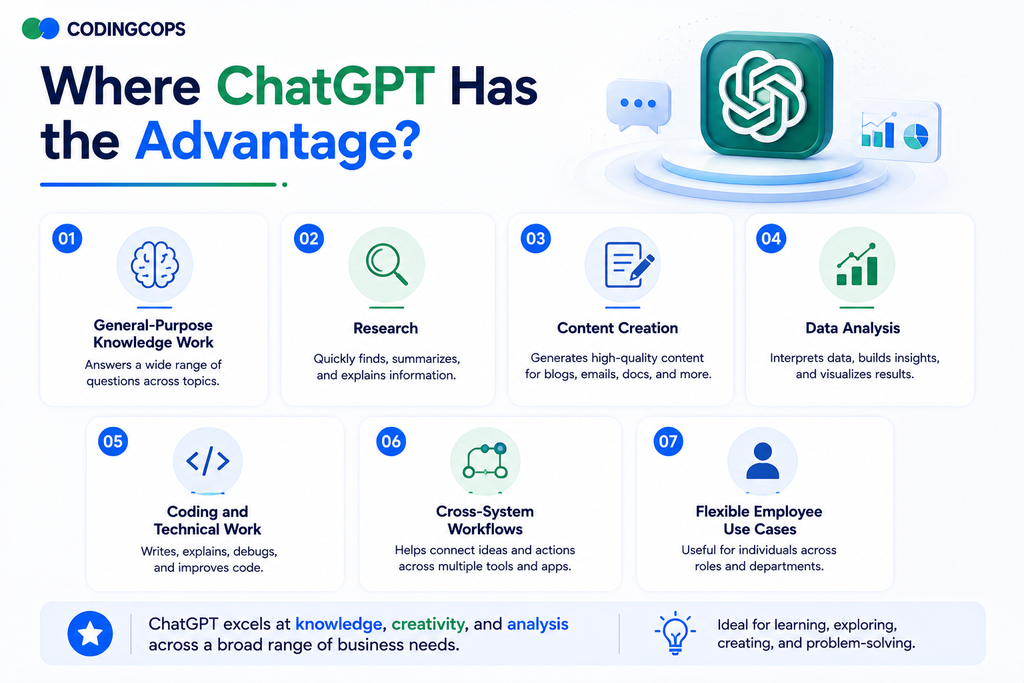
ChatGPT is particularly strong when AI needs to support a wide range of knowledge-based tasks across different teams and business systems. Rather than focusing primarily on one operational platform, it can serve as a flexible AI workspace for research, analysis, content creation, technical work, and connected workflows.
General-Purpose Knowledge Work
ChatGPT can support employees across multiple business functions, including strategy, operations, marketing, sales, finance, and management. It is useful for tasks such as summarizing information, answering questions, brainstorming ideas, preparing documents, and turning complex information into more actionable insights.
Research
ChatGPT is well-suited to research-heavy tasks that require gathering, comparing, and synthesizing information. Teams can use it to explore markets, technologies, competitors, industry trends, and business problems, helping employees reduce the time spent on manual research and initial analysis.
Content Creation
ChatGPT can assist with creating and improving a wide range of content, including reports, proposals, marketing materials, emails, documentation, and internal communications. It can also help employees adapt content for different audiences, formats, and business purposes.
Data Analysis
ChatGPT can help users explore datasets, analyze uploaded files, identify patterns, summarize findings, and explain complex information. This makes it useful for employees who need analytical support but may not have advanced technical or data science skills.
Coding and Technical Work
For developers and technical teams, ChatGPT can support software development tasks such as generating code, debugging issues, explaining unfamiliar codebases, writing documentation, reviewing technical approaches, and assisting with problem-solving.
Cross-System Workflows
Businesses rarely operate within a single platform. ChatGPT can work with documents, connected business applications, knowledge sources, and custom integrations, making it useful when information and workflows span multiple systems rather than being centered entirely around Salesforce.
Flexible Employee Use Cases
One of ChatGPT’s biggest advantages is its flexibility across different roles. A marketing professional may use it for content development, a salesperson for account research, an analyst for data exploration, an executive for strategic analysis, and a developer for coding support.
Agentforce vs ChatGPT for Sales Teams
| Sales Task | Agentforce | ChatGPT |
|---|---|---|
| Account Summaries | Strong | Strong with connected data |
| Opportunity Updates | Native strength | Via integration |
| Lead Qualification | Strong | Possible |
| CRM Record Actions | Native strength | Via integration |
| Sales Research | Good | Strong |
| Proposal Drafting | Good | Strong |
| Meeting Preparation | Strong | Strong |
| General Market Research | Limited/specialized | Strong |
Which Is Better for Sales?
If the primary objective is executing Salesforce workflows, Agentforce has a natural advantage. A sales organization that wants AI to understand pipeline data, assist with opportunity management, and trigger CRM actions should evaluate Agentforce closely.
If the primary objective is broader research, analysis, writing, and knowledge work, ChatGPT may be the better starting point.
Many sales organizations will eventually benefit from both: one AI layer for broad preparation and knowledge work, and another for CRM-specific execution.
Agentforce vs ChatGPT for Customer Service
Answering Customer Questions
Both platforms can support conversational experiences. The quality of the result depends heavily on the knowledge sources, instructions, available tools, and guardrails behind the experience.
Accessing Customer Records
Agentforce has a natural advantage when customer information already resides in Salesforce, and the service process is built around Salesforce records. ChatGPT can access customer information through properly configured and authorized integrations.
Case Management
For organizations using Salesforce Service capabilities, Agentforce is closely aligned with case workflows and service operations.
Taking Customer Actions
This is where the architecture matters. An AI assistant that only answers questions is very different from an AI agent that changes an address, updates a case, schedules a service, or initiates another business process.
Agentforce is designed specifically around combining AI interaction with enterprise actions. ChatGPT can also participate in action-oriented workflows when the appropriate tools and permissions are implemented.
Escalation to Humans
Neither platform should be designed around complete autonomy by default. Well-designed service workflows define when an agent can act, when it should request clarification, and when a human must take over.
Knowledge Retrieval
Both can support knowledge retrieval. The important question is whether the relevant information primarily exists in Salesforce or is distributed across documents, knowledge bases, collaboration platforms, and other systems.
Omnichannel Support
For organizations building customer service experiences around Salesforce, Agentforce can fit naturally into the broader service architecture. Its value is strongest when conversational AI, customer context, case handling, and downstream actions need to work together.
Agentforce vs ChatGPT for Internal Employees
Internal AI requirements are usually broader than a single team.
Employees may need help with research, internal knowledge, document analysis, reporting, sales support, marketing, coding, operations, finance, and HR.
| Employee Need | Better Starting Point |
|---|---|
| Work primarily inside Salesforce | Agentforce |
| Research complex topics | ChatGPT |
| Analyze documents | ChatGPT |
| Execute CRM workflows | Agentforce |
| Company-wide AI assistant | ChatGPT |
| Salesforce service automation | Agentforce |
| Cross-functional knowledge work | ChatGPT |
| CRM-specific agent | Agentforce |
What About Integrations?
This is one of the most important parts of the comparison because a misleading evaluation can make Agentforce and ChatGPT appear more different than they actually are.
Both can connect AI to enterprise systems. The difference is often in the starting architecture.
Agentforce Integration Options
Agentforce can extend beyond core Salesforce data through:
- Salesforce applications and data
- Flow
- Apex
- MuleSoft
- APIs
- External enterprise data and services
Salesforce’s Agent Builder can use tools such as Flows, prompts, Apex, and MuleSoft APIs as part of an agent’s available actions. This gives businesses a relatively direct path from existing Salesforce automation to agent-enabled workflows.
ChatGPT Integration Options
ChatGPT can connect with:
- Business plugins and apps
- Salesforce and CRM systems
- Data platforms
- Documents and knowledge sources
- Collaboration tools
- Custom and private integrations
OpenAI’s current architecture allows organizations to connect apps that provide external data and, where enabled, workflow capabilities. The 2026 plugin directory is designed to help users discover workflows, while underlying apps handle connections to external data and actions.
This means ChatGPT can bring business context from connected systems into an AI workflow and, depending on the app and permissions, support authorized actions.
The decision should therefore not be based on whether integration is possible. Instead, evaluate how much integration work is required, how naturally the AI fits into existing workflows, and how reliably permissions and actions can be governed.
Agentforce vs ChatGPT: Security and Data Governance
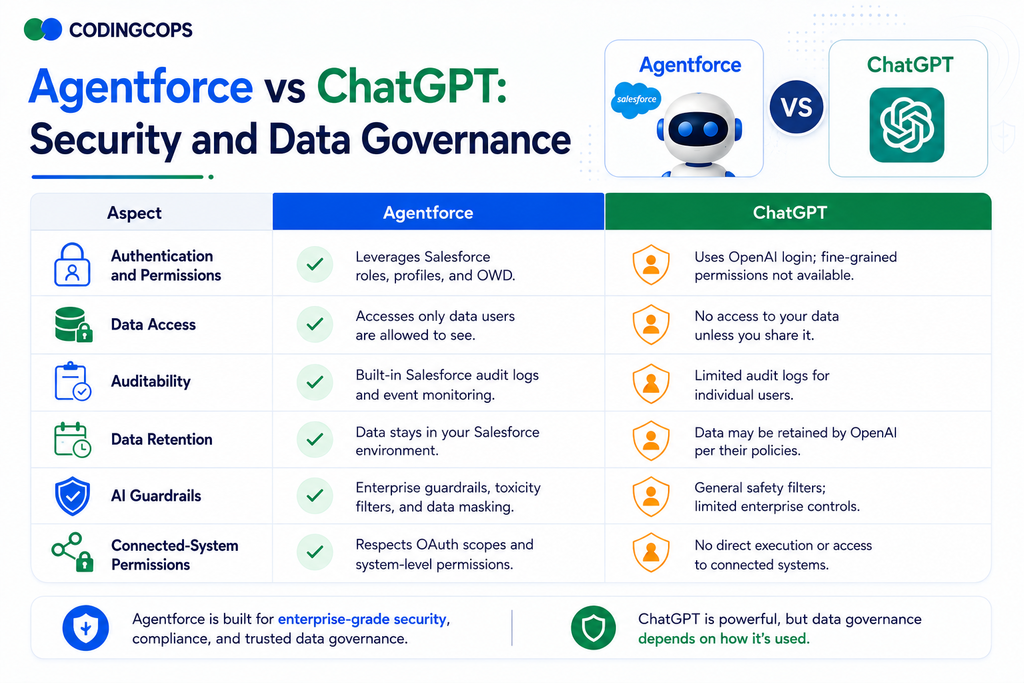
It would be inaccurate to simply say that one platform is more secure.
The real comparison involves how each implementation handles authentication, permissions, data access, retention, compliance, auditability, and AI guardrails.
Authentication and Permissions
Agentforce can build on Salesforce identity, permissions, roles, and access controls.
ChatGPT Business and Enterprise can use enterprise administration capabilities, while connected company knowledge respects the permissions users already have in the underlying connected applications. Enterprise configurations can also use controls such as RBAC, SSO, and SCIM.
Data Access
The critical question is not simply, “Does the AI have access to our data?”
A better question is:
Exactly which data can this user and this AI workflow access, under which conditions, and for what purpose?
For Agentforce, access should be designed around Salesforce and connected-system permissions, available actions, and organizational guardrails.
For ChatGPT, access depends on the enabled apps, workspace configuration, user authentication, and permissions within connected systems.
Auditability
Enterprise AI deployments should establish a way to investigate important outputs and actions, particularly when AI interacts with customer information, financial processes, regulated data, or critical business workflows.
ChatGPT Enterprise includes centralized administration, while OpenAI also provides enterprise controls and compliance capabilities depending on the product and configuration.
Data Retention
Retention requirements should be evaluated separately from general security claims. Businesses should confirm what data is stored, for how long, where applicable, and which administrative controls are available for their specific plan and deployment.
AI Guardrails
Both platforms require guardrails.
Examples include:
- Restricting available tools and actions
- Limiting access to sensitive information
- Requiring human approval for high-risk actions
- Validating outputs before execution
- Testing failure scenarios
- Monitoring production behavior
Connected-System Permissions
An AI platform can only be as well governed as the systems it connects to. Poorly configured permissions in a CRM, document repository, or custom application can create risks regardless of which AI platform is used.
For ChatGPT Business and Enterprise, OpenAI states that business inputs and outputs are not used to train models by default.
Agentforce vs ChatGPT Pricing: What Should You Compare?
Comparing only subscription prices can lead to the wrong decision. Salesforce currently offers multiple Agentforce pricing approaches, including Flex Credits, Conversations, and per-user licensing, with actual costs varying according to deployment and usage.
ChatGPT’s business and enterprise costs may also involve seats, advanced capabilities, usage, and, for custom implementations, API or development costs.
The more useful calculation is Total Cost of Ownership.
| Cost Area | Agentforce | ChatGPT | What to Evaluate |
|---|---|---|---|
| Licensing | Salesforce licensing and usage options | Business or Enterprise seats | Number of users and use cases |
| Implementation | Agent and workflow configuration | Workspace and workflow setup | Internal and external effort |
| Data Preparation | CRM and knowledge readiness | Documents and connected knowledge | Data quality and structure |
| Integration Development | Salesforce and external systems | Apps, APIs, and custom tools | Number and complexity of systems |
| Agent Configuration | Topics, actions, guardrails | Agents, workflows, instructions | Level of customization |
| Testing | Workflow and action validation | Output and tool validation | Risk and failure scenarios |
| Governance | Salesforce controls and policies | Workspace and app controls | Security requirements |
| Maintenance | Agent and integration updates | Workflow and integration updates | Ongoing ownership |
| Usage Costs | Actions, conversations, or licenses | Plan and usage-dependent | Expected volume |
| Internal Administration | Salesforce administration | AI workspace administration | Skills and operating model |
When Should You Choose Agentforce?
Agentforce is likely the stronger starting point when:
- Salesforce is central to your operations.
- Agents need deep CRM context.
- AI must update Salesforce records.
- Sales or service automation is the primary use case.
- Existing Salesforce Flows and Apex need to become agent actions.
- Customer-facing Salesforce workflows are important.
- Your highest-value AI opportunities already exist inside Salesforce processes.
The closer your desired outcome is to understanding Salesforce context and taking a governed Salesforce action, the stronger the case for Agentforce becomes.
When Should You Choose ChatGPT?
ChatGPT may be the stronger starting point when:
- You need enterprise-wide AI assistance.
- Employees perform significant research and analysis.
- Use cases span many departments.
- Document and knowledge work is important.
- Software engineering is a major use case.
- AI needs to work across multiple connected platforms.
- Salesforce is not the center of your AI strategy.
ChatGPT Enterprise combines centralized administration with capabilities including Projects, Company Knowledge, ChatGPT Agent, Deep Research, advanced data analysis, apps, and Codex.
When Should You Use Agentforce and ChatGPT Together?
For many larger organizations, this may be the most strategic option. Instead of forcing every AI requirement into one platform, a business could assign each system a distinct role:
For example, a sales manager could use ChatGPT to research an industry, analyze customer documents, prepare a strategic briefing, and synthesize information from multiple connected sources.
Agentforce could then handle the Salesforce-specific work: retrieving the appropriate account context, following defined CRM processes, and executing approved actions.
Decision Framework: Which Should Your Business Choose?
| Question | Why It Matters |
|---|---|
| How dependent are we on Salesforce? | Determines CRM integration needs |
| Does AI need to modify CRM records? | Determines action requirements |
| Do we need customer-facing agents? | Determines deployment model |
| Do employees need general AI assistance? | Determines breadth |
| How many business systems are involved? | Determines integration complexity |
| What data can AI access? | Determines governance requirements |
| Do we need research capabilities? | Determines knowledge requirements |
| What is our expected ROI? | Determines investment viability |
5 Business Scenarios and What We’d Choose
Scenario 1: Salesforce-Heavy B2B Sales Organization
Starting point: Agentforce
Imagine a B2B company where Salesforce is the central system for leads, accounts, opportunities, activities, and forecasting.
If the AI needs to qualify leads, summarize accounts, support opportunity management, and update CRM information, Agentforce is the logical starting point because the relevant context and actions already live in the Salesforce environment.
ChatGPT could still add value for market research and proposal development, but it would not necessarily need to be the operational AI layer.
Scenario 2: Consulting Company Seeking Company-Wide AI
Starting point: ChatGPT
A consulting firm may have employees who spend significant time researching industries, analyzing documents, preparing presentations, writing reports, and accessing internal knowledge.
Those use cases span multiple roles and systems. A broad AI workspace is therefore a stronger starting point than a CRM-specific agent platform.
Connected company knowledge can also help bring organizational context into employees’ workflows while respecting configured application permissions.
Scenario 3: Large Salesforce Customer Automating Customer Service
Starting point: Agentforce
If service teams already use Salesforce to manage customer records, cases, knowledge, and workflows, Agentforce is closely aligned with the problem.
The objective is not only to answer questions. The agent may need customer context and the ability to perform defined service actions.
That is fundamentally an enterprise workflow problem, which makes Agentforce a strong candidate.
Scenario 4: Software Company With Research, Coding, and Sales Teams
Starting point: ChatGPT or hybrid
A software company may need AI across engineering, product, marketing, sales, and operations.
ChatGPT provides a broad starting point for research, analysis, document work, and software development. OpenAI’s enterprise offering also includes Codex-related capabilities for engineering workflows.
However, if the company’s sales organization relies heavily on Salesforce and wants AI to execute CRM workflows, Agentforce could complement ChatGPT.
Scenario 5: Enterprise With Salesforce + Multiple Business Platforms
Starting point: Hybrid evaluation
Consider an enterprise using Salesforce alongside ERP software, data platforms, document repositories, collaboration tools, custom applications, and analytics systems.
Trying to force every workflow into Salesforce, or building every CRM interaction through external integrations, may create unnecessary complexity.
A hybrid evaluation can identify which use cases belong closest to Salesforce and which require a broader cross-system AI layer.
Common Mistakes When Choosing Between Agentforce and ChatGPT
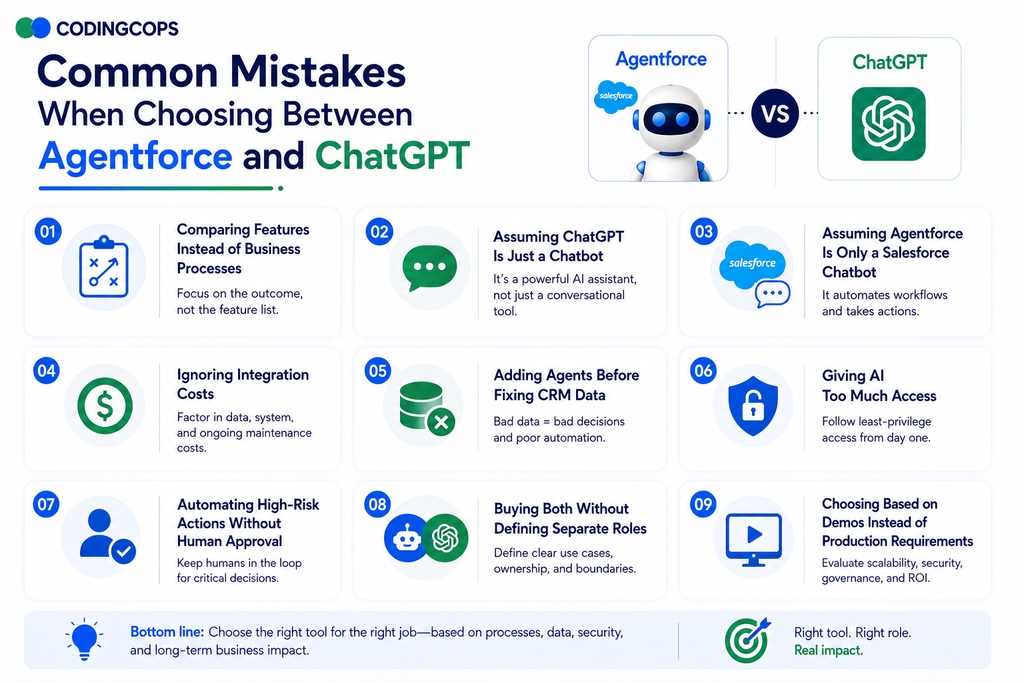
Choosing between Agentforce and ChatGPT based only on features or demos can lead to expensive implementation decisions. The most effective approach is to evaluate the business process, required data, actions, integrations, governance, and expected ROI.
Comparing Features Instead of Business Processes
Feature lists change quickly, but business problems are more consistent. Instead of asking which platform has more capabilities, start by identifying the workflow you want to improve and what the AI actually needs to accomplish.
Assuming ChatGPT Is Just a Chatbot
ChatGPT can support far more than conversational questions and answers. It can assist with research, document analysis, content creation, coding, data analysis, company knowledge, and connected workflows. Limiting the evaluation to chatbot capabilities can overlook its broader enterprise value.
Assuming Agentforce Is Only a Salesforce Chatbot
Agentforce is designed to do more than answer questions about CRM data. Depending on its configuration, agents can reason over business context, access enterprise information, and interact with approved actions, workflows, and business logic.
Ignoring Integration Costs
The ability to integrate with another system does not mean the integration will be simple or inexpensive. Businesses should consider development effort, API maintenance, authentication, permissions, monitoring, and long-term ownership when evaluating the total cost of an AI solution.
Adding Agents Before Fixing CRM Data
AI cannot compensate for poor data quality. Duplicate records, incomplete customer information, inconsistent fields, and outdated processes can reduce the reliability of an AI agent. Improving CRM data and workflow quality should often happen before introducing greater automation.
Giving AI Too Much Access
Agents should only receive the permissions required to perform their intended tasks. Giving an AI broad access to sensitive data or unrestricted system actions increases security and operational risks. Apply the principle of least privilege wherever possible.
Automating High-Risk Actions Without Human Approval
Not every task should be fully automated. High-impact actions involving financial decisions, sensitive customer information, legal communications, or irreversible changes may require human review and approval before execution.
Buying Both Without Defining Separate Roles
Using Agentforce and ChatGPT together can be valuable, but only when each platform has a clearly defined purpose. Without clear boundaries, businesses may create duplicate workflows, overlapping costs, inconsistent governance, and employee confusion.
Choosing Based on Demos Instead of Production Requirements
A successful demo doesn’t guarantee a successful production deployment. Before making a decision, evaluate data quality, integrations, permissions, failure handling, testing, monitoring, scalability, governance, and long-term maintenance.
Questions to Ask Before Making the Decision
You can use the following questions as an executive checklist. They are:
- What problem are we actually solving?
- Where does the required data live?
- Which systems must AI interact with?
- Does AI only need to answer, or must it take action?
- Which actions require human approval?
- Who will use the AI?
- Is the use case internal or customer-facing?
- What security permissions are required?
- How will outputs and actions be evaluated?
- How will we measure ROI?
- What happens when the AI gets something wrong?
How Does CodingCops Help Businesses Choose and Implement Enterprise AI?
At CodingCops, we approach enterprise AI as an architecture and business-process problem rather than starting with a predetermined platform.
Our services can support:
- Salesforce AI readiness assessment
- Agentforce consulting and implementation
- AI agent development
- ChatGPT and API integrations
- Salesforce integrations
- Custom AI development
- AI security and governance
- Workflow design
- Enterprise AI architecture
Conclusion
Agentforce and ChatGPT solve overlapping but different enterprise AI problems. Agentforce is strongest when AI needs deep Salesforce context and governed CRM actions. ChatGPT is better suited to broad knowledge work, research, analysis, coding, and cross-functional workflows.