




AI has evolved from an experimental technology into a strategic business investment. Organizations across industries are adopting AI to automate operations, improve customer experiences, increase productivity, and create new revenue opportunities. However, before starting an AI initiative, businesses face one of the most important decisions in the entire journey. Should you build an in-house AI team or hire an AI development company?
In-house AI development provides greater internal control and long-term capability, while hiring an AI development company offers faster delivery, specialized expertise, lower hiring risk, and greater scalability. Many organizations achieve the best results through a hybrid approach.
The choice impacts much more than who writes the code. It influences project timelines, hiring costs, technical expertise, scalability, innovation, governance, and the long-term return on your AI investment.
There is no one-size-fits-all answer. The ideal approach depends on your business objectives, internal technical capabilities, available budget, existing infrastructure, and how central AI is to your competitive strategy.
In this guide, we’ll compare both approaches in detail, explore their total cost of ownership, discuss their advantages and challenges, provide a practical decision framework, and explain why many organizations are choosing a hybrid AI delivery model.
Understanding the Two Approaches
Both approaches aim to build successful AI solutions, but they differ significantly in ownership, execution, and resource requirements.
What Is In-House AI Development?
In-house AI development means building and managing an internal team responsible for designing, developing, deploying, and maintaining AI systems.
This typically includes AI engineers, machine learning engineers, data scientists, software developers, data engineers, DevOps engineers, and product managers working as full-time employees.
An internal team develops deep organizational knowledge over time. They understand business processes, customer behavior, proprietary data, and long-term product strategy. This enables continuous innovation and allows AI capabilities to become part of the company’s core intellectual property.
Organizations that invest in internal AI teams usually prioritize long-term ownership, ongoing product evolution, and strategic differentiation.
What Is an AI Development Company?
An AI development company provides external specialists who help businesses plan, build, deploy, and optimize AI solutions.
These firms typically offer multidisciplinary teams that include AI consultants, machine learning engineers, solution architects, MLOps specialists, software developers, and project managers.
Rather than hiring employees individually, businesses gain immediate access to experienced professionals who have delivered AI projects across multiple industries.
Most AI development companies provide end-to-end services including:
- AI strategy consulting
- Solution architecture
- Model development
- AI agent development
- RAG implementation
- LLM integration
- Deployment
- Performance optimization
- Ongoing maintenance and support
This approach significantly reduces hiring complexity while accelerating project delivery.
In-House AI Development vs. AI Development Company
| Area | In-House AI Team | AI Development Company |
|---|---|---|
| Initial Setup | High effort to recruit and establish processes | Rapid onboarding with experienced teams |
| Time to Start | Months | Weeks |
| Hiring Effort | Very high | Minimal |
| AI Expertise | Depends on hires | Immediate access to specialists |
| Project Delivery | Slower initially | Faster implementation |
| Scalability | Limited by hiring capacity | Easily scales resources up or down |
| Technology Access | Internal procurement required | Access to modern AI tools and best practices |
| Knowledge Retention | Fully internal | Shared through documentation and handover |
| Ongoing Maintenance | Internal responsibility | Flexible support options available |
| Best Suited For | Long-term AI product companies | Businesses seeking rapid AI adoption |
Total Cost of Ownership (TCO): Which Costs More Over Time?
Many businesses compare only development costs when evaluating AI investments. In reality, total cost of ownership includes numerous direct and indirect expenses.
Recruitment Costs
Hiring experienced AI professionals is expensive and time-consuming. Recruiting specialized engineers often requires external recruiters, lengthy interview processes, and competitive compensation packages. So, working with an AI development company eliminates much of this upfront recruitment effort.
Salaries and Benefits
An internal AI team requires ongoing salaries, bonuses, insurance, benefits, equipment, and management overhead. External partners package these costs into project-based or dedicated-team engagements, making budgeting more predictable.
Training and Upskilling
AI evolves rapidly. Internal teams require continuous learning to stay current with new models, frameworks, security practices, and deployment techniques. Development partners invest in keeping their specialists up to date, reducing this burden for clients.
AI Infrastructure
AI workloads often require GPUs, cloud environments, vector databases, orchestration platforms, monitoring systems, and MLOps pipelines. Therefore, building this infrastructure internally can require substantial investment.
Development Tools and Licences
Modern AI development relies on numerous commercial tools for experimentation, observability, collaboration, security, and deployment. These recurring software costs contribute significantly to overall ownership.
Cloud and Model Costs
Organizations should also budget for:
- Model inference
- API consumption
- GPU compute
- Data storage
- Vector databases
- Monitoring
- Network costs
These expenses continue after launch regardless of who builds the solution.
Maintenance and Continuous Improvement
AI systems require ongoing:
- Model updates
- Prompt optimization
- Performance monitoring
- Security improvements
- Compliance updates
- Feature enhancements
Maintenance is an ongoing investment rather than a one-time activity.
Opportunity Cost
Perhaps the largest hidden cost is delayed implementation. If building an internal team delays AI adoption by several months, businesses may miss productivity gains, customer improvements, or competitive opportunities.
| Cost Category | In-House Team | AI Development Company |
|---|---|---|
| Recruitment | High | Low |
| Salaries | High ongoing expense | Included in engagement |
| Training | Continuous investment | Provider responsibility |
| Infrastructure | Internal responsibility | Often shared or guided |
| Tools & Licenses | Purchased internally | Often already available |
| Cloud & Models | Ongoing | Ongoing |
| Maintenance | Internal resources | Flexible support plans |
| Opportunity Cost | Higher due to slower startup | Lower through faster delivery |
Advantages of Building an In-House AI Team
Greater Organisational Knowledge
Internal teams deeply understand company data, workflows, products, and customers. This contextual knowledge often leads to highly customized AI solutions.
Long-Term Technical Ownership
Organizations maintain complete ownership of architecture, models, documentation, and intellectual property.
Internal Collaboration
Internal AI engineers work closely with product managers, designers, sales teams, and business stakeholders, enabling faster iteration.
Continuous Product Development
Businesses planning to build AI into their products for years benefit from having dedicated teams focused on continuous innovation.
Strong Alignment with Company Culture
Employees become invested in company goals and long-term vision, often improving collaboration and knowledge sharing.
This model works best for technology companies, AI-first startups, and enterprises making AI a strategic capability.
Advantages of Hiring an AI Development Company
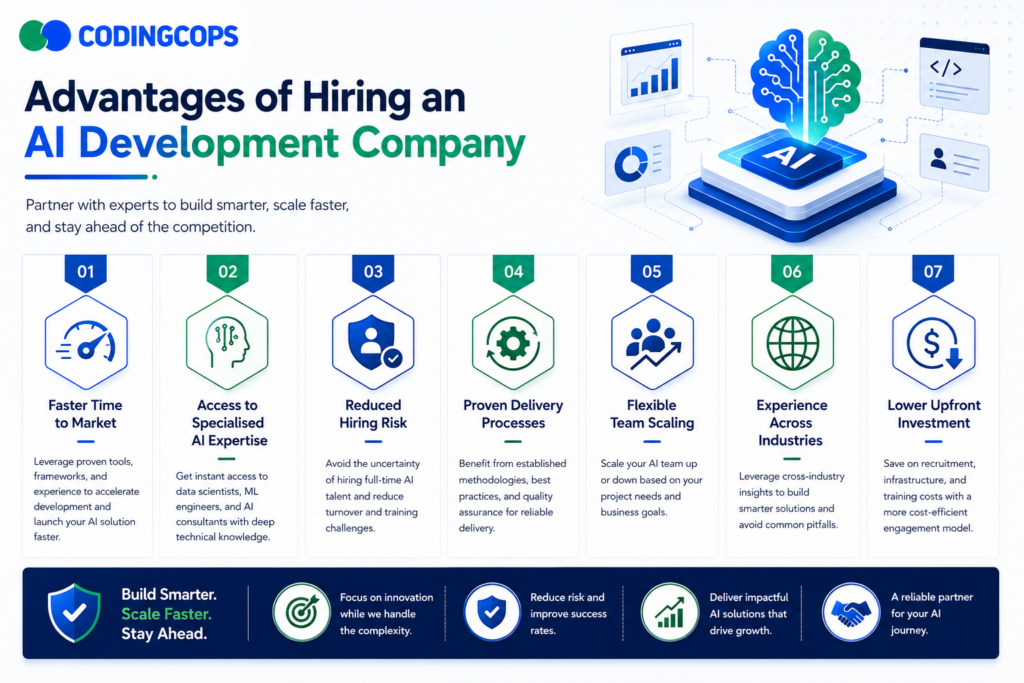
Faster Time to Market
AI development companies have experienced teams, established workflows, and proven methodologies that enable projects to move from planning to deployment much faster. Instead of spending months recruiting and training staff, businesses can begin development immediately and deliver AI solutions to market sooner.
Access to Specialised AI Expertise
An AI development company provides access to specialists in machine learning, generative AI, LLMs, AI agents, RAG, MLOps, and AI security. This broad expertise helps businesses implement advanced AI solutions without building every capability internally.
Reduced Hiring Risk
Recruiting skilled AI professionals is competitive, expensive, and time-consuming. Partnering with an AI development company removes the uncertainty of hiring, reduces recruitment costs, and ensures experienced professionals are available from the start of the project.
Proven Delivery Processes
Established AI companies follow structured development methodologies, including solution design, testing, deployment, governance, and quality assurance. Their experience delivering multiple AI projects helps reduce implementation risks and improve project outcomes.
Flexible Team Scaling
Project requirements often change as AI initiatives evolve. AI development companies can quickly increase or decrease team size by adding specialists such as AI engineers, data scientists, or DevOps experts, allowing businesses to scale efficiently without long-term hiring commitments.
Experience Across Industries
Having worked with organizations across sectors such as healthcare, finance, retail, manufacturing, and SaaS, AI development companies bring valuable industry knowledge and best practices. This experience helps businesses avoid common pitfalls and adopt proven AI implementation strategies.
Lower Upfront Investment
Hiring an external AI partner eliminates many of the initial costs associated with building an internal team, such as recruitment, employee onboarding, training, and infrastructure setup. Businesses can invest directly in project delivery while maintaining greater financial flexibility.
Challenges of Each Approach
Challenges of In-House AI Development
Hiring Experienced AI Engineers
Finding skilled AI engineers, machine learning specialists, and data scientists can be difficult due to high market demand. Recruitment often takes several months and requires competitive salaries and benefits.
High Fixed Costs
Building an internal AI team involves ongoing expenses, including employee salaries, benefits, training, software licenses, cloud infrastructure, and management overhead. These costs continue regardless of project activity.
Longer Ramp-up
Newly hired teams need time to recruit, onboard, establish development processes, and gain a deep understanding of the business before they can deliver production-ready AI solutions.
Skill Gaps
AI projects often require expertise in multiple disciplines, such as LLMs, MLOps, data engineering, AI security, and cloud architecture. A small internal team may lack experience in one or more of these specialized areas.
Staff Retention
Experienced AI professionals are in high demand, making employee retention a significant challenge. Losing key team members can delay projects, increase hiring costs, and result in the loss of valuable institutional knowledge.
Challenges of Working with an AI Development Company
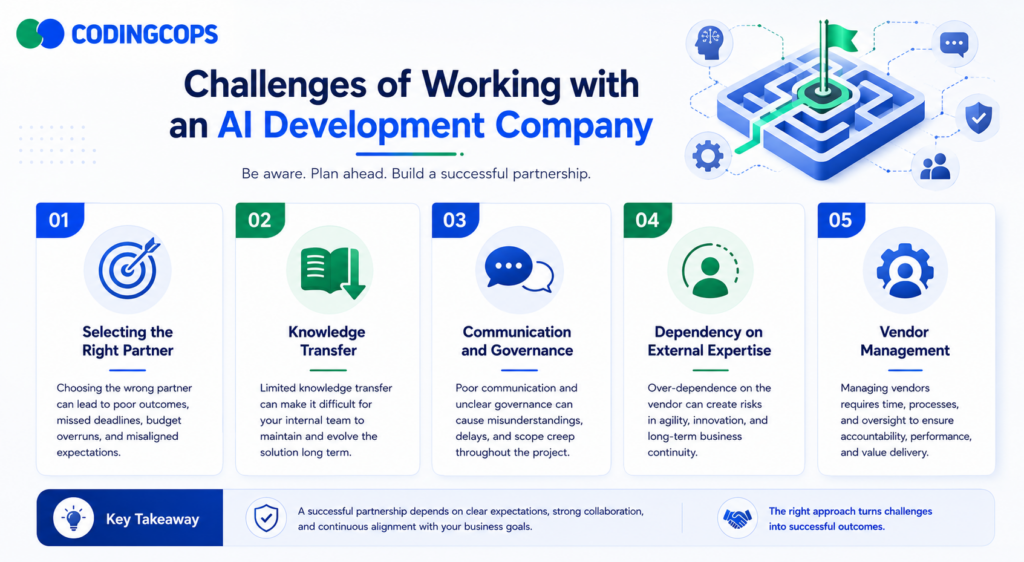
Selecting the Right Partner
Not every AI development company has the same level of expertise or industry experience. Businesses should carefully evaluate technical capabilities, past projects, security practices, and communication processes before making a decision.
Knowledge Transfer
Without proper documentation and training, organizations may become dependent on the external team. A structured knowledge transfer plan helps ensure internal teams can maintain and enhance the solution after delivery.
Communication and Governance
Working with an external partner requires clear communication, defined responsibilities, regular progress reviews, and effective governance to keep projects aligned with business objectives and timelines.
Dependency on External Expertise
Relying heavily on an external AI partner may create challenges if future enhancements or maintenance require specialized knowledge that has not been transferred to internal teams.
Vendor Management
Managing contracts, project milestones, budgets, performance expectations, and service-level agreements requires ongoing oversight to ensure the partnership continues delivering value throughout the AI lifecycle.
When Should You Build In-House?
AI Is a Core Competitive Advantage
If AI is central to your products, services, or business model, building an in-house team provides greater control over intellectual property, innovation, and long-term technology strategy. This is especially valuable for companies developing proprietary AI capabilities.
Large Internal Engineering Team
Organizations with an established engineering team can more easily integrate AI specialists into existing workflows. Strong collaboration between software engineers, data teams, and AI experts often leads to faster development and better long-term support.
Long-Term Product Innovation
Businesses planning to continuously enhance AI-powered products or services benefit from an internal team that can iterate quickly, respond to customer feedback, and develop new features over time without relying on external partners.
Continuous AI Research
Companies investing in advanced machine learning, model experimentation, or proprietary algorithms are better served by maintaining an internal AI research function. This enables ongoing experimentation and helps create unique competitive advantages.
Strong Internal AI Leadership
Organizations with experienced AI leaders, architects, or engineering managers are well-positioned to build and scale an in-house AI capability. Strong leadership helps define strategy, recruit top talent, establish best practices, and ensure AI initiatives align with business objectives.
When Should You Hire an AI Development Company?
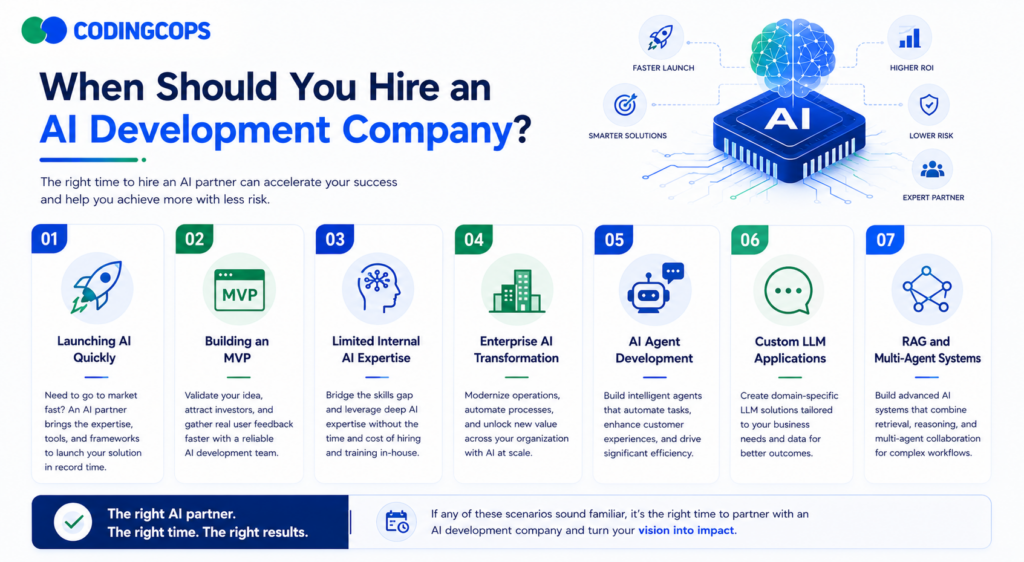
Launching AI Quickly
If speed is a priority, partnering with an AI development company allows you to begin development immediately. Experienced teams, established workflows, and proven methodologies help reduce implementation time and accelerate time to market.
Building an MVP
For businesses validating a new AI idea, an AI development company can quickly build a minimum viable product. This enables organizations to test market demand, gather user feedback, and refine the solution before making larger investments.
Limited Internal AI Expertise
Organizations without experienced AI engineers or data scientists can benefit from external specialists who bring expertise in machine learning, generative AI, data engineering, and cloud deployment without the need for lengthy recruitment.
Enterprise AI Transformation
Large-scale AI initiatives often involve multiple teams, legacy systems, and complex integrations. AI development companies have the experience to design scalable architectures, manage enterprise deployments, and minimize implementation risks.
AI Agent Development
Building autonomous AI agents requires expertise in orchestration, memory management, tool integration, workflow automation, and governance. Specialized AI partners can develop secure and production-ready AI agents more efficiently.
Custom LLM Applications
Organizations developing applications powered by LLMs, such as AI assistants, chatbots, document analysis tools, or content generation platforms, benefit from partners experienced in prompt engineering, model selection, fine-tuning, and deployment.
RAG and Multi-Agent Systems
RAG solutions and multi-agent systems involve advanced architectures, vector databases, knowledge retrieval, and agent coordination. AI development companies bring the technical expertise needed to design, implement, and optimize these complex AI systems for enterprise use.
The Hybrid Model: Why Many Businesses Choose Both
Many successful organizations combine internal teams with external AI specialists. In this approach:
- AI partners design system architecture.
- External experts develop advanced AI components.
- Internal developers integrate business logic.
- Internal teams manage daily operations.
- AI consultants mentor internal engineers.
- External specialists assist with optimization and scaling.
Decision Framework: Which Option Fits Your Business?
| Business Situation | Recommended Approach |
|---|---|
| Startup building its first AI product | AI Development Company |
| Mid-market company automating operations | Hybrid |
| Enterprise modernizing multiple business units | Hybrid |
| SaaS company embedding AI features | Hybrid or In-House |
| Organization building proprietary AI products | In-House |
Questions to Ask Before Making a Decision
Is AI Core to Your Business Strategy?
Determine whether AI will be a key differentiator for your business or simply support existing operations. If AI is central to your long-term competitive advantage, investing in internal capabilities may provide greater strategic value.
Do You Have Internal AI Expertise?
Evaluate whether your organization has experienced AI engineers, data scientists, architects, and supporting technical teams. Limited expertise may take partnering with an AI development company the faster and lower-risk option.
How Quickly Do You Need Results?
Consider your project timeline and business priorities. If quick deployment is essential, an AI development company can typically accelerate implementation by providing experienced specialists and proven delivery processes.
What Is Your Budget?
Look beyond initial development costs and assess the total cost of ownership, including hiring, infrastructure, cloud services, maintenance, and ongoing optimization. Choose the approach that aligns with both your short-term budget and long-term investment goals.
How Complex Is the Project?
Simple AI applications may be manageable with existing teams, while enterprise-scale projects involving AI agents, custom LLMs, or complex integrations often require specialized expertise and larger delivery teams.
Do You Need Long-Term AI Ownership?
If maintaining full control over AI models, intellectual property, and future development is a priority, building an internal team may be the better choice. If speed and flexibility are more important, an external partner may provide greater value.
Can Your Existing Infrastructure Support AI?
Assess whether your current data pipelines, cloud environment, security controls, and governance processes are ready for AI deployment. Infrastructure gaps may require additional investment or guidance from an experienced AI development partner.
Common Mistakes Businesses Make
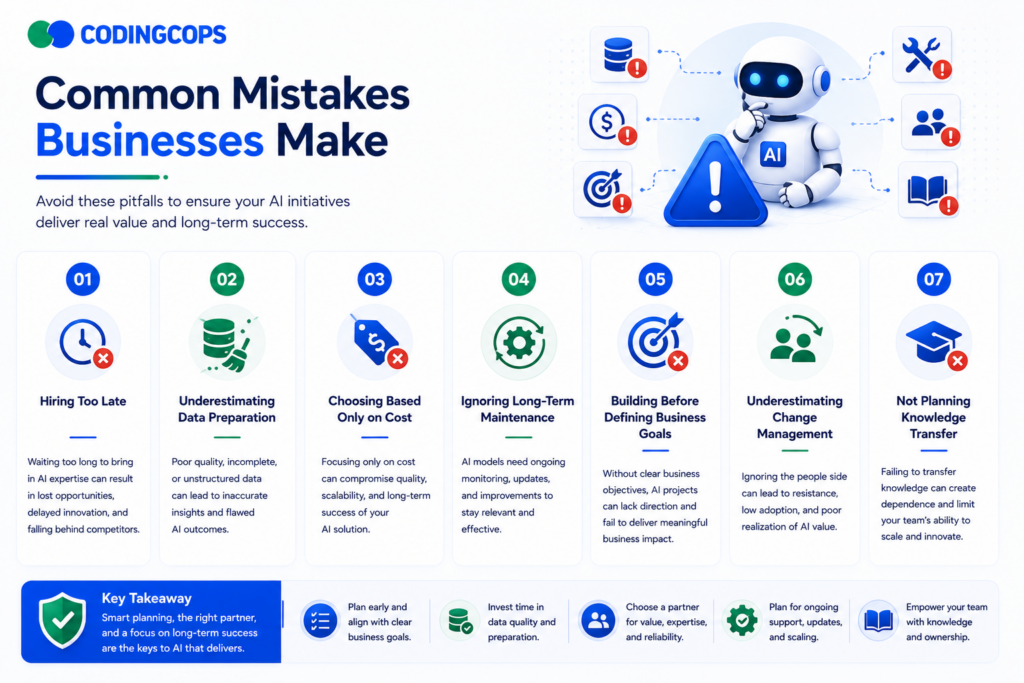
Hiring Too Late
Many organizations delay building AI capabilities until a project is already underway. This often leads to rushed hiring decisions, project delays, and missed opportunities to plan the right team and technology from the beginning.
Underestimating Data Preparation
Successful AI depends on high-quality data. Businesses frequently overlook the time and effort required to collect, clean, organize, and govern data, resulting in inaccurate models and slower project progress.
Choosing Based Only on Cost
Selecting an AI delivery approach solely because it’s the least expensive can lead to poor implementation, lower-quality solutions, and higher long-term costs. Businesses should evaluate expertise, scalability, and long-term value alongside price.
Ignoring Long-Term Maintenance
AI systems require continuous monitoring, model updates, prompt optimization, security improvements, and performance tuning. Treating AI as a one-time project instead of an ongoing capability can reduce its effectiveness over time.
Building Before Defining Business Goals
Starting development without clear business objectives often results in AI solutions that fail to solve real problems or deliver measurable ROI. Defining success metrics and use cases early helps keep projects focused and valuable.
Underestimating Change Management
AI adoption often changes workflows and employee responsibilities. Without proper communication, training, and stakeholder engagement, organizations may face user resistance and lower adoption rates.
Not Planning Knowledge Transfer
Whether working with an internal team or an AI development company, businesses should establish a structured knowledge transfer process. Proper documentation, training, and handover ensure the organization can maintain and enhance the AI solution after deployment.
Real-World Example
Mid-Market SaaS Company
A growing SaaS provider wanted to introduce AI-powered customer support and intelligent document search.
Initially, leadership considered hiring an internal AI team but estimated that recruiting key specialists would take several months. Instead, they adopted a hybrid approach.
An AI development company designed the solution architecture, implemented a RAG system, and built the initial AI assistant. At the same time, the company’s software engineers worked alongside the external specialists to understand the architecture and integrate AI capabilities into the existing product.
Within four months, the AI features were deployed to customers. Internal developers then assumed responsibility for ongoing product enhancements while the AI partner continued to provide optimization support for model performance, infrastructure, and scalability.
The company accelerated time to market, reduced hiring risk, and successfully developed internal AI expertise without delaying its product roadmap.
How CodingCops Helps Businesses Build AI Successfully?
At CodingCops, we help organizations accelerate AI adoption while minimizing technical and operational risks.
Our services include:
- AI strategy workshops to identify high-value use cases.
- AI readiness assessments covering data, infrastructure, governance, and business goals.
- Custom AI application development tailored to your workflows.
- AI agent development for business process automation.
- RAG solutions that deliver accurate and context-aware responses.
- Enterprise AI consulting for architecture, security, compliance, and scalability.
- Team augmentation with experienced AI engineers who work alongside your internal teams.
- Ongoing optimization, monitoring, maintenance, and support to ensure your AI solutions continue delivering business value.
Whether you need an end-to-end delivery partner or additional expertise to strengthen your existing team, CodingCops can help you build AI solutions that are secure, scalable, and aligned with your business objectives.
Conclusion
Choosing between an in-house team and an AI development company depends on your goals, budget, expertise, and timeline. While in-house teams offer long-term ownership, external partners provide speed and specialized knowledge. For many organizations, a hybrid approach delivers the ideal balance of innovation, scalability, and sustainable business value.