




Business AI is moving into its next phase. Companies are no longer asking only whether generative AI can write content, summarize documents, or answer employee questions. The bigger question is how AI can become part of the systems that run the business.
By 2027, business AI will likely move beyond standalone copilots toward AI agents and embedded systems that can retrieve information, coordinate workflows, interact with enterprise software, and perform increasingly complex tasks under defined human and governance controls.
That doesn’t mean companies will suddenly become fully autonomous. Instead, AI is likely to become more deeply connected to CRM platforms, ERP systems, customer service applications, internal knowledge bases, analytics platforms, and operational workflows.
AI agents, human-AI collaboration, embedded intelligence, enterprise data, governance, and measurable business outcomes are likely to define this next stage.
For business leaders, the important decisions are happening now. Companies that improve their data foundations, APIs, security, governance, and AI architecture today will be better positioned to scale AI tomorrow.
Where Business AI Stands Today?
Generative AI Has Entered Everyday Work
The generative AI market is valued at $47 billion. Moreover, it’s estimated to reach $1 trillion to $2.3 trillion by the early 2030s. Employees use gen AI for writing, research, coding, document analysis, and knowledge retrieval.
However, most of these applications still operate as assistive experiences. An employee asks a question, provides context, receives an answer, and decides what to do next.
AI Pilots Are Moving Toward Production
According to statistics, 88% to 95% AI pilot projects stall and fail to scale. Many organizations initially approached AI through small proofs of concept. However, the focus is increasingly shifting toward production use cases where AI can improve measurable outcomes such as customer resolution time, sales productivity, operational efficiency, software delivery, or employee productivity.
AI Agents Are Emerging
The global AI agent market is valued at $11 billion and is projected to expand past $50 billion by 2030. AI agents represent an important evolution from traditional chatbots and copilots.
Rather than simply responding to prompts, an agent can potentially interpret a goal, retrieve relevant information, use tools, interact with APIs, complete multiple steps, and escalate when human intervention is required.
Businesses Are Still Struggling to Prove ROI
AI adoption doesn’t automatically equal business value. A company can have hundreds of employees using AI and still struggle to demonstrate whether AI is improving revenue, reducing costs, accelerating operations, or improving customer experiences.
That is why future AI programs will increasingly be evaluated through business outcomes rather than usage statistics alone.
Governance Is Becoming a Business Requirement
As AI gains access to more sensitive information and business systems, governance becomes increasingly important.
Organizations need to understand which models can access which data, what actions AI can perform, when human approval is required, and how AI activity is recorded.
8 Ways AI in Business Could Change by 2027
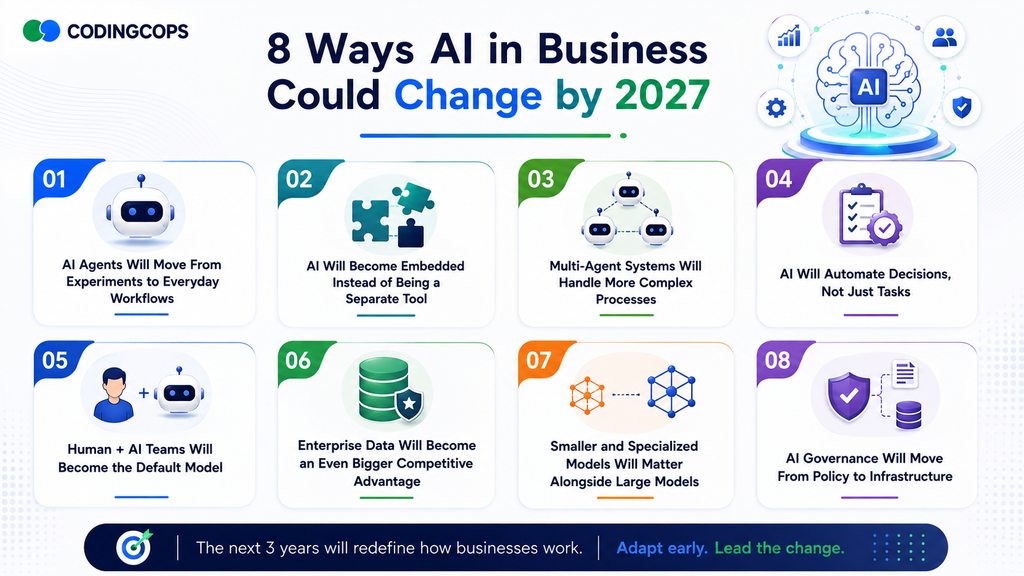
1. AI Agents Will Move From Experiments to Everyday Workflows
AI agents could move beyond experimental projects and become part of everyday business workflows. Instead of simply answering questions, agents can potentially research customers, resolve support requests, qualify leads, monitor IT systems, retrieve internal knowledge, and complete administrative tasks.
For example, a sales agent could research a prospect, summarize relevant account information, identify potential opportunities, and prepare the next action. A customer service agent could retrieve customer history, identify an issue, and recommend or execute an approved resolution.
However, autonomy will vary based on risk. Low-risk tasks may require minimal supervision, while financial, legal, security, or customer-impacting actions may require human approval.
2. AI Will Become Embedded Instead of Being a Separate Tool
AI is likely to become less visible as a standalone application and more integrated into the software employees already use.
Today, the workflow often looks like:
Employees move between an AI tool and their CRM, ERP, support platform, or other business systems.
The emerging model is:
AI could become a native capability inside CRM, ERP, customer support, finance, HR, and SaaS applications. For example, a salesperson could ask their CRM to identify high-priority opportunities without leaving the platform.
This approach reduces context switching and makes AI part of the actual business workflow rather than another tool employees have to learn.
3. Multi-Agent Systems Will Handle More Complex Processes
As AI workflows become more sophisticated, businesses may use multiple specialized agents that collaborate on different parts of a process.
For example:
Gathers company and prospect information
Evaluates the lead against business criteria
Updates customer records
Prepares the recommended follow-up
Each agent has defined responsibility, access level, and set of tools. This is less about creating futuristic autonomous organizations and more about building practical enterprise architecture where AI can coordinate multiple steps while remaining within clearly defined business rules and human oversight.
4. AI Will Automate Decisions, Not Just Tasks
Business AI could gradually evolve from completing individual tasks to supporting and executing parts of decision-making workflows.
Task automation:
“Summarize this sales call.”
Decision support:
“Which opportunities should the sales team prioritize?”
Controlled execution:
“Prepare the follow-up and update the CRM based on approved business rules.”
The important shift is that AI can potentially analyze multiple data sources, identify patterns, recommend actions, and execute approved steps.
However, organizations will need clear boundaries around what AI can recommend versus what it can actually do. High-impact decisions may continue to require human approval, while lower-risk decisions can potentially be automated.
5. Human + AI Teams Will Become the Default Model
The future of business AI is unlikely to be simply about replacing employees. A more realistic model is human-AI collaboration, where AI handles repetitive and information-heavy work while employees focus on judgment, relationships, strategy, and exceptions.
AI can assist with research, analysis, documentation, data processing, and workflow execution. Employees can supervise AI-generated outcomes, handle unusual cases, and remain accountable for critical decisions.
6. Enterprise Data Will Become an Even Bigger Competitive Advantage
As more companies gain access to similar foundation models, proprietary business data could become an increasingly important source of differentiation.
AI performance depends heavily on having access to accurate, relevant, and timely information. Businesses therefore need clean data, accessible systems, strong knowledge architectures, reliable APIs, and appropriate data governance.
Technologies such as RAG, enterprise knowledge bases, APIs, and real-time data infrastructure can help AI retrieve the information it needs at the right time.
Two companies may use similar AI models but achieve very different results because one has better customer data, workflows, integrations, and implementation.
7. Smaller and Specialized Models Will Matter Alongside Large Models
Businesses will not necessarily send every AI request to the largest and most expensive model available. Different tasks have different requirements.
Organizations may choose smaller or specialized models when they need:
- Lower operating costs
- Faster response times
- Greater privacy
- Task-specific performance
- On-device or edge processing
- Reduced infrastructure requirements
This could lead to multi-model architectures, where AI systems automatically route requests to the most appropriate model.
For example, a lightweight model could handle classification or simple document processing, while a more capable reasoning model handles complex analysis.
The goal will increasingly be to use the right model for the right task, rather than assuming the biggest model is always the best choice.
8. AI Governance Will Move From Policy to Infrastructure
As AI gains access to business data and the ability to execute actions, governance will need to become part of the underlying technology architecture.
Businesses will increasingly need mechanisms for:
- Role-based access
- AI permissions
- Audit logging
- Model monitoring
- Human approvals
- Data governance
- AI security
- Regulatory compliance
What the Enterprise AI Stack May Look Like by 2027
A mature enterprise AI environment will likely be more than an LLM connected to a chatbot. It will function as a layered technology stack connecting users, AI agents, enterprise knowledge, business applications, data security, and monitoring.
User Experience Layer
This is where employees, customers, and partners interact with AI. AI capabilities may increasingly appear directly inside web applications, mobile apps, customer portals, workplace tools, and conversational interfaces rather than requiring users to open a separate AI application.
AI Agent Layer
This layer contains specialized agents designed for specific business responsibilities, such as sales, customer support, research, finance, HR, or IT operations. Agents can retrieve information, use approved tools, and complete tasks within clearly defined permissions.
Agent Orchestration Layer
Orchestration coordinates agents, workflows, tools, and human approvals. It determines which agent handles a task, manages context and handoffs, enforces business rules, and routes complex or sensitive situations to people.
LLM / Model Layer
The model layer provides the reasoning and generation capabilities behind AI applications. Businesses may use a combination of LLMs, smaller specialized models, embedding models, and domain-specific models, selecting models based on cost, performance, privacy, and task complexity.
RAG and Enterprise Knowledge
RAG and knowledge systems provide AI with access to relevant company information without requiring everything to be stored directly in a model. Vector databases, knowledge graphs, document repositories, enterprise search, and real-time knowledge services can help AI produce more context-aware responses.
Business Applications
AI needs to connect with the systems where business activity actually happens. CRM, ERP, finance, HR, customer support, ITSM, marketing, and SaaS applications can become tools that AI reads from, writes to, and interacts with under controlled permissions.
Data Infrastructure
The data layer provides the foundation for enterprise AI. Data warehouses, data lakes, APIs, real-time streams, ETL pipelines, metadata, master data, and data-quality systems help ensure AI has access to accurate and timely information.
Governance and Security
Governance becomes increasingly important as AI gains access to sensitive data and business systems. Role-based access, AI permissions, audit logs, privacy controls, compliance policies, security guardrails, and human approval mechanisms can help organizations control AI behavior and risk.
Monitoring and Observability
AI systems require continuous monitoring after deployment. Organizations will increasingly track model performance, agent activity, costs, latency, failures, security events, response quality, and business outcomes to identify problems and continuously improve their AI systems.
How Could AI Change Different Business Functions?
The impact will likely vary significantly by function.
| Business Function | AI Today | Potential Direction |
|---|---|---|
| Sales | Summaries, scoring | Autonomous workflow assistance |
| Marketing | Content generation | Campaign orchestration |
| Customer Service | Chatbots | Resolution-oriented agents |
| Finance | Document processing | Intelligent finance workflows |
| HR | Employee assistants | Workforce operations agents |
| IT | Coding assistants | AI-assisted operations |
| Operations | Basic automation | Cross-system agent workflows |
These represent potential directions rather than guaranteed outcomes. Adoption will depend on the organization’s data, processes, risk tolerance, technology infrastructure, and AI maturity.
What Will Still Require Humans in 2027?
Even as AI becomes more capable, businesses are unlikely to remove humans from every important decision. AI may handle more analysis, recommendations, and routine execution, but human judgment, accountability, and oversight will remain essential where consequences are significant, or situations are ambiguous.
High-Risk Decisions
Financial, legal, medical, safety, and other high-impact decisions will likely require human oversight. AI can analyze information and provide recommendations, but organizations may require people to review and approve decisions that could significantly affect customers, employees, finance, or compliance.
Strategic Judgment
AI can analyze market trends, financial data, customer behavior, and competitive information, but business strategy involves priorities, uncertainty, long-term goals, and organizational context. Executives will still need to determine what the business should do, not simply what the data suggests.
Ethical Decisions
AI can identify patterns and apply predefined policies, but ethical questions often require human values and judgment. Decisions involving fairness, privacy, employee impact, customer rights, or responsible AI use will continue to require human involvement.
Complex Negotiations
AI can prepare research, analyze proposals, and suggest negotiation strategies, but complex negotiations depend on relationships, trust, emotions, timing, and nuanced communication. Humans are likely to remain responsible for sensitive partnerships, contracts, and high-value negotiations.
Exception Management
AI will increasingly handle predictable workflows, allowing employees to focus on unusual or ambiguous situations. When information is incomplete, business rules conflict, or circumstances fall outside an agent’s defined capabilities, humans can investigate the exception and determine the appropriate response.
AI Governance
Organizations will still need people to establish AI policies, define acceptable levels of autonomy, approve high-risk use cases, manage permissions, and oversee compliance. Governance will determine where AI can act independently and where humans intervene.
Final Accountability
AI may recommend decisions or execute approved actions, but businesses cannot simply transfer responsibility to a model. Leaders and designated employees will remain accountable for important outcomes, ensuring that AI systems operate within organizational policies, legal requirements, and ethical standards.
What Businesses Should Stop Doing Before 2027
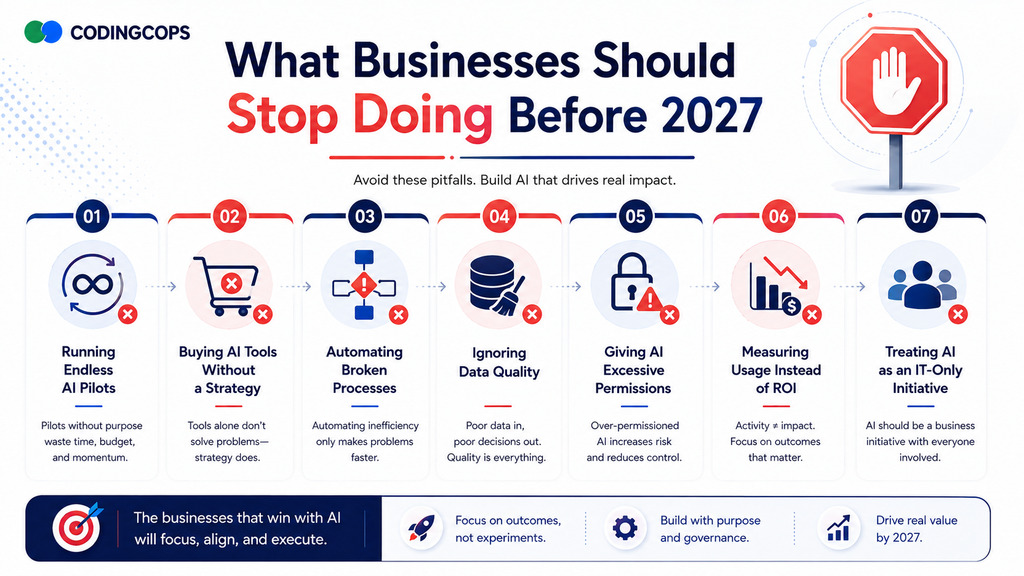
As AI moves from experimentation toward business-critical systems, organizations will need to rethink how they approach adoption. The goal should not be to implement AI everywhere, but to build the right capabilities around high-value business problems.
Running Endless AI Pilots
Pilots are useful for testing ideas, but continuously running experiments without moving successful use cases into production creates little long-term value. Businesses should establish clear success criteria and create a path from prototype to scalable implementation.
Buying AI Tools Without a Strategy
Adding more AI tools doesn’t automatically create an AI strategy. Organizations should first identify business objectives, prioritize valuable use cases, and determine how AI will integrate with existing workflows, data, and systems.
Automating Broken Processes
AI can make inefficient processes faster without making them better. Before automating a workflow, businesses should identify unnecessary steps, eliminate bottlenecks, and redesign the process where needed.
Ignoring Data Quality
AI systems depend heavily on the quality, accessibility, and consistency of business data. Poor or fragmented data can lead to unreliable outputs. Businesses should invest in data governance, integration, and knowledge management before scaling AI.
Giving AI Excessive Permissions
AI agents should not automatically receive broad access to business systems. Organizations should apply least-privilege principles, define what each agent can access or change, and require human approval for sensitive actions.
Measuring Usage Instead of ROI
The number of employees using AI or the number of prompts generated doesn’t necessarily demonstrate business value. Organizations should measure outcomes such as productivity gains, cost savings, revenue impact, quality improvements, and customer experience.
Treating AI as an IT-Only Initiative
AI affects nearly every part of an organization, from sales and marketing to finance, HR, operations, and customer service. Business leaders and domain experts should work alongside IT and AI teams to identify opportunities, manage change, and ensure AI solves real business problems.
How to Prepare Your Business for AI in 2027?
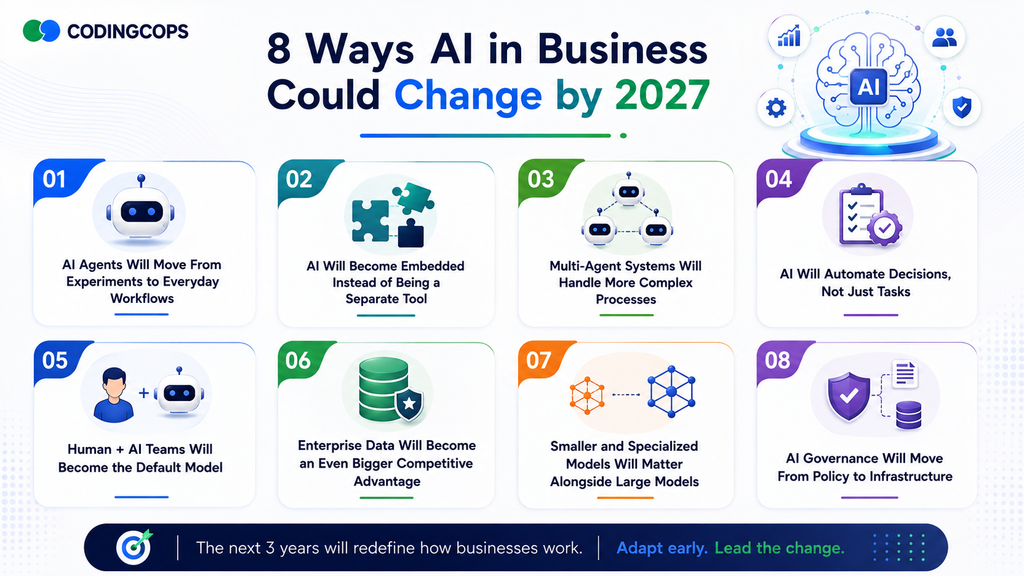
Preparing for the next phase of AI doesn’t require businesses to adopt every emerging technology. The better approach is to strengthen the foundations, prioritize valuable use cases, and gradually move from experimentation to production.
Step 1: Assess Your Current AI Maturity
Evaluate your current AI capabilities across strategy, data, infrastructure, skills, governance, and existing use cases. This helps identify capability gaps and determine what your organization is realistically ready to implement.
Step 2: Identify High-Value AI Use Cases
Focus on business problems where AI can deliver measurable value. Prioritize use cases based on potential ROI, implementation feasibility, data availability, business impact, and risk rather than simply choosing the most popular AI applications.
Step 3: Fix Your Data Foundation
Improve data quality, accessibility, consistency, and governance. AI systems need reliable business information to produce useful results, making clean data and well-structured knowledge repositories essential for production AI.
Step 4: Modernize APIs and Integrations
AI becomes significantly more useful when it can interact with existing business systems. Modern APIs, integration layers, and secure system connections allow AI applications and agents to retrieve information and perform approved actions.
Step 5: Experiment With AI Agents
Start with controlled, well-defined workflows where agents can provide measurable value. Test their ability to research, retrieve information, coordinate tasks, and interact with business applications before expanding their level of autonomy.
Step 6: Establish AI Governance
Define rules for AI access, permissions, security, data usage, human approvals, monitoring, and compliance. Governance should be built into AI architecture from the beginning rather than added after systems are already in production.
Step 7: Build AI Skills Across Teams
AI adoption requires more than technical specialists. Employees should understand how to work with AI, evaluate its outputs, redesign workflows, and identify appropriate opportunities. Technical teams also need skills in AI engineering, data, integration, security, and deployment.
Step 8: Measure Business Outcomes
Define measurable KPIs for every significant AI initiative. Track outcomes such as cost reduction, productivity, revenue, customer satisfaction, quality, processing time, or operational efficiency instead of focusing only on AI usage.
Step 9: Create a 12–18 Month AI Roadmap
Turn individual experiments into a structured roadmap. Define which use cases will be tested, which will move into production, what infrastructure is required, and how successful AI workflows can eventually scale across the organization.
AI Readiness Checklist for 2027
| Area | Question to Ask | Status |
|---|---|---|
| Strategy | Do we have measurable AI objectives? | ✔ |
| Use Cases | Have we prioritized AI by ROI? | ✔ |
| Data | Can AI securely access quality data? | ✔ |
| Infrastructure | Can existing systems integrate with AI? | ✔ |
| Security | Are AI permissions controlled? | ✔ |
| Governance | Can AI actions be audited? | ✔ |
| People | Do employees understand how to work with AI? | ✔ |
| Measurement | Can we demonstrate business impact? | ✔ |
What Should You Invest in Now and What Can Wait?
Businesses preparing for the next phase of AI should focus on foundational capabilities that will remain valuable regardless of how models evolve. At the same time, some advanced AI investments are better approached through targeted experiments rather than large-scale commitments.
Invest Now
- Data readiness: Improve data quality, accessibility, governance, and knowledge management so AI systems can work with reliable business information.
- API architecture: Build secure, well-structured APIs that allow AI applications and agents to interact with existing business systems.
- AI governance: Establish clear policies for AI usage, permissions, human oversight, compliance, and accountability.
- AI security: Protect sensitive business data and control how AI systems access information and execute actions.
- High-value pilots: Test AI on specific business problems where potential ROI can be measured clearly.
- AI literacy: Train employees to use AI effectively, evaluate outputs, and understand how AI changes their workflows.
- Integration capabilities: Ensure AI can connect with CRM, ERP, SaaS, databases, and other operational systems.
- Measurement frameworks: Define KPIs that connect AI initiatives to productivity, revenue, cost savings, quality, or customer experience.
Don’t Rush
- Fully autonomous operations: Start with controlled autonomy and expand permissions as systems demonstrate reliability.
- Massive custom model training: Custom models may not be necessary when existing foundation models can meet the business requirements.
- Complex multi-agent architectures: Use multi-agent systems when workflows genuinely require multiple specialized agents, not simply because the technology is available.
- Replacing working software solely because it predates generative AI: Modernize systems where there is a clear business or technical reason rather than replacing stable platforms unnecessarily.
AI Investment Priorities
| Investment | Priority | Why |
|---|---|---|
| Data Readiness | High | Foundation for reliable production AI |
| API & Integrations | High | Enables AI to interact with business systems |
| Governance | High | Helps control enterprise AI risk |
| AI Agents | Test now | Validates high-value workflow opportunities |
| Custom Models | Case dependent | Existing models may already meet requirements |
| Multi-Agent Systems | Case dependent | Most valuable for sufficiently complex workflows |
Three Possible AI Business Scenarios for 2027
Businesses are unlikely to adopt AI in exactly the same way. Their approach will depend on industry, technology maturity, data readiness, risk tolerance, and investment capacity. Organizations could broadly fall somewhere across three models.
Scenario 1: AI-Augmented Business
In an AI-augmented business, employees remain the primary decision-makers while using AI assistants and copilots to improve productivity. AI helps with research, writing, analysis, coding, customer communication, and knowledge retrieval. This model can be a practical starting point for organizations that are still developing their AI capabilities.
Scenario 2: AI-Orchestrated Business
In an AI-orchestrated business, AI moves beyond individual productivity and becomes part of larger workflows. Agents can potentially coordinate tasks across CRM, ERP, customer service, finance, and other systems while employees supervise exceptions and high-impact decisions. This model could significantly reduce manual coordination and accelerate multi-step business processes.
Scenario 3: AI-Native Business
An AI-native business designs products, operations, customer experiences, and decision processes around AI from the beginning. Instead of simply adding AI to existing workflows, AI becomes part of the organization’s core architecture. These businesses may use agents, real-time data, intelligent automation, and AI-powered products as fundamental components of how they operate.
How CodingCops Helps Businesses Prepare for the Next Phase of AI?
Businesses preparing for the next stage of AI need more than access to an AI model. They need a practical strategy for connecting AI to real business processes.
CodingCops helps organizations with:
- AI readiness assessments
- AI strategy and roadmaps
- AI use-case prioritization
- Custom AI development
- AI agent development
- Enterprise integrations
- Legacy software modernization
- AI security and governance
- Production deployment and optimization
The goal is to connect AI investment to measurable business outcomes rather than technology experimentation.
Conclusion
AI in business by 2027 will likely be less about standalone chatbots and more about intelligence embedded throughout workflows, products, and enterprise systems. The winners will not necessarily be companies using the biggest models, but those combining strong data, integrations, governance, people, and AI strategically to deliver measurable business outcomes.