




Hero Introduction
Building a SaaS product requires more than just code; it demands the right strategy, validation, and execution. This guide walks you through a clear, step-by-step approach to turning an idea into a scalable SaaS product.
Executive Summary
The blog outlines how to build a SaaS product, from idea validation and MVP development to tech stack selection, pricing, launch, and scaling, helping you create a sustainable and high-growth solution.
Why Is a SaaS Product Important for Organizations?
SaaS has evolved from a convenient software delivery model into a core driver of business growth and innovation. Organizations aren’t just adopting SaaS; they are building their digital ecosystems around it to stay agile and competitive.
Scalability on Demand
One of the most significant advantages of SaaS is its ability to scale effortlessly. Traditional systems often require expensive infrastructure upgrades to support growth, whereas SaaS platforms leverage cloud environments to scale seamlessly.
Whether a company is onboarding new users, entering new markets, or adding advanced features, SaaS allows businesses to scale without operational bottlenecks. This flexibility is especially valuable for startups and fast-growing organizations.
Cost Efficiency
SaaS eliminates the need for heavy upfront investments in hardware and software. Instead, organizations pay a predictable subscription fee, making budgeting more manageable.
This model reduces financial risk and enables businesses to invest in innovation rather than infrastructure. It also allows companies to experiment with new tools and technologies without long-term commitments, fostering a more agile approach to growth.
Enhanced Accessibility
With SaaS, applications are accessible from anywhere. This has transformed how teams work, enabling seamless collaboration across different locations and time zones.
In a world where remote and hybrid work models are the norm, SaaS ensures that teams stay connected, productive, and aligned.
Continuous Updates
Unlike traditional software that requires manual updates, SaaS platforms continuously evolve. Providers roll out updates, new features, and security enhancements automatically.
This ensures that organizations always have access to the latest capabilities without downtime or disruption. It also allows businesses to quickly adapt to changing market demands and customer experiences.
Faster Time-to-Market
Speed is a competitive advantage, and SaaS enables organizations to move quickly. Deployment is faster since there’s no need for complex installations or infrastructure setup.
This allows businesses to launch products, test ideas, and respond to customer feedback in a fraction of the time compared to traditional software models.
Data-Driven Decision Making
Modern SaaS platforms come equipped with built-in analytics and reporting tools. These capabilities provide real-time insights into user behavior, performance metrics, and operational efficiency.
Organizations can use this data to make informed decisions, optimize processes, and identify new growth opportunities.
Security and Compliance
Security has become a top priority for organizations, and leading SaaS providers invest heavily in protecting user data. From encryption and multi-factor authentication to compliance with global standards, SaaS platforms offer reliable security frameworks.
For many organizations, this level of security is difficult to achieve in-house, making SaaS a safer and more reliable option.
Integration and Ecosystem
SaaS products are often designed with an API-first approach, making it easier to integrate with other tools and platforms. This allows organizations to build a connected ecosystem where different systems work together seamlessly.
From CRM and marketing tools to analytics and finance platforms, SaaS enables a unified digital infrastructure that improves efficiency and productivity.
How to Build a SaaS Product?
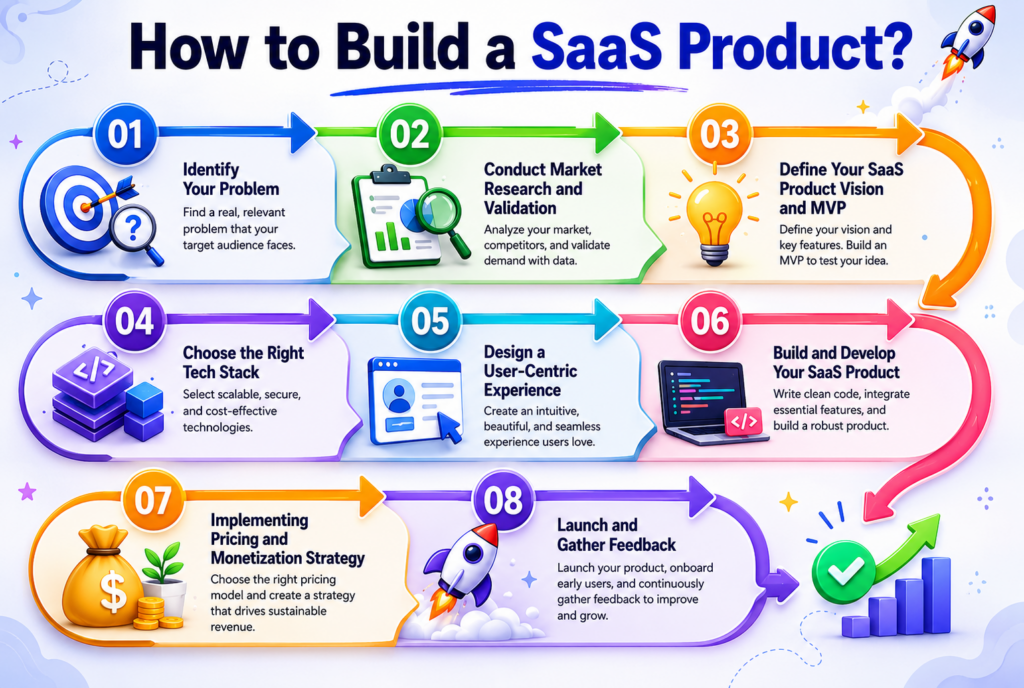
Building a SaaS product is a structured journey that blends business thinking, user understanding, and technical execution. Moreover, successful SaaS products are not just well-built, they are deeply validated, user-driven, and designed for continuous evolution. Below is a step-by-step breakdown of how to move from idea to launch.
Identify Your Problem
Every successful SaaS product starts with a real and expensive problem.
The first step is problem discovery. You need to understand what people are struggling with in their workflows, processes, or daily operations. The stronger and more frequent the pain point, the higher the chances your solution will succeed.
Start by observing industries where inefficiencies are common, such as finance, healthcare, logistics, HR, or marketing operations. Look for repetitive manual tasks, fragmented tools, or outdated systems.
To go deeper, engage directly with potential users:
- Conduct one-on-one interviews
- Observe how teams currently work
- Ask what slows them down or frustrates them
The goal is to uncover problems that users may not even fully articulate yet. A strong SaaS idea is often rooted in hidden inefficiencies, not obvious requests.
Conduct Market Research and Validation
Once you have identified a problem, the next step is to validate whether it’s worth solving at scale.
Market research helps you understand both demand and competition. Start by identifying:
- Who your target users are
- What alternatives are they currently using
- How big is the market opportunity
Then analyze competitors in detail. Study their:
- Feature sets
- Pricing models
- User reviews
- Strengths and weaknesses
This helps you position your product in a way that is meaningfully different.
Validation is even more important than research. You need proof that users actually want your solution. This can be done through:
- Landing pages with clear value propositions
- Early access or waitlist signups
- Paid pilot programs or prototypes
- User surveys and interviews
Define Your SaaS Product Vision and MVP
Once your idea is validated, you need a clear product vision and focused MVP.
Your product vision defines the long-term direction:
- What problem are you ultimately solving?
- Who are you building for?
- What transformation will your product enable?
This vision keeps your product aligned as it evolves.
The MVP is your first working version of the product. MVPs are expected to be lean but intelligent, often including automation or AI-driven features that deliver immediate value.
When defining your MVP:
- Focus only on core functionality
- Remove all non-essential features
- Prioritize speed to market over perfection
A strong MVP allows you to:
- Test assumptions quickly
- Reduce development risk
- Gather real-world feedback early
Choose the Right Tech Stack
Your tech stack determines how scalable, maintainable, and flexible your SaaS product will be.
The key layers to consider include:
- Frontend: Responsible for user experience and interface responsiveness
- Backend: Handles logic, APIs, and data processing
- Database: Stores and manages structured or unstructured data
- Cloud infrastructure: Powers hosting, scaling, and reliability
Modern SaaS products are typically:
- API-first
- Cloud-native
- Modular and integration-ready
You also need to decide on architecture:
- Monolithic architecture: Faster to build, simpler early on
- Microservices: Better for scaling and complex systems
- Serverless: Ideal for cost efficiency and event-driven workloads
The right choice depends on your product complexity and growth expectations.
Design a User-Centric Experience
User experience is one of the strongest differentiators in SaaS. Even if your product is powerful, users will leave if it feels confusing or slow.
Focus on:
- Simple and intutive navigation
- Clean and minimal interface design
- Smooth onboarding flows
- Clear action-driven workflows
Onboarding is especially critical. The faster users reach their first value moment, the higher your retention rate.
Some best practices include:
- Guided tutorials or walkthroughs
- Progressive feature unlocking
- Contextual tooltips and guidance
Design should not look good; it should reduce friction at every step.
Build and Develop Your SaaS Product
This is where your idea becomes a real product.
Adopt an agile development approach:
- Break development into short sprints
- Deliver features incrementally
- Continuously test and iterate
Modern SaaS development also involves strong engineering practices:
- CI/CD pipelines for automated deployment
- Version control and code reviews
- Automated testing
You will also need to integrate essential services such as:
- Authentication and user management
- Payment gateways
- Analytics and monitoring tools
Security should be embedded from day one, not added later. This includes encryption, secure APIs, and compliance readiness.
Implementing Pricing and Monetization Strategy
Pricing is a strategic lever that directly impacts growth and profitability.
Most SaaS businesses rely on one or a combination of the following models:
- Subscription-based pricing: Fixed monthly or annual plans
- Usage-based pricing: Pay according to consumption
- Freemium model: Free entry with paid usages
When defining pricing:
- Align pricing with the value delivered
- Study competitor pricing but avoid copying it blindly
- Understand your customer’s willingness to pay
A strong SaaS pricing strategy usually includes tiered plans:
- Basic (entry-level users)
- Professional (core users)
- Enterprise (advanced needs and scalability)
Launch and Gather Feedback
Launching your SaaS product is not the end, it’s the beginning of real learning.
Start with a controlled or soft launch:
- Release to a small group of users
- Monitor performance and usability
- Identify bugs and friction points
This phase is critical for refinement before scaling.
After launch, focus heavily on feedback loops:
- In-app feedback forms
- User interviews
- Behavior analytics
- Support tickets and usage patterns
Some key metrics to track include:
- Customer acquisition cost
- Churn rate
- Lifetime value
- Activation and retention rates
The insights gathered here will guide your next set of product improvements.
Common Challenges in Building SaaS Products
Building a SaaS product may look straightforward on paper, but in practice, it involves a series of strategic, technical, and operational challenges. Many products fail not because the idea is weak, but because execution hurdles are underestimated.
Achieving Product-Market Fit
One of the most difficult challenges in SaaS is reaching product-market fit. This happens when your product consistently solves a real problem for a clearly defined audience, and users are willing to pay for it.
Many teams overbuild features before validating demand, which leads to products that are technically impressive but misaligned with user needs. Others struggle because they target too broad an audience instead of focusing on a specific niche.
To overcome this challenge, SaaS teams must:
- Continuously validate assumptions with real users
- Focus on solving one core problem extremely well
- Iterate quickly based on feedback and usage data
Higher Customer Churn
Customer retention is often more difficult than customer acquisition. Many SaaS products initially attract users but fail to keep them engaged over time, leading to high churn rates.
Churn usually happens due to:
- Poor onboarding experiences
- Lack of perceived value
- Complex or unintutive interfaces
- Missing key features or integrations
Is SaaS, first impressions are critical. If users don’t experience value quickly, they are unlikely to stay.
To reduce churn, companies must:
- Design smooth and guided onboarding flows
- Continuously improve usability
- Provide proactive customer support
- Regularly deliver new value through updates
Scaling Infrastructure and Performance
As your SaaS product grows, infrastructure challenges become more prominent. A system that works well for a few hundred users may struggle under thousands or millions.
Common scaling issues include:
- Slow application performance under load
- Database bottlenecks
- Increased latency in different regions
- High cloud infrastructure costs
Scaling is not just about handling more users, it’s about maintaining performance, reliabiility, and cost efficiency at scale.
To address this, SaaS teams must:
- Design systems with scalability in mind from the beginning
- Use cloud-native and distributed architectures
- Implement caching and load balancing strategies
- Monitor system performance continuously
Managing Development Complexity
As SaaS products change, they naturally become more complex. New features, integrations, and user requirements can make systems harder to maintain and extend.
This complexity often results in:
- Slower development cycles
- Increased bugs and technical debt
- Difficult onboarding for new developers
Without proper architecture and discipline, even simple changes can become risky.
To manage complexity, teams should:
- Follow modular or microservices-based architecture where appropriate
- Maintain clean and well-documented codebases
- Enforce coding standards and code reviews
- Refactor regularly to reduce technical debt
Customer Acquisition Costs and Growth Pressure
Acquiring customers in a competitive SaaS market can be expensive. Paid ads, marketing campaigns, and sales efforts often lead to Customer Acquisition Costs, especially in early stages.
At the same time, investors and stakeholders expect rapid growth, creating pressure to scale quickly.
The challenge is balancing:
- Growth vs. profitability
- Marketing spend vs. customer lifetime value
- Short-term traction vs. long-term sustainability
To manage this effectively, SaaS companies must:
- Focus on organic and product-led growth strategies
- Improve conversion rates across funnels
- Increase retention to maximize lifetime value
- Optimize marketing channels based on ROI
Final Words
Building a SaaS product requires a clear problem focus, strong validation, thoughtful design, and scalable execution. Success depends on continuous iteration, user feedback, and adaptability. While challenges like competition and scaling exist, a disciplined, user-centric approach can transform a simple idea into a sustainable and high-growth SaaS business.