




Hero Introduction
React remains a preferable choice for building fast and scalable web applications. However, hiring the right React developers comes with varying costs depending on multiple factors. Therefore, understanding these costs is essential to making smart and budget-conscious decisions.
Executive Summary
Hiring React developers typically costs between $19.23 and $75.96 per hour, depending on experience, location, and hiring model. Offshore options are more cost-effective, while local hires offer greater control. The key is balancing cost with quality and long-term value.
Why React Developers Are in High Demand?
React continues to dominate frontend development due to its flexibility, performance, and strong ecosystem. Businesses now prioritize fast, responsive user experiences, and React enables exactly that through its component-based architecture.
The growing popularity of single-page applications and interactive platforms has significantly increased the need for skilled React developers. From SaaS dashboards to eCommerce platforms, companies rely on React to deliver seamless user interfaces.
Another reason behind the high demand is the expansion of React’s ecosystem. Tools like Next.js and TypeScript have made React more powerful, allowing developers to build scalable and production-ready applications. As a result, businesses aren’t just hiring developers; they are seeking professionals who can handle complex architectures and integrations.
What Factors Influence the Cost of Hiring React Developers?
The cost of hiring React developers isn’t determined by a single variable; it’s shaped by a combination of technical, geographic, and business-related factors. Therefore, understanding these in depth helps you avoid overpaying while still securing the right talent for your project.
Experience Level
Experience remains one of the most significant cost drivers. However, it’s not just about years; it’s about problem-solving ability, ownership, and efficiency.
- Junior Developers
Typically cost-effective and suitable for basic UI tasks, bug fixes, or working under supervision. While their rates are lower, they often require guidance, which can increase indirect costs.
- Mid-Level Developers
These developers can work independently on most features, making them a solid balance between cost and productivity. They are often the best choice for growing teams.
- Senior Developers
Senior developers command higher rates, but they bring deep expertise in architecture, scalability, and performance optimization. They can make critical technical decisions, reduce technical debt, and accelerate delivery timelines.
- Architects
These professionals are the most expensive but are essential for complex or enterprise-level applications. They ensure the system is built for long-term sustainability and maintainability.
Location
Location significantly impacts developer rates due to differences in living costs, market demand, and economic conditions. However, cost shouldn’t be the only consideration. Time zone differences, communication skills, and cultural alignment can impact productivity and collaboration.
Hiring Model
The way you hire developers plays a crucial role in determining total costs, not just hourly rates.
- Freelancers:
Lower upfront costs and high flexibility. Ideal for short-term or well-defined tasks. However, reliability and consistency can be concerns for long-term projects.
- In-House Developers:
Provide maximum control, better collaboration, and long-term commitment. However, costs extend beyond salary to include benefits, office space, equipment, and recruitment expenses.
- Outsourcing Agencies:
Offer a complete package including development, project management, and quality assurance. While slightly more expensive, they reduce internal workload and risk.
- Dedicated Development Teams:
A hybrid approach where developers work exclusively on your project. This model offers scalability, predictability in costs, and better team alignment.
Project Complexity
The scope and complexity of your project directly affect how much you’ll pay.
- Simple Projects:
Static websites or basic user interfaces require minimal efforr and lower-cost developers.
- Medium Complexity Projects:
Applications with API integrations, state management, and dynamic UI features require more experienced developers.
- Enterprise Projects:
These involve advanced architecture, performance optimization, security considerations, and scalability planning. They require senior developers or entire teams, significantly increasing costs.
Skill Set and Technical Expertise
Not all React developers offer the same value. Their technical skill set can greatly influence their rates.
Developers with knowledge of the broader React ecosystem, such as Next.js for server-side rendering, TypeScript for type safety, Redux or Zustand for state management, and GraphQL for efficient data handling, typically charge higher rates.
Additionally, developers who understand:
- Performance optimization techniques
- Testing frameworks
- CI/CD pipelines
- Cloud platforms
bring more value to your project, and can reduce long-term maintenance costs.
Tools, Infrastructure, and Hidden Costs
Beyond salaries or hourly rates, these are additional expenses to consider:
- Development tools and software licenses
- Project management tools
- Collaboration platforms
- Hardware and infrastructure
- Onboarding and training
Communication and Collaboration Requirements
Developers who are fluent in English and experienced in working with international teams often charge higher rates.
Moreover, strong communication skills can:
- Reduce misunderstandings
- Improve project efficiency
- Minimize rework
While it may seem like a soft factor, communication directly affects timelines and overall costs.
Market Demand and Talent Availability
Market trends play a big role. The demand for React developers remains high due to:
- Growth in SaaS and web applications
- Increased adoption of AI-driven interfaces
- Expansion of remote work
What is The Average Cost of Hiring React Developers by Region?
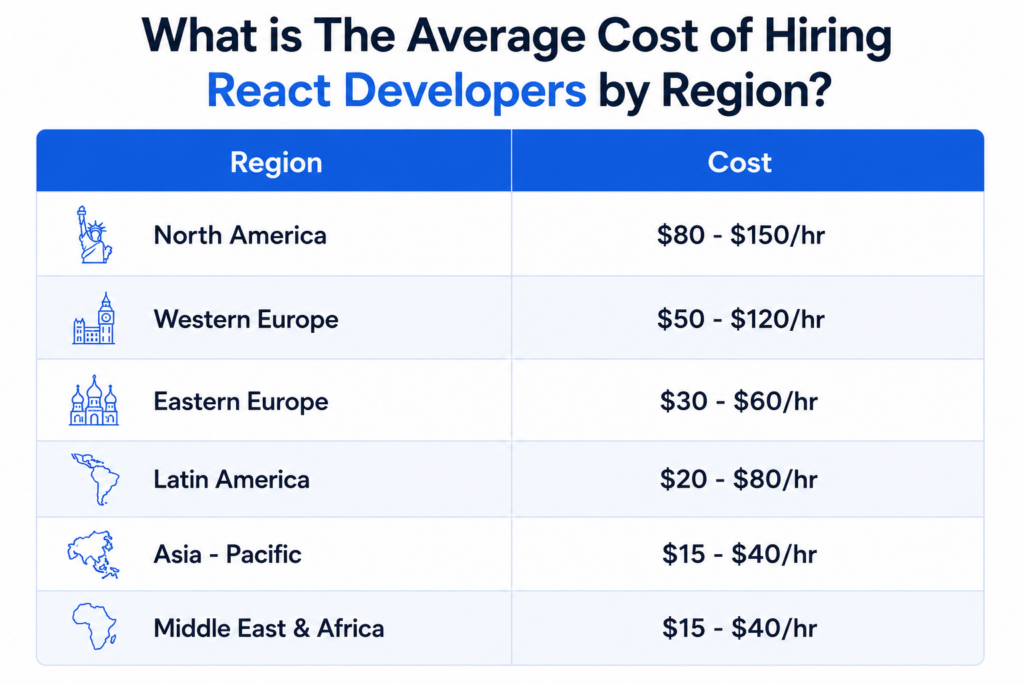
Cost Breakdown by Hiring Model
Choosing the right hiring model isn’t just a staffing decision, it directly shapes your total development cost and long-term scalability. Each model comes with its own pricing structure, advantages, and hidden trade-offs.
Freelancers
Freelancers are often the first choice for businesses looking for flexibility and quick execution. You are paying for:
- Pure development time
- Specific tasks or short-term deliverables
Advantages:
Freelancers are cost-effective for small projects, quick fixes, or MVP development. You can hire them on demand without long-term commitments, which makes them ideal for startups or businesses testing new ideas.
Limitations:
While freelancers are affordable upfront, they can introduce risks. Availability may fluctuate, and consistency can be an issue for long-term projects. There’s also no built-in project management or quality assurance, which means you may need internal resources to oversee the work.
Some hidden costs to consider are:
- Time spent managing and coordinating tasks
- Potential rework due to lack of standardization
- Delays if the freelancer becomes unavailable
In-House Developers
Hiring in-house developers gives you complete control over your team and development process. You are paying for:
- Salary
- Employee benefits
- Office space, equipment, and infrastructure
- Recruitment and onboarding costs
Advantages:
In-house developers are fully aligned with your business goals. They offer better collaboration, faster communication, and long-term commitment. This model is ideal for companies building core products that require continuous development and iteration.
Limitations:
This is the most expensive hiring model. Beyond salaries, the additional overhead can significantly increase total costs. Scaling up or down is also slower compared to other models.
Some hidden costs to consider:
- Recruitment fees and hiring time
- Training and onboarding
- Employee retention and turnover costs
- Paid leaves and downtime
Outsourcing Agencies
Outsourcing agencies provide a more structured and managed approach to development. You are paying for:
- Development team
- Project management
- Quality assurance and testing
- Process-driven delivery
Advantages:
Agencies reduce the burden on your internal team by handling everything from planning to execution. They bring established workflows, experienced teams, and faster turnaround times. This can significantly reduce time-to-market.
Limitations:
Agencies may cost more than freelancers due to added services like managment and QA. You may also have less direct control over individual developers compared to in-house teams.
Some hidden costs to consider are:
- Change requests that increase project scope
- Communication layers that may slow feedback cycles
- Long-term dependency on the agency
Dedicated Development Teams
This model has become increasingly popular, especially among startups and scaling companies. You are paying for:
- A full-time developer dedicated to your project
- Often includes basic management and support
- Infrastructure and administrative overhead handled by the provider
Advantages:
Dedicated teams offer the best balance between cost and control. You get a consistent team that works as an extension of your business, without the overhead of hiring in-house. This model is highly scalable; you can increase or decrease team size based on project needs.
Limitations:
While more flexible than in-house hiring, you still rely on an external partner. Success depends on choosing the right vendor and establishing clear communication processes.
Some hidden costs to consider are:
- Initial onboarding and knowledge transfer
- Time invested in team integration
- Potential dependency on the service provider
How to Optimize Your Hiring Budget?
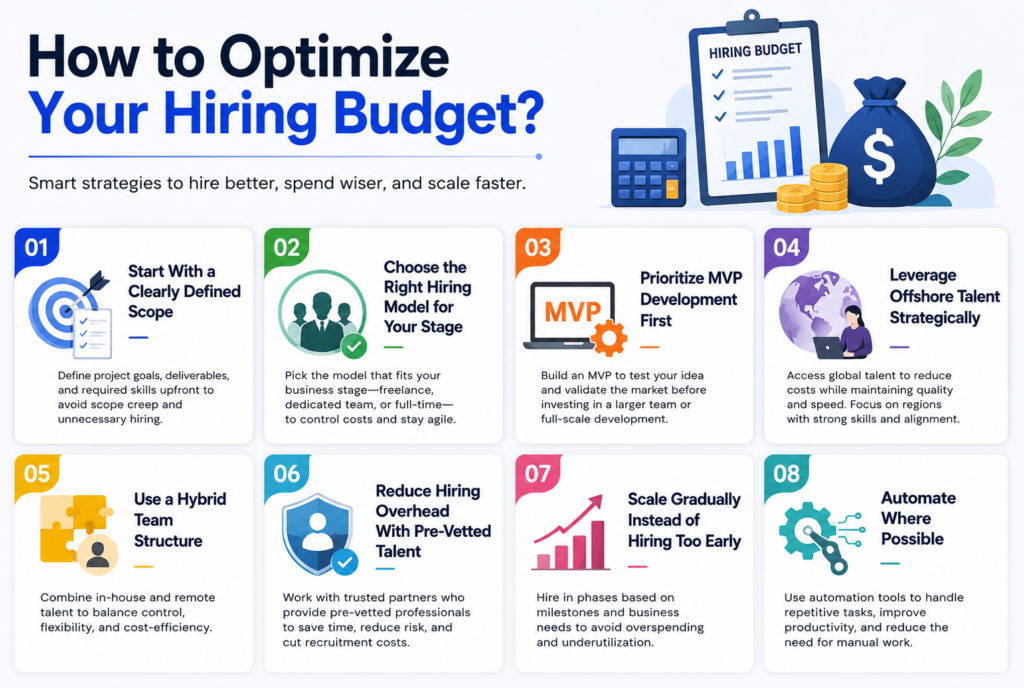
When it comes to hiring React developers can quickly become one of the largest expenses in a digital product’s lifecycle, especially if the hiring strategy isn’t planned carefully. However, the good news is that optimizing your budget doesn’t mean compromising on quality; it means making smarter decisions about how, when, and whom you hire.
Start With a Clearly Defined Scope
One of the most common reasons companies overspend on development is unclear or constantly changing requirements. When the project scope is vague, developers spend more time guessing, revising, and reworking features.
Before hiring, clearly define:
- Core features vs. optional features
- Technical requirements
- Expected timelines and milestones
- User experience goals
Choose the Right Hiring Model for Your Stage
Not every business needs a full in-house React team from day one. Choosing the wrong hiring model can significantly inflate costs.
- Startups: Freelancers or offshore dedicated developers are usually more cost-effective
- Medium-sized companies: Dedicated teams offer scalability without heavy overhead
- Enterprises: In-house and outsourcing hybrid models ensure control and efficiency
Matching your hiring model to your business stage ensures you are not overpaying for capabilities you don’t yet need.
Prioritize MVP Development First
Building a Minimum Viable Product is one of the most effective ways to control development costs.
Instead of building a full-featured application upfront, you should focus on:
- Core functionality only
- Essential user flows
- Basic UI/UX implementation
This allows you to validate your idea in the market before investing heavily in advanced features. Once validated, you can scale gradually based on real user feedback instead of assumptions.
Leverage Offshore Talent Strategically
Offshore development remains one of the most powerful cost-optimization strategies. Regions such as South Asia and Eastern Europe offer highly skilled React developers at significantly lower rates compared to North America or Western Europe.
However, cost savings should be balanced with:
- Communication quality
- Time zone overlap
- Technical vetting process
Use a Hybrid Team Structure
A hybrid model combines the strengths of in-house and external teams.
For example:
- Keep product strategy, architecture, and decision-making in-house
- Outsource execution-heavy tasks to offshore developers
This approach ensures:
- Better control over product direction
- Lower development costs
- Faster scaling when needed
Many companies find this model ideal for balancing quality and budget efficiency.
Reduce Hiring Overhead With Pre-Vetted Talent
Recruitment itself can be expensive and time-consuming. Screening candidates, conducting interviews, and testing technical skills all add indirect costs.
To optimize this:
- Use pre-vetted developer networks or agencies
- Work with trusted outsourcing partners
- Leverage platforms that provide ready-to-deploy React developers
Scale Gradually Instead of Hiring Too Early
Many companies over-hire in anticipation of future needs. This leads to unnecessary salary burn and underutilized developers.
A better approach is:
- Start with a small and efficient team
- Scale only when workload increases
- Add specialists when specific needs arise
Automate Where Possible
Automation can significantly reduce the amount of manual development effort required.
Examples include:
- Using component libraries to speed up UI development
- Implementing CI/CD pipelines for faster deployment
- Leveraging reusable React components
- Using third-party APIs instead of building from scratch
Final Words
So, hiring React developers requires balancing cost, quality, and scalability. By understanding pricing factors, choosing the right hiring model, and optimizing your approach, you can control expenses without sacrificing performance. You should focus on long-term value and efficient execution to build a high-performing React team that supports sustainable business growth.