




According to statistics, 70-90% of proof of concepts fail to move beyond the initial stage. This is because they demonstrate technical feasibility in controlled environments but fail to create measurable business value once real world complexity sets in. Even models that appear powerful in demonstrations have trouble with operational restrictions and complex data.
Many AI attempts stop in the space between testing and actual effect. Therefore, improving models alone won’t be enough to close that gap; greater planning and a clear focus on business goals are also necessary.
In this guide, we will discuss what an AI proof of concept is and how companies may successfully move from PoC to production so that AI can offer long term commercial value.
AI Proof of Concept
An AI Proof of Concept is a focused, low risk experiment designed to verify if AI can effectively address a specific business problem. A proof of concept seeks to answer one fundamental question: Is it worthwhile to utilize AI to solve this problem? Rather than concentrating on size or completeness.
At this stage, the goal is not to build a polished system or production grade solution. Instead, an AI PoC serves as a learning exercise that helps organizations move from assumptions to evidence before committing significant time.
What Does an AI PoC Typically Include?
While the exact scope varies, most AI PoCs share common characteristics:
- A narrowly defined problem statement
- A limited dataset, often historical or sampled
- One or more baseline models for comparison
- Simple evaluation metrics, such as accuracy or error rates
- A basic demonstration or visualization of results
The emphasis is on speed and learning rather than reliability. Many trade offs are intentionally made to accelerate experimentation.
How AI PoCs Differ from Prototypes and MVPs?
Although they serve different purposes, AI PoCs are sometimes mistaken for prototypes or MVPs. Prototypes investigate user experience, MVPs seek to provide customer value, while PoCs concentrate on technical viability.
Why AI PoCs Fail to Scale into Production?
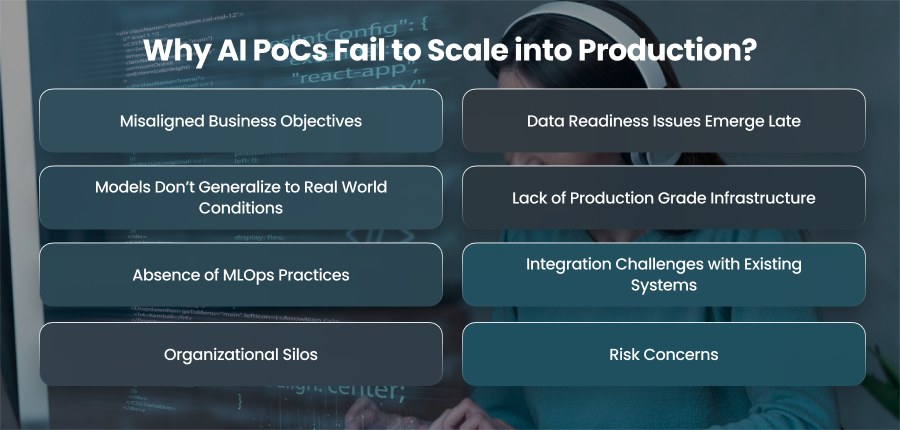
Misaligned Business Objectives
One of the most common reasons AI PoCs stall is the absence of a clearly defined business goal. Many PoCs are launched to explore what AI can do rather than what the business needs it to do. As a result, performance is assessed using technical measures without connecting them to observable business results.
Teams find it difficult to give a convincing response when leadership inquires about how the PoC enhances revenue or risk management. PoCs lose momentum and are unable to obtain clearance for more investment in the absence of a clear connection to business value.
Data Readiness Issues Emerge Late
AI PoCs often rely on limited and carefully curated datasets. These datasets may work well in a controlled environment, but fail to represent real world conditions. When teams attempt to scale, they encounter problems like insufficient data or restricted access due to governance standards.
Additionally, many companies undervalue the effort required to maintain data quality over time. Models that perform well during the PoC phase rapidly deteriorate in production situations in the absence of dependable data pipelines and ownership.
Models Don’t Generalize to Real World Conditions
Performance in a PoC doesn’t guarantee performance in production. PoCs seldom take into consideration the unpredictability introduced by real-world settings, such as noisy inputs and unforeseen edge situations. These modifications eventually cause data drift and decreased model accuracy.
If there are no procedures in place to monitor model performance, organizations lose trust in AI outcomes. Once stakeholders see AI as unreliable, its adoption stops entirely.
Lack of Production Grade Infrastructure
PoCs are typically built using lightweight tools and temporary infrastructure. Although this method speeds up testing, scalability becomes difficult. PoCs are not made to fulfill the dependability and low latency needs of production systems.
Teams often discover too late that their PoC architecture cannot support real world workloads. Retrofitting production requirements at this stage is expensive and time consuming, leading many projects to fail.
Absence of MLOps Practices
The gap between data science and engineering becomes especially visible when moving to production. Basic MLOps techniques like rollback mechanisms and model version management are absent from many AI Proof of Concepts.
Even minor adjustments become dangerous without MLOps, and sustaining models over time becomes unfeasible. Long-term adoption is discouraged by this operational instability.
Integration Challenges with Existing Systems
AI systems rarely operate in isolation. They must integrate with legacy software and user interfaces. PoCs often sidestep these integration challenges, focusing solely on model development.
When integration becomes unavoidable, teams face unexpected complexity. APIs and process changes introduce friction that can derail otherwise promising AI initiatives.
Organizational Silos
Data science, engineering, product, compliance, and business teams must work together to produce AI. Progress is slowed when roles and duties are unclear. Engineering teams could not completely comprehend the purpose or constraints of the model, and data scientists might not have the power to push models into production.
Risk Concerns
As AI approaches manufacturing, concerns about fairness and compliance grow increasingly urgent. Stakeholders may be hesitant to adopt systems that are difficult to explain or audit, especially in regulated companies.
How to Build a Production Ready AI Foundation?
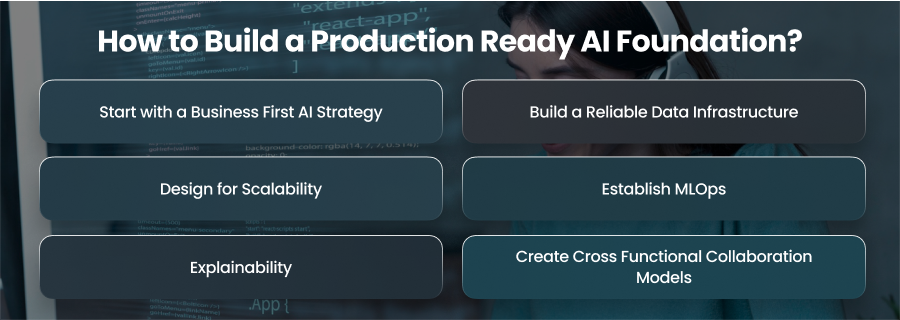
Start with a Business First AI Strategy
Understanding the business problem that the AI system is meant to solve completely is the first step in creating a production-ready AI system. A lot of AI projects fall short because they put technology ahead of commercial results. Finding high impact use cases that support strategic goals is an essential component of a solid foundation. Additionally, establishing ownership and responsibility precisely guarantees that each stakeholder is aware of their part in attaining the intended results.
Build a Reliable Data Infrastructure
A production ready foundation depends on reliable and accessible data. To guarantee accountability and consistency, organizations require well-defined data sources and ownership. Deployment is accelerated, and human error is decreased via automated data pipelines for intake and transformation.
While dependable governance guarantees data integrity and compliance, versioning datasets and labels enables teams to monitor changes over time. As a result, early data infrastructure investment reduces the risks that frequently cause AI projects to fail as they go from proof of concept to production.
Design for Scalability
AI systems must be designed to handle growth in data and computational complexity. Scalable design entails careful planning around architecture rather than needless over engineering. Based on performance requirements and regulatory restrictions, organizations should select cloud or hybrid solutions.
Models can change independently of the larger system when components are separated via microservices or APIs. The AI system may adjust to shifting business needs without needing an expensive rebuild if it is planned for growing compute and storage demands.
Establish MLOps
MLOps is the bridge between experimentation and production. It provides the processes and practices needed to deploy and maintain AI systems over time. Drift monitoring, automated testing and deployment pipelines, and model version control are some of its constituent parts. By including MLOps early in the AI lifecycle, organizations can transform AI from a fragile proof of concept into a sustainable capacity.
Explainability
Adoption and long term success depend on people having faith in AI results. AI systems that are ready for production must be transparent about the decision making process, especially in regulated settings. Stakeholder confidence can be increased by clear exposition of assumptions and limitations and simple models. Users are more inclined to integrate AI into daily tasks when they comprehend and have faith in the technology.
Create Cross Functional Collaboration Models
The productionization of AI is a cooperative endeavor that calls for collaboration amongst several teams. Accountability is ensured and silos are avoided by clearly defining roles and duties. Additionally, promoting frequent communication and team decision-making creates an atmosphere where AI activities complement corporate objectives. By incorporating collaboration into the foundation, organizations may accelerate the PoC production process while maintaining flexibility and responsiveness to changing business requirements.
How to Transition from PoC to Production?
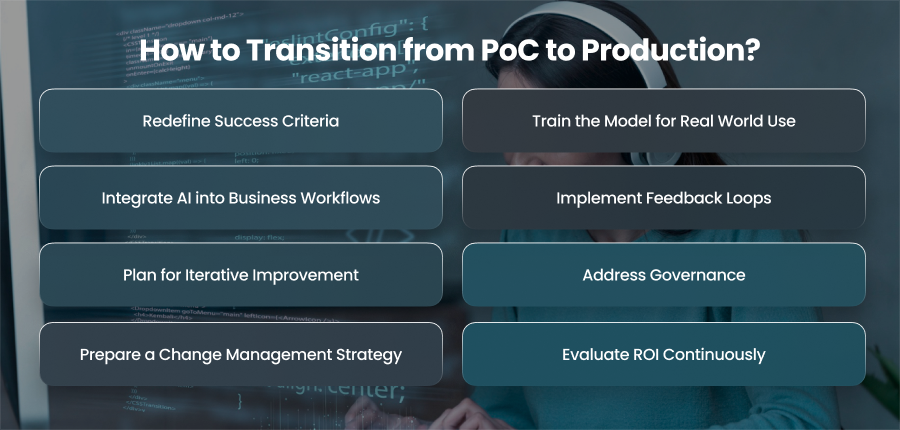
Redefine Success Criteria
It’s crucial to reevaluate and rethink what success looks like before putting an AI solution from proof of concept to production. Success in the PoC phase is frequently evaluated using technical metrics like precision or accuracy. These measures are significant, but they may not accurately represent the impact in the actual world. Success in manufacturing must be linked to either risk reduction or business results. Therefore, establishing clear and business KPIs ensures that the AI system is evaluated on its ability to create measurable value rather than simply performing well in a controlled environment.
Train the Model for Real World Use
Models that perform well in a proof of concept often fail in production due to the complexity of the real world. To ensure reliability, extensive testing is required before to manufacturing. This entails making sure that outcomes can be explained and stress testing the model under various data situations. To satisfy production objectives, models may require performance and scalability improvement.
Integrate AI into Business Workflows
AI delivers value only when it seamlessly integrates into existing business processes. Transitioning from PoC to production requires thoughtful integration into workflows. This could involve exposing models via APIs and embedding predictions into dashboards. The goal is to make AI outputs easily accessible to end users.
Implement Feedback Loops
Once put into practice, AI systems are dynamic, evolving in step with processes. Furthermore, continuous monitoring is necessary to spot anomalies or data drift in real time. Errors are found and predictions are improved through user and system feedback loops. Retraining procedures guarantee that models maintain their accuracy and applicability over time. Businesses are significantly more likely to maintain long term value from their investments if they approach AI as a living system.
Plan for Iterative Improvement
Putting AI into production is only the start of a cycle of continual progress, not the end. Production models should be viewed by organizations as dynamic assets that are always being assessed and improved. Retraining models with fresh data or fine tuning features are examples of iterative improvements. This iterative process guarantees that AI will continue to provide growing value over time and adjust to shifting business conditions.
Address Governance
Production AI is subject to business governance and regulatory compliance requirements. Before going from proof of concept to production, robust access controls and audit procedures must be implemented. Compliance with corporate policies and data protection regulations must be ensured from the start. Early problem solving minimizes risks.
Prepare a Change Management Strategy
Even the most technically sound AI solution can fail if user are unprepared. Effective team onboarding throughout the PoC to production transition involves training and clear documentation. Additionally, teaching users how to evaluate AI results and follow suggestions guarantees that the system is properly implemented and provides the desired business value.
Evaluate ROI Continuously
Organizations should establish mechanisms to monitor the cost effectiveness of production AI. This includes infrastructure costs and retraining. By continuously evaluating ROI, teams can prioritize improvements and scale successful solutions.
Final Words
Moving AI from PoC to production requires more than strong models; it demands clear business alignment and scalable architecture. Organizations that design for production early and iterative continuously are far more likely to turn AI experimentation into measurable and long term business value.