




Quick Summary
Most delivery challenges stem from weak ownership, not execution. Hiring more developers or adding processes rarely helps without clear responsibility. High-performing teams define ownership, align accountability, and structure around outcomes, enabling consistent, scalable, and reliable delivery.
Introduction
Most engineering teams believe that improving execution will solve delivery challenges.
They invest in:
- Agile Processes
- Sprint Planning
- Tracking Tools
- Performance Metrics
While these improvements can help, many organizations still struggle with:
- Missed Deadlines
- Production Issues
- Inconsistent Delivery Quality
The underlying issue is often misunderstood.
Execution determines how work gets done. Ownership determines whether the right outcomes are achieved.
Without ownership, execution becomes fragmented.
Teams deliver tasks, but systems fail.
Features are built, but reliability suffers.
This article explores why ownership is the most critical factor in software delivery and how engineering leaders can build systems that prioritize accountability and long-term success.
What Is Ownership in Software Engineering?
Ownership refers to clear responsibility for a system, service, or domain across its entire lifecycle.
This includes:
- Design And Architecture
- Development And Implementation
- Deployment And Infrastructure
- Monitoring And Reliability
- Long-Term Maintenance
Ownership is not about individual tasks. It is about end-to-end responsibility for outcomes.
What Is Execution?
Execution refers to the ability to complete tasks efficiently.
It focuses on:
- Delivering Features
- Completing Sprint Tasks
- Writing Code
- Meeting Deadlines
Execution measures activity. Ownership ensures outcomes.
Ownership vs Execution: The Core Difference
Many teams focus on execution to increase output, but long-term delivery success depends on ownership. Ownership creates accountability, system stability, and sustainable engineering outcomes.
| Factor | Execution-Focused Teams | Ownership-Driven Teams |
|---|---|---|
| Responsibility | Task-Based | Outcome-Based |
| Focus | Completing Work | Delivering Results |
| Accountability | Shared Loosely | Clearly Defined |
| Decision-Making | Distributed Without Clarity | Owned By Domain Leaders |
| System Health | Often Overlooked | Actively Maintained |
| Long-Term Thinking | Limited | Strong |
Execution ensures work is done. Ownership ensures the system works.
Why Execution Alone Fails
1. Tasks Get Completed, Systems Break
Execution-focused teams prioritize delivering features.
However:
- Systems Become Fragile
- Integrations Fail
- Technical Debt Increases
Without ownership, no one is responsible for system health.
2. Accountability Becomes Diffused
When multiple teams contribute without ownership:
- Issues Are Passed Between Teams
- Problems Take Longer To Resolve
- Decisions Are Delayed
Diffused accountability slows delivery.
3. No One Owns Production Outcomes
In many organizations:
- Development Teams Build Features
- Operations Teams Manage Infrastructure
This separation creates gaps.
Without ownership:
- Production Issues Persist
- Reliability Suffers
- Incident Resolution Slows
4. Decision-Making Becomes Slow
Without clear ownership:
- Decisions Require Alignment Across Multiple Stakeholders
- Approval Processes Increase
- Progress Slows
Ownership enables faster decision-making.
5. Technical Debt Accumulates
Execution-focused teams prioritize short-term delivery.
Without ownership:
- Refactoring Is Delayed
- System Design Degrades
- Complexity Increases
Over time, this reduces delivery speed.
What Ownership-Driven Teams Do Differently
1. Define Clear System Ownership
High-performing teams assign ownership across:
- Services
- Infrastructure
- Data Systems
Each system has a responsible team.
2. Align Teams with End-to-End Responsibility
Teams own:
- Development
- Deployment
- Monitoring
- Maintenance
This ensures accountability across the lifecycle.
3. Build Accountability into Culture
Ownership is reinforced through:
- Clear Expectations
- Measurable Outcomes
- Responsibility For Production Systems
Teams are accountable for results, not just tasks.
4. Structure Teams Around Domains
Instead of functional teams, organizations create:
- Domain-Based Teams
- Product-Aligned Teams
This reduces dependencies and improves ownership.
5. Prioritize System Health
Ownership-driven teams actively manage:
- System Reliability
- Performance
- Scalability
They treat system health as a core responsibility.
Ownership in Practice: Key Areas
1. Architecture Ownership
Teams define and maintain system architecture.
This prevents fragmentation.
2. Infrastructure Ownership
Teams manage deployment environments and infrastructure.
This ensures reliability.
3. Data Ownership
Clear ownership of data pipelines and data quality.
This supports consistency.
4. Monitoring and Reliability Ownership
Teams are responsible for:
- Uptime
- Incident Response
- Performance
This improves system stability.
Step-by-Step Framework to Build Ownership
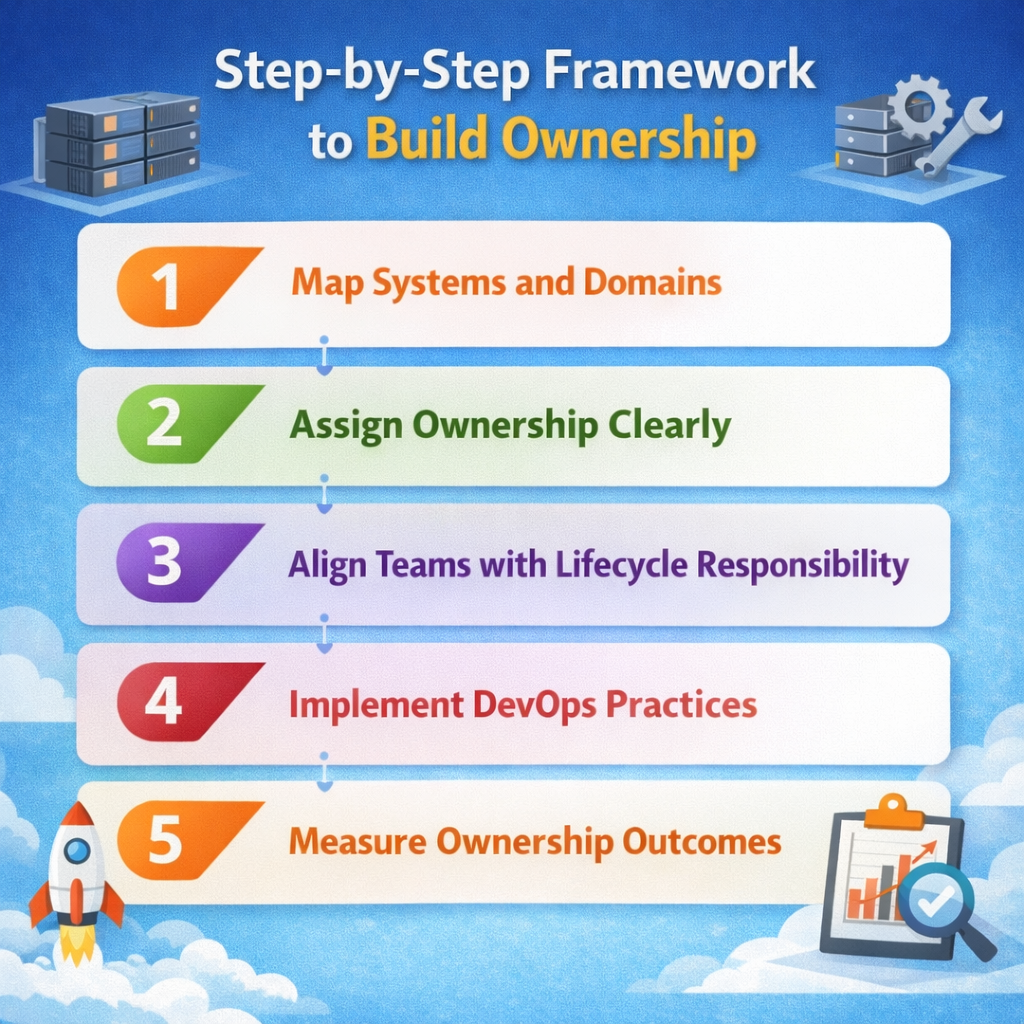
Step 1: Map Systems and Domains
Identify:
- Services
- Infrastructure
- Data Systems
Understand system boundaries.
Step 2: Assign Ownership Clearly
Assign a team to each domain.
Ensure:
- Clear Responsibility
- Decision-Making Authority
Step 3: Align Teams with Lifecycle Responsibility
Ensure teams own:
- Build
- Deploy
- Operate
Avoid splitting responsibility across teams.
Step 4: Implement DevOps Practices
Enable teams to:
- Deploy Independently
- Monitor Systems
- Respond To Incidents
Support ownership with infrastructure.
Step 5: Measure Ownership Outcomes
Track:
- System Reliability
- Incident Response Time
- Delivery Consistency
Use metrics to reinforce accountability.
Common Mistakes Organizations Make
Confusing Ownership with Responsibility
Assigning tasks is not the same as assigning ownership.
Splitting Ownership Across Teams
Shared ownership often results in no ownership.
Focusing Only on Execution Metrics
Velocity metrics do not reflect system health.
Ignoring Long-Term System Health
Short-term delivery often comes at the cost of long-term stability.
Industry Trends in Ownership Models
Rise of DevOps and Platform Engineering
Teams are increasingly responsible for both development and operations.
Domain-Driven Team Structures
Organizations are aligning teams with business domains.
Increased Focus on Reliability Engineering
Reliability is becoming a core engineering function.
Shift Toward Outcome-Based Metrics
Organizations are measuring success based on outcomes, not output.
Conclusion
Software delivery is not just about execution.
It is about ownership.
Organizations that focus only on execution often struggle with reliability, scalability, and consistency.
Those that prioritize ownership build systems that deliver long-term value.