




AI agents are rapidly becoming a core component of enterprise automation. Organizations are moving beyond simple chatbots and experimenting with intelligent systems that can understand requests, reason through problems, access business data, and complete complex tasks with minimal human intervention. However, building a successful AI agent requires much more than choosing a powerful large language model.
The right AI agent architecture provides the foundation for how your AI system thinks, remembers information, interacts with applications, and operates securely within your organization. A well-designed architecture improves scalability, reliability, maintainability, and long-term return on investment. Conversely, choosing the wrong architecture can lead to inconsistent responses, poor performance, rising operational costs, and difficult maintenance.
This guide explains what AI agent architecture is, the different architectural patterns available, the components that make up modern AI agents, and how to select the right architecture based on your business objectives. Whether you are planning your first AI initiative or expanding enterprise automation, you will gain a practical framework for making informed architecture decisions.
What Is AI Agent Architecture?
AI agent architecture is the overall design that defines how an AI agent receives information, reasons about tasks, stores knowledge, interacts with external systems, and delivers actions or responses.
Rather than focusing only on the AI model itself, architecture describes how every component works together to create an intelligent system capable of solving business problems.
Unlike a traditional chatbot that mainly generates text responses, an AI agent can:
- Understand business context
- Plan multiple steps
- Access internal knowledge
- Use external APIs
- Execute workflows
- Learn from previous interactions
- Collaborate with humans or other agents
An AI model, such as an LLM, acts as the brain for language understanding and reasoning. The architecture determines how that brain connects with memory, tools, business applications, databases, monitoring systems, and governance controls.
Building Blocks of an AI Agent Architecture
A complete AI agent architecture typically includes:
- User interface
- Large Language Model
- Memory layer
- Planning and reasoning engine
- Tool calling framework
- API integrations
- Business databases
- Workflow orchestration
- Monitoring and logging
- Security and governance
Why Choosing the Right AI Agent Architecture Matters
The architecture behind an AI agent directly influences its business performance and long-term success.
Scalability
As organizations automate more workflows, AI agents must support growing numbers of users, larger datasets, and increasingly complex tasks without performance degradation.
Performance
Efficient orchestration, optimized memory management, and intelligent tool selection reduce latency and improve response quality.
Security
Enterprise AI agents frequently access confidential customer information, financial records, and proprietary business data. A secure architecture protects sensitive information while enforcing strict access controls.
Compliance
Industries such as healthcare, banking, insurance, and government require AI systems that support audit trails, data governance, privacy regulations, and responsible AI practices.
Operational Efficiency
Well-designed architectures reduce manual work, minimize duplicate processing, and simplify system maintenance.
Moreover, according to statistics, the multi-agent systems market is projected to grow at a CAGR of 48.5%. However, single-agent systems hold 59.24% market share.
Key Components of an AI Agent Architecture
A modern AI agent is much more than a large language model generating responses. It’s a collection of interconnected components that work together to understand requests, retrieve relevant information, make decisions, interact with business systems, and continuously improve performance. Each component plays a specific role, and the overall effectiveness of an AI agent depends on how well these components are designed and integrated.
Large Language Model
The Large Language Model serves as the cognitive engine of an AI agent. It processes natural language, understands user intent, reasons through problems, and generates human-like responses. Depending on the use case, the LLM may also decide which tools to use, when to retrieve external information, or how to break a complex task into smaller steps.
However, an LLM alone is not sufficient for enterprise AI. While it excels at language understanding and reasoning, it doesn’t inherently possess up-to-date business knowledge or direct access to enterprise systems. That’s why it must work alongside other architectural components such as memory, APIs, and workflow orchestration.
When selecting an LLM, organizations should evaluate several factors, including response quality, latency, operational cost, context window size, multilingual capabilities, privacy requirements, and deployment options. Some businesses prioritize cloud-hosted models for quick deployment, while others choose private or on-premises models to meet strict security and compliance requirements.
Memory Layer
Memory enables AI agents to maintain context and provide more intelligent, personalized interactions. Without memory, an AI agent treats every conversation or request as entirely new, leading to repetitive questions and inconsistent user experiences.
Modern AI agent architectures typically include multiple types of memory:
- Short-term memory stores the context of the current conversation or workflow, allowing the agent to maintain continuity during an interaction.
- Long-term memory retains important information across sessions, such as user preferences, previous conversations, completed tasks, or organizational knowledge.
- Semantic memory stores structured business knowledge, policies, documentation, and frequently referenced information that can be retrieved when needed.
For example, a customer support AI agent can remember a customer’s previous support tickets, product preferences, and communication history. This allows it to provide more relevant recommendations without requiring the customer to repeat information.
Planning & Reasoning Engine
Many enterprise tasks involve more than simply answering a question. They require analyzing information, making decisions, and completing multiple actions in a logical sequence. This is the role of the planning and reasoning engine.
Rather than responding immediately, the planning engine evaluates the user’s objective and determines the most efficient path to complete it. It can divide a complex request into smaller tasks, prioritize actions, validate intermediate results, and adjust its approach if circumstances change.
For example, if a user asks an AI agent to schedule a customer meeting and prepare a sales summary. The planning engine may:
- Retrieve customer information from the CRM
- Analyze recent interactions
- Generate a meeting summary
- Check calendar availability
- Schedule the appointment
- Send confirmation emails
This structured reasoning allows AI agents to automate sophisticated workflows that would otherwise require significant human involvement.
Tool and API Integration
Enterprise AI agents deliver the most value when they can interact directly with existing business systems. Tool and API integration allows AI agents to move beyond conversation and perform real business actions.
Common integrations include:
- Customer Relationship Management systems
- Enterprise Resource Planning platforms
- Email services
- Calender applications
- Document management systems
- Payment gateways
- Collaboration platforms
- Cloud storage
- Internal databases
- Business intelligence tools
For example, instead of simply explaining how to create an invoice, an AI agent connected to an ERP system can generate the invoice automatically, send it for approval, and notify the finance team.
Workflow Orchestration
Workflow orchestration coordinates how all components within the AI agent architecture work together. It manages the sequence of tasks, determines which services should be called, handles failures, and ensures that workflows execute reliably from start to finish.
In simple implementations, orchestration may involve only a few API calls. In enterprise environments, however, workflows often span multiple teams, applications, and AI agents.
An orchestration layer typically manages:
- Task sequencing
- Agent coordination
- Conditional logic
- Retry mechanisms
- Error handling
- Approval workflows
- Event triggering
- Parallel task execution
For example, an employee onboarding workflow might involve HR software, identity management systems, IT ticketing platforms, payroll systems, and communication tools. The orchestration layer ensures that each task occurs in the correct order while handling exceptions automatically.
Data Sources
AI agents are only as effective as the information they can access. The data layer provides the knowledge required for accurate reasoning, informed decision-making, and context-aware responses.
Common enterprise data sources include:
- Internal knowledge
- CRM records
- ERP databases
- Product catalogs
- Policy documents
- Standard operating procedures
- Financial systems
- Customer support tickets
- Cloud storage
- External APIs
- Real-time operational data
Monitoring & Observability
Deploying an AI agent is only the beginning. Continuous monitoring and observability are essential for ensuring consistent performance, maintaining user trust, and identifying opportunities for optimization.
Monitoring provides visibility into how AI agents behave in production environments. Organizations can track important metrics such as:
- Response accuracy
- User satisfaction
- Response latency
- API performance
- Tool failures
- Token usage
- Infrastructure costs
- Workflow completion rates
- Hallucination frequency
- Security events
Security & Governance
Security and governance form the foundation of every enterprise AI architecture. Since AI agents often process sensitive business information, organizations must implement comprehensive controls to protect data and comply with industry regulations.
Key security measures include:
- Identity and access management
- Role-based access control
- Data encryption
- Secure API authentication
- Audit logging
- Data masking
- Prompt injection protection
- Input validation
- Output filtering
- Compliance reporting
AI Agent Architecture Components Overview
| Component | Purpose | Business Impact |
|---|---|---|
| Large Language Model | Understands natural language, reasons through requests, and generates responses. | Enables intelligent interactions, automation, and decision support. |
| Memory Layer | Stores conversational context, user preferences, and long-term organizational knowledge. | Improves personalization, consistency, and response accuracy. |
| Planning & Reasoning Engine | Breaks complex tasks into logical steps and determines execution strategies. | Automates multi-step workflows while improving efficiency and accuracy. |
| Tool & API Integration | Connects AI agents with enterprise applications, databases, and external services. | Enables real business actions instead of simple conversational responses. |
| Workflow Orchestration | Coordinates tasks, manages execution flows, handles failures, and synchronizes multiple systems or agents. | Increases reliability, scalability, and operational efficiency. |
| Data Sources | Supplies business knowledge through databases, documents, APIs, and knowledge bases. | Improves factual accuracy and reduces hallucinations. |
| Monitoring & Observability | Tracks system performance, usage, costs, errors, and response quality. | Supports continuous optimization, troubleshooting, and cost control. |
| Security & Governance | Protects sensitive data, enforces access controls, and ensures regulatory compliance. | Reduces business risk while building trust and enabling responsible AI adoption. |
Common Types of AI Agent Architectures
Single-Agent Architecture
A single AI agent manages all reasoning, planning, and execution.
Pros
- Easy to develop
- Lower operational costs
- Faster deployment
- Simpler maintenance
Cons
- Limited scalability
- Can become overloaded
- Difficult to handle specialized tasks
Best For
- Customer FAQs
- Internal assistants
- Simple automation
- Knowledge retrieval
Multi-Agent Architecture
Multiple specialized AI agents collaborate to solve complex business problems.
For example:
- Research agent
- Planning agent
- Finance agent
- Compliance agent
- Reporting agent
Pros
- Highly scalable
- Better specialization
- Improved task quality
- Easier expansion
Cons
- Greater architectural complexity
- More monitoring requirements
- Higher implementation costs
Best For
- Enterprise automation
- Large organizations
- Cross-team workflows
Hierarchical Agent Architecture
A supervisor agent delegates work to specialized child agents.
This improves coordination while maintaining centralized decision-making.
Ideal for:
- Large operational workflows
- Customer service escalation
- Project management
Event-Driven Agent Architecture
Agents respond automatically when business events occur.
Examples include:
- New customer registration
- Payment received
- Inventory storage
- Security alert
- Support ticket creation
This architecture enables real-time automation across enterprise systems.
Human-in-the-Loop Architecture
Certain decisions require human approval before execution.
Examples include:
- Loan approvals
- Medical recommendations
- Legal document generation
- Financial transactions
| Architecture | Complexity | Scalability | Best Use Case |
|---|---|---|---|
| Single-Agent | Low | Moderate | Small automation projects |
| Multi-Agent | High | Excellent | Enterprise automation |
| Hierarchical | Medium | High | Large coordinated workflows |
| Event-Driven | Medium | High | Real-time automation |
| Human-in-the-Loop | Medium | High | Regulated industries |
Factors to Consider Before Choosing an AI Agent Architecture
Business Objectives
Clearly define what you want the AI agent to accomplish. Customer support, workflow automation, analytics, and software development assistants each require different architectural approaches.
Workflow Complexity
Simple question-answering systems require fewer architectural components than multi-step decision-making processes involving approvals and external applications.
Integration Requirements
Consider the number of business systems the AI agent must access, including CRMs, ERPs, databases, messaging platforms, and proprietary software.
Data Availability
Evaluate the quality, accessibility, and freshness of your organizational data. AI agents depend on reliable information to produce accurate outputs.
Security Requirements
Determine whether the system will process confidential customer information, financial records, or intellectual property, and design security controls accordingly.
Compliance Needs
Businesses operating under regulations should incorporate governance, auditability, and policy enforcement from the start rather than retrofitting them later.
Scalability
Choose an architecture that can grow alongside your business without requiring significant redesign.
Performance
Evaluate latency requirements, expected workloads, and acceptable response times for users.
Budget
Balance implementation costs with expected business value. More sophisticated architectures often require greater upfront investment but can deliver higher long-term returns.
Internal AI Expertise
Organizations with limited AI engineering resources may benefit from simpler architectures initially before progressing to more advanced multi-agent systems
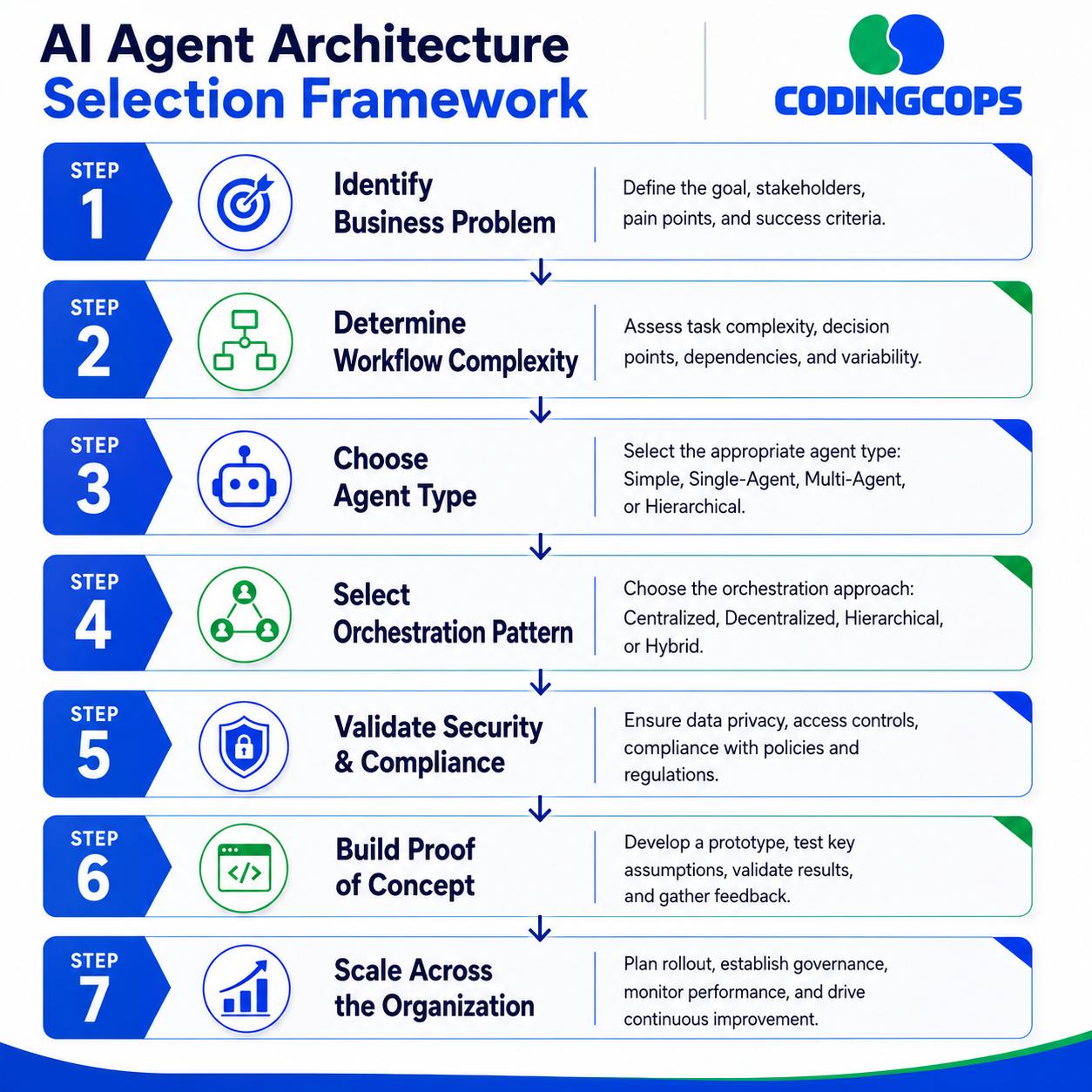
AI Agent Architecture Selection Framework
Selecting an architecture becomes easier when you follow a structured decision-making process.
Decision Matrix
| Business Requirement | Recommended Architecture |
|---|---|
| FAQ Automation | Single-Agent |
| Enterprise Process Automation | Multi-Agent |
| Healthcare Approvals | Human-in-the-Loop |
| Manufacturing Monitoring | Event-Driven |
| Project Coordination | Hierarchical |
| Financial Compliance | Human-in-the-Loop + Multi-Agent |
AI Agent Architecture by Business Use Case
Customer Support
Customer support agents benefit from architectures that combine conversational AI, memory, CRM, integration, and knowledge retrieval. Multi-agent designs are particularly useful for routing inquiries, escalating complex issues, and generating personalized responses.
Sales Automation
Sales AI agents can qualify leads, schedule meetings, update CRM records, generate proposals, and recommend follow-up actions. Integration with communication tools and customer data platforms is essential.
HR
Human resources teams can automate onboarding, answer employee questions, assist with policy searches, and streamline recruitment while keeping sensitive employee information secure through governance controls.
Finance
Finance departments require architectures with strong compliance, approval workflows, and audit capabilities. Human-in-the-loop designs are often preferred for reviewing invoices, expense reports, or financial recommendations.
IT Operations
AI agents help monitor infrastructure, analyze logs, troubleshoot incidents, create tickets, and recommend solutions. Event-driven architectures enable rapid responses to system alerts.
Healthcare
Healthcare AI agents can support appointment scheduling, patient communication, documentation assistance, and clinical workflow management. Security, privacy, and human oversight are essential.
Manufacturing
Manufacturers use AI agents to monitor equipment, predict maintenance needs, optimize production schedules, and coordinate supply chain operations through event-driven automation.
Knowledge Management
Knowledge management agents retrieve information from documents, internal wikis, policies, and databases, providing employees with accurate answers while reducing time spent searching for information.
Common Mistakes Businesses Make
Many AI projects struggle because organizations prioritize the AI model instead of the overall architecture.
Some common mistakes include:
- Choosing an architecture based only on the LLM
- Ignoring governance and compliance requirements
- Failing to implement monitoring and observability
- Overlooking memory management strategies
- Building weak API integrations
- Missing fallback and recovery mechanisms
- Overengineering simple business workflows
- Underestimating maintenance and operational costs
Best Practices for Designing an AI Agent Architecture
You can use the following checklist when planning your AI solution:
- Start with a single high-value workflow before expanding.
- Define measureable business outcomes success metrics.
- Design modular agents that can evolve independently.
- Keep humans involved in high-risk decisions.
- Build security and governance into every layer.
- Integrate only the systems required for the initial use case.
- Implement monitoring, logging, and alerting from day one.
- Continuously evaluate model performance and response quality.
- Optimize prompts, workflows, and orchestration regularly.
- Plan for future scalability instead of one-time deployment.
Real-World Examples of AI Agent Architectures
Customer Support Automation
A software company deployed a multi-agent architecture with seperate agents for customer authentication, knowledge retrieval, troubleshooting, and ticket creation. This reduced support reponse times, improved first-contact resolution, and allowed human agents to focus on complex issues.
Intelligent Document Processing
A financial services provider implemented a human-in-the-loop architecture to process invoice and contracts. AI extracted key information, validated data against internal systems, and routed uncertain cases to employees for review, improving efficiency while maintaining compliance.
IT Operations
An enterprise IT team adopted an event-driven architecture that monitored infrastructure logs, detected anomalies, opened incident tickets, and recommended remediation steps. Automated responses shortened incident resolution times and reduced manual monitoring.
Enterprise Knowledge Assistant
A global organization built a knowledge management agent connected to internal documentation, policies, and collaboration tools. Employees received accurate answers in seconds, reducing repetitive questions and improving productivity across teams.
How CodingCops design AI Agent Architectures?
Successful AI implementations begin with understanding business processes rather than selecting technology first. At CodingCops, we follow a structured approach that balances innovation with long-term maintainability.
Our process starts with discovery workshops to identify automation opportunities, business objectives, workflow complexity, and success metrics. This analysis helps determine whether a single-agent, multi-agent, event-driven, or hybrid architecture is the best fit.
Next, we create a detailed architecture plan covering model selection, memory strategy, orchestration patterns, integrations, security controls, and governance requirements. Before full-scale implementation, we build a proof of concept to validate technical feasibility and measure business value.
Once the architecture is validated, we integrate AI agents with existing business systems, databases, APIs, and enterprise applications while implementing strong security practices, role-based access controls, monitoring, and compliance safeguards.
Deployment is only the beginning. Continuous monitoring, performance optimization, prompt refinement, and workflow improvements ensure AI agents remain accurate, reliable, and aligned with evolving business needs.