




Hero Introduction
Businesses are using AI to solve real problems, from detecting fraud in real time to predicting supply chain disruptions before they happen. The focus has shifted from hype to measurable outcomes.
For CTOs, the real question is execution. How do you move from idea to impact quickly, without wasting time or resources? The answer lies in applying AI where it delivers immediate value, and doing it right the first time.
Executive Summary
AI is transforming how businesses operate by solving real-world challenges across industries. From healthcare and finance to retail and cybersecurity, companies are leveraging AI to improve efficiency and reduce costs.
However, success depends on execution. Organizations must decide whether to build in-house or partner with experts to scale AI effectively and achieve meaningful ROI.
Why 2026 is a Turning Point for AI Adoption?
Over the past few years, businesses have moved beyond proofs of concept and are now deploying AI in production environments that directly impact revenue and operations.
One of the biggest reasons for this shift is the maturity of AI technologies. Large language models and predictive analytics tools have become more accurate and easier to integrate. What once required massive R&D budgets can now be implemented with the right expertise and infrastructure.
Cloud platforms and pre-trained models have also lowered the barrier to entry. Startups can now build AI-powered products without building everything from scratch, while enterprises can scale solutions across departments.
From a CTO’s perspective, this raises an important question: Are we still experimenting with AI, or are we actually deploying it where it matters? So, staying in the experimentation phase too long can mean falling behind competitors who are already seeing ROI.
AI is no longer limited to innovation labs; it’s automating workflows and enhancing decision-making across entire organizations. This leads to a natural follow-up: What percentage of our operations can realistically be automated? The answer often surprises leadership teams when they begin assessing repetitive and data-heavy processes.
However, scaling AI requires more than tools; it requires expertise. Many organizations find themselves asking: Do we have in-house capability to build, deploy, and maintain AI systems at scale? This is where strategic decisions around hiring or partnering come into play.
What Real-World Problems AI is Solving?
How AI is Transforming Key Industries
AI is no longer experimental. It is actively driving measurable impact across industries by improving decision-making, optimizing operations, and enabling real-time intelligence at scale.
| Section | Key Areas | Description |
|---|---|---|
| Introduction | AI Impact | AI is solving real-world problems with improved precision and real-time decision-making. |
| Healthcare | Diagnostics | AI detects diseases (e.g., cancer, neurological disorders) earlier and more accurately. |
| Predictive Analytics | Helps anticipate patient deterioration and manage hospital resources. | |
| Drug Discovery | Speeds up identification of treatments using molecular data. | |
| Challenges | Data privacy, regulatory compliance, and workflow integration. | |
| Finance | Fraud Detection | Identifies suspicious transactions in real time, reducing financial losses. |
| Risk Management | Improves credit scoring using alternative data sources. | |
| Investment Analysis | Helps optimize portfolios through market trend analysis. | |
| Challenges | Need for explainability, transparency, and measurable ROI. | |
| Retail & eCommerce | Personalization | Predicts customer behavior for better recommendations. |
| Dynamic Pricing | Adjusts prices in real time to maximize revenue. | |
| Inventory Management | Improves demand forecasting and reduces stock issues. | |
| Challenges | Balancing long-term customer loyalty vs short-term sales. | |
| Supply Chain & Logistics | Demand Forecasting | Predicts future demand using historical and external data. |
| Route Optimization | Finds efficient delivery routes considering real-time factors. | |
| Warehouse Automation | Automates sorting and inventory tracking. | |
| Challenges | Improving resilience and reducing operational inefficiencies. | |
| Cybersecurity | Threat Detection | Detects anomalies in network activity to prevent breaches. |
| Adaptive Security | Learns and adapts to new and unknown threats. | |
| Automated Response | Takes real-time action against threats. | |
| Challenges | Reducing false positives and ensuring data quality. | |
| Customer Experience | Chatbots | Handles complex customer queries efficiently. |
| Sentiment Analysis | Analyzes feedback to improve services. | |
| Personalized Marketing | Delivers targeted content at the right time. | |
| Challenges | Avoiding poor automation that harms user experience. |
AI is delivering value where it matters most, solving operational bottlenecks and reducing risks that were previously hard to achieve. What’s different now is the level of precision and real-time decision-making AI brings to the table.
Let’s break down how AI is tackling real-world challenges across different industries, along with the practical considerations CTOs must evaluate.
Healthcare
Healthcare has seen one of the most impactful transformations through AI. The ability to process vast amounts of medical data quickly has enabled earlier and more accurate diagnoses.
AI imaging tools can now detect diseases such as cancer and neurological disorders at stages when human detection might be delayed. Beyond diagnostic, predictive analytics is helping hospitals anticipate patient deterioration and manage resources more efficiently.
AI is also accelerating drug discovery by analyzing molecular data and identifying potential treatments in a fraction of the traditional time.
However, from a CTO’s perspective, the opportunity comes with responsibility. A key question is: Can AI reduce operational costs while maintaining or improving care quality? In many cases, it does, but only when systems are poorly integrated into clinical workflows.
Another critical consideration is compliance. Healthcare data is highly sensitive, so CTOs must ask: How do we ensure our AI systems meet regulatory standards and protect patient data? Without addressing this, even the most advanced solution can become a liability.
Finance
In the financial sector, AI is solving one of the most pressing challenges: fraud. Traditional systems often fail to detect sophisticated fraud patterns, especially in real time. AI changes that by continuously learning from transaction data and identifying anomalies instantly.
This allows banks and fintech companies to flag suspicious activities before they escalate, saving millions in potential losses.
AI is also transforming risk management. Credit scoring models are becoming more nuanced, incorporating alternative data sources to provide more accurate assessments. Investment firms are using AI to analyze market trends and optimize portfolios.
But these advancements raise an important concern: How explainable are AI-driven decisions? In a highly regulated industry, black-box models can create compliance issues.
CTOs must ensure that AI systems are not only accurate but also transparent and auditable. Another key question is: What is the measurable ROI of implementing AI in fraud detection? In most cases, reduced fraud losses and improved efficiency provide a strong justification.
Retail and eCommerce
Retailers are using AI to move beyond basic personalization into predictive experiences. Instead of reacting to customer behavior, businesses can now anticipate it.
AI-driven recommendation engines analyze browsing patterns and even real-time interactions to suggest products that customers are more likely to buy. This significantly improves conversion rates and average order value.
Dynamic pricing is another area where AI is making a difference. By analyzing demand and customer behavior, businesses can adjust prices in real time to maximize revenue.
Inventory management has also improved. AI forecasts demand more accurately, reducing overstocking and stockouts.
For CTO’s, this leads to a crucial question: Can AI genuinely improve customer retention, or is it just driving short-term sales? The answer lies in implementation. When AI is used to create meaningful and consistent customer experiences, it drives long-term loyalty and not just immediate transactions.
Supply Chain and Logistics
Global supply chains have become increasingly complex and vulnerable to disruptions. AI is helping organizations build resilience by enabling predictive and adaptive systems.
Demand forecasting models analyze historical data and external factors to predict future demand with greater accuracy. This helps businesses plan production and manage inventory more effectively.
Route optimization is another major benefit. AI can identify the most efficient delivery routes in real time, considering factors like traffic and fuel costs.
Warehouse operations are also becoming smarter. AI systems can automate sorting and inventory tracking, reducing errors and improving efficiency.
A key question a CTO must address is: How resilient is our supply chain today? AI provides the tools to not only react to disruptions but to anticipate them.
Another important consideration is ROI: Can AI significantly reduce delays and operational inefficiencies? In many cases, the answer is yes, especially for businesses with complex logistics networks.
Cybersecurity
Cybersecurity threats are evolving faster than traditional defense systems can handle. AI is stepping in to bridge this gap by enabling proactive threat detection.
AI systems analyze network activity, user behavior, and system logs to identify anomalies that may indicate a security breach. Unlike rule-based systems, AI can adapt to new and unknown threats.
Automated response mechanisms further enhance security by isolating threats and taking corrective actions in real time.
However, no system is perfect. CTOs must ask: Can AI reduce false positives while maintaining high detection accuracy? Excessive false alarms can overwhelm security teams, while missed threats can be catastrophic.
The effectiveness of AI in cybersecurity depends heavily on the quality of data and continuous model training. Another concern is bias; if models are trained on incomplete data, they may fail to detect certain types of attacks.
Customer Experience
AI is redefining customer experience by enabling faster, more personalized interactions. Chatbots and virtual assistants are now capable of handling complex queries and reducing the burden on human agents.
Sentiment analysis tools help businesses understand customer feedback in real time, allowing them to respond proactively and improve services.
AI is also powering hyper-personalized marketing campaigns, ensuring that customers receive relevant content at the right time.
But there’s a fine balance to maintain. CTOs must consider: Are we enhancing the customer experience or just automating interactions? Poorly implemented AI can lead to frustration rather than satisfaction.
Benefits of AI Adoption for Enterprises and Startups
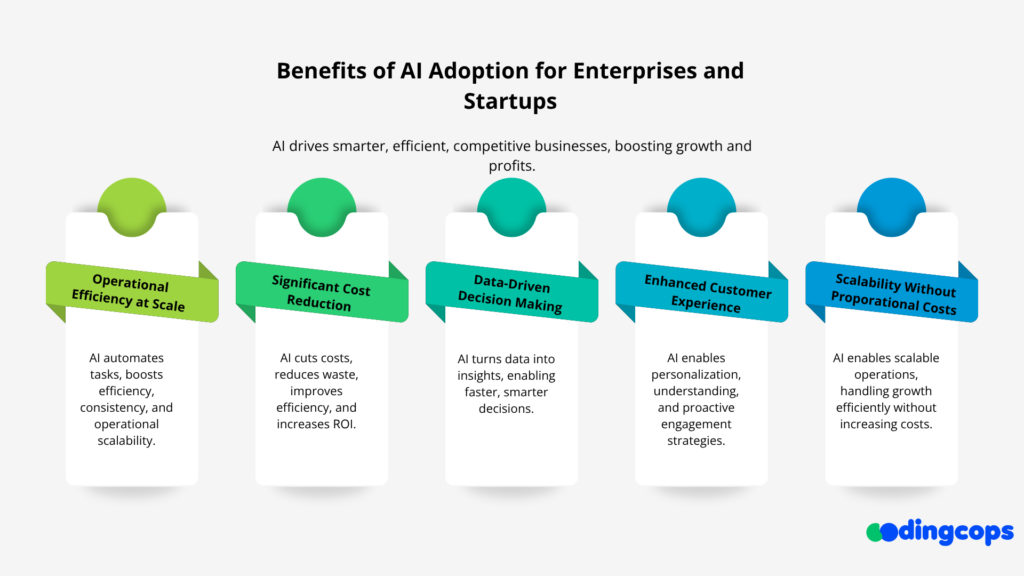
AI adoption is no longer just about innovation; it’s about building a smarter, more efficient, and more competitive business. Whether you are an enterprise managing complex operations or a startup trying to scale, AI offers tangible advantages that directly impact growth and profitability.
Operational Efficiency at Scale
One of the most immediate benefits of AI is its ability to automate repetitive and time-consuming tasks. From processing large datasets to handling routine customer queries, AI reduces the need for manual intervention.
For enterprises, this means streamlining large-scale operations across teams. For startups, it allows small teams to achieve more with limited resources.
This naturally leads to a key CTO-level question: What percentage of our operations can realistically be automated?
In many organizations, the answer is higher than expected, especially in areas like data processing, customer support, and internal workflows.
The real advantage isn’t just automation, but consistency. AI systems perform tasks with minimal errors, improving overall efficiency.
Significant Cost Reduction
AI helps businesses cut costs in multiple ways. Automation reduces labor expenses, predictive maintenance minimizes downtime, and optimized processes eliminate waste.
For example, AI-driven forecasting prevents overproduction in manufacturing, while intelligent chatbots reduce the need for large customer support teams.
But the real question CTOs need to answer is: Where are we currently overspeeding due to inefficiencies? AI often reveals hidden cost leaks that traditional systems fail to identify.
It’s also important to consider long-term savings. While AI implementation requires upfront investment, the operational cost reduction over time often leads to a strong return on investment.
Data-Driven Decision Making
Businesses often struggle not with a lack of data, but with making sense of it. AI changes that by turning raw data into actionable insights.
Predictive analytics can forecast trends and recommend optimal actions. This enables leaders to make faster and more informed decisions.
From a CTO’s standpoint, this raises an important consideration: Are our decisions still based on intuition, or are they backed by data? Organizations that rely on AI insights tend to outperform those that depend solely on traditional analysis.
Enhanced Customer Experience
Customer expectations have evolved significantly, and AI is helping businesses keep up. Personalized recommendations and tailored experiences are now standard expectations.
AI enables businesses to understand customer behavior at a granular level, and how they prefer to interact.
This leads to a critical question: Are we truly understanding our customers, or just reacting to them? AI allows businesses to move from reactive to proactive engagement.
Scalability Without Proporational Costs
One of the biggest challenges for growing businesses is scaling operations without significantly increasing costs. AI solves this problem by enabling systems that can handle increased workloads without requiring proportional resources.
For example, an AI customer support system can manage thousands of queries simultaneously, something that would require a large human team.
CTOs must evaluate: Can our current system handle growth, or will they become bottlenecks? AI provides the flexibility to scale efficiently without compromising performance.
Why Hiring an AI Development Company Makes Sense?
As AI continues to mature, many organizations face a critical decision: build everything in-house or partner with an AI development company. While in-house teams offer control, the reality is that AI implementation is far more complex than traditional software development.
It involves data engineering, model training, MLOps, and continuous optimization. This is exactly where many enterprises and startups struggle, not because they lack vision, but because they lack specialized execution capabilities.
Faster Time-to-Market
One of the biggest advantages of hiring an AI development company is speed. Experienced teams already have frameworks and proven workflows in place.
Instead of starting from scratch, businesses can move directly into solution design and deployment. This significantly reduces development cycles, from months or years to weeks or a few months, depending on complexity.
Access to Specialized AI Expertise
AI is not a single skill, it’s a combination of multiple disciplines including machine learning, deep learning, NLP, and cloud infrastructure.
Hiring and retraining experts across all these domains internally is both expensive and time-consuming. AI development companies already have cross-functional teams with hands-on experience across industries and use cases.
Reduced Risk of Failure
AI projects have a high failure rate when not executed properly. Common reasons include poor data quality, lack of scalability planning, and weak integration with existing systems.
AI development companies reduce these risks by following established best practices, conducting feasibility analysis early, and ensuring proper architecture design from the start.
Stronger Focus on Core Business
Building AI in-house requires significant attention from leadership and infrastructure resources. This can distract organizations from their core business priorities.
By outsourcing AI development, internal teams can focus on product innovation and strategic growth while experts handle the complexity of AI implementation.
Cost Efficiency in the Long Run
At first glance, building an in-house AI team may seem like a long-term investment. However, when factoring in hiring costs, training, and infrastructure setup, the total cost often becomes significantly higher.
AI development companies provide predictable pricing models and reduce wasted effort by leveraging experience from similar projects.
What to Look for in an AI Development Partner?
Choosing an AI development partner is not a typical vendor decision; it’s a strategic move that can directly impact your business outcomes. In 2026, when AI initiatives are tied closely to revenue and competitive advantage, the wrong partner can slow you down, while the right one can accelerate your entire roadmap.
Proven Experience Across Industries and Use Cases
Experience matters, but not just in terms of years. What truly counts is whether the partner has solved real-world problems similar to yours.
An experienced AI company brings practical insights and applies proven approaches instead of relying on trial and error. Therefore, CTOs should ask: Have they worked on use cases similar to ours?
A team that has built fraud detection systems, recommendation engines, or predictive analytics models before will move faster and deliver better results.
Strong Technical Expertise with End-to-End Capabilities
AI development is not just about building models; it’s an end-to-end process that includes:
- Data collection and preprocessing
- Model development and training
- Deployment and integration
- Monitoring and optimization
A reliable partner should be able to handle the entire lifecycle, not just isolated parts of it. Managing multiple vendors often leads to delays and integration issues.
Business Understanding, Not Just Technical Skills
One of the most common reasons AI projects fail is a disconnect between technical execution and business objectives.
A strong AI partner takes the time to understand your business model, challenges, and goals before proposing solutions. They don’t just ask, “What do you want to build?,” they ask, “ What problem are you trying to solve?”
Data Security
AI systems rely heavily on data, often sensitive and business-critical. This makes security and compliance non-negotiable.
Your AI partner should follow best practices for:
- Data encryption and secure storage
- Access control and governance
- Compliance with regulations
Final Words
AI is no longer optional; it’s a strategic necessity. Businesses that apply AI to real problems gain efficiency and a competitive advantage. Success depends on execution, clear use cases, and the right partner. For CTOs, the focus should be on delivering measurable outcomes, not just adopting technology for the sake of innovation.