




Hero Introduction
AI isn’t just about building smarter models; it’s about building smarter systems. Enterprises are shifting from isolated machine learning models to fully integrated AI platforms where data, models, infrastructure, and orchestration work together as a single ecosystem.
This evolution has made AI architecture a core strategic priority. The way systems are designed now directly impacts scalability, cost efficiency, and reliability. In other words, architecture has become as important as the models themselves.
This blog explores the core AI system architectures and platform capabilities, and how they are enabling enterprise-grade intelligence at scale.
Executive Summary
AI systems are built as layered platforms combining data pipelines, model orchestration, deployment infrastructure, and governance frameworks. Success is no longer determined by model accuracy alone but by the strength of the entire system.
This blog covers:
- Core layers of modern AI system architecture
- Essential platform capabilities for scalable AI
- Deployment strategies across cloud, edge, and hybrid systems
- AI orchestration and agent-based systems
What Are AI System Architectures?
AI system architecture refers to how different components of an AI solution are structured and connected to deliver intelligent outcomes at scale. These architectures are modular, distributed, and continuously changing.
Unlike traditional machine learning pipelines that followed a linear flow, modern AI architectures operate as dynamic ecosystems where data, models, and applications interact in real time.
A typical AI system architecture includes four core layers:
Data Layer
The foundation of all AI systems, responsible for collecting, storing, and preparing data. It includes:
- Real-time streaming pipelines
- Batch processing systems
- Data lakes and lakehouse architectures
- Vector databases for embeddings and semantic search
Modern systems prioritize data freshness, context, and accessibility rather than just storage.
Model Layer
This is where intelligence is created. It includes:
- Foundation models
- Fine-tuned domain-specific models
- Multi-modal ensembles working together
Instead of relying on a single model, modern systems dynamically route tasks to the most appropriate models.
Orchestration Layer
This layer connects all components and controls execution flow. It includes:
- AI workflow engines
- Agent-based task execution systems
- Event-driven pipelines
It ensures that the right model, data, and tools are used at the right time.
Infrastructure Layer
This supports compute and deployment needs:
- GPU/TPU clusters for training and inference
- Cloud-native environments
- Edge computing systems for low-latency use cases
- Kubernetes-based container orchestration
This layer ensures scalability and reliability across environments.
What Are the AI Platform Capabilities?
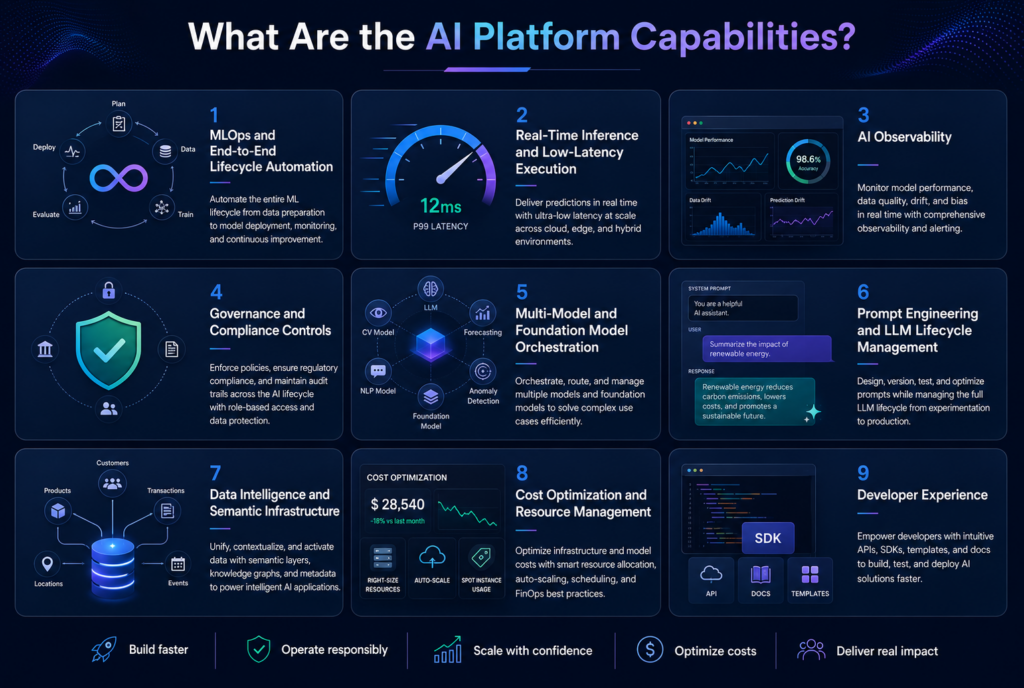
AI platforms have evolved into full-stack operational environments that support the entire lifecycle of intelligent systems, from data ingestion and model training to deployment, monitoring, and continuous optimization.
The real value of these platforms lies in their ability to abstract complexity. Instead of engineers stitching together pipelines and deployment logic manually, AI platforms provide unified capabilities that make systems scalable and production-ready by default.
MLOps and End-to-End Lifecycle Automation
MLOps has matured into a foundational pillar of AI platforms. It’s no longer about simple CI/CD for models; it’s about fully automated intelligence lifecycle management.
Modern AI platforms support:
- Automated data validation and preprocessing pipelines
- Continuous training and retraining based on new data streams
- Automated model evaluation across multiple metrics
- Version control for datasets, models, and prompts
- Safe rollout mechanisms, including canary deployments and instant rollback
This level of automation ensures that AI systems don’t degrade over time. Instead, they continuously evolve with changing data distributions and business requirements.
Real-Time Inference and Low-Latency Execution
One of the most critical capabilities of modern AI platforms is real-time inference. AI is deeply embedded in systems that require immediate responses, such as fraud detection, personalization engines, autonomous systems, and conversational agents.
To support this, platforms provide:
- Sub-second inference pipelines optimized for GPU and specialized hardware
- Streaming data processing for continuous prediction updates
- Event-driven architectures that trigger AI responses instantly
- Load balancing across model replicas for high throughput
Unlike earlier systems, where batch predictions were common, modern AI platforms are designed for continuous inference loops where predictions are generated as data arrives.
AI Observability
As AI systems become more complex, observability has become essential for trust, debugging, and performance optimization. AI platforms now include advanced monitoring systems specifically designed for machine learning workloads.
Some key observability capabilities include:
- Data drift detection: Identifying when incoming data deviates from training distributions
- Model drift monitoring: Tracking degradation in model performance over time
- Latency and throughput tracking: Ensuring systems meet performance SLAs
- Explainability tools: Providing insights into why a model made a specific decision
- Prompt behavior tracking: Monitoring LLM inputs and outputs for consistency
This layer is critical because AI systems are probabilistic by nature. Without observability, issues can remain hidden until they impact users or business outcomes.
Governance and Compliance Controls
With AI now deeply embedded in enterprise decision-making, governance has become a first-class capability in AI platforms.
Moreover, platforms are designed with built-in compliance and security frameworks that include:
- Fine-grained access control for models, data, and APIs
- Data encryption at rest and in transit
- Audit logs for all model interactions and predictions
- Policy enforcement for responsible AI usage
- Compliance alignment with regulations
This is especially important for industries like healthcare, finance, and government, where AI decisions must be transparent and auditable.
Multi-Model and Foundation Model Orchestration
Modern AI platforms rarely rely on a single model. Instead, they orchestrate multiple models, each optimized for specific tasks, domains, or performance requirements.
Its capabilities include:
- Routing requests dynamically to the most suitable model
- Combining large language models with smaller specialized models
- Integrating open-source and proprietary models within the same workflow
- Managing fallback systems when primary models fail or exceed latency limits
This approach improves efficiency and reduces cost, as smaller models can handle simpler tasks while larger foundation models are reserved for complex reasoning.
Prompt Engineering and LLM Lifecycle Management
With the dominance of large language models, prompt engineering has become a critical platform capability.
Modern AI platforms now treat prompts as structured assets that require:
- Versioning and testing across different model versions
- A/B testing for prompt performance optimization
- Prompt templates for reusable workflows
- Safety filters to prevent hallucinations or unsafe outputs
This has led to the emergence of prompt lifecycle management, where prompts are continuously refined, evaluated, and deployed much like traditional software components.
Data Intelligence and Semantic Infrastructure
AI platforms are increasingly built around semantic understanding of data rather than just structured storage.
Its capabilities include:
- Vector databases for embedding-based search and retrieval
- Retrieval-Augmented Generation pipelines
- Real-time indexing of unstructured data
- Unified data access layers combining structured and unstructured sources
This allows AI systems to understand enterprise knowledge rather than simply process raw data.
Cost Optimization and Resource Management
Running large-scale AI systems is expensive, especially with high-frequency inference workloads. Modern platforms include built-in optimization capabilities such as:
- Dynamic scaling of compute resources based on demand
- Model quantization and compression techniques
- Intelligent caching of frequent queries
- Workload prioritization based on business value
These features help organizations balance performance with cost efficiency, ensuring that AI systems remain economically sustainable at scale.
Developer Experience
Another defining capability of AI platforms is the focus on developer experience. Platforms are designed to reduce friction in building and deploying AI systems.
This includes:
- Low-code and no-code AI pipeline builders
- SDKs for rapid integration into applications
- Pre-built templates for common AI use cases
- Unified dashboards for model training, deployment, and monitoring
The goal is to make AI development more accessible while still supporting advanced engineering use cases.
Deployment Architectures for Scalable AI Systems
Deploying AI systems at scale is fundamentally different from traditional software deployment. Unlike conventional applications, AI systems are dynamic and continuously evolving. This means deployment is no longer a one-time release event; it’s an ongoing lifecycle of serving, monitoring, updating, and optimizing models in production.
Cloud-Native AI Deployment
Cloud-native deployment remains the most widely adopted architecture for AI systems due to its flexibility, scalability, and ecosystem maturity.
In this approach, AI models are deployed on cloud infrastructure using containerized environments and managed services. This enables teams to scale workloads up or down based on demand without worrying about underlying hardware constraints.
Some key characteristics include:
- Containerized deployments using Kubernetes-based orchestration
- Elastic scaling of GPU and CPU resources
- Managed AI services for model hosting and inference
- Centralized monitoring and logging systems
- Easy integration with data storage and pipeline services
Cloud-native deployment is especially effective for:
- Large-scale training workloads
- Batch inference systems
- Enterprise analytics and recommendation engines
However, while cloud environments offer scalability, they may introduce latency challenges for real-time applications if not properly optimized.
Edge AI Deployment
Edge AI deployment brings intelligence closer to where data is generated. Instead of sending data to the cloud, models are deployed directly on devices or local edge servers.
This architecture is critical for applications where latency, bandwidth, or privacy is a constraint.
Some common use cases include:
- Autonomous vehicles and drones
- Smart manufacturing systems
- IoT-enabled devices and sensors
- Mobile AI applications
Some benefits of edge deployment include:
- Ultra-low latency decision-making
- Reduced dependency on cloud connectivity
- Enhnaced data privacy and security
- Lower bandwidth usage
However, edge deployment introduces constraints such as limited compute power, memory restrictions, and the need for lightweight model optimization techniques like quantization and pruning.
Hybrid AI Deployment Architectures
Hybrid deployment combines the strengths of both cloud and edge systems, creating a balanced and flexible architecture.
In this model:
- Heavy computation tasks are handled in the cloud
- Real-time or latency-sensitive tasks are executed at the edge
This architecture is increasingly becoming the default choice for enterprise AI systems because it optimizes for performance, cost, and scalability simultaneously.
Some key features include:
- Distributed model serving across environments
- Seamless data synchronization between edge and cloud
- Dynamic workload routing based on latency and cost
- Centralized governance with decentralized execution
Hybrid systems are especially useful in industries like healthcare, retail, and logistics where both real-time responsiveness and centralized intelligence are required.
Multi-Region Deployment Strategies
As AI systems become global, organizations must ensure availability, compliance, and performance across different regions.
Multi-region deployment architectures address this by distributing AI workloads across multiple cloud regions worldwide.
Some advantages include:
- Reduced latency for global users through geographic proximity
- High availability through failover systems
- Compliance with data residency regulations
- Load balancing across regions for optimal performance
In this setup, data and models may be replicated or selectively synchronized across regions depending on regulatory and operational requirements.
Serverless AI Deployment Architectures
Serverless AI deployment is gaining traction for event-driven and lightweight inference workloads.
In this model, AI functions are executed on demand without managing underlying infrastructure. The platform automatically allocates resources when a request is made and scales down when idle.
Its benefits are:
- Pay-per-use cost efficiency
- Automatic scaling during traffic spikes
- Reduce operational overhead
- Fast deployment cycles for experimental models
Serverless architectures are particularly useful for:
- API-based inference services
- Chatbots and conversational agents
- Lightweight prediction tasks
However, they may not be ideal for high-throughput or low-latency systems due to cold start delays.
What Are AI Orchestration and Agent-Based Systems?
AI orchestration and agent-based systems represent one of the most important shifts in how intelligent applications are built and operated. Instead of relying on a single model performing isolated tasks, modern AI systems are increasingly structured as coordinated networks of models, tools, and autonomous agents working together to complete complex objectives.
AI Orchestration
AI orchestration refers to the coordination layer that manages how different AI components interact and execute tasks across a system. It acts as the control plane for AI workloads, ensuring that data flows, model calls, and tool usage happen in the correct sequence and context.
In modern enterprise systems, orchestration typically manages:
- Routing tasks to appropriate models
- Managing multi-step AI workflows
- Coordinating data retrieval and processing pipelines
- Handling dependencies between models and external tools
- Ensuring reliability, retries, and fallback execution
Rather than treating AI as a single funciton call, orchestration systems treat it as a workflow of interconnected steps. This enables more complex reasoning pipelines, especially for enterprise use cases like analytics, automation, and decision support.
Agent-Based AI Systems
Agent-based systems take orchestration a step further by introducing autonomy. Instead of simply executing predefined workflows, AI agents can independently plan and carry out tasks to achieve a goal.
An AI agent typically includes:
- Perception layer: Understands inputs
- Reasoning layer: Breaks down goals into steps
- Action layer: Execute tasks using tools, APIs, or other models
- Memory layer: Stores context and learns from past interactions
This architecture enables agents to operate with a degree of independence, making decisions dynamically rather than following rigid instructions.
Multi-Agent Systems
One of the most powerful developments is the emergence of multi-agent systems, where multiple specialized agents collaborate to solve complex problems.
Instead of a single general-purpose agent, systems are divided into specialized roles such as:
- Data collection agents
- Analysis agents
- Planning agents
- Execution agents
- Validation and compliance agents
These agents communicate and coordination with each other, often through an orchestration layer that manages task distribution and synchronization.
These agents communicate and coordinate with each other, often through an orchestration layer that manages task distribution and synchronization.
This structure mirrors human organizations, where different roles contribute to a shared objective. The result is improved efficiency, modularity, and scalability.
Multi- agent systems are particularly useful in:
- Lage-scale business automation
- Supply chain optimization
- Financial modeling and forecasting
- Customer support ecosystems
Tool-Using AI and Function Calling
A defining feature of modern agent-based systems is their ability to use external tools. Instead of relying solely on internal knowledge, agents can interact with APIs, databases, search engines, and enterprise software.
This capability is often enabled through function calling, where models are trained or configured to:
- Identify when a tool is needed
- Select the appropriate function
- Format structured requests
- Interpret returned results
For example, an AI agent might:
- Query a CRM system for customer data
- Pull live financial information from an API
- Execute a database query
- Trigger a workflow in a business application
This transforms AI from a passive responder into an active participant in enterprise workflows.
Memory and Context Management in Agents
AI agents require memory to maintain context across tasks and sessions. Modern systems implement multiple types of memory:
- Short-term memory: Maintains context within a session
- Long-term memory: Stores persistent knowledge across interactions
- Episodic memory: Tracks past actions and outcomes
- Semantic memory: Stores structured knowledge about entities and relationships
Effective memory management allows agents to:
- Learn from past interactions
- Maintain continuity in long-running tasks
- Personalize outputs based on use history
- Improve decision-making over time
However, managing memory at scale introduces challenges in storage efficiency, privacy, and relevance filtering.
Final Words
AI is defined by integrated architectures, advanced platform capabilities, and intelligent orchestration. Success now depends on building cohesive systems rather than isolated models. Organizations that align data, models, infrastructure, and agents into unified platforms will provide greater efficiency and long-term value from their AI investments.