




The market for AI development is expected to reach over $800 billion over the next four years, according to statistics. This is a result of businesses realizing more and more how AI can improve operations and produce smarter products faster. But creating AI solutions is not without its difficulties. Despite the potential, many companies struggle to finish AI projects on time.
In reality, AI projects are often more complex than regular software development projects. They demand current models, high quality data, and careful alignment with company goals. The project experiences delays or poor performance when any of these elements are mishandled.
In this guide, we will discuss how AI development impacts product delivery. We will also discuss common AI development mistakes that increase cost and delay delivery.
How Does AI Development Impact Product Delivery?
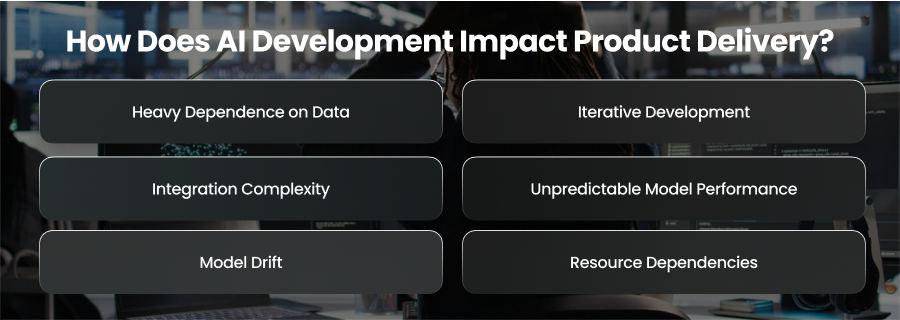
Heavy Dependence on Data
AI models are fundamentally dependent on the quality and diversity of data. Poor or incomplete data can derail a project before it even begins. Data preparation frequently takes up a large amount of project time for teams.
For instance, inconsistent sensor readings or missing logs might make it difficult for models to forecast problems in a predictive maintenance AI project for industrial equipment. The entire development process is affected by the delays brought on by data problems. This affects testing and deployment timelines.
Iterative Development
Unlike conventional software, which follows a more deterministic development path, AI development is inherently experimental. Model development sometimes takes multiple testing iterations to achieve acceptable accuracy.
Depending on the volume of data and the complexity of the model, each iteration may take days or even weeks. Teams frequently discover that their initial model performs poorly. It also necessitates modifications to feature engineering or even model architecture. This iterative nature introduces uncertainty into the delivery schedule. This makes it difficult to predict exactly when the AI solution will be production ready.
Integration Complexity
Rarely do AI solutions function independently. They must function flawlessly with the implemented processes. Furthermore, because older platforms might not be compatible, incorporating AI into legacy systems could be difficult.
For example, real time data pipelines and frontend integration are equally important as the model when implementing an AI recommendation engine on an eCommerce site. If not carefully prepared, any of these elements may cause delays. Hence, it can impact overall product delivery timelines.
Unpredictable Model Performance
AI outcomes are probabilistic rather than deterministic. Models may exhibit unpredictable behavior when exposed to fresh data in production, despite meticulous development. Additional testing or fine tuning may be required due to this unpredictability.
For instance, when used in a real world setting, an AI fraud detection system may produce a significant number of false positives while performing well on historical data. Iterative changes are frequently needed to close these performance gaps, which increases delivery time.
Model Drift
AI models degrade over time due to changes in underlying data patterns. We call this model drift. In order to preserve accuracy, ongoing monitoring and optimization are crucial.
Furthermore, ignoring these continuous needs may cause unanticipated delays in updates or improvements to the product. If teams don’t prepare for maintenance, they can end up going over the project again.
Resource Dependencies
AI development requires specialized skills. Data science and machine learning engineering fall under this category. As a result, finding the proper people can be difficult, particularly for those with short deadlines. Lack of resources can prolong delivery timelines and hinder development cycles.
10 AI Development Mistakes That Can Increase Cost and Delay Delivery.

Underestimating the Importance of Data Quality
Data quality is the backbone of any AI solution, yet it’s often treated as a secondary concern. In reality, poor data might take up a large portion of the project schedule.
Inaccurate models that need constant retraining and improvement are the result of incomplete or inconsistent data. Teams may need to gather more datasets or change functionality if they find later in the project that their data does not accurately reflect real world circumstances.
Overengineering the AI Solution
Selecting extremely complicated models when more straightforward methods would be enough is another frequent error. Although deep learning models are remarkable, they are not always required.
Overengineered solutions increase computational costs and maintenance complexity. They also require specialized expertise, making it harder to troubleshoot or scale the system later. In many cases, simpler machine learning models can deliver comparable results with faster deployment and lower long term costs.
Selecting the Wrong Technology Stack
Early stage technological choices have long term effects. Selecting mismatched stacks or experimental frameworks might cause major problems later on.
When the selected stack fails to scale or integrate with existing systems, teams may need to architect major components of the solution again. This rework is costly and disruptive to delivery schedules. A poorly chosen tech stack can turn a promising AI project into a maintenance burden.
Ignoring Production Readiness
Many AI models perform well in controlled development environments but fail under real world conditions. Ignoring scalability and production constraints is a frequent cause of delayed launches.
Issues like as long inference times and problematic deployments frequently appear only during production testing. Addressing these flaws late in the process involves extensive reengineering, increasing time to market.
Treating Deployment as an Afterthought
AI deployment is not a simple push to production step. Models require specialized deployment pipelines and rollback mechanisms.
When deployment planning is delayed, teams face bottlenecks related to environment configuration and model versioning. Errors and delays are further increased by manual deployment procedures. Additionally, inadequate MLOps procedures can lead to longer release cycles and increased operating expenses.
Poor Collaboration Between Teams
Building AI applications requires strong collaboration between different teams. Technically sound models may be produced by technical teams, but they may not meet user or commercial needs. Rework and more testing result from this disconnect. Additionally, maintaining timely and cost effective AI initiatives requires open communication and shared ownership.
Not Looking After Model Drift
Deploying an AI model is not the end. Model performance deteriorates and user behavior shifts with time. Additionally, companies that don’t budget for regular maintenance and model drift frequently experience unexpected performance problems that call for quick repairs. The delivery schedules for upcoming improvements are thrown off by these unforeseen interventions. Proactive maintenance strategies can ensure consistent performance.
Overlooking Security Requirements
In AI projects, security and compliance are frequently neglected, particularly when teams prioritize functionality and performance. This oversight may be expensive.
Late stage compliance reviews may reveal problems with data privacy. In addition, these problems often require redesigning data pipelines or making architectural changes. Therefore, addressing security early prevents delays and protects organizations from risks.
Treating AI Development as a One-Time Project
Many organizations treat AI as a one off initiative rather than an ongoing project. This mindset limits long term success and increases hidden costs.
AI systems must be regularly updated and adjusted in order to remain successful. Without a plan, teams struggle to adapt the model to fresh data. Therefore, addressing AI as a continuous project guarantees long term benefit and more seamless iterations.
Failing to Validate AI Outputs
Delaying user validation till the very end of the project lifecycle is a frequent but frequently disregarded error in AI development. Teams may overlook how consumers truly engage with AI results in favor of concentrating primarily on model correctness and technical metrics.
After deployment, the product encounters resistance or even rejection if AI forecasts or automated choices don’t match user expectations or procedures. Fixing usability issues late requires redesigning interfaces or retraining models with new feedback loops.
Best Practices for AI Development
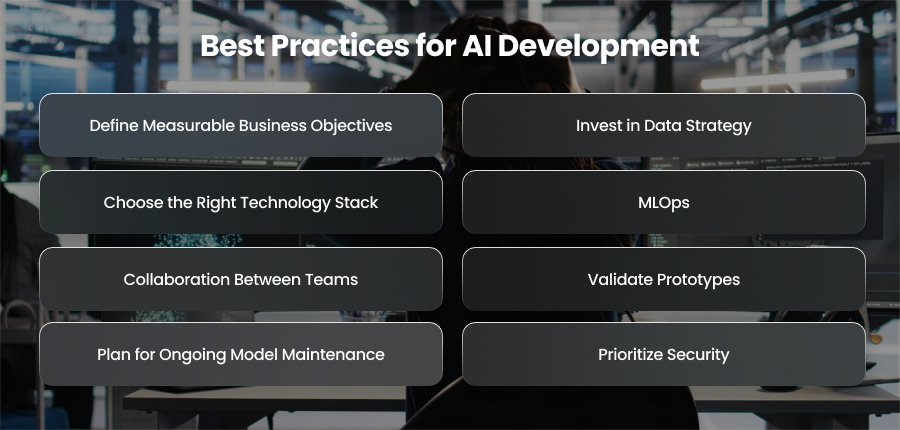
Define Measurable Business Objectives
AI projects must begin with a well defined problem statement and measurable business outcomes. Teams may waste time experimenting with various models or features that don’t address the real demand if they don’t have clear goals. Every level of development is focused and coordinated when the business case and anticipated results are well defined. These quantifiable goals also aid in controlling stakeholder expectations. This guarantees that the finished AI system will provide actual value rather than turning into an aimless technological endeavor.
Invest in Data Strategy
Any AI system is built on data, and many of the delays and inefficiencies that afflict AI projects may be avoided by investing in a data strategy early on. Organizations must emphasize gathering representative and high quality data while setting up procedures for managing and cleansing it. Strong data governance also minimizes prejudice and guarantees consistency. Teams may prevent recurring training and unforeseen performance problems by addressing data quality early on.
Choose the Right Technology Stack
The technology stack chosen at the beginning of the project has a significant impact on how well the AI system is developed. Teams must select infrastructure that works with existing systems. Furthermore, models can handle increasing user loads without requiring a complete rebuild thanks to a scalable technology stack.
MLOps
MLOps is essential for reducing friction in the AI development lifecycle since it incorporates automation and version control in model deployment. Automated pipelines offer uniformity across many settings. Additionally, teams can quickly detect model drift before it becomes a serious issue thanks to real time monitoring.
Collaboration Between Teams
The success of AI depends on teamwork since each team brings unique insights to the table. When these teams operate independently, there will unavoidably be mistaken expectations. Delays and needless rework might result from this. All teams are guaranteed to comprehend the project’s objectives and dependencies through regular communication and collaborative planning meetings. Strong collaboration results in AI solutions that are both practically useful.
Validate Prototypes
Early user validation is essential to ensuring that an AI system functions well in situations that are actual. Teams should get input early in the development process rather than waiting until the very end to see how customers interact with the product. Long before they become costly to fix, this early assessment finds usability problems or process inefficiencies. Additionally, by incorporating consumer input early on, businesses reduce rework.
Plan for Ongoing Model Maintenance
Over time, data patterns shift, and models’ performance is impacted by outside variables. Organizations must plan for continuous monitoring and optimization to keep models accurate and relevant. Long term performance stability is ensured by putting procedures in place for identifying model drift and planning retraining. Therefore, preventive maintenance avoids abrupt performance declines that can interfere with operations or necessitate quick fixes.
Prioritize Security
AI development must prioritize security and compliance. AI systems often use sensitive data. Strict security measures are necessary to stop leaks and illegal access. Early adoption of audit procedures and encryption helps save costly redesigns. Therefore, addressing compliance early on ensures that the AI system maintains user confidence during deployment and operation and conforms with industry specific rules.
Final Words
AI development is really beneficial, but only when it is carried out with careful planning and strategy. Teams may cut expenses and enhance product results by avoiding typical blunders and adhering to best practices. To be competitive, successful algorithms for AI need to be clear and constantly improving.