




Agentic AI is an advanced form of AI that can autonomously plan, reason, make decisions, and complete multi-step tasks to achieve a goal. Unlike traditional chatbots, which simply answer questions based on user prompts, Agentic AI can retain context, use external tools, interact with software systems, and adapt its actions to changing conditions. This allows businesses to automate entire workflows instead of isolated conversations.
AI has evolved rapidly over the past few years. Businesses have moved from simple rule-based chatbots to AI assistants powered by large language models, and now many organizations are exploring autonomous AI systems capable of managing complex business processes.
However, many companies still confuse chatbots, AI assistants, AI agents, and Agentic AI. While these technologies share similar foundations, they differ significantly in their level of autonomy, reasoning ability, and workflow execution.
Instead of simply responding to prompts, Agentic AI can define action plans, interact with multiple business applications, monitor outcomes, and adjust its decisions without requiring continuous human intervention.
In this guide, you will learn what Agentic AI is, how it works, how it compares with other AI systems, its business benefits, common use cases, implementation challenges, and practical steps for adopting it successfully.
What Is Agentic AI?
Agentic AI refers to AI systems designed to pursue objectives independently rather than simply generating responses. These systems combine reasoning, planning, memory, decision-making, and tool usage to complete complex tasks from beginning to end.
Unlike traditional AI applications that require users to direct every interaction, Agentic AI continuously evaluates progress, chooses the next best action, and adapts when conditions change.
Its core characteristics include:
- Goal-oriented behavior
- Multi-step reasoning
- Long-term memory
- Tool and API integration
- Autonomous decision-making
- Continuous monitoring and adaptation
Traditional AI often performs one task at a time, such as answering questions or generating text. Agentic AI coordinates multiple tasks across systems, making it suitable for real business operations.
Businesses are adopting Agentic AI because it reduces manual coordination, accelerates workflows, improves operational efficiency, and enables employees to focus on higher-value work instead of repetitive administrative tasks.
Key Takeaway: Agentic AI autonomously plans, reasons, and executes multi-step workflows using memory, tools, and intelligent decision-making instead of simply responding to prompts.
How Does Agentic AI Work?
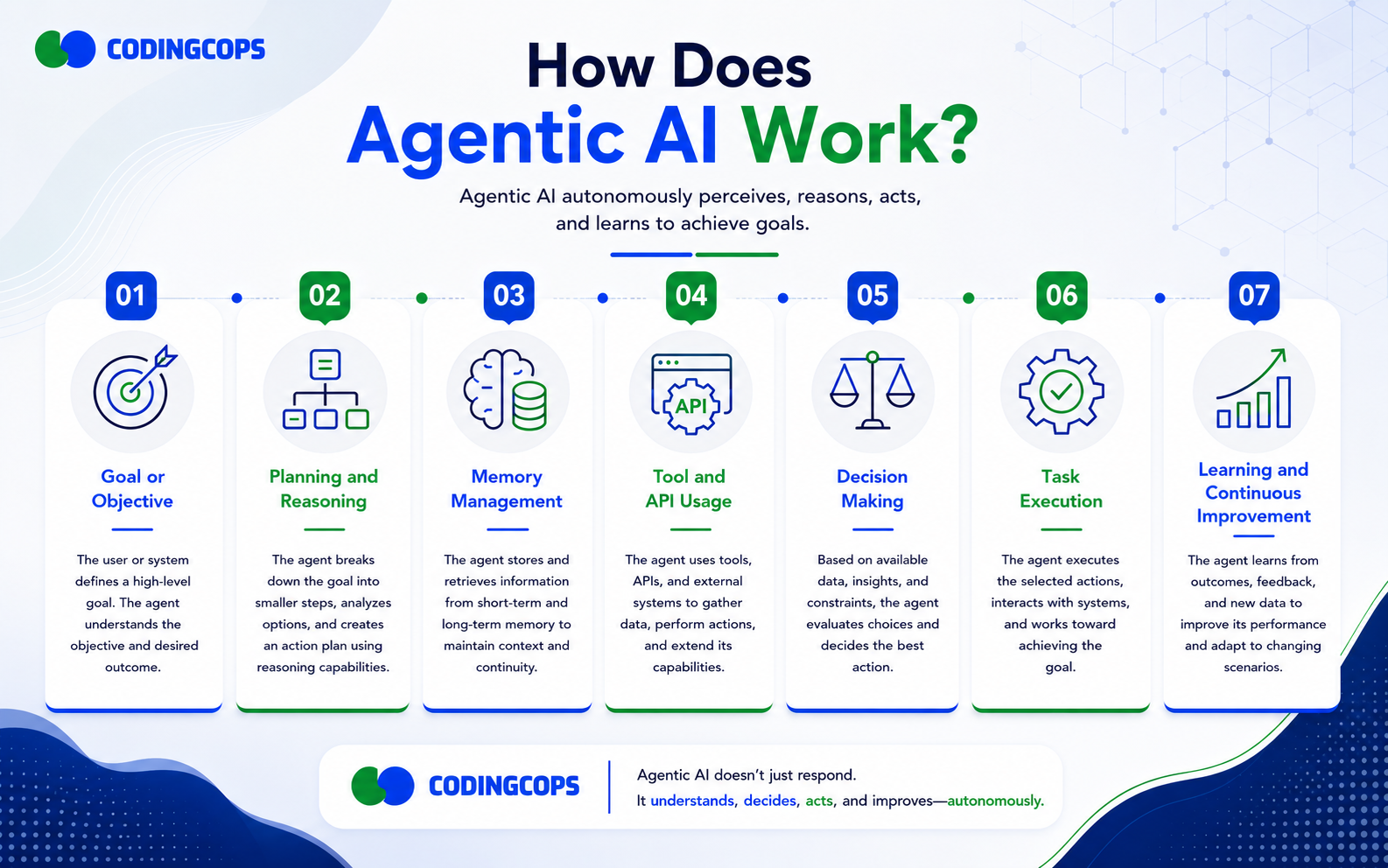
Agentic AI operates through a sequence of coordinated processes that transform a business objective into completed actions.
Goal or Objective
Every workflow begins with a clearly defined objective.
Examples include:
- Resolve a customer complaint
- Process an insurance claim
- Schedule interviews
- Generate weekly executive reports
- Monitor cybersecurity threats
The AI understands the desired outcome before deciding how to achieve it.
Planning and Reasoning
Rather than executing the first available action, Agentic AI creates a logical plan.
It breaks large objectives into smaller subtasks, evaluates dependencies, prioritizes actions, and determines the most efficient execution path. Reasoning enables the system to adapt when unexpected situations occur instead of following rigid workflows.
Memory Management
Memory allows Agentic AI to retain relevant information across interactions.
It can remember:
- Previous conversations
- Customer preferences
- Business policies
- Workflow history
- Earlier decisions
- Task progress
This persistent context enables more consistent and personalized decision-making.
Tool and API Usage
Agentic AI extends its capabilities by interacting with external applications.
Common integrations include:
- CRM platforms
- ERP systems
- Email services
- Databases
- Document repositories
- Payment gateways
- Calender systems
- Internal business applications
Instead of generating instructions, the AI performs the required actions directly.
Decision Making
Agentic AI evaluates available information before selecting the next action.
It considers:
- Business rules
- Confidence scores
- Historical outcomes
- Organizational policies
- Current workflow status
Human approval can be incorporated whenever required for sensitive decisions.
Task Execution
Once decisions are made, the system executes actions automatically.
Examples include:
- Updating CRM records
- Creating invoices
- Sending emails
- Scheduling meetings
- Opening support tickets
- Triggering workflows
- Generating reports
Learning and Continuous Improvement
Modern Agentic AI systems continuously improve through monitoring and feedback.
Performance metrics help identify:
- Failed tasks
- Workflow bottlenecks
- Decision accuracy
- Response quality
- Automation opportunities
This allows organizations to refine workflows over time.
Agentic AI vs Chatbots vs AI Assistants vs AI Agents
Although these terms are often used interchangeably, they represent different levels of intelligence and autonomy.
Traditional Chatbots
Traditional chatbots rely on predefined rules or scripted conversations. They answer common questions but cannot reason, plan, or complete business workflows.
AI Assistants
AI assistants use large language models to understand natural language and generate intelligent responses. They help users perform tasks but still depend heavily on user guidance.
AI Agents
AI agents can perform individual tasks using external tools and limited planning. They automate specific workflows but often operate within narrow boundaries.
Agentic AI
Agentic AI combines planning, reasoning, memory, tool integration, monitoring, and autonomous decision-making but often operates within narrow boundaries.
| Feature | Chatbots | AI Assistants | AI Agents | Agentic AI |
|---|---|---|---|---|
| Primary Purpose | Answer questions | Assist users | Perform tasks | Achieve business goals |
| Autonomy | Low | Low | Medium | High |
| Planning | No | Limited | Moderate | Advanced |
| Multi-Step Execution | No | Limited | Yes | Extensive |
| Memory | Minimal | Short-term | Moderate | Persistent |
| Tool Integration | Limited | Yes | Yes | Extensive |
| Decision-Making | Rule-based | User-guided | Conditional | Autonomous |
| Human Supervision | Constant | Frequent | Moderate | Configurable |
| Typical Business Use | FAQs | Productivity | Task automation | End-to-end workflow automation |
Why Agentic AI Matters for Businesses?
Workflow Automation
According to stats, 40% of enterprise applications are expected to include AI agents by this year. Agentic AI automates complete business processes rather than isolated activities, reducing repetitive manual work and minimizing delays caused by human coordination.
Operational Efficiency
Organizations can reduce operational costs by allowing AI to manage repetitive administrative tasks while employees focus on strategic initiatives.
Faster Decision-Making
By analyzing data across multiple systems simultaneously, Agentic AI enables quicker and more consistent decisions than manual workflows.
Improved Customer Experience
Customers receive faster responses, proactive updates, and personalized interactions because the AI can access historical context and complete requests without multiple handoffs.
Employee Productivity
Instead of spending hours switching between applications, employees can delegate routine workflows to autonomous AI systems.
Scalability
Agentic AI can handle thousands of concurrent workflows with consistent performance, making it easier to scale operations as demand grows.
Real-World Business Use Cases for Agentic AI
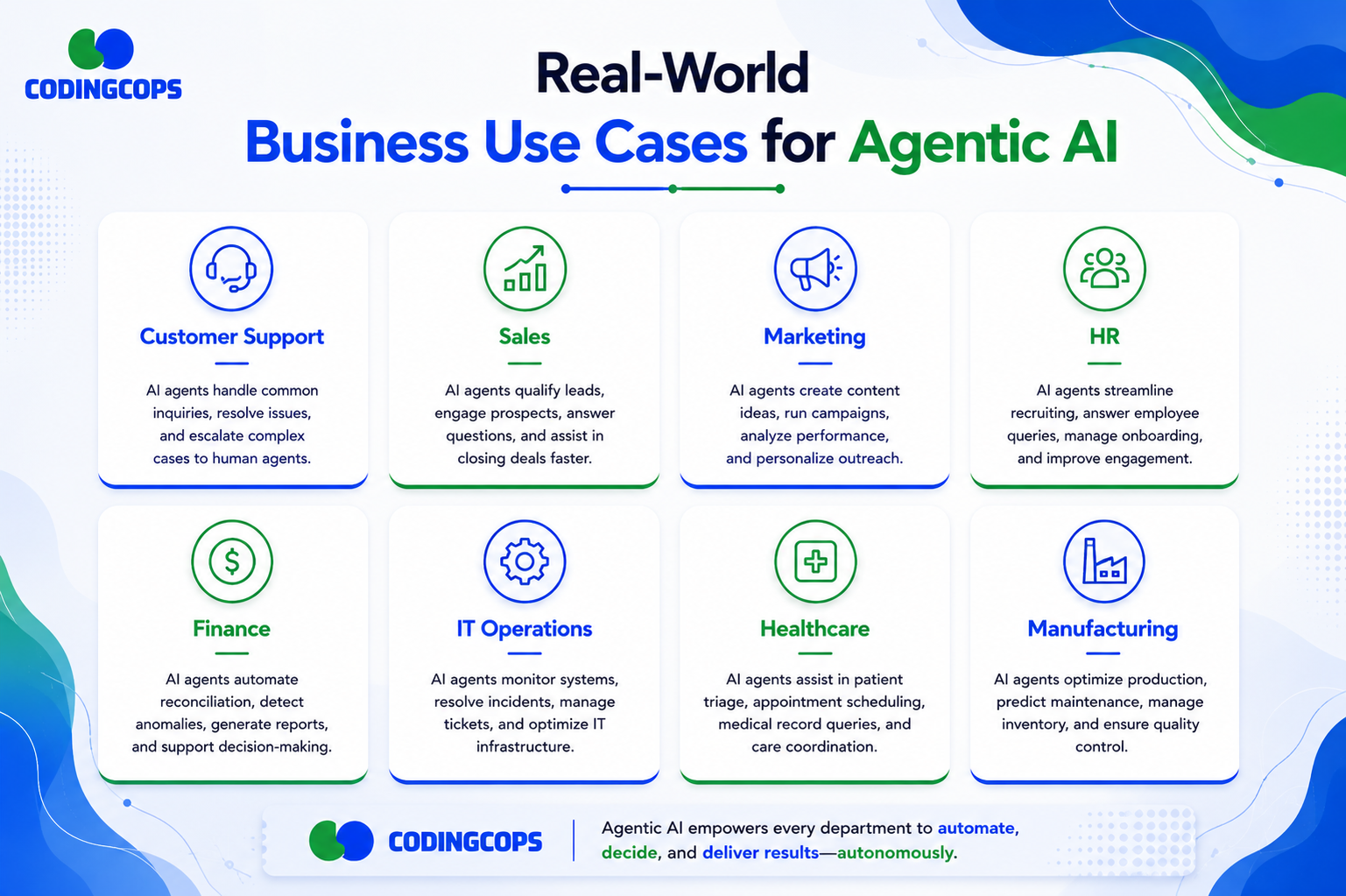
Customer Support
Agentic AI can resolve support tickets, verify customer information, update CRM records, process refunds, and follow up automatically.
Sales
Sales teams use Agentic AI to qualify leads, schedule meetings, update pipelines, prepare proposals, and manage customer communications.
Marketing
Marketing teams automate campaign creation, audience segmentation, performance analysis, and personalized content recommendations.
HR
HR teams streamline candidate screening, interview scheduling, onboarding, document collection, and employee support.
Finance
Finance teams automate invoice processing, expense approvals, fraud detection, financial reporting, and payment reconciliation.
IT Operations
IT teams use Agentic AI for incident response, system monitoring, ticket routing, software deployment, and infrastructure management.
Healthcare
Healthcare providers automate appointment scheduling, patient communication, clinical documentation, and administrative workflows while maintaining appropriate human oversight.
Manufacturing
Manufacturers improve production planning, predictive maintenance, inventory optimization, and quality assurance through autonomous workflow management.
| Business Function | Agentic AI Use Case | Business Outcome |
|---|---|---|
| Customer Support | Ticket resolution | Faster service |
| Sales | Lead qualification | Higher conversions |
| Marketing | Campaign optimization | Improved ROI |
| HR | Recruitment automation | Faster hiring |
| Finance | Invoice processing | Reduced manual effort |
| IT | Incident management | Improved uptime |
| Healthcare | Patient coordination | Better care delivery |
| Manufacturing | Predictive maintenance | Reduced downtime |
Benefits of Agentic AI
Organizations investing in Agentic AI often realize benefits than extend well beyond simple automation.
Some important advantages include:
- Autonomous decision-making across business workflows
- End-to-end execution without constant supervision
- Reduced manual coordination between teams
- Highly personalized customer experiences
- Faster operational processes
- Continuous workflow optimization
- Better visability through monitoring and analytics
- Improved consistency and compliance
- Increased employee productivity
- Lower operational costs over time
Challenges and Risks of Agentic AI
Security and Access Control
AI systems often require access to multiple enterprise applications. Organizations must carefully manage permissions using least-privilege principles.
AI Hallucinations
Even advanced models can generate inaccurate outputs. Validation mechanisms and human review remain important for high-risk processes.
Governance and Compliance
Organizations need clear policies defining acceptable AI behavior, decision boundaries, audit logging, and regulatory compliance.
Human Oversight
Critical decisions involving legal, financial, or healthcare outcomes should include human approval before execution.
Data Privacy
Sensitive customer information must be protected through encryption, access controls, and compliance with privacy regulations.
Cost and Infrastructure
Building reliable Agentic AI systems involves investments in models, orchestration platforms, monitoring, infrastructure, and ongoing optimization.
Monitoring and Observability
Continuous monitoring helps organizations identify failures, improve workflows, detect anomalies, and maintain reliable performance.
Is Agentic AI Right for Your Business?
Not every business process requires full autonomy.
Consider these questions:
- Are your workflows repetitive?
- Do tasks involve multiple software systems?
- Is decision-making largely rule-based?
- Do employees spend excessive time coordinating work?
- Can approvals be clearly defined?
- Are workflow outcomes measurable?
Decision Framework
| Question | Yes | No |
| Are workflows repetitive? | ||
| Multiple systems involved? | ||
| Rule-based decisions? | ||
| Manual coordination? | ||
| Approval process exists? |
How to Get Started with Agentic AI?
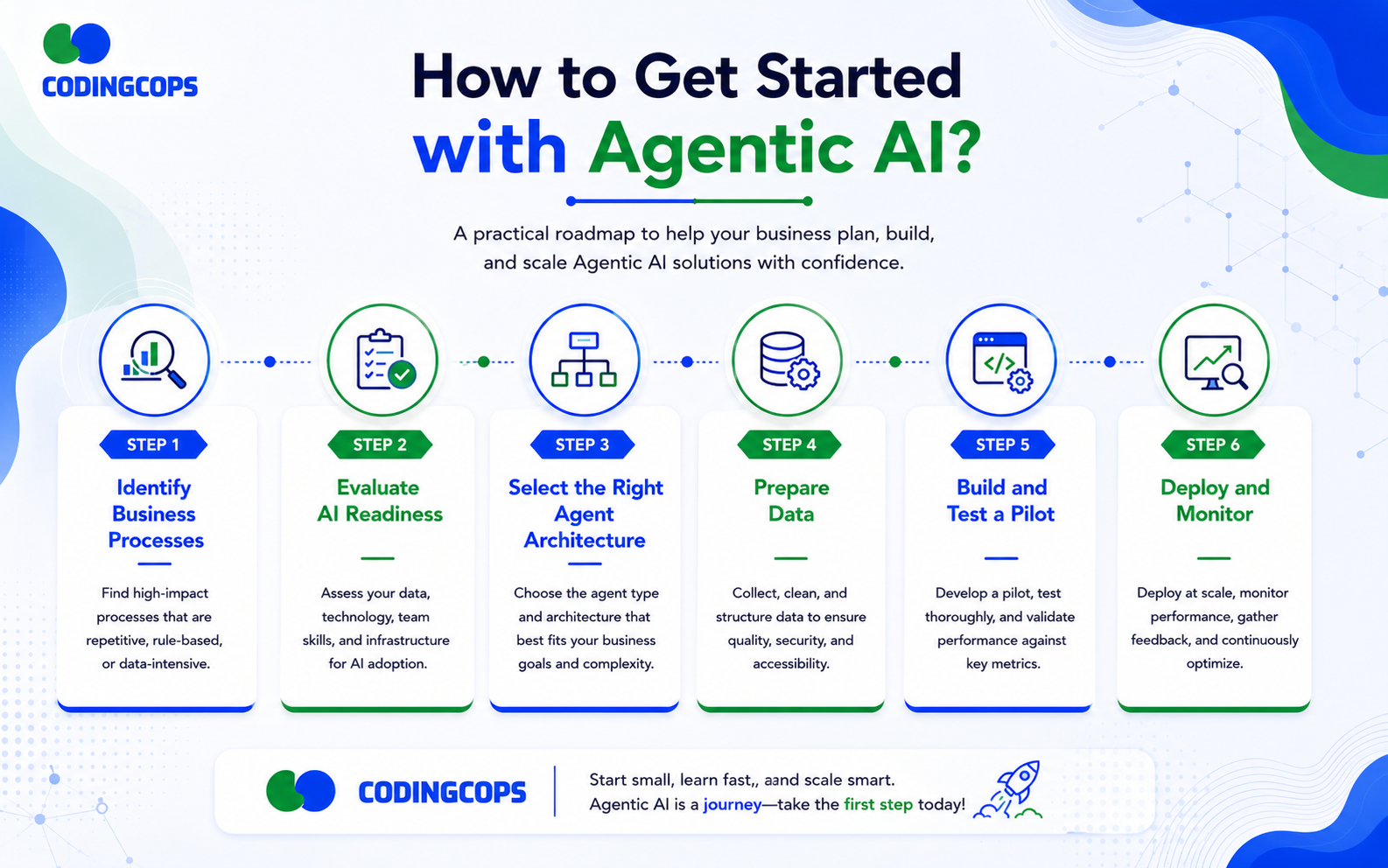
Implementing Agentic AI successfully requires more than choosing a large language model or deploying an AI platform. Organizations need a structured approach that aligns AI capabilities with business objectives, ensures data quality, and establishes governance from the beginning. Starting with a focused pilot and scaling gradually helps reduce risk while delivering measurable business value.
Step 1: Identify Business Processes
The first step is determining where Agentic AI can create the greatest impact. Rather than attempting to automate every business function, focus on processes that are repetitive, time-consuming, and involve multiple steps or systems.
Look for workflows where employees spend significant time on manual coordination, such as processing customer requests, managing approvals, updating multiple applications, or preparing reports. These processes often involve predictable decision-making and benefit from automation.
When evaluating potential use cases, consider:
- Frequency of the task
- Time spent completing it
- Number of systems involved
- Potential cost savings
- Customer or employee impact
- Ease of measuring success
Prioritizing high-value, low-risk workflows allows organizations to achieve quick wins while building confidence in Agentic AI.
Step 2: Evaluate AI Readiness
Before building an AI agent, assess whether your organization has the necessary technical and operational foundations.
An AI readiness assessment should examine your existing infrastructure, data quality, integration capabilities, security policies, and governance framework. Even the most advanced AI models cannot perform effectively if they rely on incomplete, outdated, or inconsistent information.
Some important areas to evaluate include:
- Availability of structured and unstructured data
- Existing APIs and system integrations
- Cloud infrastructure and computing resources
- Security and access controls
- Compliance requirements
- Internal AI expertise
- Business process documentation
Identifying gaps early helps reduce implementation delays and ensures the project starts on a solid foundation.
Step 3: Select the Right Agent Architecture
The architecture determines how your Agentic AI system will reason, access information, interact with business applications, and execute tasks. Choosing the right architecture is essential for achieving reliability, scalability, and security.
Simple workflows may only require a single AI agent with access to a few tools. More complex enterprise environments often benefit from multi-agent architectures, where specialized agents collaborate to complete different parts of a workflow.
When selecting an architecture, consider:
- Workflow complexity
- Number of business systems involved
- Required level of autonomy
- Human approval requirements
- Scalability needs
- Security and compliance expectations
- Monitoring and observability capabilities
A well-designed architecture ensures that AI agents remain efficient, transparent, and easy to maintain as business requirements evolve.
Step 4: Prepare Data
Data is the foundation of every successful Agentic AI implementation. AI agents depend on accurate, complete, and accessible information to make reliable decisions and execute workflows correctly.
Before deployment, organizations should review their data sources, eliminates duplicates, standardize formats, and ensure information remains current. Data should also be organized so the AI can retrieve relevant context quickly through APIs, databases, document repositories, or knowledge bases.
Important data preparation activities include:
- Cleaning inaccurate or duplicate records
- Standardizing data formats
- Organizing internal documentation
- Connecting enterprise systems
- Defining data ownership
- Establishing access permissions
- Protecting sensitive information
Step 5: Build and Test a Pilot
Instead of deploying Agentic AI across the entire organization immediately, begin with a limited pilot focused on a single business process.
A pilot allows teams to validate assumptions, identify technical issues, and measure business outcomes before investing in larger-scale deployments. It also provides an opportunity to collect user feedback and refine workflows based on real-world performance.
During the pilot, measure key performance indicators such as:
- Task completion rate
- Accuracy of decisions
- Workflow execution time
- Cost savings
- Employee productivity
- Customer satisfaction
- Number of human interventions
- Error rates
Testing should also include edge cases and unexpected scenarios to ensure the AI behaves consistently under different conditions.
Step 6: Deploy and Monitor
Deployment is only the beginning of the Agentic AI lifecycle. Continuous monitoring ensures that AI agents remain accurate, secure, and aligned with changing business requirements.
Organizations should establish dashboards that track workflow performance, system health, decision quality, and user satisfaction. Monitoring also helps detect failures, identify bottlenecks, and uncover opportunities for further optimization.
An effective monitoring strategy should include:
- Performance metrics
- Audit logs
- AI decision tracking
- Security monitoring
- Error detection and alerting
- Compliance reporting
- Human feedback collection
- Continuous model and workflow improvements
As business processes evolve, Agentic AI should be updated regularly by refining workflows, improving integrations, expanding knowledge sources, and incorporating user feedback. Continuous optimization ensures the system.
Common Misconceptions About Agentic AI
Many misconceptions prevent organizations from adopting Agentic AI effectively.
Myth: Agentic AI will replace all employees.
Reality: It augments employees by automating repetitive tasks while people focus on strategic, creative, and relationship-driven work.
Myth: Agentic AI works without governance.
Reality: Successful implementations require strong security, compliance, monitoring, and approval mechanisms.
Myth: Bigger models automatically create better agents.
Reality: Effective agent performance depends on architecture, workflows, data quality, tools, and governance, not just model size.
Myth: Human oversight is unnecessary.
Reality: Human review remains essential for sensitive decisions and regulatory compliance.
Myth: Only large enterprises benefit.
Reality: Small and mid-sized businesses can also automate repetitive workflows and improve efficiency using scalable Agentic AI solutions.
How CodingCops Helps Businesses Build Agentic AI Solutions?
Building production-ready Agentic AI requires more than selecting a large language model. Success depends on aligning technology with business objectives, designing reliable workflows, integrating enterprise systems, and establishing strong governance.
CodingCops helps organizations adopt Agentic AI through a structured implementation approach.
Our services include:
- AI readiness assessments
- Business process discovery
- Agent architecture design
- Custom AI agent development
- Enterprise application integrations
- Security and governance implementation
- Continuous monitoring and optimization
Whether you are exploring your first AI workflow or scaling enterprise-wide automation, our team focuses on delivering secure, measurable, and business-driven Agentic AI solutions.
Conclusion
Agentic AI represents the next evolution of enterprise AI by enabling systems to reason, plan, and execute complex workflows rather than simply responding to prompts. Organizations that identify the right use cases, build a robust architecture, maintain strong governance, and implement continuous monitoring are best positioned to realize its value. Before inventing, assess your AI readiness, prioritize high-impact workflows, and adopt a phased implementation strategy to maximize long-term business success.