




Hero Introduction
From intelligent chatbots and predictive analytics platforms to generative AI applications, organizations across industries are utilizing AI to improve efficiency, reduce costs, and drive innovation.
As adoption continues to accelerate, one question remains at the forefront of every AI initiative: How much does AI development cost?
The answer depends on several factors, including project complexity, data requirements, and the expertise required to build and maintain the solution. In this guide, we’ll explore the key cost drivers, break down AI development expenses, and share practical strategies to maximize ROI while keeping budgets under control.
Executive Summary
AI development costs vary widely based on the type of solution being built. A simple AI-powered application may cost between $10,000 and $50,000, while advanced enterprise-grade systems can require investments of $500,000 or more.
Some factors influencing costs include:
- Project complexity
- Data preparation and management
- AI model development
- Infrastructure and cloud resources
- Development team expertise
- Ongoing maintenance and optimization
What Determines AI Development Costs?
AI development costs vary significantly from one project to another. While some businesses may launch a basic AI-powered solution with a modest budget, others may invest hundreds of thousands of dollars into enterprise-grade platforms. The difference often comes down to several key factors that influence the scope, complexity, and resources required throughout the development lifecycle.
Project Complexity
Project complexity is one of the most important factors affecting AI development costs. A simple chatbot that answers frequently asked questions requires significantly less effort than a sophisticated AI platform capable of analyzing large datasets, automating business processes, and generating real-time insights.
Complex projects typically require:
- Advanced machine learning models
- Multiple AI capabilities within a single platform
- Real-time data processing
- Extensive integrations with existing systems
- Custom workflows and automation
- Enhanced security and compliance measures
As complexity increases, development teams spend more time on architecture design, model training, testing, and optimization, leading to higher overall costs.
Type of AI Solution
The type of AI application being developed has a direct impact on development costs. Different AI technologies require varying levels of expertise, infrastructure, and computational resources.
- Generative AI Applications
Generative AI solutions such as AI assistants, content generators, code copilots, and enterprise search systems are among the fastest-growing AI investments. These applications often involve integrating large language models, implementing retrieval systems, designing prompt workflows, and ensuring response accuracy.
Because generative AI solutions require significant infrastructure and ongoing optimization, they typically carry higher development and operational costs than traditional software applications.
- Predictive Analytics Solutions
Predictive analytics systems help organizations forecast outcomes, identify trends, and support data-driven decision-making. Examples include sales forecasting, demand prediction, customer churn analysis, and fraud detection.
The cost of predictive analytics projects largely depends on data quality, model complexity, and reporting requirements. Businesses with well-structured historical data can often reduce development expenses and accelerate implementation.
- Computer Vision Applications
Computer vision enables machines to interpret and analyze visual information such as images and videos. Common use cases include facial recognition, quality inspection, object detection, medical imaging, and security monitoring.
These projects often require large datasets, image annotation, specialized AI models, and powerful computing infrastructure. As a result, computer solutions tend to be more expensive than many other AI applications.
- NLP Solutions
NLP applications help systems understand, process, and generate human language. Examples include chatbots, sentiment analysis tools, document processing systems, and language translation platforms.
Development costs vary based on language support requirements, accuracy expectations, and the complexity of the tasks being automated.
3. Data Availability and Quality
Data is the foundation of every successful AI system. Even the most advanced AI model cannot produce accurate results without reliable, high-quality data.
Many organizations underestimate the effort required to prepare data for AI development. In reality, data-related activities often account for a substantial portion of the total project budget.
Infrastructure and Computing Requirements
AI applications rely heavily on computing power, storage, and networking resources. The infrastructure needed depends on the scale and complexity of the project.
Businesses developing advanced AI systems often require:
- Cloud computing services
- GPU or TPU resources
- Data storage solutions
- Model hosting environments
- Monitoring and analytics tools
Generative AI applications, in particular, can generate substantial infrastructure costs due to their high computational demands.
Integration Requirements
Most AI solutions must work seamlessly within an organization’s existing technology ecosystem. Integrating AI with business applications often requires significant development effort.
Common integrations include:
- CRM systems
- ERP platforms
- Marketing automation tools
- Customer support software
- Payment systems
- Internal databases
Customization and Feature Requirements
Every business has unique goals, workflows, and operational challenges. While some companies can utilize standardized AI solutions, others require highly customized functionality.
Custom features may include:
- Industry-specific workflows
- Personalized recommendation engines
- Advanced reporting dashboards
- Proprietary algorithms
- Multi-language capabilities
- Role-based access controls
Security and Compliance Requirements
As AI systems increasingly process sensitive business and customer information, security has become a major cost factor.
Organizations operating in regulated industries such as healthcare, finance, and insurance often need additional safeguards, including:
- Data encryption
- Access controls
- Audit trails
- Compliance monitoring
- Secure model deployment practices
Cost Components of AI Development
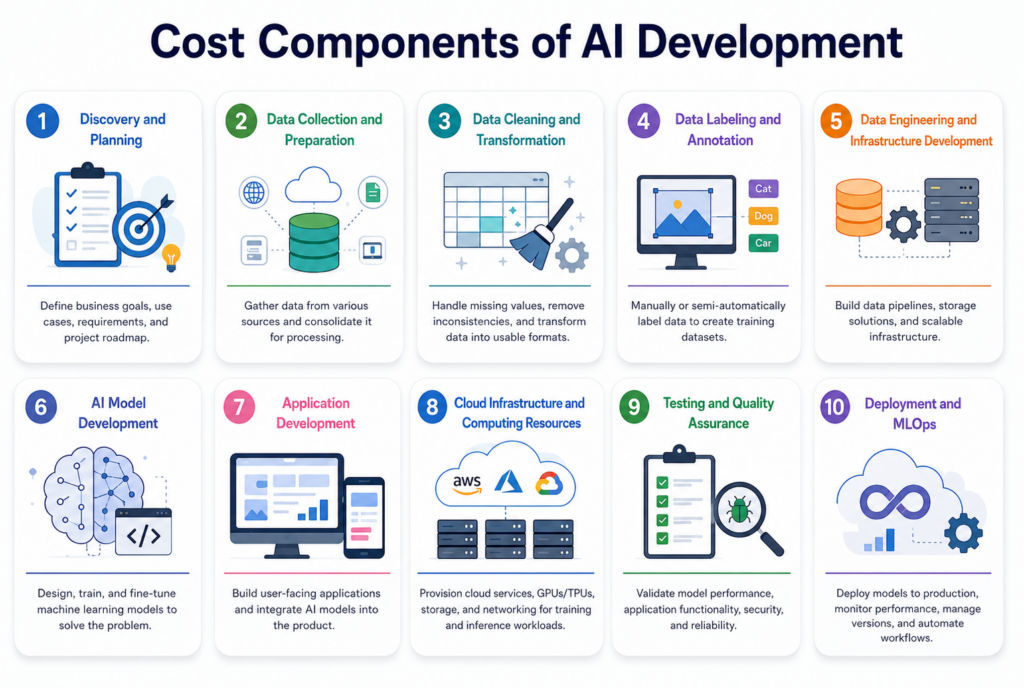
While the exact cost breakdown varies from project to project, most AI development budgets are distributed across several key components. Each stage play a critical role in ensuring the solution is accurate, scalable, and aligned with business objectives.
Discovery and Planning
Every successful AI project begins with a thorough discovery and planning phase. Although businesses sometimes overlook this stage in an effort to accelerate development, investing in proper planning often reduces costs later by minimizing rework and preventing scope creep.
During this phase, stakeholders and technical teams collaborate to define project goals, evaluate feasibility, and identify the most suitable AI approach.
Some key activities include:
- Business requirements gathering
- Use case identification
- Technical feasibility assessment
- Risk analysis
- Data availability evaluation
- Success metric definition
- AI strategy development
- Roadmap creation
The complexity of the business problem largely determines the effort required during discovery. Organizations implementing AI for mission-critical processes typically spend more time validating assumptions and aligning stakeholders before development begins.
Data Collection and Preparation
AI systems largely depend on large volumes of high-quality data to learn patterns and make accurate predictions. However, business data is rarely ready for immediate use. Significant effort is usually required to collect, organize, clean, and prepare datasets before model training can begin.
- Data Collection
Organizations may need to gather data from multiple sources, such as:
- Internal databases
- CRM systems
- ERP platforms
- Customer interactions
- IoT devices
- Third-party providers
- Public datasets
If sufficient data is unavailable, businesses may need to invest in acquiring new datasets, which can significantly increase project costs.
Data Cleaning and Transformation
Raw data often contains errors, inconsistencies, duplicate entries, and missing values. Data engineers and analysts spend considerable time preparing information for AI models by:
- Removing duplicate records
- Correcting inaccuracies
- Standardizing formats
- Filling missing values
- Validating data quality
Data Labeling and Annotation
Many machine learning models require labeled datasets.
Examples include:
- Annotating images for object detection
- Tagging documents for classification
- Labeling customer feedback for sentiment analysis
- Categorizing transactions for fraud detection
Data Engineering and Infrastructure Development
Once data has been collected and prepared, organizations must establish the infrastructure needed to store, process, and manage it effectively.
Data engineering focuses on building reliable systems that ensure AI models have access to clean, accurate, and up-to-date information.
Some activities include:
- Designing data architectures
- Building ETL pipelines
- Developing data warehouses and lakes
- Creating real-time data streams
- Implementing governance frameworks
- Managing data security
Organizations handling large volumes of information often require sophisticated data infrastructure that supports scalability and performance.
AI Model Development
Model development is the core component of any AI project. This phase involves designing, training, testing, and optimizing machine learning models capable of solving specific business challenges.
The cost of model development varies depending on the complexity of the problem and the type of AI being implemented.
- Model Selection
- Training and Fine-tuning
- Model Evaluation
Application Development
The AI model itself is only one part of the final product. Businesses also need software applications that allow users to interact with AI functionality.
Application development often represents a significant portion of the overall project budget. This includes the following:
- Frontend Development
- Backend Development
- API Development and Integration
Cloud Infrastructure and Computing Resources
AI applications require substantial computing resources throughout development and production.
Cloud Infrastructure expenses often include:
- Model Training Resources
Training machine learning models may require:
- High-performance GPUs
- TPUs
- Distributed computing environments
The larger the dataset and model, the higher the infrastructure costs.
- Model Hosting
Once deployed, AI models require hosting environments capable of handling user requests efficiently.
Hosting expenses depend on:
- User Volume
- Response speed requirements
- Data processing needs
- Availability expectations
- Storage Costs
Organizations must store:
- Training datasets
- Processed data
- Model versions
- Logs
- Backups
Storage requirements can grow significantly over time, particularly for data-intensive AI applications.
Testing and Quality Assurance
AI systems require more extensive testing than traditional software because their outputs can vary based on data inputs and model behavior.
Quality assurance efforts help ensure reliability, security, and business value.
Testing activities often include:
- Functional Testing
Verifying that the AI application performs as expected and meets business requirements.
- Performance Testing
Evaluating speed, responsiveness, and scalability under different workloads.
- Accuracy Testing
Assessing whether AI predictions, recommendations, or outputs achieve acceptable accuracy levels.
- Security Testing
Ensuring sensitive data remains protected and vulnerabilities are identified before deployment.
- Bias and Fairness Testing
Detecting and mitigating unintended biases that may affect model outcomes.
Deployment and MLOps
Deploying an AI solution into production requires specialized processes and infrastructure.
MLOps helps organizations manage AI systems efficiently throughout their lifecycle.
Deployment-related costs often include:
- Infrastructure provisioning
- CI/CD pipeline implementation
- Model version control
- Monitoring systems
- Automated retraining workflows
- Performance tracking
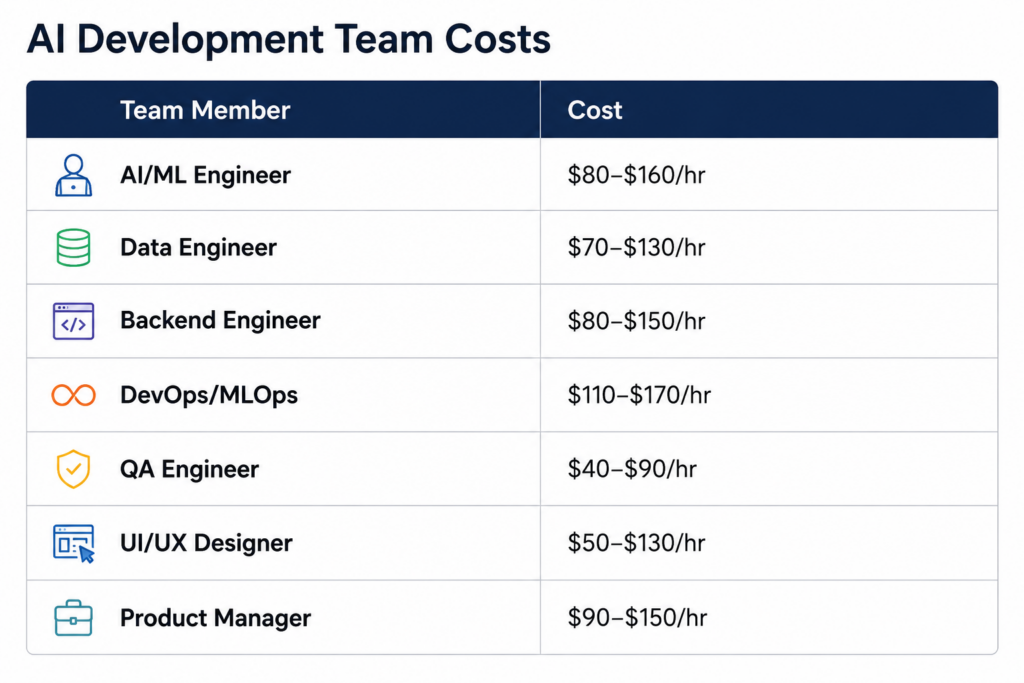
AI Development Team Costs
How to Reduce AI Development Costs Without Sacrificing Quality?
AI development can require a significant investment, but reducing costs doesn’t mean compromising performance or scalability. In fact, many successful AI initiatives achieve strong returns because organizations focus on smart planning, efficient resource allocation, and strategic implementation rather than simply spending more.
Start with a Proof of Concept
One of the most effective ways to reduce AI development costs is to begin with a Proof of Concept rather than immediately investing in a full-scale solution.
A PoC allows organizations to validate whether an AI idea is technically feasible and commercially viable before committing significant resources. Instead of building a complete product, development teams create a smaller version that demonstrates core functionality and validates assumptions.
Benefits of a PoC include:
- Identifying technical challenges early
- Testing data quality and availability
- Evaluating expected business outcomes
- Securing stakeholder buy-in
- Reducing investment risk
Utilize Pre-trained Models
Training AI models from scratch can be one of the most expensive aspects of development. It often requires large datasets, extensive computational resources, and months of experimentation.
Fortunately, businesses can significantly reduce costs by utilizing pre-trained models and existing AI frameworks.
Popular approaches include:
- Fine-tuning foundation models
- Using open-source machine learning models
- Utilizing commercial AI APIs
- Applying transfer learning techniques
Adopt an Iterative Development Approach
Building a large-scale AI solution all at once can lead to higher costs, longer timelines, and increased project risks.
Instead, organizations should embrace iterative development methodologies that prioritize continuous improvement and incremental delivery.
An iterative approach typically involves:
- Launching an MVP
- Collecting user feedback
- Measuring performance
- Refining features
- Expanding capabilities over time
This strategy helps organizations:
- Reduce upfront development costs
- Identify issues earlier
- Improve user adoption
- Align development with changing business needs
Final Words
AI development costs depend on factors such as project complexity, data readiness, infrastructure, and team expertise. Businesses that prioritize strategic planning, high-quality data, scalable architecture, and iterative implementation can maximize ROI while controlling expenses. A well-executed AI investment delivers long-term value and sustainable growth.