




Hero Introduction
AI is now central to enterprise transformation, but the real challenge isn’t adoption; it’s prioritization. With countless AI use cases across functions, organizations often struggle to decide what to build first and what truly drives business value. An AI investment Prioritization Framework helps leaders focus on high-impact opportunities that align with ROI, strategy, and feasibility.
Executive Summary
Enterprises are rapidly investing in AI, but without a clear prioritization approach, many initiatives fail to deliver meaningful results. This blog introduces a structured framework for evaluating AI use cases based on business impact, technical feasibility, and strategic alignment.
It explains why prioritization matters, outlines key principles for decision-making, and categorizes AI use cases into revenue, cost, risk, and experience-driven opportunities. The goal is to help organizations invest in AI more intentionally and achieve measurable ROI.
Why AI Investment Prioritization Matters?
AI is often seen as a limitless opportunity, but enterprise reality is far more constrained. Budgets, talent, data readiness, and execution bandwidth all impose hard limits on how many AI initiatives an organization can pursue at once. This makes prioritization not just important, but essential.
Without a structured approach, companies tend to fall into a pattern of scattered experimentation, launching multiple pilots across teams without a clear path to scale or measurable impact. Over time, this leads to wasted investment and stakeholder fatigue.
Finite Resources Demand Strategic Allocation
AI initiatives require more than just ideas; they demand skilled talent, robust infrastructure, high-quality data, and ongoing maintenance. Data scientists, ML engineers, and AI architects are both scarce and expensive. When these resources are spread across too many projects, none receive the focus needed to succeed.
Prioritization ensures that the most critical initiatives receive the attention and resources required to deliver results, rather than diluting efforts across low-impact experiments.
Avoid the Pilot Trap
Many organizations successfully build AI prototypes but fail to scale them into production. This is often known as the pilot trap, which occurs when projects are selected based on novelty rather than business value or feasibility.
Without prioritization:
- Teams focus on technically interesting problems instead of business-critical ones
- Projects lack executive sponsorship
- Integration challenges are underestimated
By prioritizing use cases with clear ROI and implementation pathways, organizations increase the likelihood of moving from pilot to production.
Aligning AI With Business Strategy
AI initiatives shouldn’t exist in isolation. They must directly support broader business objectives such as revenue growth, operational efficiency, customer retention, or market expansion.
Prioritization creates alignment between:
- Business leaders defining strategic goals
- Technical teams building AI solutions
- Finance teams evaluating investment returns
When AI is tied to business strategy, it becomes easier to secure executive buy-in, allocate budgets, and measure success.
Managing Complexity and Execution Risk
AI projects are inherently complex. They involve multiple dependencies, including data pipelines, model training, deployment infrastructure, and integration with existing systems. Additionally, risks such as data privacy concerns and model bias must be addressed.
Attempting to execute too many complex initiatives at once increases the likelihood of delays, cost overruns, or outright failure.
Prioritization allows organizations to:
- Start with feasible, lower-risk projects
- Build internal capabilities gradually
- Learn and refine processes before scaling
- Accelerating Time to Market
Organizations need to demonstrate tangible results from AI investments quickly to justify continued funding and maintain stakeholder confidence.
Prioritization helps identify quick wins, use cases that:
- Have readily available data
- Require moderate technical effort
- Deliver visible business outcomes in a short timeframe
These early successes create momentum, validate AI strategies, and pave the way for more complex and long-term initiatives.
Enhancing Cross-Functional Collaboration
AI initiatives often span multiple teams, IT, operations, marketing, finance, and more. Without prioritization, each department may pursue its own agenda, leading to siloed efforts and duplicated work.
A structured prioritization framework fosters collaboration by:
- Creating a shared evaluation model
- Encouraging cross-functional input
- Aligning stakeholders around common goals
This unified approach ensures that AI investments benefit the organization as a whole, not just individual teams.
Strengthening Competitive Advantage
AI is a key differentiator, but only when applied effectively. Companies that prioritize high-impact AI initiatives can:
- Optimize operations faster
- Deliver superior customer experiences
- Innovate ahead of competitors
On the other hand, organizations that lack focus risk falling behind despite heavy investment.
What Are the Principles of an AI Investment Framework?
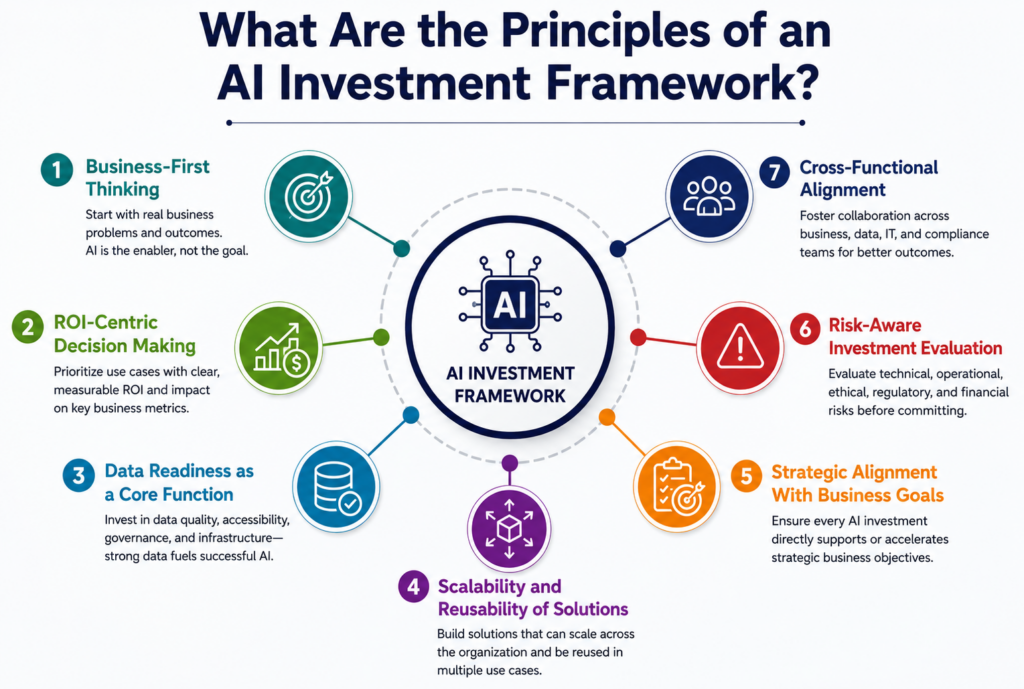
An effective AI Investment Framework isn’t just a scoring mechanism, it’s a structured way of thinking that guides how organizations evaluate, fund, and scale AI initiatives. When applied consistently, these principles ensure that AI investments remain aligned with business value and technical feasibility.
Business-First Thinking
Every AI initiative must begin with a clearly defined business problem, not a model or tool. Too often, organizations start by asking, “Where can we use AI?” instead of “What business problem are we solving?” This technology-first mindset leads to solutions in search of problems, which rarely deliver ROI.
A business-first approach ensures that:
- Each AI use case maps to a measurable business outcome
- Stakeholders can clearly articulate expected value
- Success is defined in business terms
For example, instead of building a generic recommendation engine, the focus shifts to increasing cart size in eCommerce or improving customer retention in subscription models.
ROI-Centric Decision Making
AI investments must be evaluated through a financial lens. Unlike traditional IT projects, AI initiatives often require ongoing investment in data pipelines, model retraining, and infrastructure.
A strong framework requires organizations to estimate ROI before committing resources.
This includes:
- Revenue uplift
- Cost savings
- Risk reduction
- Productivity gains
Even if exact numbers are uncertain, organizations should define directional ROI ranges. If the value cannot be reasonably estimated, the use case should be deprioritized or revisited later.
Data Readiness as a Core Function
AI cannot function without data, but not all data is usable.
A critical principle of AI investment is assessing whether the required data is:
- Available
- Clean and consistent
- Sufficient in volume and quality
- Legally and ethically usable
- Accessible across systems
Many AI initiatives fail not because of model limitations, but because of poor data readiness. A strong framework forces early validation of data maturity before significant investment is made. This prevents costly reworks and ensures realistic execution planning.
Scalability and Reusability of Solutions
AI should be treated as a long-term capability, not a one-time project.
A key principle is prioritizing use cases that can scale across:
- Business units
- Geographies
- Customer segments
- Product lines
Additionally, reusable AI components, such as shared data pipelines, feature stores, or model APIs, should be preferred over isolated and one-off solutions.
For example, a fraud detection model built for one financial product should ideally be extensible across multiple products or regions.
These principles ensure that AI investments compound in value over time rather than remaining siloed.
Strategic Alignment With Business Goals
AI initiatives must directly support the organization’s broader strategic priorities.
This could include:
- Expanding into new markets
- Improving operational efficiency
- Enhancing customer experience
- Driving digital transformation
Without strategic alignment, even technically successful AI projects may fail to gain executive support or budget continuity.
A strong framework evaluates whether each AI use case:
- Contributes to a key business KPI
- Supports long-term organizational goals
- Strengthens competitive positioning
Risk-Aware Investment Evaluation
AI introduces unique risks that must be accounted for during investment decisions.
These include:
- Data privacy and regulatory compliance risks
- Ethical concerns
- Model reliability and explainability issues
- Operational risks from automation failures
A robust framework doesn’t avoid risk, but evaluates it systematically. Moreover, use cases with high business value but high risk may still proceed, but with additional controls, governance, and phased rollout strategies.
Cross-Functional Alignment
AI success depends on collaboration across multiple functions, not just date science teams.
A strong investment framework ensures alignment between:
- Business leaders defining outcomes
- Technical teams building solutions
- Finance teams evaluating ROI
- Compliance teams ensuring governance
This principle reduces friction during execution and ensures that AI initiatives are not blocked due to organizational misalignment.
Cross-functional validation also improves the quality of use case selection, as each stakeholder brings a different perspective on feasibility and value.
What Are the Categories of AI Use Cases in Enterprises?
One of the biggest challenges in AI investment is that not all use cases serve the same purpose, or deliver value in the same way. Treating every AI initiative as equal leads to poor prioritization and scattered outcomes.
A more effective approach is to group AI use cases into clear categories based on the type of business value they deliver. This helps organizations compare opportunities more objectively, allocate budgets wisely, and balance short-term with long-term transformation.
Revenue-Generating AI Use Cases
These are the mostly directly measurable and often the most attractive AI investments. Revenue-generating use cases focus on increasing top-line growth by improving how organizations acquire, convert, and retain customers.
Some characteristics are:
- Direct impact on sales or revenue metrics
- Often tied to customer-facing functions
- Typically easier to justify at the executive level
Common examples:
- Personalized recommendations: Suggesting products or services based on user behavior
- Dynamic pricing: Adjusting prices in real time based on demand, competition, and customer segments
- Lead scoring and sales prioritization: Identifying high-conversion prospects
- Customer churn prediction: Proactively retraining at-risk customers
Cost-Reduction AI Use Cases
Cost-focused AI initiatives aim to improve operational efficiency and reduce expenses. These are often among the first AI projects organizations pursue because their ROI is easier to quantify.
Characteristics:
- Focus on automation and process optimization
- Deliver measurable cost savings
- Often involve operational functions
Examples:
- Intelligent process automation: Combining AI with RPA to automate repetitive workflows
- Predictive maintenance: Anticipating equipment failures before they occur
- Supply chain optimization: Reducing waste and improving logistics efficiency
- AI-powered customer support: Chatbots and virtual agents handling routine queries
Risk Mitigation AI Use Cases
Risk-focused AI applications are designed to protect the organization from financial loss, compliance issues, or operational disruptions. While they may not generate revenue directly, their value lies in prevention.
Characteristics:
- Focus on detention, prediction, and prevention
- Often critical in regulated industries
- High importance despite less visible ROI
Examples:
- Fraud detection systems: Identifying suspicious transactions in real time
- Cybersecurity threat detection: Monitoring anomalies across networks
- Compliance monitoring: Ensuring adherence to regulatory requirements
- Credit risk assessment: Evaluating borrower risk profiles
Experience Enhancement Use Cases
These AI applications focus on improving the experience of customers, employees, or partners. While their ROI may be less direct, they play a crucial role in long-term growth and retention.
Characteristics:
- Focus on personalization and usability
- Indirect but meaningful business impact
- Often tied to customer satisfaction and engagement
Examples:
- Customer journey optimization: Delivering seamless, personalized interactions across channels
- AI-driven UX personalization: Tailoring interfaces based on user prefrences
- Employee productivity tools: AI assistants for knowledge retrieval or task automation
- Voice and conversational interfaces: Enhancing accessibility and engagement
Decision Intelligence and Analytics Use Cases
This category focuses on enhancing decision-making through predictive and prescriptive insights. These use cases are especially valuable for leadership and strategic planning.
Characteristics:
- Data-driven insights for better decision-making
- Often used by management and analysts
- Require strong data integration and governance
Example:
- Demand forecasting: Predicting product demand to optimize inventory
- Financial forecasting: Improving budgeting and planning accuracy
- Scenario modeling: Evaluting different business strategies
- Operational analytics: Identifying inefficiencies and improvement areas
Foundational and Enabling AI Capabilities
Not all investments are tied to immediate use cases. Some are foundational capabilities that enable future AI success.
Characteristics:
- Indirect ROI
- Long-term value creation
- Critical for scaling AI across the enterprise
Examples:
- Data platforms and pipelines: Ensuring reliable data flow
- MLOps infrastructure: Supporting model deployment and monitoring
- AI governance frameworks: Managing risk, compliance, and ethics
- Feature stores and shared services: Enabling reuse across models
Final Words
AI success depends on disciplined prioritization, not just ambition. By applying clear principles and categorizing use cases effectively, organizations can align AI investments with measurable business value. A structured framework ensures smarter decisions and scalable impact, turning AI from scattered experimentation into a focused, ROI-driven engine for sustainable growth and competitive advantage.