




Many businesses invest in CRM software expecting it to solve their sales challenges, only to discover that revenue growth remains consistent. The problem usually isn’t the CRM itself; it’s how the platform is implemented and used. Salesforce improves lead generation and helps businesses increase revenue by centralizing customer data, automating repetitive tasks, qualifying leads intelligently, enabling faster sales engagement, and providing AI-powered insights that help teams focus on the highest-value opportunities.
Salesforce is much more than a digital contact database. It serves as the foundation for modern revenue operations by bringing together marketing, sales, customer service, automation, and analytics into a single platform. When implemented strategically, it helps businesses capture leads from multiple channels, prioritize prospects, nurture relationships, and close deals more efficiently.
However, software alone doesn’t guarantee success. Sustainable revenue growth depends on a combination of clean CRM data, effective sales processes, workflow automation, AI-driven recommendations, and continuous optimization.
In this guide, you’ll learn how Salesforce supports every stage of the lead generation funnel, the features that drive revenue, and how AI enhances sales performance.
Why Salesforce Is More Than Just a CRM
Modern businesses generate customer data from websites, social media, emails, webinars, events, and advertising campaigns. Managing this information manually quickly becomes overwhelming. Salesforce brings these touchpoints together to create a complete view of every customer interaction.
Rather than functioning as a simple contact manager, Salesforce supports every stage of the revenue lifecycle.
Lead Management
Salesforce automatically captures, organizes, and tracks leads from multiple sources, ensuring no potential customer is overlooked.
Opportunity Tracking
As prospects move through the sales pipeline, Salesforce records every interaction, meeting, proposal, and stage change, giving sales teams full visibility into deal progress.
Sales Automation
Routine activities such as assigning leads, sending follow-up emails, creating reminders, and updating records can all be automated, allowing sales representatives to spend more time selling.
Marketing Integration
Salesforce integrates with marketing platforms to connect campaigns directly with CRM data. This alignment helps marketers understand which campaigns generate qualified leads and revenue.
Customer Intelligence
By consolidating customer interactions, purchase history, engagement data, and communication records, Salesforce provides valuable insights that support personalized selling.
Revenue Forecasting
Managers gain real-time visibility into pipeline health, expected revenue, and sales performance, enabling better planning and resource allocation.
How Does Salesforce Support the Entire Lead Generation Funnel?
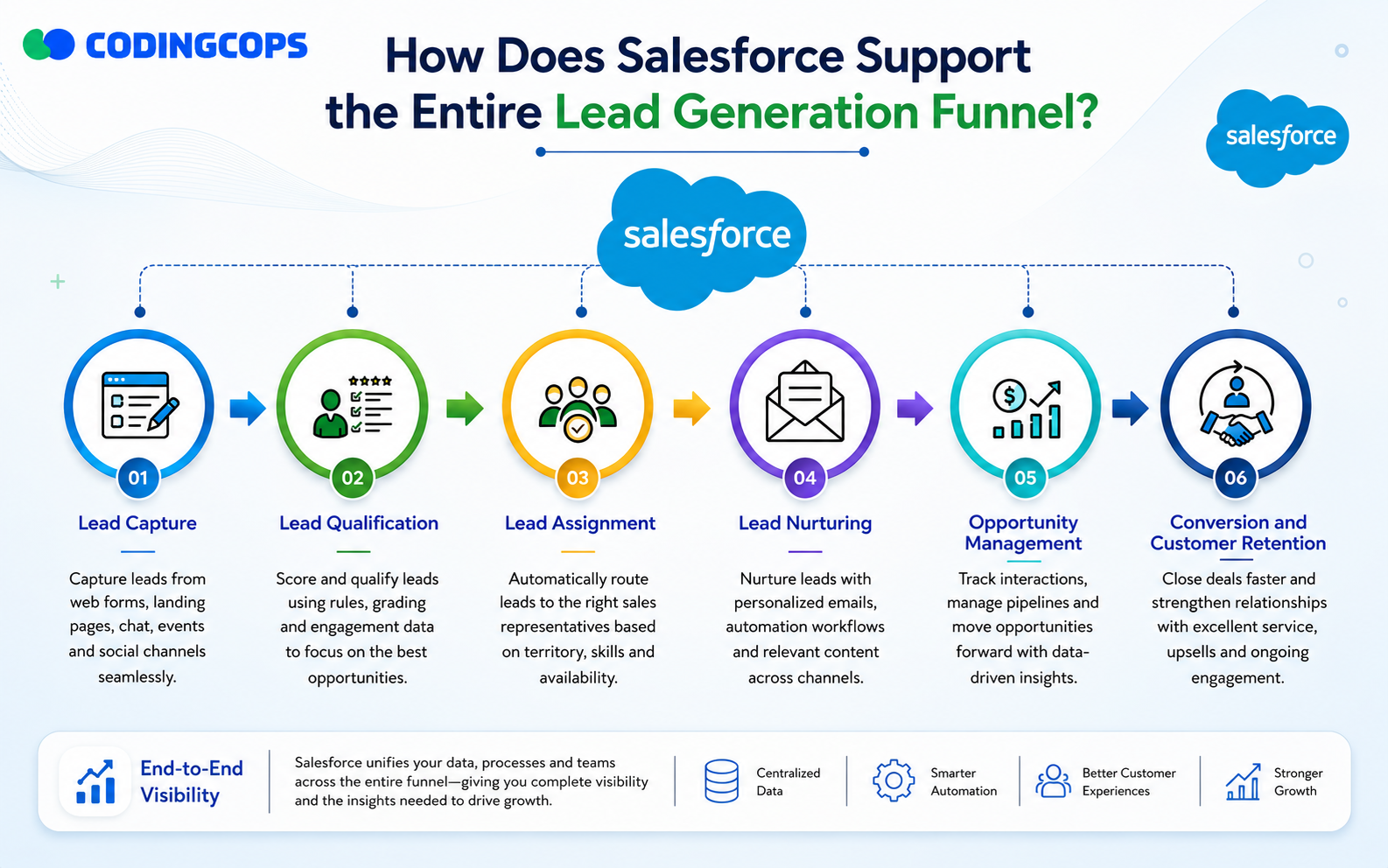
Successful lead generation isn’t a single activity; it’s a continuous process that guides prospects from initial awareness to long-term customer relationships.
Lead Capture
Businesses attract leads through websites, paid advertising, webinars, referrals, trade shows, landing pages, and social media. Salesforce automatically captures these inquiries and stores them in a centralized CRM.
Lead Qualification
Not every lead is equally valuable. Salesforce helps sales teams qualify leads based on demographics, company size, industry, engagement level, purchasing intent, and other custom criteria.
Lead Assignment
Once qualified, Salesforce automatically routes leads to the appropriate sales representative based on geography, product interest, industry, or workload.
Lead Nurturing
Many prospects aren’t ready to buy immediately. Automated workflows keep them engaged through personalized email campaigns, educational resources, reminders, and follow-ups until they become sales-ready.
Opportunity Management
Qualified leads become opportunities, where sales teams manage meetings, proposals, negotiations, and forecasting throughout the sales cycle.
Conversion and Customer Retention
After closing the sale, Salesforce continues supporting customer success through onboarding, account management, upselling opportunities, and ongoing engagement.
Essential Salesforce Features That Drive Lead Generation
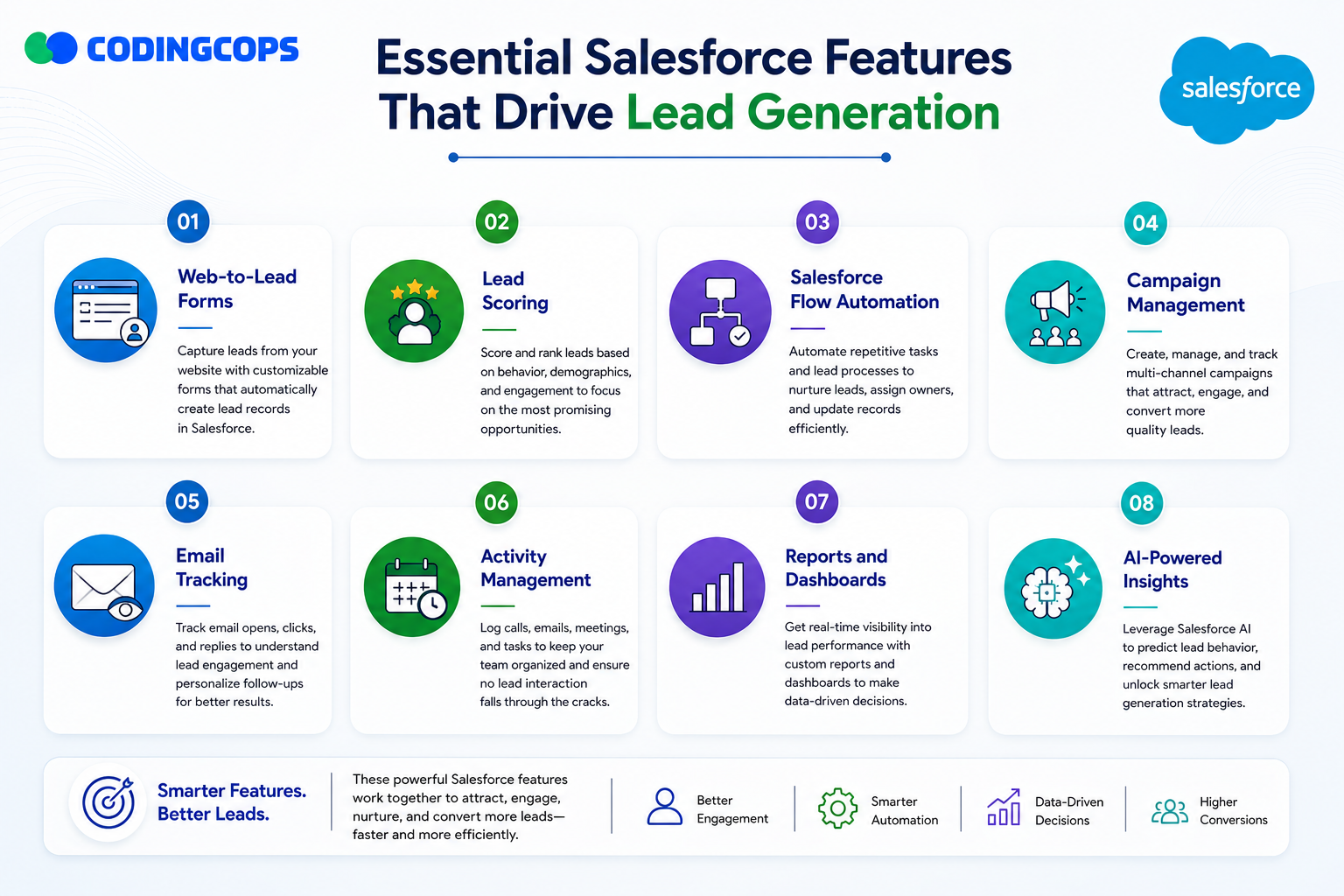
Salesforce offers a comprehensive set of features that help businesses capture more leads, improve sales efficiency, and increase revenue. By combining automation, customer intelligence, and data-driven insights, organizations can streamline the entire sales process while ensuring every lead receives the right level of attention.
Web-to-Lead Forms
One of the easiest ways to generate leads is by capturing inquiries directly from your website. Salesforce Web-to-Lead forms automatically collect information submitted through landing pages, contact forms, or registration pages and create new lead records within Salesforce.
Instead of manually entering customer information, sales teams receive leads instantly, reducing delays and minimizing data entry errors. Businesses can also customize forms to capture the information most relevant to their sales processes, such as company size, industry, product interest, or location.
Some of its benefits include:
- Automatic lead creation
- Faster response times
- Reduced manual data entry
- Improved lead tracking
- Better customer experience
Lead Scoring
Not every lead has the same potential to become a customer. Lead scoring helps sales teams prioritize prospects based on their likelihood of converting.
Salesforce assigns scores using factors such as demographics, job title, company size, website activity, email engagement, and previous interactions. Businesses can also create custom scoring models tailored to their specific sales process.
By focusing on high-value prospects first, sales representatives spend more time on opportunities that are most likely to generate revenue.
Lead scoring improves:
- Sales productivity
- Lead prioritization
- Conversation rates
- Marketing and sales alignment
- Revenue forecasting
Salesforce Flow Automation
Salesforce Flow is a powerful automation tool that eliminates repetitive manual work across the lead generation process.
Organizations can automate tasks such as:
- Lead assignment
- Approval workflows
- Email notifications
- Task creation
- Status updates
- Follow-up reminders
- Record updates
Automation ensures every lead follows a standardized process without requiring constant manual intervention. This not only increases operational efficiency but also reduces the chances of leads being overlooked.
Campaign Management
Understanding which marketing campaigns generate the highest-quality leads is essential for maximizing return on investment.
Salesforce Campaign Management enables businesses to track campaigns across multiple channels, including:
- Email marketing
- Paid advertising
- Social media
- Trade shows
- Webinars
- Referral programs
- Events
Marketing and sales teams can measure campaign performance by monitoring lead generation and revenue attribution. This visibility helps businesses invest more confidently in the campaigns that consistently produce qualified leads.
Email Tracking
Email remains one of the most effective communication channels for B2B and B2C sales. Salesforce Email Tracking provides insights into customer engagement by monitoring:
- Email opens
- Link clicks
- Replies
- Attachment viewed
- Follow-up activity
Sales representatives gain a better understanding of buyer interest and can contact prospects when engagement is highest, increasing the likelihood of meaningful conversations.
Activity Management
Successful lead management depends on consistent follow-up and organized customer interactions. Salesforce Activity Management centralizes all communication activities, including:
- Phone calls
- Emails
- Meetings
- Tasks
- Notes
- Calender events
- Customer conversations
Having every interaction stored in one location provides complete visibility into each prospect’s journey, making collaboration easier across sales teams.
Reports and Dashboards
Salesforce provides powerful reporting and visualization tools that help organizations measure every stage of the sales funnel.
Custom dashboards display real-time insights such as:
- Lead sources
- Marketing performance
- Conversion rates
- Sales pipeline value
- Opportunity stages
- Team productivity
- Forecasted revenue
- Individual sales performance
These reports allow decision-makers to identify bottlenecks, monitor KPIs, and make data-driven improvements to their lead generation strategy.
AI-Powered Insights
AI has become one of Salesforce’s biggest competitive advantages. Salesforce AI capabilities help sales teams make smarter decisions without replacing human expertise.
AI analyzes historical CRM data, customer behavior, and engagement patterns to provide valuable recommendations, including:
- Predictive lead scoring
- Opportunity prioritization
- Recommended next actions
- Customer sentiment analysis
- Pipeline forecasting
- Automated meeting summaries
- Sales coaching recommendations
- Personalized customer insights
Instead of spending hours analyzing CRM records, sales representatives receive actionable recommendations that help them engage the right prospects at the right time.
| Salesforce Feature | Purpose | Revenue Impact |
|---|---|---|
| Web-to-Lead Forms | Automatically capture leads from websites and landing pages. | Increases lead volume and reduces response times. |
| Lead Scoring | Rank prospects based on conversion potential. | Helps sales teams focus on high-value opportunities. |
| Salesforce Flow Automation | Automate repetitive sales and CRM workflows. | Improves productivity and accelerates lead processing. |
| Campaign Management | Track marketing campaigns and measure ROI. | Optimizes marketing spend and improves lead quality. |
| Email Tracking | Monitor customer engagement with emails. | Enables timely follow-ups and increases response rates. |
| Activity Management | Organizes calls, meetings, emails, and tasks. | Improves sales consistency and customer engagement. |
| Reports and Dashboards | Provide real-time sales and marketing insights. | Support data-driven decisions and pipeline optimization. |
| AI-Powered Insights | Predict customer behavior and recommend next actions. | Increase conversion rates, forecasting accuracy, and overall revenue. |
Building a High-Performing Lead Generation Process in Salesforce
Step 1: Define Your Ideal Customer Profile (ICP)
You should identify the industries, company sizes, job roles, pain points, and buying behaviors that represent your best customers.
Step 2: Capture Leads from Multiple Channels
Integrate websites, landing pages, advertising platforms, webinars, chatbots, events, and referral programs into Salesforce.
Step 3: Standardize CRM Data
Use required fields, validation rules, and standardized naming conventions to maintain consistent, accurate customer information.
Step 4: Implement Lead Scoring
Assign scores based on demographic fit, engagement, purchasing signals, and historical conversion data.
Step 5: Automate Lead Assignment
Use Salesforce automation to instantly route leads to the right representatives based on predefined rules.
Step 6: Nurture Leads with Personalized Workflows
Develop automated email sequences, reminders, educational campaigns, and follow-up activities tailored to customer interests.
Step 7: Measure Conversion Performance
Monitor every stage of the sales funnel to identify bottlenecks and continuously improve conversion rates.
How AI Improves Lead Generation in Salesforce?
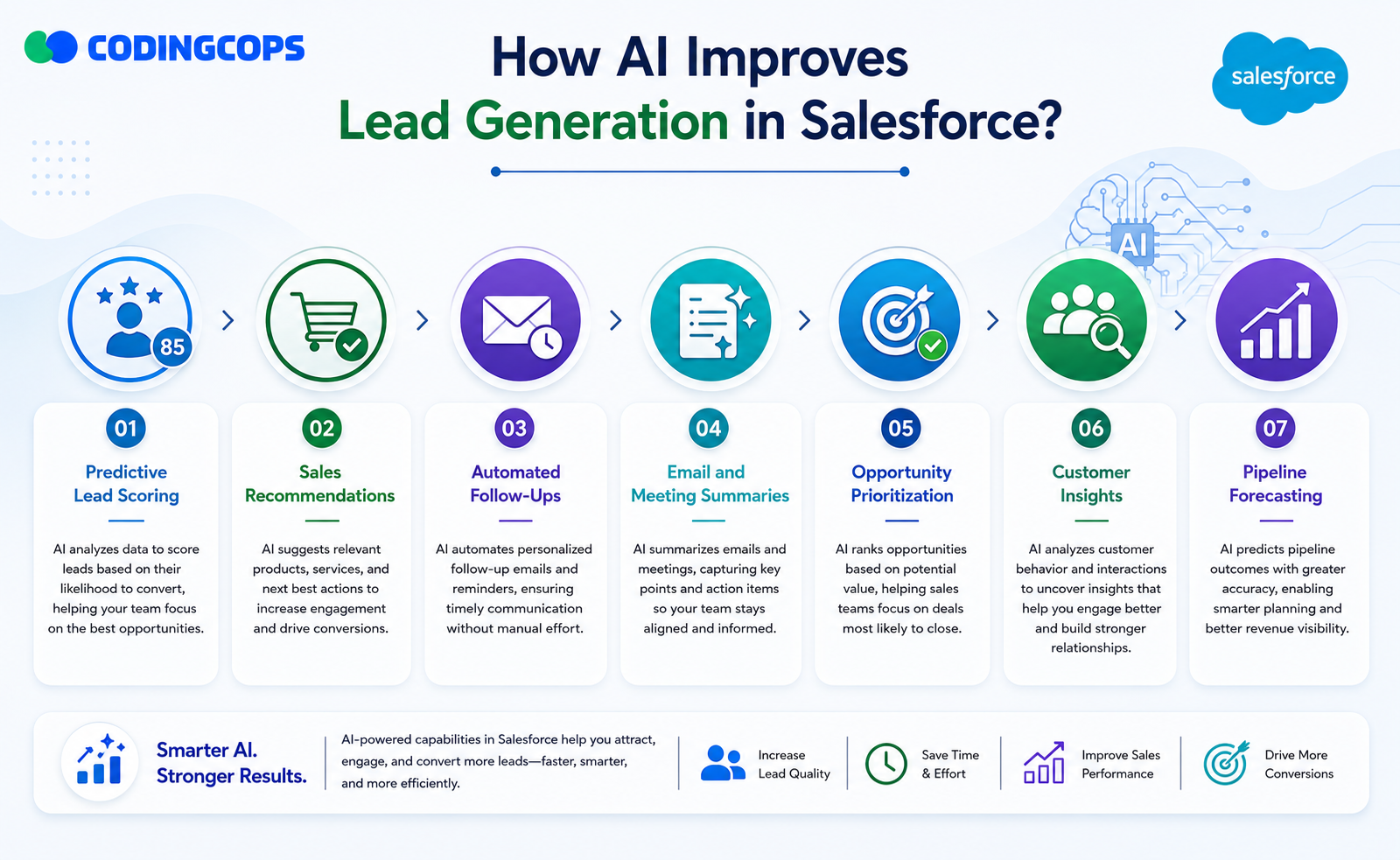
AI helps sales teams make smarter decisions without replacing human relationships. Instead, AI reduces manual work and highlights the opportunities most likely to convert.
Predictive Lead Scoring
AI evaluates historical sales data, engagement patterns, and customer attributes to identify leads with the highest likelihood of conversion.
Sales Recommendations
Sales representatives receive suggested next actions based on customer behavior, helping them engage prospects at the right time.
Automated Follow-Ups
AI triggers reminders and personalized communications when prospects become inactive or demonstrate buying intent.
Email and Meeting Summaries
AI automatically summarizes customer conversations, allowing sales teams to quickly review key discussion points and action items.
Opportunity Prioritization
Rather than managing every opportunity equally, AI identifies deals that deserve immediate attention.
Customer Insights
AI uncovers trends, customer preferences, buying behaviors, and potential upselling opportunities hidden within CRM data.
Pipeline Forecasting
Predictive analytics improve revenue forecasting by identifying pipeline risks and expected sales outcomes.
Common Lead Generation Challenges and How Salesforce Solves Them
Poor Lead Quality
Lead scoring and qualification rules help prioritize prospects that match your ideal customer profile.
Slow Response Times
Automated notifications and lead routing ensure sales representatives respond quickly.
Duplicate Records
Duplicate detection and validation rules maintain a clean CRM database.
Inconsistent Sales Processes
Standardized workflows ensures every sales representative follows the same proven process.
Limited Visibility into the Pipeline
Real-time dashboards provide complete visibility into sales performance and pipeline health.
Weak Marketing and Sales Alignment
Shared CRM data helps both teams work toward common revenue goals.
| Challenge | Salesforce Solution | Business Benefit |
|---|---|---|
| Poor Lead Quality | Lead scoring | Higher conversions |
| Slow Responses | Workflow automation | Faster engagement |
| Duplicate Records | Duplicate management | Better data quality |
| Inconsistent Processes | Standardized workflows | Predictable sales execution |
| Limited Visibility | Dashboards | Better forecasting |
| Marketing Misalignment | CRM integration | Improved campaign ROI |
Best Practices for Turning Salesforce Into a Revenue Engine
A successful Salesforce implementation requires continuous improvement rather than a one-time deployment.
Revenue Growth Checklist
- Keep CRM data accurate and up to date.
- Automate repetitive administrative tasks
- Ensure marketing and sales share common goals.
- Regularly review lead quality and scoring criteria.
- Continuously optimize workflows based on performance data.
- Monitor key revenue metrics through dashboards
- Train users regularly to encourage platform adoption.
- Review automation rules periodically to eliminate inefficiencies.
Salesforce Lead Generation Metrics Every Business Should Track
Measuring performance helps organizations understand whether their sales process is improving.
| KPI | Why It Matters | Typical Business Goal |
|---|---|---|
| Lead Volume | Measures demand generation. | Increase qualified leads. |
| Marketing Qualified Leads (MQLs) | Indicates marketing effectiveness. | Improve lead quality. |
| Sales Qualified Leads (SQLs) | Measures sales readiness. | Increase conversion potential. |
| Lead Response Time | Faster engagement improves conversions. | Respond within minutes or hours. |
| Conversion Rate | Tracks funnel performance. | Improve overall efficiency. |
| Opportunity Win Rate | Measures sales success. | Close more qualified deals. |
| Sales Cycle Length | Indicates sales efficiency. | Shorten the buying journey. |
| Customer Acquisition Cost (CAC) | Measures acquisition efficiency. | Reduce acquisition costs. |
| Revenue Per Lead | Evaluates lead quality. | Increase revenue generated. |
| Customer Lifetime Value (CLV) | Measures long-term profitability. | Maximize customer value. |
Real-World Example
B2B SaaS Company
A growing B2B SaaS company generated thousands of monthly website leads but struggled with inconsistent follow-ups and poor visibility into its sales pipeline.
Initial Challenge
- Manual lead assignment
- Slow response times
- Duplicate CRM records
- Limited reporting
- Low conversion rates
Salesforce Implementation
The company implemented Sales Cloud, integrated marketing automation, standardized CRM fields, and introduced automated workflows.
Automation Strategy
Incoming website leads were automatically assigned to the appropriate sales representative based on territory and product interest. Follow-up emails, reminders, and qualification tasks were triggered automatically.
AI Features Used
- Predictive lead scoring
- Opportunity prioritization
- AI-generated meeting summaries
- Revenue forecasting
Revenue Improvements
Within several months, the company experienced:
- Faster lead response times
- Improved lead quality
- Higher sales productivity
- Better forecasting accuracy
- Increased conversion rates
- More consistent revenue growth
Common Mistakes That Limit Salesforce ROI
Many organizations fail to realize Salesforce’s full potential because they overlook process improvements.
Common mistakes include:
- Treating Salesforce as only a contact database
- Low user adoption across sales teams
- Dirty, incomplete, or inconsistent CRM data
- Minimal workflow automation
- Weak lead qualification processes
- Ignoring reports and dashboards
- Failing to continuously optimize workflows
- Not aligning marketing and sales objectives
How CodingCops Helps Businesses Grow Revenue with Salesforce
At CodingCops, we help organizations transform Salesforce into a complete revenue platform rather than simply another CRM system.
Our Salesforce services include:
- Salesforce consulting and implementation
- CRM strategy and lead generation consulting
- Sales Cloud customization
- Workflow and process automation
- AI-powered CRM solutions
- Third-party CRM integrations
- Advanced reporting and executive dashboards
- Continuous optimization and platform support
Whether you’re implementing Salesforce for the first time or optimizing an existing deployment, our team focuses on improving efficiency, increasing lead conversions, and supporting measurable revenue growth.
Conclusion
Salesforce delivers the greatest business value when it supports the entire customer journey, from capturing leads and qualifying prospects to automating sales activities, providing AI-driven insights, and measuring performance with actionable reporting. Organizations that combine clean data, standardized sales processes, intelligent automation, and continuous optimization are far more likely to generate qualified leads, improve conversion rates, and increase long-term revenue than those relying on CRM software alone. By treating Salesforce as a strategic revenue platform rather than simply a database, businesses can build a scalable and data-driven sales engine that supports sustainable growth.