




Salesforce is one of the most powerful CRM platforms available, but its value depends on how well it’s implemented, managed, and continuously optimized. Simply purchasing Salesforce licenses doesn’t guarantee better customer relationships, higher sales, or streamlined operations. Therefore, businesses need the right expertise to configure the platform, align it with business goals, and ensure users adopt it effectively.
Which option saves more in the long run? The answer depends on your business needs. An in-house Salesforce Admin is often the most cost-effective choice for stable, day-to-day CRM management and user support. However, Salesforce consulting typically delivers greater long-term value for complex implementations, integrations, AI initiatives, process optimization, and business transformation. Many organizations achieve the best return on investment by combining both through a hybrid approach.
This guide compares Salesforce consultants and in-house administrators across responsibilities, costs, scalability, implementation, security, and business impact. You’ll also learn when each option makes the most sense, how to evaluate total cost of ownership, and how to choose the approach that best supports your organization’s long-term growth.
Understanding the Two Approaches
Both Salesforce consultants and Salesforce administrators contribute to CRM success, but their responsibilities and business impact differ significantly.
What Is a Salesforce Consultant?
A Salesforce consultant focuses on helping organizations maximize business value from Salesforce. Rather than managing daily operations, consultants take a strategic approach by designing CRM solutions that support business objectives.
Their responsibilities often include:
- CRM strategy and roadmap development
- Salesforce implementation and migration
- Business process analysis
- Platform customization
- Third-party system integrations
- AI and automation implementation
- Architecture design
- Performance optimization
- Digital transformation initiatives
- User adoption planning
Consultants usually work on projects with defined objectives, helping businesses solve complex challenges or prepare Salesforce for future growth.
What Is a Salesforce Admin?
A Salesforce Administrator focuses on maintaining the platform after implementation. Their primary responsibility is ensuring Salesforce continues operating efficiently for everyday users.
Typically, responsibilities include:
- User management
- Permission and security management
- Reports and dashboards
- Workflow maintenance
- Data quality management
- CRM configuration
- Troubleshooting user issues
- Managing page layouts and fields
- Supporting business teams
- Monitoring system health
Administrators are operational specialists who keep the CRM running smoothly every day.
Salesforce Consultant vs. In-House Admin: Side-by-Side Comparison
| Area | Salesforce Consultant | In-House Admin |
|---|---|---|
| Primary Role | Strategic advisor | Platform administrator |
| Strategic Planning | Yes | Limited |
| CRM Implementation | Extensive | Minimal |
| Daily Administration | Limited | Primary responsibility |
| Integrations | Advanced | Basic maintenance |
| AI & Automation | Design and implementation | Maintenance |
| Custom Development | Often works with developers | Limited configuration |
| Cost Structure | Project or retainer based | Salary and benefits |
| Scalability | Highly scalable | Limited by individual capacity |
| Availability | Project-based or ongoing support | Full-time internal resource |
| Best Suited For | Implementations, optimization, transformation | Daily CRM management |
Total Cost of Ownership (TCO): Which Is More Cost-Effective?
Looking only at salary or consulting fees rarely tells the full story. Businesses should evaluate the complete cost of ownership over several years.
Hiring Costs
Recruiting an experienced Salesforce administrator requires job postings, interviews, onboarding, and recruitment expenses. Hiring may take several weeks or even months. Moreover, consultants eliminate recruitment costs because expertise is available immediately.
Salaries and Benefits
An in-house administrator requires:
- Annual salary
- Health benefits
- Bonuses
- Paid leave
- Payroll taxes
- Equipment
- Office costs
Consultants typically charge hourly, through monthly retainers, or with fixed project fees, allowing businesses to pay only for the expertise required.
Training and Certifications
Salesforce releases three major platform updates every year. Internal admins require ongoing certification renewals and training to remain current.
Also, consulting firms usually invest continuously in certifications, reducing training costs for clients.
Consulting Fees
Consulting services often involve higher short-term expenses but provide access to specialists in:
- Architecture
- AI
- Integrations
- Security
- Data migration
- Multi-cloud implementations
Rather than hiring multiple specialists internally, businesses can access an entire team.
Project Costs
Major CRM initiatives such as migrations or enterprise implementations usually require specialized skills beyond the capabilities of a single administrator. Also, using experienced consultants often reduces costly implementation mistakes.
Opportunity Costs
If an administrator spends weeks solving complex architecture problems, routine CRM maintenance may suffer. Likewise, delaying CRM optimization because internal expertise is unavailable can slow revenue growth.
Long-Term Maintenance
After implementation, ongoing administration generally costs less when handled by an internal administrator who understands company processes. Many businesses therefore transition from consulting-led implementation to internal administration.
| Cost Category | Consultant | In-House Admin |
|---|---|---|
| Recruiting | Low | High |
| Salary | None | Ongoing |
| Benefits | None | Ongoing |
| Certifications | Included | Employer-funded |
| Project Expertise | High | Limited |
| Long-Term Maintenance | Moderate | Lower |
| Scalability | Excellent | Limited |
When an In-House Salesforce Admin Makes the Most Sense?
Stable CRM Environment
If Salesforce has already been implemented successfully and business processes rarely change, an administrator can efficiently maintain the system.
Limited Customization Needs
Organizations using mostly standard Salesforce functionality typically don’t require ongoing consulting support.
Small User Base
Businesses with relatively few Salesforce users usually benefit from having a dedicated administrator who can respond quickly to support requests.
Routine CRM Administration
Daily tasks include:
- Creating users
- Resetting passwords
- Updating reports
- Maintaining dashboards
- Managing permissions
- Cleaning data
These activities align well with an administrator’s expertise.
Predictable Workload
Companies with consistent CRM requirements often find full-time administration more economical than recurring consulting engagements.
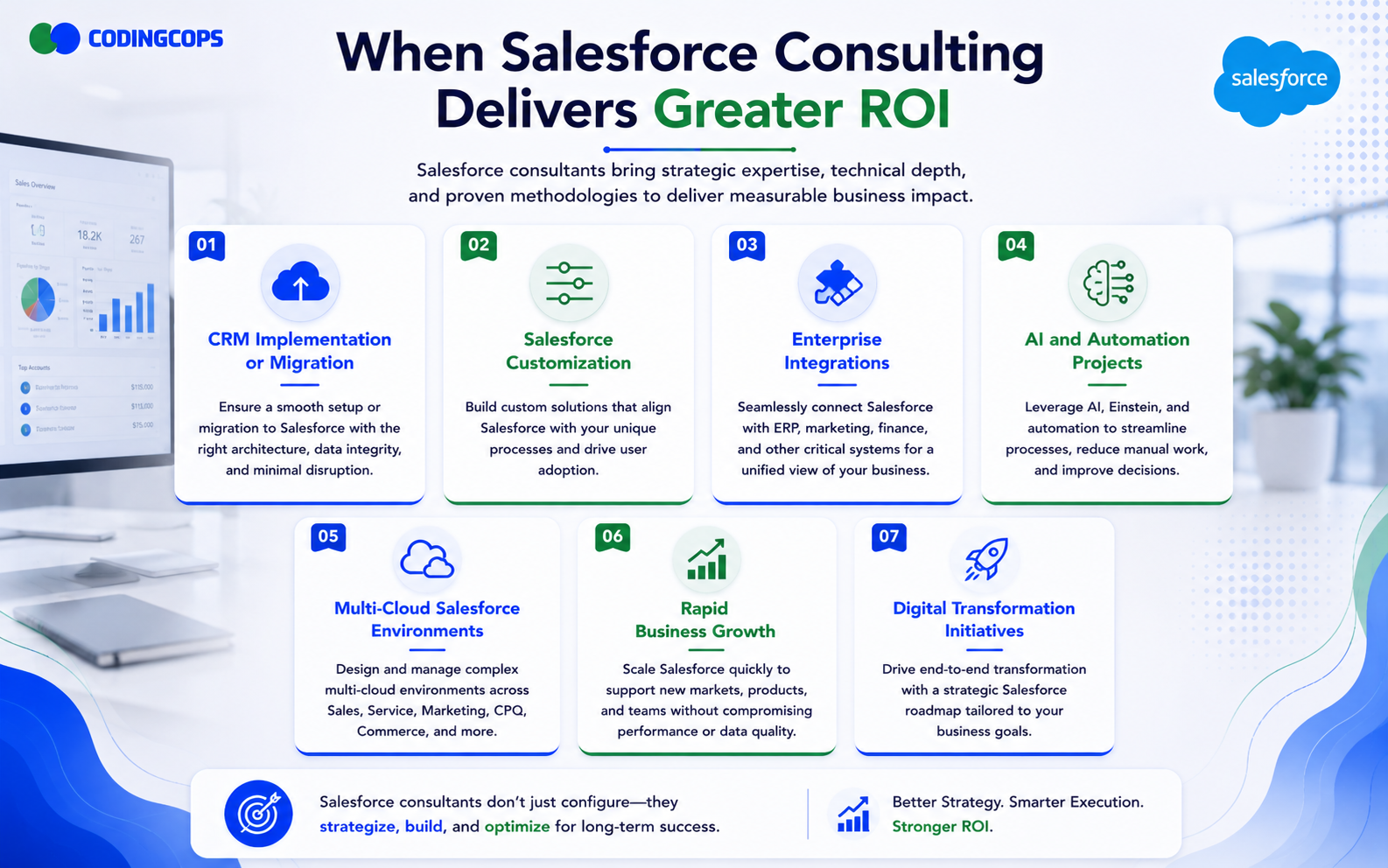
When Salesforce Consulting Delivers Greater ROI
CRM Implementation or Migration
Implementing Salesforce correctly from the beginning prevents expensive redesigns later. Consultants help define architecture, migrate data, configure objects, and establish governance.
Salesforce Customization
Businesses with unique workflows often require custom objects, automation, and tailored user experiences that consultants can design efficiently.
Enterprise Integrations
Connecting Salesforce with:
- ERP systems
- Marketing automation
- Finance platforms
- Customer support software
- Data warehouses
requires specialized integration expertise.
AI and Automation Projects
Modern Salesforce environments increasingly include AI capabilities, predictive insights, intelligent workflows, and automated business processes. Consultants help organizations deploy these technologies strategically.
Multi-Cloud Salesforce Environments
Organizations using Sales Cloud, Service Cloud, Marketing Cloud, Experience Cloud, or Data Cloud require architecture expertise beyond routine administration.
Rapid Business Growth
Moreover, fast-growing companies frequently outgrow their original CRM design. Consultants help redesign Salesforce to support expanding teams, regions, and product lines.
Digital Transformation Initiatives
When Salesforce becomes the central platform connecting multiple teams, consultants ensure scalability, governance, and business alignment.
The Hybrid Approach: Why Many Businesses Choose Both
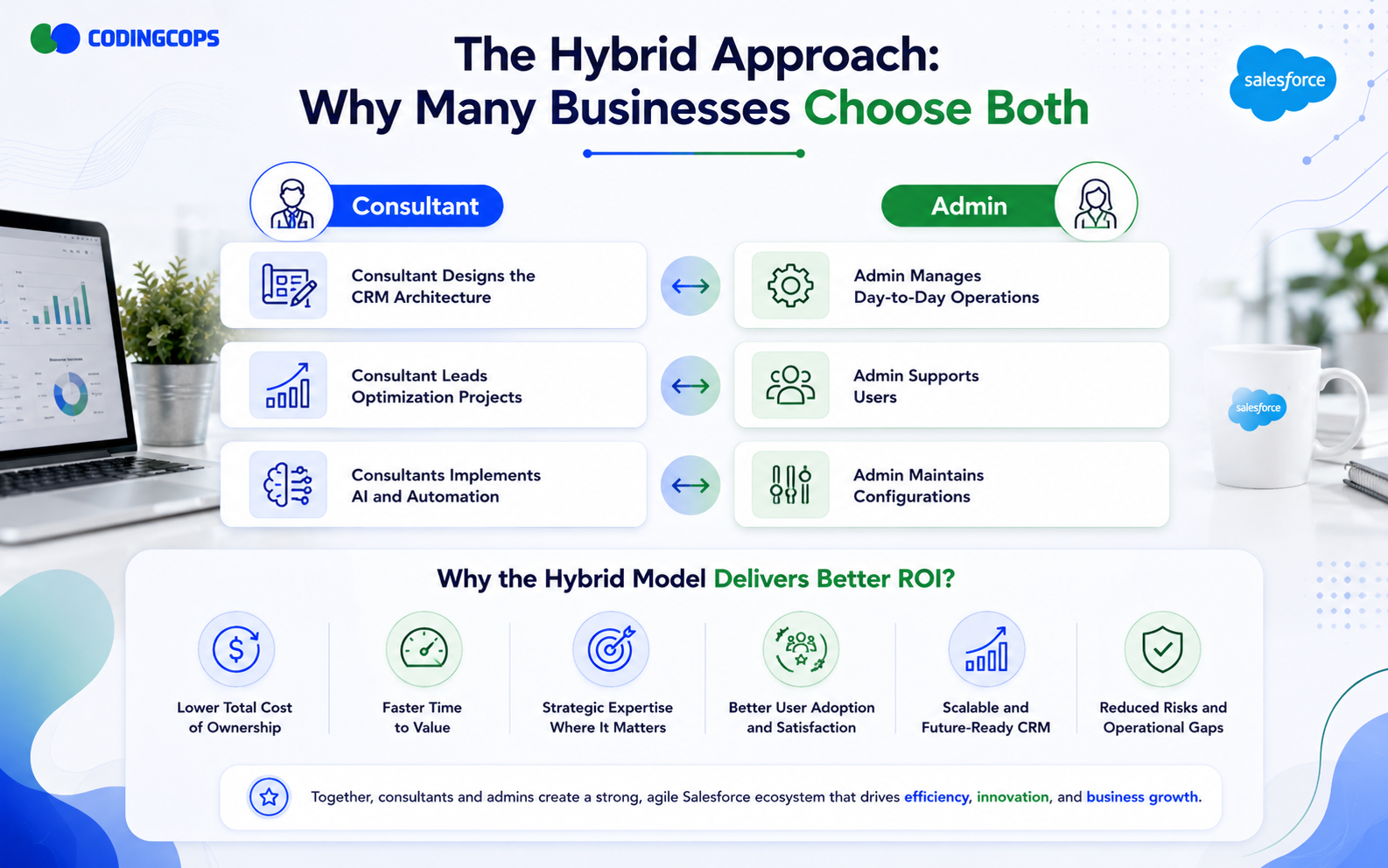
For many organizations, choosing between a Salesforce consultant and an in-house Salesforce Admin isn’t an either-or decision. Instead, they combine both roles to maximize the value of their CRM investment. A hybrid approach allows businesses to benefit from strategic expertise during major initiatives while ensuring reliable day-to-day platform management.
Salesforce consultants and administrators bring different but complementary skill sets. Consultants focus on long-term planning, system architecture, and business transformation, whereas administrators ensure the platform continues to operate efficiently after implementation. Together, they create a balance between innovation and operational stability.
This approach is especially valuable for growing businesses that frequently introduce new products, expand into new markets, integrate additional systems, or adopt emerging Salesforce technologies like AI and automation. Rather than relying on a single resource to handle every responsibility, organizations assign strategic projects to consultants while entrusting routine CRM management to their internal admin.
Consultant Designs the CRM Architecture
A successful Salesforce implementation begins with well-designed architecture. Salesforce consultants analyze business processes, identify future growth requirements, and build a scalable CRM foundation that aligns with organizational goals.
Their responsibilities may include:
- Designing custom data models
- Planning security and permission structures
- Defining automation strategies
- Creating integration architecture
- Establishing CRM governance
- Recommending Salesforce products and features
By building the platform correctly from the start, consultants help reduce technical debt and make future enhancements easier and more cost-effective.
Admin Manages Day-to-Day Operations
Once Salesforce is implemented, the in-house administrator becomes responsible for keeping the platform running smoothly. They serve as the primary point of contact for users and ensure the CRM remains accurate, secure, and reliable.
Daily responsibilities typically include:
- Managing user accounts and permissions
- Creating reports and dashboards
- Maintaining workflows and approval processes
- Cleaning and validating CRM data
- Resolving user issues
- Updating page layouts and fields
- Monitoring platform performance
This ongoing support helps employees use Salesforce effectively while maintaining high data quality across the organization.
Consultant Leads Optimization Projects
Business requirements evolve over time, and Salesforce should evolve with them. Consultants periodically review the CRM environment to identify opportunities for improvement and ensure the platform continues to support business growth.
Optimization projects often include:
- Redesigning sales processes
- Improving automation workflows
- Enhancing reporting capabilities
- Streamlining customer journeys
- Optimizing lead management
- Implementing new Salesforce features
- Improving system performance
Rather than making incremental changes without direction, consultants ensure every enhancement aligns with broader business objectives.
Admin Supports Users
User adoption plays a significant role in Salesforce success. Even the most advanced CRM implementation delivers limited value if employees struggle to use it effectively.
Salesforce administrators provide ongoing support by:
- Answering user questions
- Delivering onboarding sessions
- Creating training materials
- Troubleshooting configuration issues
- Gathering user feedback
- Recommending small usability improvements
Their close interaction with employees allows them to identify recurring challenges and communicate valuable insights to consultants for future optimization initiatives.
Consultants Implements AI and Automation
As Salesforce continues to expand its AI capabilities, businesses increasingly rely on consultants to implement intelligent automation that improves efficiency and decision-making.
Consultants help organizations:
- Deploy AI-powered lead scoring
- Build automated sales workflows
- Implement intelligent case routing
- Configure predictive forecasting
- Integrate Salesforce AI features
- Connect AI models with business data
- Design approval workflows with human oversight
Because these projects often involve multiple systems and business processes, consultants provide the specialized expertise needed for successful implementation.
Admin Maintains Configurations
After AI solutions, automations, and custom workflows are deployed, adminstrators ensure they continue operating correctly over time.
Their ongoing responsibilities include:
- Monitoring automation performance
- Updating workflow rules
- Managing validation rules
- Maintaining dashboards
- Adjusting user permissions
- Supporting new employees
- Keeping configurations aligned with business changes
This continuous maintenance helps preserve system performance while minimizing disruptions to daily operations.
Why the Hybrid Model Delivers Better ROI?
The hybrid approach combines strategic innovation with operational consistency. Consultants focus on designing scalable solutions and driving transformation, while administrators ensure those solutions continue delivering value every day.
This model offers several benefits:
- Faster Salesforce implementations
- Lower long-term maintenance costs
- Improved user adoption
- Better data quality
- Greater system scalability
- Continuous optimization
- Reduced operational risk
- More efficient use of internal resources
Instead of expecting one person to handle strategy, implementation, optimization, and daily administration, businesses utilize specialists for each area. This not only improves Salesforce performance but also enables organizations to respond more quickly to changing business needs.
Factors to Consider Before Making a Decision
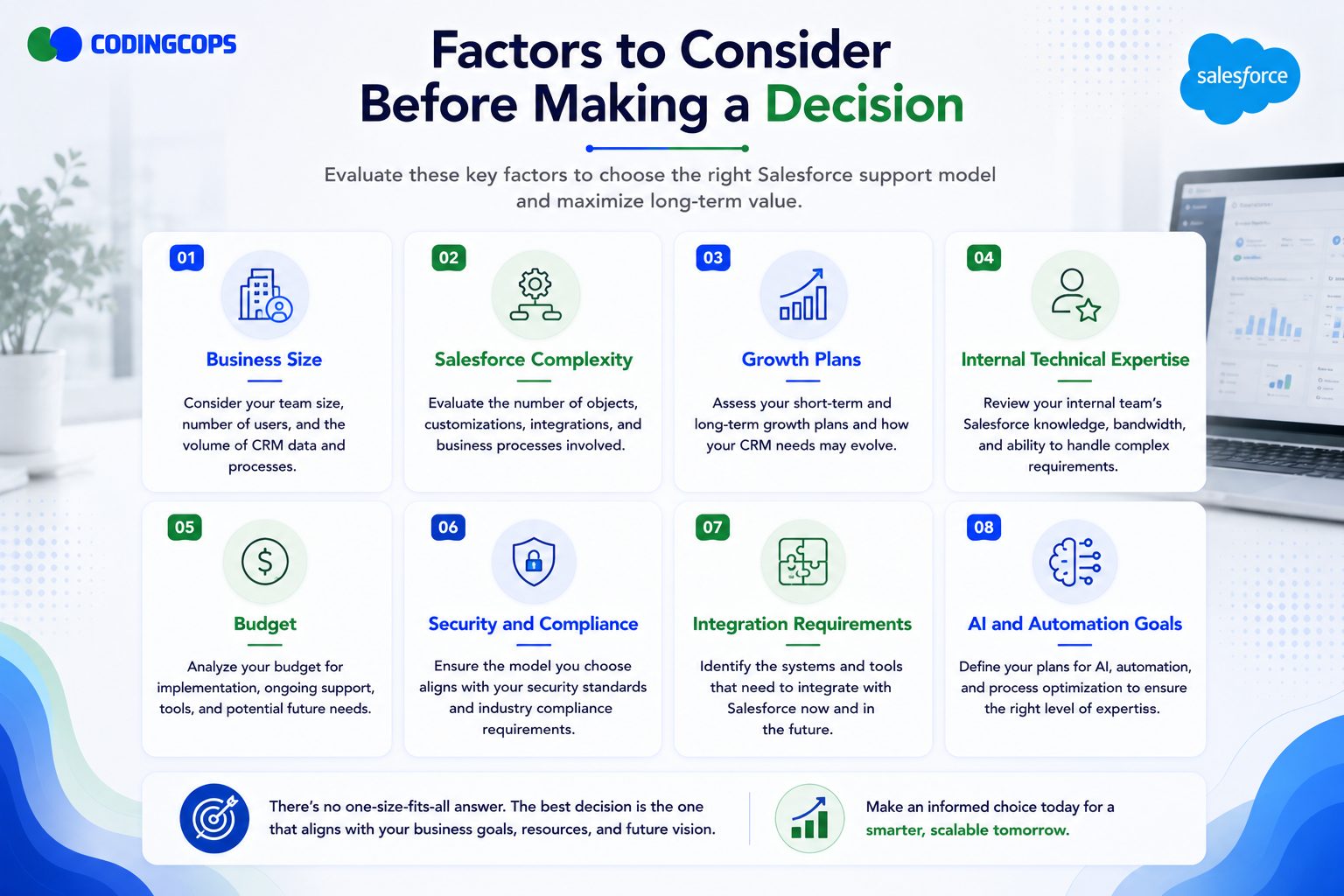
Choosing between a Salesforce consultant, an in-house Salesforce Admin, or a hybrid approach requires more than comparing costs. The right decision should align with your organization’s current needs, future growth strategy, technical capabilities, and long-term CRM objectives. Evaluating the following factors will help ensure your Salesforce investment delivers maximum business value.
Business Size
Small businesses and startups typically have straightforward sales processes and fewer Salesforce users. They often benefit from working with a Salesforce consultant during the initial implementation to establish a solid CRM foundation. Once the platform is stable, an in-house administrator, or even a part-time admin, can manage routine operations.
Mid-sized companies usually experience rapid growth, expanding teams, and evolving business processes. These organizations often require both strategic consulting for ongoing improvements and an administrator for daily support, making a hybrid model particularly effective.
Large enterprises generally operate across multiple teams, regions, or business units. They often rely on multiple Salesforce Clouds, custom applications, and enterprise integrations, requiring a combination of consultants, administrators, developers, and architects to manage their CRM ecosystem effectively.
Salesforce Complexity
Not every Salesforce implementation requires the same level of expertise. The complexity of your CRM environment should play a major role in your decision.
Organizations using Salesforce primarily for contact management and opportunity tracking may only need ongoing administrative support. However, businesses with custom objects, advanced automation, multiple business processes, or industry-specific workflows often benefit from experienced Salesforce consultants.
Complex Salesforce environments commonly include:
- Custom applications
- Advanced approval workflows
- Complex security models
- Industry-specific configurations
- Multiple Salesforce Clouds
- Large volumes of customer data
- Extensive automation
- Custom Lightning components
As complexity increases, the need for strategic architecture and specialized consulting expertise becomes more important.
Growth Plans
If your organization plans to launch new products, enter international markets, acquire other companies, or significantly increase its customer base, your CRM must be designed to scale without requiring expensive rework.
Salesforce consultants help businesses build scalable architectures that accommodate future growth, while administrators ensure the platform continues operating efficiently as new users and processes are added.
Consider your long-term roadmap, including:
- Geographic expansion
- New product or service launches
- Sales team growth
- Customer support expansion
- Mergers and acquisitions
- Increased automation initiatives
Planning for growth early reduces future implementation costs and minimizes operational disruption.
Internal Technical Expertise
Organizations with experienced CRM professionals, developers, and IT teams may only require consultants for specialized projects such as AI implementation, integrations, or architecture reviews.
Conversely, companies with limited Salesforce experience often benefit from consultant-led implementation followed by administrator training and ongoing support.
Evaluate whether your internal team has expertise in:
- Salesforce administration
- CRM governance
- Business process design
- Data migration
- API integrations
- Automation tools
- Security configuration
- User training
Budget
While budget is always an important consideration, businesses should evaluate the total cost of ownership rather than focusing solely on short-term expenses.
Hiring an in-house Salesforce Admin involves ongoing costs such as salary, benefits, training, certifications, and employee retention. Consulting services may require a higher initial investment but often reduce long-term costs by delivering faster implementations, scalable solutions, and fewer costly mistakes.
Instead of asking, “Which option is cheaper?”, ask:
- Which approach delivers the highest long-term ROI?
- What are the costs of implementation delays?
- How much revenue could improved automation generate?
- What are the risks of poor CRM adoption or inefficient processes?
A strategic investment in Salesforce expertise often produces significant operational and financial returns over time.
Security and Compliance
For organizations handling sensitive customer information, security and regulatory compliance should be central to the decision-making process.
Industries such as healthcare, finance, insurance, and government often operate under strict compliance requirements. Salesforce consultants can help design secure CRM architectures, implement role-based access controls, establish governance policies, and ensure compliance with industry regulations.
Meanwhile, Salesforce administrators maintain these security measures by managing user permissions, monitoring access, and supporting regular audits.
Important security considerations include:
- User authentication and access controls
- Role hierarchy and permission management
- Data encryption
- Audit trails
- Compliance reporting
- Backup and disaster recovery
- Secure integrations
- Data retention policies
A secure Salesforce environment protects customer trust while reducing operational risk.
Integration Requirements
Salesforce rarely operates as a standalone platform. Most organizations integrate it with multiple business applications to create a connected digital ecosystem.
The more systems involved, the greater the complexity of implementation and ongoing management.
Common Salesforce integrations include:
- ERP systems
- Marketing automation platforms
- Accounting software
- Customer support tools
- eCommerce platforms
- Communication platforms
- Business intelligence solutions
- Data warehouses
Salesforce consultants typically design and implement these integrations, ensuring reliable data flow and system performance. After deployment, administrators monitor integration health, troubleshoot routine issues, and manage user-facing configurations.
AI and Automation Goals
AI is becoming a core component of modern Salesforce environments. Organizations looking to automate repetitive work, improve decision-making, and enhance customer experience should consider whether they have the expertise to implement AI effectively.
Salesforce developers help organizations identify high-value automation opportunities and deploy solutions such as:
- AI-powered lead scoring
- Intelligent case routing
- Predictive sales forecasting
- Automated approval workflows
- Customer service automation
- Personalized customer engagement
- AI-driven analytics
- Agentic AI and Salesforce Agentforce implementations
Once these capabilities are deployed, Salesforce administrators ensure automations remain accurate, update workflows as business processes evolve, and monitor overall system performance.
Decision Framework: Which Option Is Right for Your Business?
| Business Scenario | Recommended Approach |
|---|---|
| Startup implementing Salesforce for the first time | Salesforce Consultant |
| Growing SaaS company | Hybrid |
| Enterprise using multiple Salesforce Clouds | Salesforce Consultant + Internal Team |
| Mature CRM with stable processes | In-House Admin |
| International expansion | Hybrid |
Common Mistakes Businesses Make
Several common decisions reduce Salesforce ROI:
- Hiring an administrator before defining CRM strategy
- Using consultants for routine administrative work
- Delaying CRM optimization until problems become severe
- Underestimating integration complexity
- Ignoring user adoption and training
- Choosing solely based on short-term costs rather than long-term business value
Best Practices for Maximizing Salesforce ROI
Use this checklist to get the most from your Salesforce investment:
✔ Define business goals before hiring.
✔ Invest in CRM governance.
✔ Keep system documentation updated.
✔ Measure user adoption and business outcomes.
✔ Review automation regularly.
✔ Align Salesforce strategy with business growth.
✔ Combine consulting and internal expertise when appropriate.
Regular reviews ensure Salesforce continues supporting evolving business priorities rather than becoming outdated.
Real-World Example
Growing B2B Technology Company
A mid-sized B2B software company implemented Salesforce to replace spreadsheets and multiple disconnected sales tools.
Initial CRM Challenges
The company struggles with:
- Duplicate customer records
- Manual lead assignments
- Limited reporting
- Poor sales visibility
- Disconnected marketing systems
Consultant-Led Implementation
A Salesforce consulting partner designed the CRM architecture, migrated data, integrated marketing automation, implemented workflow automation, and created executive dashboards.
Transition to In-House Administration
Once implementation was complete, the company hired a Salesforce Administrator to manage users, maintain reports, monitor data quality, and support daily operations.
Ongoing Optimization Projects
As the business expanded internationally, consultants periodically returned to:
- Implement AI-powered lead scoring
- Integrate new business systems
- Optimize automation
- Improve forecasting
Business Results
Within the first year, the company achieved:
- Faster sales processes
- Improved reporting accuracy
- Higher CRM adoption
- Better data quality
- Reduced manual work
- Greater executive visibility
How CodingCops Helps Businesses Maximize Salesforce ROI?
At CodingCops, we help organizations unlock the full value of Salesforce through strategic consulting and long-term optimization.
Our Salesforce services include:
- Salesforce consulting and strategy
- CRM implementation and migration
- Custom Salesforce development
- AI-powered automation
- Third-party system integrations
- Managed Salesforce support
- Salesforce Admin augmentation
- Continuous platform optimization
Whether you are implementing Salesforce for the first time, modernizing an existing CRM, or expanding into AI-powered workflows, our teams help you build a scalable Salesforce environment that grows alongside your business.
Conclusion
There is no universal answer to the Salesforce consultant versus in-house admin debate. The right choice depends on your organization’s size, CRM maturity, technical complexity, and growth ambitions. An in-house administrator is ideal for maintaining a stable Salesforce environment and supporting users, while a consultant provides the strategic expertise needed for implementation, optimization, integrations, and innovation.