



The worldwide quantum AI industry is anticipated to grow to $3.9 billion over the next seven years, according to a report. This is because traditional computer systems are beginning to have performance issues as datasets grow in size and models get more intricate. As a result, training complex algorithms frequently takes days and demands a lot of processing power.
Quantum computing can be useful in this situation. It solves issues that are unsolvable for classical systems by utilizing the concepts of quantum mechanics. Moreover, when combined with AI, this is known as Quantum AI. It has the potential to exponentially boost computation and accuracy.
In this guide, we’ll discuss what quantum AI is and how it can improve machine learning. Furthermore, we will also look at its real world applications.
Quantum AI
Quantum AI is essentially the fusion of quantum computing with artificial intelligence. Artificial intelligence allows robots to learn from this data and make well informed decisions, while quantum computing provides a fresh method for information processing. Therefore, by combining them, quantum AI aims to speed up problem solving that is now beyond the capabilities of even the most potent conventional computers.
Additionally, quantum AI improves machine learning algorithms by using quantum features. To learn from them, machine learning models in classical AI must handle massive datasets and carry out laborious computations. However, many of these actions may be carried out in parallel by quantum algorithms, greatly cutting down on training time and energy usage.
This is especially helpful for applications like probabilistic reasoning and pattern recognition, where the search field is rather large and traditional approaches find it difficult to find the best answers fast.
How Quantum Computing Can Help Improve Machine Learning?
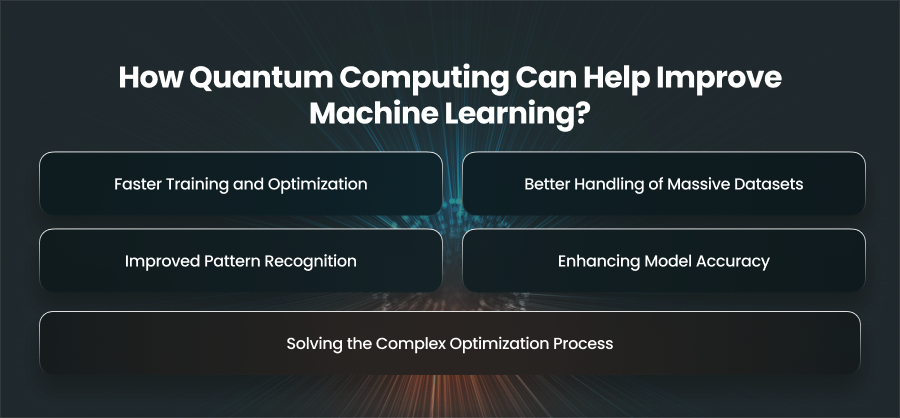
Faster Training and Optimization
If you have ever trained a deep learning model, you know the pain. Your progress bar must creep across the screen for hours on end. In order to train an AI model, a vast array of options must be explored in order to determine the optimal set of parameters that minimizes mistakes. Unlike conventional computers, which can only look for these options one at a time, quantum computers may explore several routes simultaneously since they can exist in multiple states.
This is where ideas like variational quantum algorithms and quantum annealing come into their own. Compared to traditional techniques like gradient descent, they are built to identify optimal solutions over vast landscapes considerably more quickly.
Better Handling of Massive Datasets
Data is essential to machine learning, but the amount of data is growing daily—petabytes upon petabytes. When datasets grow too large to handle effectively, classical systems suffer. This is altered by quantum computing, which makes it possible to store and analyze data in superposition, enabling parallel computations that can handle massive volumes of data simultaneously.
In complicated datasets, quantum methods such as the Quantum Fourier Transform and Quantum Principal Component Analysis are far more effective in finding patterns and reducing dimensionality. Imagine being able to examine all potential relationships in a dataset simultaneously rather than one at a time. This is what quantum computing offers to machine learning: extremely rapid insights from data that would otherwise need a very long time to understand.
Improved Pattern Recognition
Furthermore, pattern recognition is a key component of machine learning. This is elevated to a whole new level by quantum computing. Because quantum neural networks can represent exponentially huge data spaces, they are able to identify intricate and nuanced relationships that conventional systems could miss.
Correlations between several variables can be concurrently captured by quantum states. This allows Quantum AI systems to build models that not only recognize patterns but also understand them more deeply, leading to improved decision making and predictions.
Solving the Complex Optimization Process
Machine learning and real world decision making, such as supply chain and financial portfolio optimization, are fundamentally based on optimization. While classical algorithms often produce acceptable solutions, they may not always find the best one because they become trapped in “local minima.” However, quantum algorithms increase the likelihood of locating the global optimum by evaluating several options simultaneously through superposition and entanglement.
When it comes to solving optimization problems that would take years for conventional computers, quantum annealers are already demonstrating potential. Imagine being able to optimize thousands of interconnected variables simultaneously.
Enhancing Model Accuracy
One of the biggest headaches in machine learning is ensuring that models don’t just memorize data but actually learn generalizable patterns. ML models may use quantum states to represent data in higher dimensional domains thanks to quantum computing. Additionally, models are better able to identify small variations and produce more accurate predictions when these representations are richer.
In actuality, this may result in AI systems that learn more efficiently with less data. A quantum enhanced model might be able to make accurate predictions even when trained on smaller datasets, saving both time and resources.
Applications of Quantum AI
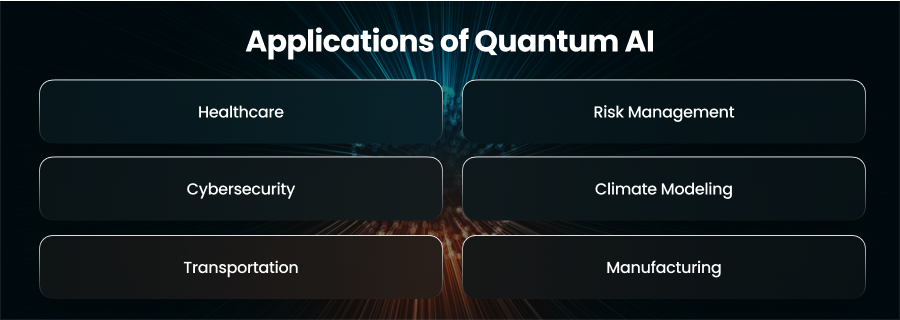
Healthcare
Research on pharmaceuticals and healthcare is one of the most promising uses of quantum AI. Finding new medications is a very costly and time consuming procedure; it sometimes takes more than 10 years and billions of dollars to bring a single medication to market. By accurately replicating chemical structures and interactions at the atomic level, quantum AI has the ability to alter that.
Traditional computers can only approximate how molecules behave, but quantum systems can model these interactions in their natural quantum states. This suggests that by more accurately and swiftly anticipating how a medicine will bind to a target protein, quantum AI may greatly minimize the amount of trial and error required in drug research.
Additionally, scientists may find the most promising compounds in a quarter of the time it takes now by combining machine learning with quantum chemistry simulations.
Risk Management
The financial sector thrives on data and speed, both of which are Quantum AI’s greatest strengths. Quantum systems have the potential to transform algorithmic trading and risk analysis in markets where a millisecond delay may result in millions of dollars won or lost.
Large volumes of financial data may be analyzed concurrently by quantum AI, which can identify hidden relationships and forecast market patterns more quickly than any traditional model. For example, Quantum Machine Learning algorithms can process nonlinear relationships in stock movements or credit risks.
Another area where quantum AI excels is risk management. It can evaluate the possible consequences of market volatility with remarkable accuracy by doing several simulations simultaneously. Banks and insurance companies may utilize these results to lower financial risk and build stronger portfolios.
Cybersecurity
Traditional security measures are finding it difficult to keep up with the rising sophistication of cyber attacks. Quantum improved detection and quantum safe encryption are two advantages of quantum AI in cybersecurity.
On one side, AI models powered by quantum computing can process massive networks datasets to detect threats or unusual behaviors far faster than classical systems. These models can recognize subtle and complex patterns in network traffic that often go unnoticed. This enables real time prevention rather than delayed reaction.
On the other side, quantum cryptography, especially Quantum Key Distribution, uses the principles of quantum mechanics to create virtually unbreakable encryption. Any attempt to intercept or measure a quantum key changes its state and alerts the the system immediately. When combined with AI driven monitoring, this creates a security infrastructure that’s not just reactive, but proactive and nearly impenetrable.
Climate Modeling
Understanding and predicting climate behavior requires analyzing enourmous datasets involving temperature and atmospheric chemistry. Classical computers can only approximate these interactions. Quantum AI, however, can handle this complexity directly.
Quantum AI can create considerably more realistic climate models by modeling the interactions between several factors at once. Scientists may be able to forecast catastrophic weather occurrences or precisely optimize renewable energy installations with the aid of these models.
For instance, by quickly evaluating millions of material combinations to identify the best options, quantum accelerated machine learning may enhance energy efficiency and carbon capture models. Quantum AI has the ability to reduce fuel usage and carbon footprints across sectors by enhancing global logistics and resource allocation.
Transportation
The transportation and logistics sectors largely rely on optimization for anything from controlling traffic in busy cities to coordinating global supply chains. Quantum AI is really good at this. Traditional systems can optimize routes or delivery schedules, but only within limited parameters. Quantum AI can handle thousands of interconnected factors simultaneously.
For instance, in route optimization, a quantum powered algorithm can analyze real time traffic and vehicle capacity. Hence, this makes finding the most efficient routes easy.
In aviation and shipping, Quantum AI can optimize fleet scheduling and even air traffic management. Imagine a system capable of coordinating thousands of flights globally this reduces delays.
Manufacturing
Quantum AI integration has enormous potential benefits for robotics and manufacturing. Future factories will depend on predictive maintenance and intelligent robots, both of which need accurate and fast data processing.
By evaluating sensor data from thousands of devices at once and seeing problem indicators long before they occur, quantum AI can speed up predictive maintenance. This ensures smooth production by reducing downtime and saving money.
What Are the Challenges in Quantum AI?
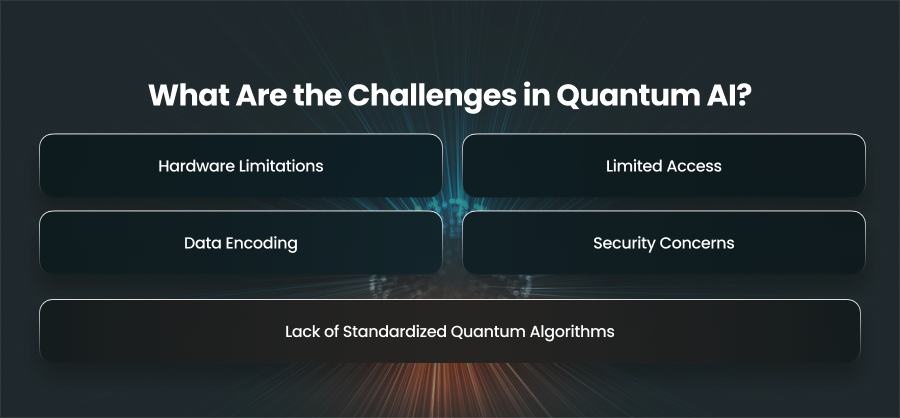
Hardware Limitations
The hardware itself presents one of the biggest obstacles. Qubits are used by quantum computers to carry out calculations, however they are infamously unstable. They are extremely sensitive to outside influences like vibrations and temperature. Even little disturbances can cause quantum decoherence, in which qubits lose their quantum state and the system collapses into classical behavior.
In order to maintain coherence, quantum computers often operate at temperatures close to absolute zero. As a result, their construction and maintenance are extremely expensive. These days, very few businesses have the resources and infrastructure needed to operate these devices.
Lack of Standardized Quantum Algorithms
In a classical machine learning, there’s a wealth of mature algorithms, like decision trees and support vector machines, that developers can easily apply and adapt. However, the quantum computing field lacks standardized algorithms that can be universally used for AI and machine learning tasks.
Quantum algorithms are still in experimental stage, often tailored for specific hardware or narrow use cases. Developing reliable and efficient algorithms is major research challenge. Moreover, translating classical models into quantum equivalents isn’t straightforward because quantum systems follow different rules of logic and data representation.
Limited Access
Another barrier to Quantum AI advancement is limited accessibility. Quantum computers are not only scarce but also extremely costly to operate. Most researchers and organizations rely on cloud based quantum computing services offered by tech giants to test their algorithms. While this provides access, it’s often limited by computational capacity and high operational costs.
For startups, these constraints make it difficult to experiment freely or run large scale quantum AI simulations.
Data Encoding
Quantum encoding, sometimes called quantum feature mapping, is the process of transforming conventional data into quantum data so that AI models can benefit from quantum computing. Because high dimensional classical data must be embedded into quantum states without losing information, this procedure is difficult and resource-intensive.
Additionally, quantum systems are vulnerable to quantum noise, which can skew computing outputs.
Security Concerns
New ethical and cybersecurity issues are brought forth by the evolution of quantum AI. Data privacy might be at danger because quantum computers have the ability to crack existing encryption standards.
In the meanwhile, autonomous judgments might be made very quickly by AI systems augmented by quantum power.
Final Words
Faster learning and previously unheard of problem solving skills are promised by quantum AI, a combination of quantum computing with artificial intelligence. Even while issues like scalability and hardware constraints still exist, continued research is bridging the gap.