




According to statistics, the DevOps market is expected to reach $25.5 billion in the next three years. However, Gartner predicts that by next year, 80% of companies will have specialized platform engineering teams.
This is due to the fact that DevOps is now the standard operating paradigm for contemporary software teams. It pushed ogrown more distrganizations toward faster releases and stronger automation. However, as systems have ributed and cloud native. Therefore, DevOps alone is no longer enough to handle the mounting operational burden on engineering teams. This is where Platform Engineering can help.
In this guide, we will discuss the differences between DevOps and Platform Engineering and what CTOs should focus on as they plan their engineering strategy.
DevOps
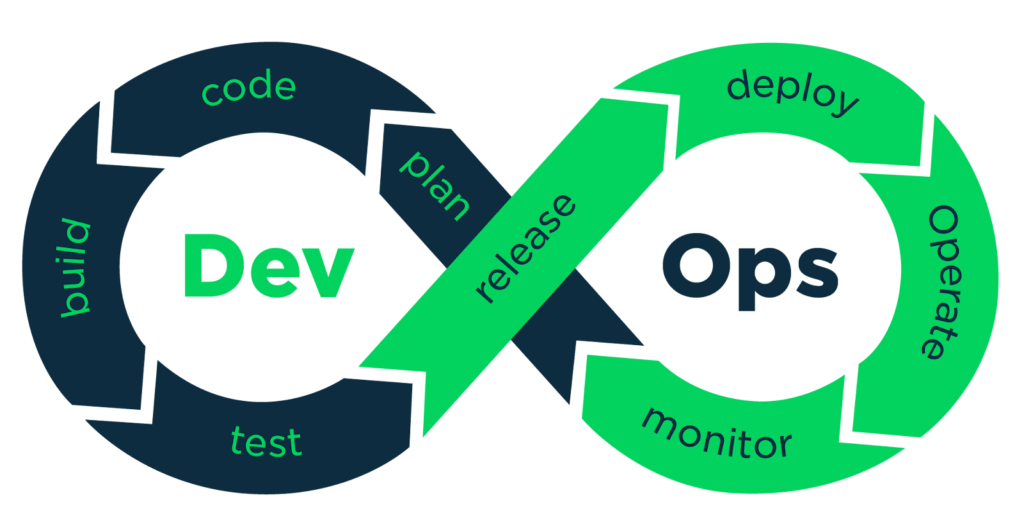
DevOps has always been more about culture than technology. DevOps essentially encourages collaboration and automation between the operations and development teams. It compels companies to eliminate organizational divisions and provide a reliable pipeline from development to production.
Moreover, the goals of DevOps include:
- Minimize conflict between operations and developers
- Reduce deployment cycles and increase release frequency
- Automate infrastructure and deployment workflows
- Increase stability through monitoring and integration
DevOps techniques have evolved over time to encompass incident management and infrastructure as code in addition to CI/CD. DevOps now encompasses everything required to deliver software more quickly.
Where DevOps Starts to Struggle?
DevOps works exceptionally well for small teams or organizations with simple architectures. But as companies grow, challenges begin to appear:
- Tool Sprawl: Teams adopt different tools without standardization.
- Increased cognitive load: Developers must understand YAML files, Docker Images, on top of their actual coding work.
- Inconsistency: Each team may build its CI/CD workflows differently. This leads to governance issues.
Platform Engineering
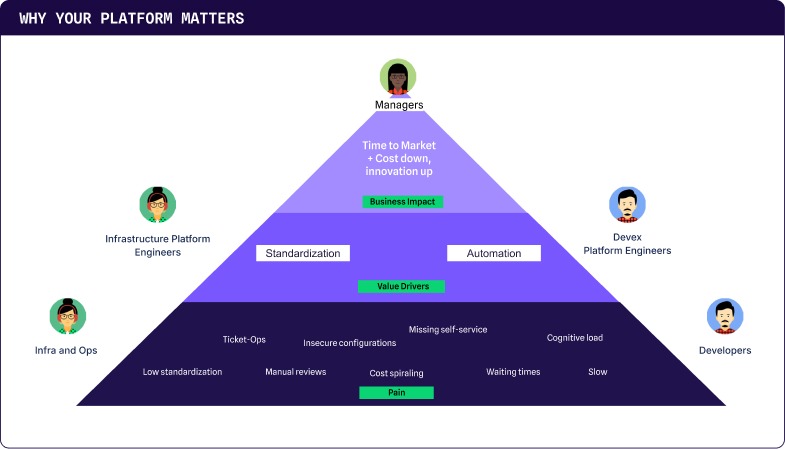
The operational overload brought on by microservices and cloud native ecosystems gave rise to platform engineering. Platform engineering centralizes this effort and treats it like a product rather than making each technical team manage its own pipeline.
Platform Engineering teams create Internal Developer Platforms, self service systems that give developers everything they need to build and deploy software without dealing with the underlying complexity.
This includes:
- Standardized service templates
- Self service infrastructure provisioning
- Automated security and compliance policies
- Pre built CI/CD pipelines
- Observable systems out of the box
Why Platform Engineering Matters?
The increasing complexity of modern systems makes it unrealistic for developers to know everything about Kubernetes and cloud governance. Platform Engineering solves this by removing low level decisions from developers and providing a paved road that’s safe and consistent.
Some of the biggest benefits include:
- Lower cognitive load
- Higher developer productivity
- Standardized infrastructure and workflows
- Reduced cloud and tooling costs
- More secure and compliant deployments
In many ways, Platform Engineering takes the principles of DevOps and operationalizes them into a product that scales across the entire organization.
Differences Between DevOps and Platform Engineering
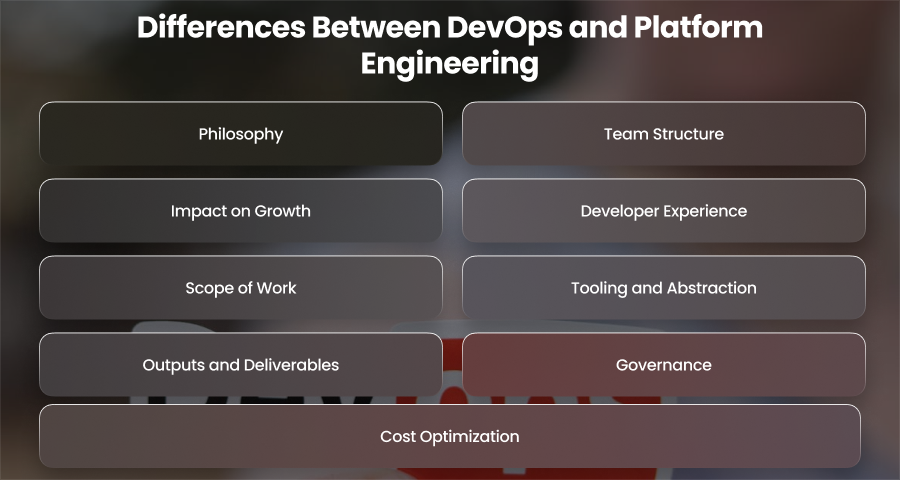
Philosophy
DevOps is an organizational and cultural change. It promotes strong collaboration between development and operations teams to create automated pipelines that eliminate manual tasks. It’s about changing how teams work.
Platform Engineering takes those cultural principles and transforms them into a technical solution. Instead of relying on each team to figure out how to do DevOps, platform engineering creates an opinionated and unified approach.
Team Structure
DevOps teams are structured in many different ways. Some companies embed DevOps engineers directly into feature teams, while others operate centralized DevOps units that act as internal consultants. As a result, DevOps practices often vary from team to team.
Platform Engineering introduces a more formalized model. Platform teams operate like internal product organizations that serve the entire engineering department. They maintain backlogs and cross team feedback loops. This creates standardization across all engineering teams.
Scope of Work
DevOps engineers focus on the full software delivery lifecycle. By bridging the gap between various developers, they ensure that code moves smoothly from development to production. A more basic set of duties falls within the purview of platform engineers.
They build Internal Developer Platforms and create golden paths for common workflows. They also standardize infrastructure modules and maintain shared observability tooling. Instead of helping developers individually, they create reusable systems that eliminate repetitive support work.
Developer Experience
One of the clearest differences is the impact on developer experience. In a DevOps only environment, developers often interact directly with cloud services and write deployment configurations. This increases cognitive load, especially for developers who prefer focusing on product features rather than infrastructure details. Platform Engineering dramatically reduces this burden. By providing self service capabilities and unified deployment workflows, it shields developers from unnecessary complexity.
Impact on Growth
For smaller teams, DevOps grows very well, although fragmentation is a common problem in bigger enterprises. Each team can build its own automation scripts or use inconsistent infrastructure patterns. As the engineering organization grows, so does the operational burden, often requiring additional DevOps engineers to support each team.
Platform Engineering scales differently. A strong platform team can support hundreds of developers by centralizing workflows and enforcing standardized tooling. Improvements made by the platform team benefit the entire organization, turning the platform into a force multiplier rather than a team specific solution.
Tooling and Abstraction
DevOps emphasizes automating existing workflows. If a team uses Kubernetes, DevOps automates deployments. If a team uses Terraform, DevOps helps codify infrastructure.
Platform Engineering takes a higher level approach by abstracting complexity away entirely. Instead of exposing developers to raw Kubernetes manifests or cloud configurations, the platform provides a simplified interface that automatically translates into the correct underlying resources.
Outputs and Deliverables
The outcomes produced by DevOps and Platform Engineering differ significantly. DevOps outputs include automated pipelines and infrastructure scripts. These are essential but vary across teams and use cases.
Platform Engineering outputs tangible internal products and standardizes observability frameworks. These deliverables reshape the daily workflows of every engineering team.
Governance
Although DevOps guarantees that security and governance procedures are automated, teams frequently apply them differently. Platform Engineering embeds those policies direclty into the platform. Security guardrails and resource standards become part of the underlying system rather than optional steps.
Cost Optimization
Results usually depend on how each team maintains its infrastructure, even though DevOps may save costs through automation and more effective deployments. Platform Engineering introduces centralized cost visibility and standardized resource configurations. Instead of relying on individual teams to optimize spend, cost efficiency becomes part of the platform itself. This leads to far more predictable and controlled cloud expenditures.
How DevOps and Platform Engineering Work Together?
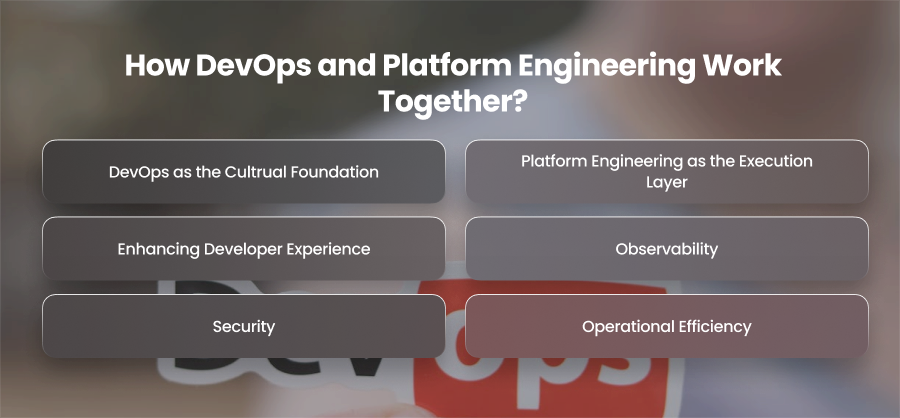
DevOps as the Cultrual Foundation
The concepts of shared ownership and continuous delivery are propelled by DevOps. It promotes a culture of responsibility and continuous improvement and fosters cross functional cooperation between different teams. DevOps makes ensuring that technical teams follow uniform procedures and deal with mistakes without assigning blame. However, DevOps alone doesn’t standardize workflows or provide self service solutions for developers.
Platform Engineering as the Execution Layer
Platform engineering is used to transform DevOps principles into scalable and repeatable solutions. By establishing Internal Developer Platforms, platform teams allow developers to utilize standardized templates. It also automates workflows without having to handle underlying infrastructure. The platform provides prebuilt, secure solutions rather than needing each team to create Kubernetes clusters.
Enhancing Developer Experience
One of the most important intersections between these two approaches is improving developer experience. DevOps encourages rapid releases and iterative improvement. However, without platform support, developers can become burdened with infrastructure complexity and configuration challenges.
By offering user friendly interfaces and predefined environments, platform engineering solves these problems. While adhering to the best practices encouraged by DevOps, developers can concentrate on producing code and providing value.
Observability
DevOps places a strong emphasis on monitoring to guarantee system dependability and prompt problem response. These observability features are immediately integrated into the internal platform by Platform Engineering. Standardized dashboards and automated notifications help teams find and address issues more quickly. This link will ensure that all services follow operational best practices and are constantly visible.
Security
Another area where Platform Engineering and DevOps work together is security. DevOps encourages the incorporation of security early in the development lifecycle by adhering to the DevSecOps guidelines. Platform Engineering regularly applies these security protections across the platform using hardened deployment pipelines. When combined, these strategies guarantee that security is integrated across the company. This allows developers to concentrate on creating new products rather than manually setting up regulations.
Operational Efficiency
DevOps processes alone may become dispersed as businesses expand, with each team overseeing its own infrastructure. Scalable operations are made possible by platform engineering, which centralizes reusable workflows and templates. This guarantees uniform procedures across several teams and minimizes redundancy. Platform Engineering offers the structural framework to sustain efficiency at scale. While DevOps culture continues to promote incremental improvements.
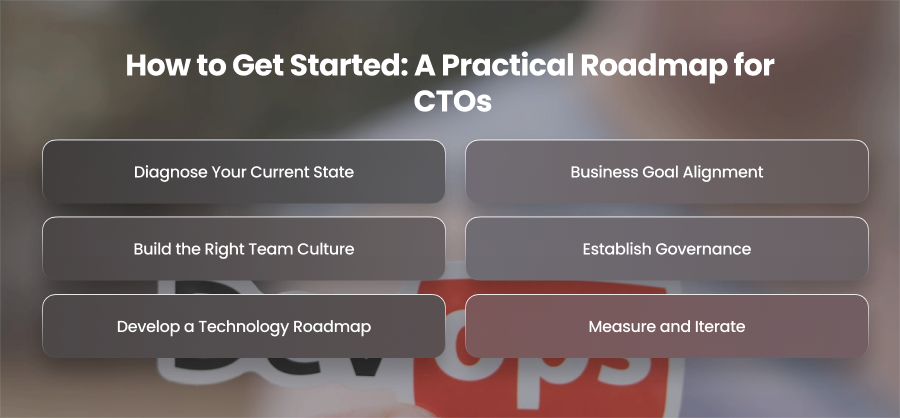
How to Get Started: A Practical Roadmap for CTOs
Diagnose Your Current State
The first step for any CTO is to gain a clear picture of where the organization stands. You should asses the maturity of your DevOps practices. At the same time, evaluate whether your teams are struggling with fragmented tooling or a lack of self service infrastructure. These pain points often signal the need for Platform Engineering.
Business Goal Alignment
Technology decisions should never be made in a vacuum. In your capacity as CTO, you must directly connect these approaches to business outcomes. Focus on improving pipelines if speed to market is your top priority. Stress platform consistency and governance if dependability and compliance are crucial.
Build the Right Team Culture
Without the appropriate people, neither platform engineering nor DevOps can be successful. Determine your skill gaps first. You should also foster a collaborative environment and make strategic recruiting selections. Encourage teams to see platform engineering as an enabler. Also, teams should see DevOps as a mindset that lets developers own delivery.
Establish Governance
As you scale, governance and security become non negotiable. Standardize coding practices and compliance checks across both DevOps and Platform Engineering initiatives. You should implement strong monitoring and incident response processes. This ensures that developers can innovate without compromising security. A well governed platform reduces risk while maintaining agility, giving leadership confidence in the technology stack.
Develop a Technology Roadmap
Make a plan that strikes a balance between immediate gains and long term goals. Automating repetitive tasks is one improvement that can provide instant results. Also, long term initiatives like building a reliable Internal Developer Platform should be planned iteratively. This will keep the roadmap flexible to business shifts. It will also ensure that both DevOps practices and Platform Engineering grow together.
Measure and Iterate
To monitor progress, you need also set up precise metrics. This might refer to the frequency of deployments or the recovery time for DevOps. Conversely, track adoption rates and a decrease in support issues for Platform Engineering. Additionally, you should continually improve your plan using these findings.
Final Words
So, CTOs should view Platform Engineering and DevOps as complementary forces. DevOps drives culture and speed, while Platform Engineering provides structure and scalability. Together, they help teams to innovate and deliver faster.