




According to statistics, 70% of Fortune 100 companies use MongoDB for diverse applications. This is because as businesses scale and applications become more data intensive, the need for flexible and higly available databases has skyrocketed. Organizations have embraced contemporary database systems throughout time to support real-time applications and satisfy client demands for quicker and more integrated services.
Because MongoDB is so simple to integrate with contemporary designs like microservices, it has become a top option in this new era of application development. Database migration has therefore emerged as a crucial component of digital transformation as businesses continue to update IT stacks. The procedure calls for careful preparation, whether you are updating an existing MongoDB deployment or switching from a relational system to MongoDB.
Everything you need to know about relation migration tools and MongoDB migration will be covered in this article. The best methods for guaranteeing a successful and seamless relocation will also be covered.
What is Data Migration in MongoDB?
Data migration in MongoDB is the process of transferring data from one system into MongoDB or moving data between MongoDB environments. This could involve:
- Migration from relational databases like MySQL
- Moving between MongoDB on premises and MongoDB Atlas
- Consolidating multiple MongoDB collections
- Upgrading MongoDB clusters or restructuring data models
Because MongoDB uses a flexible and document oreinted structure, migration can often be easier than migrating between rigid relational systems. Mapping data models and making sure the new structure satisfies application requirements are still necessary, though.
There are typically three types of MongoDB migrations:
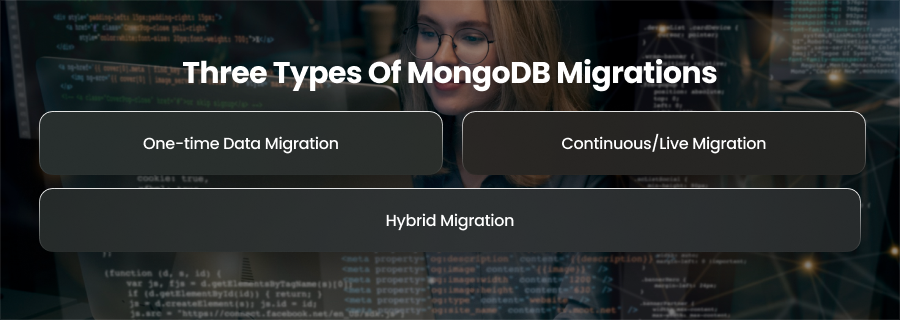
One-time Data Migration
A simple import/export process used for small or medium sized datasets or when downtime is acceptable.
Continuous/Live Migration
It is ideal for production systems where data must remain synchronized until the migration cutover.
Hybrid Migration
A combination of batch and live sync, usually used in large scale projects.
Differences Between MongoDB and Relational Databases
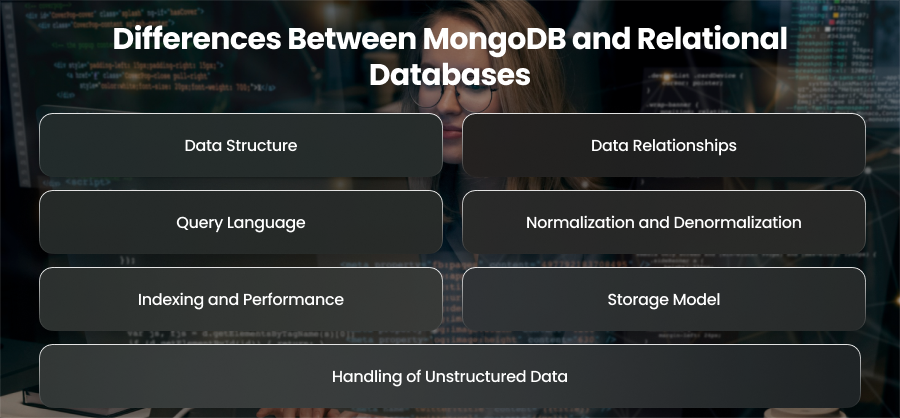
Data Structure
MongoDB is a versatile, schema free method to store data in BSON documents. Each document can have a unique form and set of fields. Because of this, developers may quickly alter the data model without generating any problems. Thus, MongoDB is ideal for rapidly developing apps and agile teams. Conversely, relational databases use structured tables with preset schemas. Every row must have the same format and data types. But altering that structure often requires schema migrations or downtime.
Data Relationships
Relational databases are designed around structured relationships. They use foreign keys and well defined constraints to maintain strong connections between tables. Developers may precisely and consistently get relevant data from several tables using complex JSON methods. MongoDB manages relationships differently; when it enhances efficiency, it promotes embedding linked documents directly into a parent document rather than depending on complicated joins.
Query Language
SQL is the universal language of relational databases, providing powerful tools for manipulating data. Its standardized structure makes it easy for developers to write complex queries across different relational systems. MongoDB uses a JSON like query language where filters and operations are expressed as key value objects.
Developers construct queries as nested objects that represent operators and conditions rather than writing text-based SQL strings. Although MongoDB’s aggregation structure is robust and expressive, it necessitates a different way of thinking and frequently entails rewriting SQL queries and stored procedures during conversion.
Normalization and Denormalization
In order to minimize redundancy and preserve consistency, relational databases mostly rely on normalization. This indicates that data is frequently divided into several tables and connected by relationships. When it enhances efficiency and minimizes the need for several queries, MongoDB promotes a denormalized strategy in which relevant information is consolidated into a single document. MongoDB reduces expensive joins and speeds up reads by embedding data, although this may result in duplication. Teams must carefully consider when to embed or reference data during migration in order to achieve the ideal balance between maintainability and performance.
Indexing and Performance
Although they use different techniques, relational databases and MongoDB both use indexes to enhance query performance. Numerous indexing strategies are supported by relational databases. This includes B-tree indexes and sophisticated optimizers that analyze query patterns. MongoDB offers single field and text indexes, as well as partial and wildcard indexes for irregular data structures. While both databases provide strong indexing capabilities, translating indexes during migration requires thoughtful analysis to avoid performance drops and ensure the new database is optimized for its workload.
Storage Model
Each document in MongoDB’s collections has its own information and structure. Flexibility and simpler processing of unstructured or semi structured data are made possible by this self-describing storage paradigm. Relational databases store data in tabular form and manage column and relationship information apart from the data itself. This structured storage ensures efficiency and consistency for well defined datasets, but it is insufficiently adaptable for irregular data.
Handling of Unstructured Data
Relational databases are optimized for structured data with predictable columns and relationships. They find it difficult to integrate unstructured or semi structured data into tables since doing so frequently necessitates complicated transformations. MongoDB’s document-based architecture, which supports nested objects and changeable fields, makes it an excellent tool for managing big, unstructured collections. Because of this, it is an ideal option for contemporary applications that produce a variety of unexpected data. This distinction has an impact on the transformation and storage of data in the destination system during migration.
MongoDB Migration Tools
MongoDB Atlas Live Migration
MongoDB Atlas Live Migration is one of the most powerful and user friendly options for organizations moving from self managed deployments or other cloud databases to MongoDB Atlas. You may move your data with this tool with little downtime. It ensures data consistency throughout the process by automatically syncing ongoing updates from the source database to your Atlas cluster. Since the migration happens in real time, teams can continue operating without disrupting application availability.
MongoDB Database Tools
Database Tools are a collection of command-line tools that MongoDB offers. These include mongoexport and mongoimport for data export and import, and mongodump and mongorestore for binary backups and data restoration. They are frequently utilized for straightforward dataset transfers and minor migrations. Their straightforward usage and flexibility make them a good fit for developers working with partial datasets or microservices that need to move specific collections rather than entire databases.
MongoSync
A smooth transition from an AWS DocumentDB cluster to MongoDB Atlas is made possible by MongoSynch. It replicates changes in almost real time by continually streaming oplog entries from the source database. This preserves data integrity while reducing downtime and guaranteeing a seamless transfer. MongoSync is a specialist solution for teams moving from AWS managed NoSQL environments to a completely native MongoDB ecosystem since it is tailored to handle variations in features and behaviors during the transfer because DocumentDB supports the MongoDB API.
MongoDB Compass
MongoDB Compass, the official GUI client, also includes simple import and export features that help users move sample datasets or individual collections. With its intutive interface, users can upload JSON or CSV files directly into their database without needing to write script or use CLI commands. While not designed for large production migrations, Compass import/export is ideal for smaller projects or developers who want a visual approach to data movement.
Kafka Connect MongoDB Connector
The MongoDB Connector for Apache Kafka is an effective tool for businesses creating streaming based pipelines or gradually moving data. Real-time data flow to and from MongoDB is made possible by its support for source and sink connections. Organizations moving from event driven or microservices based architectures will find this very helpful.
Third Party ETL Tools
Several ETL platforms offer direct support for MongoDB migrations. Tools like Talend and Airbyte provide drag and drop interfaces and workflow automation to migrate data between MongoDB and relational databases. They are especially useful for complex workloads that require significant transformation.
Relational Database Migration Tools
AWS Database Migration Service
AWS Database Migration Service is one of the most popular tools for migrating relational databases to AWS managed environments or to other database engines. It supports both homogenous and heterogeneous migrations. AWS DMS perform continuous replication. This allows teams to migrate databases with minimal downtime. Its built in validation and error handling make it ideal for large scale enterprise migrations where high availability is priority. Additionally, DMS is frequently used when companies shift from relational databases to MongoDB hosted AWS.
Azure Database Migration Service
Azure’s Database Migration Service is designed for companies moving workloads to Microsoft’s cloud ecosystem. It supports migrations from SQL Server and PostgreSQL to Azure SQL Database or Azure hosted databases. The service automates assessment and data transfer. Azure DMS is particularly useful when dealing with hybrid cloud environments, offering comprehensive guidance on compatibility issues.
Google Database Migration Service
Google Cloud’s Database Migration Service enables reliable and low latency data replication from PostgreSQL. It uses native replication features from the source database to ensure real time synchronization. With a serverless architecture, Google DMS eliminates the need for managing migration infrastructure. Its reliability makes it suitable not only for cloud migrations but also for companies looking to modernize their database stack while minimizing operational overhead.
Best Practices for Successful Database Migration
Start with a Comprehensive Assessment
A migration should always begin with a deep assessment of your current database environment. This involves reviewing schema designs and indexing strategies. For relational to MongoDB migrations, the assessment phase also includes understanding how normalized data will translate into MongoDB’s document oriented model.
Choose the Right Migration Approach
Selecting the right migration strategy is essential for balancing speed and business continuity. A big bang migration works best for small systems or non critical apps. Bigger systems usually need phased or incremental migration, which enables data to migrate in batches without affecting day-to-day operations. Furthermore, since real-time application synchronizes fresh changes as the major migration occurs, it is the best strategy when downtime must be nearly low. The correct strategy guarantees that the relocation minimizes operational interruptions and is in line with organizational goals.
Prioritize Schema and Data Mapping
In every migration, schema mapping is essential, especially when switching between essentially different database models. Normalized tables frequently need to be reorganized into embedded documents when moving from relational databases to MongoDB. Aligning data types and indexing patterns is the aim of relational system migrations. Therefore, clearly documenting the mapping process helpe prevent discrepencies during migration and ensures that the targte schema supports application performance and scalability as intended.
Clean and Validate Data
Data quality issues always become magnified during migration, which makes data cleaning an essential step. Removing duplicate entries and ensuring refrential integrity helps prevent migration failures and improves the accuracy of the final dataset. Clean data also facilitates the adoption of MongoDB’s document model, which relies on consistent field values for structured documents. Verifying the data before and after the migration ensures that nothing was lost or destroyed and that all entries were moved correctly.
Test Everything Thoroughly
One of the best markers of a successful relocation is thorough testing. You may test the migration process from beginning to end by building a staging environment that is identical to the production system. This includes validating data accuracy and checking query performance. It also includes analyzing index behavior and confirming that permissions work correctly. Furthermore, load testing is also vital, as performance can change drastically when transitioning from relational joins to MongoDB’s document queries or aggregations.
Final Words
It takes careful preparation and the appropriate tools to migrate databases, whether to MongoDB or between relational systems. Data integrity and optimal performance are ensured by comprehending database variations and adhering to best practices. Organizations may accomplish a successful and seamless relocation with the right planning.