


Statistics show that 78% of multinational corporations use AI in their day-to-day operations. This is a result of AI evolving at a never before seen rate. Businesses are racing to use AI in order to obtain a competitive edge.
However, individuals are forgotten in the race to automated operations and better models. The promise of AI doesn’t materialize just because an organization adopts the latest model or stacks a dozen AI tools on top of its tech infrastructure. The real transformation happens when employees understand how to use AI effectively.
In this guide, we’ll discuss why human skills matter now more than ever and the risks of ignoring workforce readiness. We will discuss the key competencies organizations need to build.
Why Human Skills Matter More Than Ever?
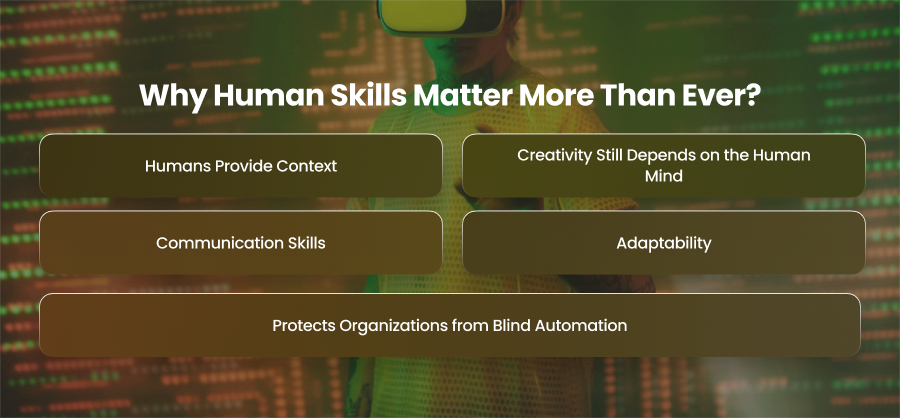
Humans Provide Context
AI is very good at identifying patterns in large amounts of data, but it cannot understand the logic underlying decisions. A model can spot trends, but it can’t fully understand cultural peculiarities. Humans bring essential context and historical knowledge to every decision. This insight ensures that AI outputs align with real world expectations and organizational goals.
Protects Organizations from Blind Automation
Even the most advanced AI systems can make mistakes. It can produce results that are not in line with business goals. Significant operational risks may result from a blind reliance on these systems. Also, human critical thinking is required to analyze AI results and uncover abnormalities that models cannot detect. Employees who apply judgment can determine when to follow AI recommendations and when to intervene. This ensures that automation complements rather than compromises business decisions.
Creativity Still Depends on the Human Mind
AI can generate variations and even propose solutions, but true creativity originates from human experience and imagination. Humans are capable of combining abstract concepts and taking risks that models aren’t equipped to explore. Employees can focus on high value tasks like developing unique customer experiences when AI is used as a creative partner rather than a replacement.
Communication Skills
AI can handle repetitive tasks, but people are still necessary for decision making. The successful implementation of AI depends on employees’ ability to understand outputs and integrate AI into cross functional operations.
Collaboration and communication guarantee that AI findings become useful. This promotes efficiency and alignment throughout the company.
Adaptability
Workers are more suited to use AI if they can swiftly adapt and frequently pick up new abilities. Businesses may easily incorporate new technology because of this flexibility. Also, businesses can enhance their operations. By creating an atmosphere where workers feel at ease learning alongside AI, businesses make sure that human abilities stay up to date with AI developments.
Risks of Ignoring Workforce Upskilling
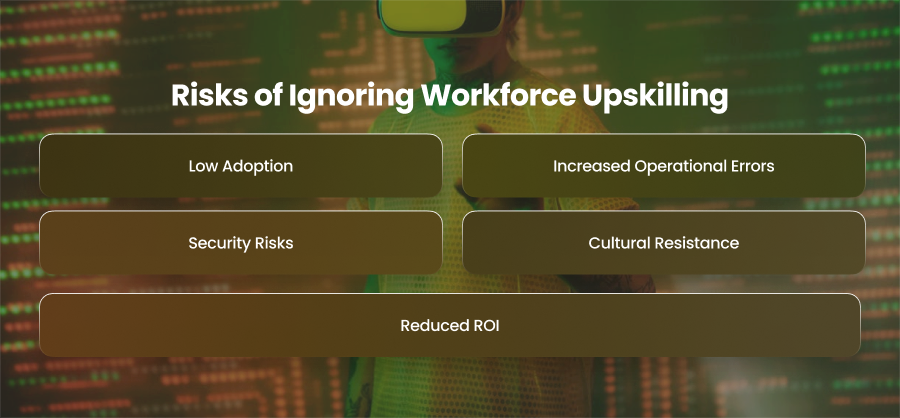
Low Adoption
Low adoption of AI systems is one of the most direct consequences of ignoring upskilling. AI technologies are frequently avoided by workers who are not familiar with them or who are confused about how to incorporate them into their regular tasks. This underutilization results in lost investments due to a business’s failure to realize the efficiency that AI offers.
Increased Operational Errors
AI can accelerate work it can also amplify mistakes. Employees who lack training can blindly rely on AI outputs without validation or biased results. For example, unskilled staff could misunderstand predictive data or apply AI techniques that disagree with business regulations. Such errors can have tangible consequences. This includes financial losses and regulatory noncompliance.
Security Risks
When workers feel unprepared or unsupported, they often employ unapproved AI technology outside of the company’s permitted systems. This might lead to serious risks. Security protections may be circumvented using unauthorized means. Businesses that don’t offer adequate training unintentionally promote the deployment of shadow AI. This can endanger data integrity. Therefore, proactive upskilling reduces these risks by equipping employees with the knowledge and confidence to use approved AI systems effectively.
Cultural Resistance
AI adoption can trigger uncertainty among employees. This is especially true when there is no training to demonstrate its purpose. Without guidance, AI can be perceived as a threat to job security. Anxiety might result from this. If teams see automation as a danger, they are less likely to embrace AI. Consequently, these worries are mitigated by investing in personnel upskilling.
because it may inspire workers to see AI as a tool to increase productivity rather than a substitute.
Reduced ROI
Ignoring workforce development limits an organization’s ability to maximize AI’s potential. Even the most advanced models are useless if employees cannot integrate them into decision making or customer interactions. Organizations can struggle to identify automation opportunities. A reduced return on investment may arise from this. As a result, businesses that place a high priority on upskilling can develop a workforce that can strategically use AI.
Skill Areas Every Organization Needs to Develop
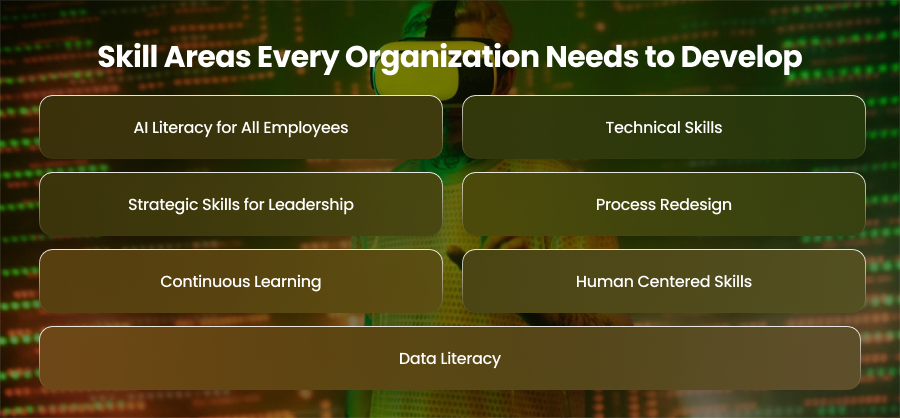
AI Literacy for All Employees
Any workforce change in the AI era must start with AI literacy. It guarantees that workers in every department are aware of AI’s capabilities and limitations as well as how to use it appropriately. Learning how to provide useful prompts and spot any biases is part of this. Even non technical teams benefit from understanding AI capabilities and ethical considerations. When employees posses basic AI literacy they are more willing to adopt new tools.
Technical Skills
For teams directly responsible for developing or integrating AI, deeper technical skills are essential. These include proficiency in MLOps to manage AI model deployment and maintenance effectively. Technical teams also require knowledge of data pipelines and vector databases. Understanding AI system behavior and drift detection allows AI developers to fine tune models. Developing these capabilities ensures that AI tools are not only implemented successfully but also optimized for long term performance.
Strategic Skills for Leadership
Adoption of AI is a strategic and cultural problem in addition to a technological one. Leaders must acquire the skills necessary to successfully manage risk and match AI efforts with company objectives.
This entails establishing ethical standards and setting AI policies. AI savvy leaders may also encourage adoption and find a balance between innovation and appropriate use. Strategic AI leaders ensure that technology promotes business objectives while maintaining organizational integrity.
Process Redesign
AI delivers maximum value when workflows are redesigned to integrate automation. Employees must learn to identify processes that can benefit from AI and implement AI augmented workflows. These skills include understanding no code and low code tools, and iteratively improving workflows based on performance feedback. So, by equipping teams with process redesign capabilities organizations ensure that AI is applied where it creates the most impact. This enhances productivity and reduces redundant effort.
Continuous Learning
Because AI is developing so rapidly, employees need to embrace lifelong learning. Relevant skills may need to be updated If company goals change tomorrow. Staff workers will remain competent and proactive while utilizing AI if a culture of adaptability and lifelong learning is established. Companies that promote a culture of ongoing education cultivate workers that are flexible.
Human Centered Skills
As AI takes over routine tasks, human centered skills become even more crucial. Employees need strong communication and cross functional collaboration abilities to work effectively alongside AI and each other. Creative thinking and problem solving allow employees to interpret AI outputs and build solutions AI cannot. These interpersonal capabilities ensure that teams utilize AI as a partner rather than a replacement.
Data Literacy
AI systems rely heavily on quality data. Hence, this makes data literacy essential across all roles. Instead of taking data outputs at face value, employees must be able to read and analyze them. Critical thinking abilities can assist teams in assessing AI advice and reaching well informed conclusions. When employees across departments posses data literacy, organizations reduce the risk of misuse and build a deeply informed workforce.
How to Build an AI Ready Workforce?
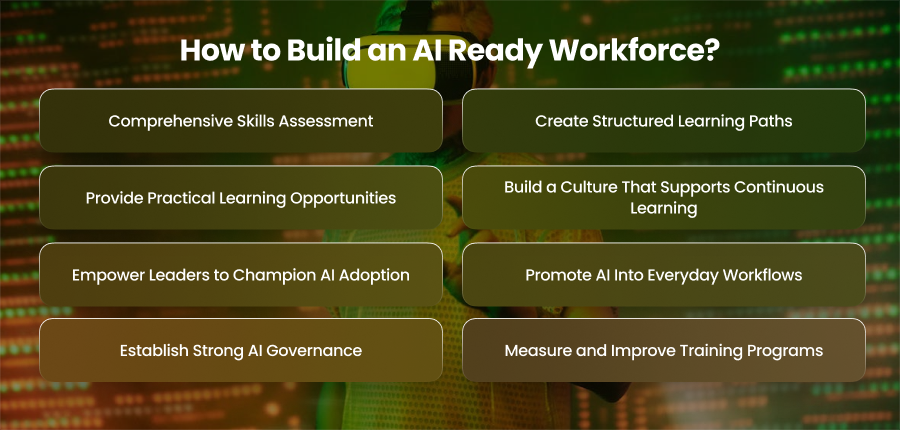
Comprehensive Skills Assessment
The first step in creating an AI workforce is to know where your people are right now. Businesses need to identify talent gaps. Also, companies need to forecast which roles will change due to an AI adoption. A detailed skills audit helps leaders prioritize the most critical training needs instead of applying generic development programs. This ensures learning investments are effective and aligned with long term business goals.
Create Structured Learning Paths
Once gaps are identified organizations should design tailored learning pathways that reflect the skill needs of different job roles. Not everyone needs deep technical expertise. But everyone should understand AI fundamentals and how it impacts their daily work. Companies make learning accessible while ensuring specialist receive the depth of training they need by developing tiered learning programs.
Provide Practical Learning Opportunities
Employees require real world settings where they may experiment with AI apps. Sandbox settings and workshops are examples of hands on approaches that help demystify AI and boost trust. AI becomes less daunting and more of a productivity boost when workers can immediately apply concepts to their activities.
Build a Culture That Supports Continuous Learning
AI is always evolving, hence training cannot be done once. Through continual cycles of upskilling and peer knowledge exchange, organizations must integrate continuous learning into their culture. By promoting experimentation and demonstrating the use of AI in their own processes, leaders may strengthen this culture.
Empower Leaders to Champion AI Adoption
Leadership plays a crucial role in shaping workforce readiness. Also, leaders must communicate a clear vision of how AI will support employees. Moreover, when managers actively champion AI initiatives and guide teams through change, employees adopt a more positive outlook and adapt more quickly to changing processes.
Promote AI Into Everyday Workflows
Employees need AI technologies integrated into their everyday tasks; upskilling shouldn’t occur in a vacuum. Learning is naturally reinforced when AI is integrated into current systems. When workers consistently utilize AI, their comprehension grows and their productivity increases. This phase speeds up acceptance and transforms AI from a desperate endeavor into a logical extension of labor.
Establish Strong AI Governance
A responsible AI ready workforce must understand how to use AI ethically. You should implement goverance frameworks that outline acceptable use and transparency requirements. Also, you should provide employees with practical training on ethical decision making and compliance.
Measure and Improve Training Programs
AI preparedness is a dynamic process. Through skill evaluations and performance results, organizations must continuously monitor the success of their training activities. You should modify training materials and learning pathways in accordance with industry trends based on findings. Also, iteration ensures the workforce remains aligned with the company’s AI transformation journey.
Final Words
Only with an informed and adaptable workforce can AI reach its full potential. Therefore, by investing in AI literacy, businesses can empower employees to collaborate with technology.