




According to statistics, 27% of companies that include Salesforce in their workflow report decreased support costs. Additionally, 29% say their production has risen. Organizations still have trouble coordinating their sales and marketing teams. Companies lose revenue when these teams work in silos.
Therefore, it’s a necessity for scaling organizations. Salesforce is one of the best platforms for enabling this alignment. This offers a unified structure that connects every stage of the consumer experience.
In this guide, we will discuss the revenue alignment problem and how Salesforce bridges the gap between teams. We will also discuss the best practices for building a truly aligned revenue organization.
What is The Revenue Alignment Problem in Modern Organizations?
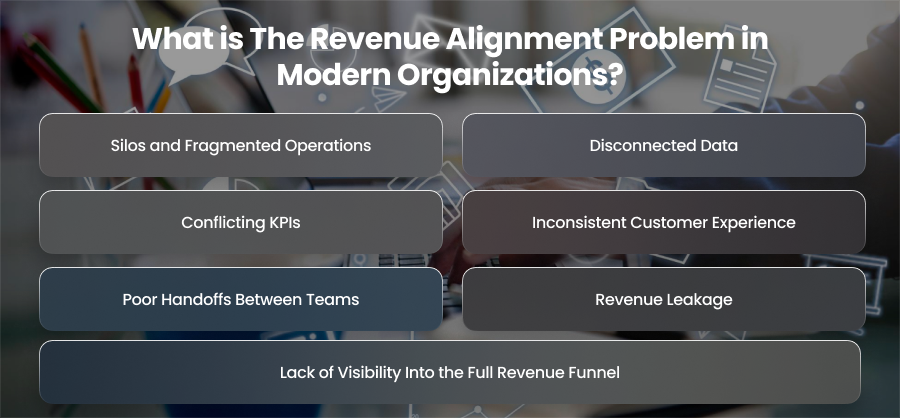
Silos and Fragmented Operations
Revenue mismatch is mostly caused by organizational silos. Marketing, sales, and customer success teams often operate autonomously with different procedures. Each team optimizes for its own success rather than the organization’s overall sales performance.
For example, marketing may focus on generating a high volume of leads. On the other hand, sales teams might prioritize closing value deals. While the customer success teams aim to reduce churn. However, these teams seldom ever work together on strategy or execution in the absence of a common framework.
Disconnected Data
Most companies use a range of technologies to manage different stages of the customer experience. While marketing teams keep an eye on campaigns and engagement, support teams keep an eye on tickets and onboarding. Teams operate with inaccurate data when these systems are not interconnected.
Poor decision making results from the absence of a single source of truth. Marketing could not know which initiatives generate actual income, and sales might follow up with unqualified leads.
Also, customer success may lack visibility into promises during the sales process.
Conflicting KPIs
Another core issue is misaligned incentives. Customer success teams are frequently paid for retention measures, whereas marketing teams are frequently awarded for lead volume. Even if every statistic is noteworthy, they may result in behaviors that are inconsistent.
Sales may overpromise in order to complete transactions, while marketing may emphasize quantity. Teams inadvertently work against one another when revenue and retention goals are not discussed.
Inconsistent Customer Experience
Consumers anticipate a smooth travel experience. On the other hand, inconsistent communications and interactions result from mismatched teams. During onboarding, a candidate could hear one message from marketing and encounter something quite different.
These disparities erode trust and pleasure. Customers think they are dealing with many companies instead of just one, which increases the possibility of attrition and negative referrals.
Poor Handoffs Between Teams
Poor management frequently occurs throughout the shift from marketing to sales and from sales to customer success. Customer success teams may get accounts without knowing what is expected of them, and leads may be transferred without enough context.
Both teams and consumers experience delays and irritation as a result of poor handoffs. This is one of the most frequent ways that businesses lose money.
Revenue Leakage
Misalignment has a direct influence on revenue in addition to efficiency. Ineffective onboarding leads to slips through the gaps and causes consumers to leave. Furthermore, because customer success lacks sales insights, expansion chances are lost. These gaps eventually result in large income leakage and hinder firms’ ability to scale consistently.
Lack of Visibility Into the Full Revenue Funnel
Many businesses don’t have complete visibility into their income stream. Campaign performance is seen by marketing, and retention data are seen by customer success, but nobody has a full view.
Leaders find it difficult to predict income and make strategic choices in the absence of uniform reporting. Growth is reactive rather than proactive due to this lack of vision.
How Salesforce Aligns Different Teams?
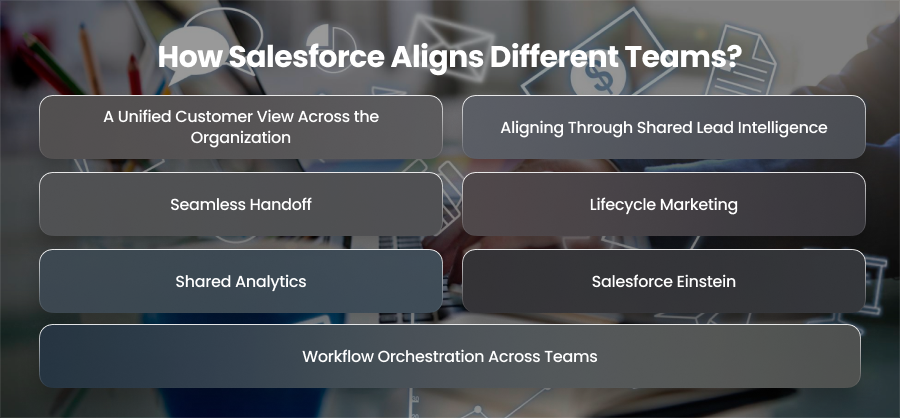
A Unified Customer View Across the Organization
One of Salesforce’s biggest strengths is its ability to create a 360 degree customer profile. One system can record every interaction.
Sales teams may examine lead behavior and previous interactions, while marketing teams can observe how prospects interact with campaigns. Also, customer success teams can access contract details and support records. This unified data foundation ensures that every team understands the customer’s journey and context.
Aligning Through Shared Lead Intelligence
Salesforce connects campaign data to the sales pipeline, bridging the gap between marketing and sales. Campaign generated leads may be automatically collected and forwarded to the right salespeople.
While sales teams get comprehensive information about each prospect’s interests and preparedness to finish the transaction, marketing teams may utilize behavioral data to qualify leads. Conversion rates rise, and lead quality is enhanced by this alignment.
Both teams may monitor campaign ROI and income attribution with the use of shared dashboards. This openness guarantees that both teams are responsible for revenue results and removes the usual conflict between different teams.
Seamless Handoff
The transition from sales to customer success is one of the most crucial stages of the customer lifecycle. Salesforce ensures that all parties involved in the transaction are included in the complete record that customer success teams get.
With access to opportunity data and contracts, customer success teams can onboard customers with full context. This lowers the difficulty of onboarding and fosters trust right away.
To guarantee a consistent post purchase experience, Salesforce can also automate onboarding procedures and milestone monitoring.
Lifecycle Marketing
Salesforce allows marketing teams to extend their role beyond acquisition into retention and advocacy. Marketing teams may develop focused onboarding and product adoption campaigns using customer data from Sales Cloud and Service Cloud.
For example, customers who haven’t used key features can receive educational campaigns, while highly engaged customers can be invited to referral programs.
Shared Analytics
All teams can see the whole sales funnel thanks to Salesforce’s powerful analytics features. Shared dashboards that monitor KPIs like pipeline velocity are accessible to executives and customer success teams.
Because of unified reporting, all teams will utilize the same metrics and insights. This shared visibility encourages accountability and supports data driven decision making throughout the whole organization.
Workflow Orchestration Across Teams
Salesforce Flow and automation features facilitate the coordination of marketing and customer success activities. Onboarding duties may be initiated upon transaction close, and leads can be directed automatically.
Automation guarantees uniform performance across teams and minimizes manual labor. Salesforce lets businesses expand alignment without adding to operational complexity by standardizing procedures.
Salesforce Einstein
Salesforce Einstein helps teams remain in sync with predicted insights by integrating intelligence throughout the platform. Customer success can forecast churn risks, and marketing can leverage AI driven lead scoring.
Teams are able to take proactive rather than reactive action because to these insights. AI suggestions increase revenue predictability by ensuring that all teams concentrate on the most significant prospects.
Common Challenges Companies Face in Aligning Different Teams
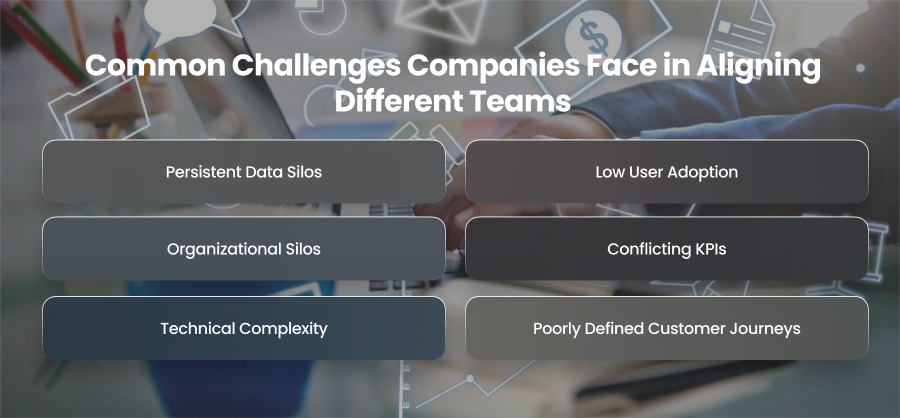
Persistent Data Silos
Data fragmentation is one of the most prevalent issues. Businesses frequently keep using other technologies for product use tracking and marketing automation even after deploying Salesforce. Teams will keep using contradictory data if these systems are not effectively connected.
For example, marketing may not be able to view product usage data, and sales may not be able to view support tickets. When there isn’t a true single source of truth, teams continue to make decisions based on insufficient information.
Low User Adoption
Many organizations struggle with low Salesforce adoption, especially among sales and marketing teams who prefer legacy tools or spreadsheets.
Sales teams may skip logging activities, and customer success teams rely on external onboarding tools. When usage is inconsistent, Salesforce becomes an incomplete system of records.
Organizational Silos
Aligning teams requires cultural change and not just technical implementation. Teams often operate independently with their own leadership and budgets. Sharing data and metrics can feel threatening to established structures.
Sales may resist marketing influence on pipeline metrics and customer success may be excluded from strategic planning. Without executive sponsership and cross functional governance, alignment initiatives can stall due to resistance to change.
Conflicting KPIs
Even with Salesforce in place, misaligned incentives can undermine collaboration. Marketing is often rewarded for lead volume and customer success for retention and satisfaction. These metrics can drive conflicting behaviors.
Technical Complexity
Salesforc is highly customizable. On the other hand, over-customization may prevent alignment. The system may be challenging to maintain due to intricate workflows and inadequately documented automations.
Over customization raises technological debt and hinders teams’ ability to modify procedures as the business changes. Instead of enabling alignment, the platform can become a bottleneck if not managed with a scalable architecture strategy.
Poorly Defined Customer Journeys
Many businesses neglect to clearly identify handoff points between teams and map the whole customer experience. As a result, clients may be transferred to customer success without clear expectations, and prospects may be transferred to sales without enough context.
Inadequate handoffs might lead to uneven experiences and delays. Customers are less trustworthy and more prone to go since they feel like they are beginning over every time.
Best Practices for Aligning Teams with Salesforce
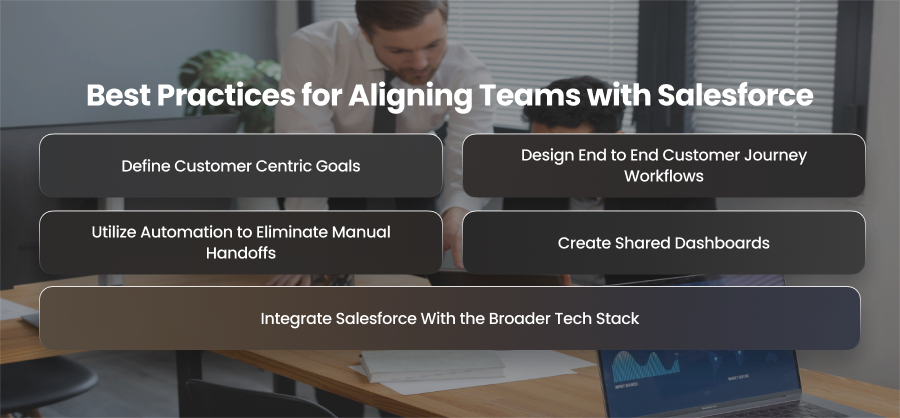
Define Customer Centric Goals
Alignment starts with shared objectives. Marketing and customer success must work toward common business outcomes rather than isolated team KPIs.
Instead of measuring marketing purely on leads and sales on closed deals, organizations adopt shared metrics such revenue growth and customer lifetime value.
When all teams are accountable for revenue, collaboration becomes natural. Also, Salesforce dashboards can reinforce this alignment by displaying shared KPIs across teams.
Design End to End Customer Journey Workflows
To align teams effectively, organizations must map the entire customer lifecycle. Each stage should have defined processes and success criteria.
Salesforce workflows should reflect this journey. For example, when a lead becomes an opportunity and alerts can be triggered for sales. When a deal closes, onboarding tasks cann be automatically assigned to customer success, lifecycle marketing can be launched.
Utilize Automation to Eliminate Manual Handoffs
One of the main reasons for misalignment is manual handoffs between teams. Workflows across many teams may be coordinated using Salesforce automation solutions like Flow and Process Builder.
Leads can be routed automatically based on industry or behavior. Onboarding tasks can be triggered upon deal closure. Workflows for escalation and renewal reminders can be planned according to contract dates.
Automation guarantees that teams follow established procedures and that crucial tasks are never overlooked.
Integrate Salesforce With the Broader Tech Stack
Salesforce alignment is most effective when the platform serves as the central hub for customer and revenue data. All teams will have the same data base thanks to the integration of analytics and marketing automation tools.
For instance, including data on product usage aids customer success in identifying expansion prospects and attrition threats. While marketing can personalize retention campaigns based on usage patterns.
Create Shared Dashboards
Transparency drives alignment. Salesforce dashboards should be designed for cross funtional visibility. This provides insights into the entire revenue funnel.
Executives need high level revenue and retention dashboards. However, sales, marketing, and customer success teams require consistent operational dashboards. Metrics like pipeline velocity and conversion rates ought to be available to all parties involved.
Final Words
Salesforce enables true revenue alignment by unifying data and teams across marketing, sales, customer success. With the right strategy, organizations can eliminate silos and drive predictable growth.