



Django has a 33.22% market share among different web frameworks. This is because Django offers an unmatched development pace. Additionally, this is crucial for startups that want to create an MVP. With an MVP, entrepreneurs may introduce a working version of their product without squandering money or time on extraneous features.
As a result, the speed at which an MVP can be developed and expanded is greatly influenced by the choice of technology stack. Django has continuously proven to be a dependable option for companies looking to move quickly without compromising quality.
We’ll go over why Django is a startup friendly framework in this article, as well as how its features speed up MVP development.
Why Django is Startup Friendly Framework?
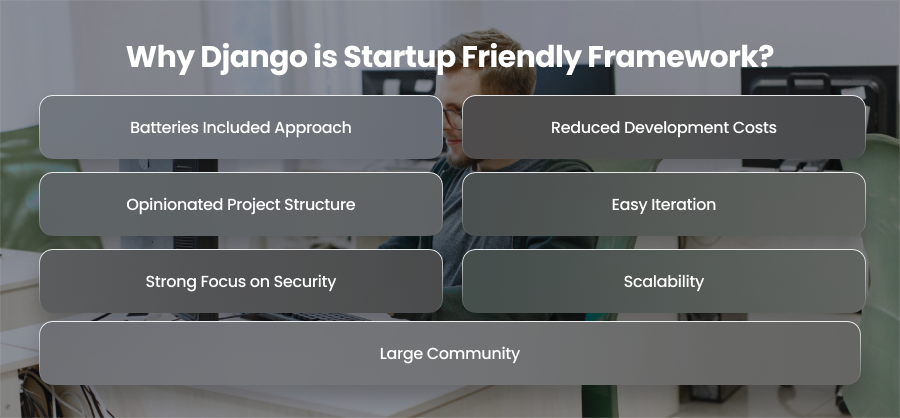
Batteries Included Approach
Django follows a battries included philosophy, meaning it comes with most of the features required to build a web application right out of the box. Consequently, businesses no longer need to incorporate many third party libraries. Developers can focus on developing product features rather than infrastructure setup. This enables MVPs to launch much more quickly.
Reduced Development Costs
Budgetary constraints are a reality for the majority of companies. Django helps decrease development costs by reducing the time and effort required to produce an MVP. Smaller teams can produce greater functionality in less time because many necessary components are pre built.
This efficiency means startups don’t need large engineering teams in the early stages. A lean Django team can quickly develop and iterate on product ideas while staying within budget.
Opinionated Project Structure
Django enforces a well defined project structure that promotes clean and maintainable code. Django’s opinionated nature actually helps startups by lessening decision fatigue, whereas some frameworks provide total flexibility.
Teams may work together more efficiently and steer clear of disorganized codebases that impede future growth when a consistent architecture is in place.
Easy Iteration
Startups frequently change course in response to consumer input or consumer demand. Features can be easily changed without affecting the system as a whole because to Django’s modular app based architecture.
Its migration system allows database changes to be applied safely, which is especially important when MVPs change rapidly. This flexibility enables startups to experiment and adapt without costly rewrites.
Strong Focus on Security
During MVP development, security is often undervalued, yet early breaches can undermine credibility and confidence. Django takes care of this by incorporating built in defenses against prevalent flaws like SQL injection.
This means that even in the early phases, firms can launch more quickly without sacrificing user safety or data protection.
Scalability
MVPs are meant to be straightforward, but successful startups require a scalable architecture. Django supports growth through caching and seamless integration with cloud services.
Startups can begin with a simple MVP and gradually scale the application as user demand increases, without having to change the underlying technology.
Large Community
Django has a mature ecosystem backed by a large global community. This means extensive documentation and community support are always available.
For startups, this reduces technical risk. Moreover, problems are easier to solve, and all the best practices are well documented.
Django Features That Accelerate MVP Development
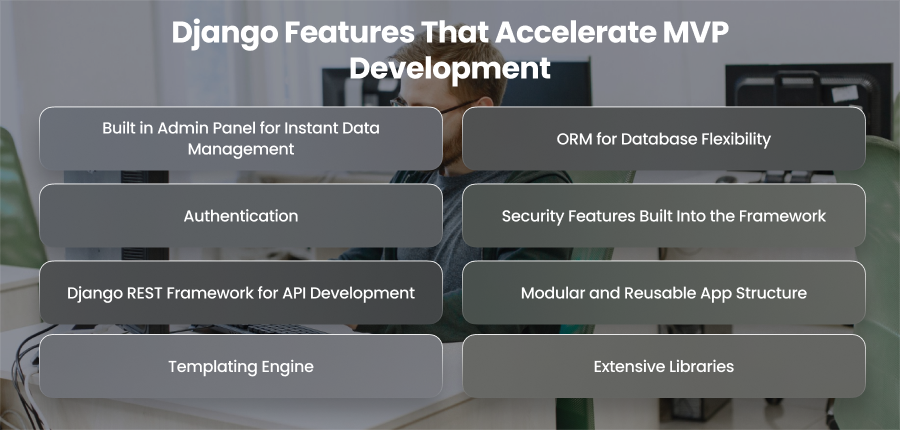
Built in Admin Panel for Instant Data Management
Django’s automatically produced admin panel is one of its best features. Developers may design a fully functional backend interface to manage users with just a few lines of code.
This saves startups weeks of development effort compared to creating a custom admin dashboard. Additionally, content and user data can be managed directly by founders and product managers. While developers focus on core application logic.
ORM for Database Flexibility
Instead of writing raw SQL queries, developers may interface with databases using Python objects thanks to Django’s ORM technology. This implies that teams can efficiently and consistently develop and update the database.
For MVPs, which often require frequent changes in data models, Django’s migration system makes it easy to apply updates safely. Moreover, startups can pivot quickly and restructure data without downtime or risk of data loss.
Authentication
Most web applications require user authentication and role based permissions. Django provides a secure authentication system that includes login and user permissions.
Startups benefit from this feature because it eliminates the need to develop security critical functionality from scratch. With minimal setup, your MVP can have user accounts and permissions. This provides a professional grade experience from day one.
Security Features Built Into the Framework
Security is often overlooked during MVP development, but early stage breaches can be costly for a startup’s reputation. Django has built in defenses against common security flaws.
Therefore, Django reduces stress for small teams that cannot afford specialized security engineers in the early stages by managing these security problems automatically, allowing firms to launch quickly while protecting user data.
Django REST Framework for API Development
Modern MVPs often require APIs to connect mobile apps and frontend frameworks. The Django REST Framework enables startups to build scalable and maintainable APIs efficiently.
With DRF, teams can create clean and well documented endpoints that support future product expansion. This makes it easier to iterate or integrate external services without rewriting backend code.
Modular and Reusable App Structure
Django encourages a modular architecture through reusable apps. Every app manages a distinct feature that can be integrated into many projects or applied to several items.
Because it enables teams to concentrate on a single item at a time and reuse tested code without affecting the overall system, this modularity speeds up development for startups.
Templating Engine
Django’s built in templating engine makes it easy to combine HTML and Python code to create dynamic web pages. As a result, it is now possible to prototype user interfaces without just relying on frontend frameworks. Because of this, entrepreneurs could present an aesthetically pleasing MVP to early users.
Extensive Libraries
Django boasts a strong ecosystem with dozens of reusable libraries. These technologies, which range from file processing and search capabilities to social authentication. This can help startups accelerate their development.
Instead of building every feature from scratch, development teams can integrate trusted third party solutions.
Use Cases of Django for Startup MVPs
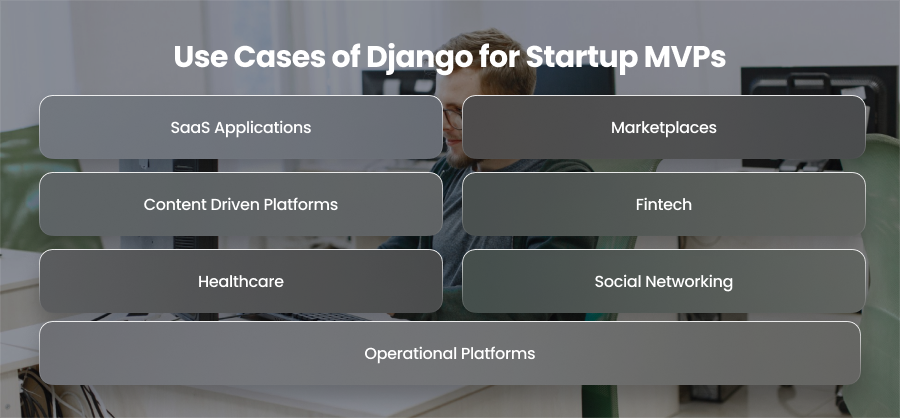
SaaS Applications
Because Django makes it easier to create essential SaaS features, it is a great option for SaaS companies. Django’s built in capabilities and third-party connectors allow for the rapid development of user authentication and analytics.
For MVPs, startups can launch with essential features such as user onboarding and reporting. As the product matures, advanced capabilities like usage tracking and integrations can be added without restructuring the backend.
Marketplaces
Managing various user roles and communication flows is necessary while developing a marketplace MVP. These intricate interactions are made simpler by Django’s ORM and organized backend.
Startups can quickly implement features like user profiles and admin moderation. Django’s scalability ensures the platform can grow as users and transactions increase. This makes it a reliable choice for marketplace MVPs.
Content Driven Platforms
Django’s roots in content management make it ideal for blogs and news platforms. Its admin panel allows non technical users to manage content and publishing workflows efficiently.
Startups may introduce MVPs with an emphasis on user interaction and content engagement, then, as usage increases, progressively improve customization and recommendation capabilities.
Fintech
For fintech startups, security and data integrity are non negotiable. Django’s built in security features and clean architecture make it a suitable for MVPs involving payments or transaction management.
With Django, startups can integrate secure payment gateways and manage user accounts. This helps validate financial workflows while maintaining a compliance ready foundation for scaling.
Healthcare
Healthcare startups often deal with sensitive user data and complex workflows. Django’s strong security practices and database handling capabilities make it a practical choice for building health related MVPs.
Startups can develop data analysis tools or appointment scheduling systems while protecting user data. Django’s adaptability enables the system to evolve without requiring significant rewrites when rules change.
Social Networking
Social and community driven platforms need features such as user profiles and content sharing. Django’s modular architecture allows these features to be developed incrementally.
For MVPs, startups can focus on basic engagement mechanics and iterate based on user behavior. Django REST framework also makes it easier to extend these platforms to mobile apps later.
Operational Platforms
Many startups build internal tools as MVPs to improve operations or test business processes. Django is excellent for creating dashboards and workflow management systems.
Its rapid development capabilities allow startups to experiment internally and later transform these tools into customer facing products if needed.
Best Practices for Building an MVP with Django
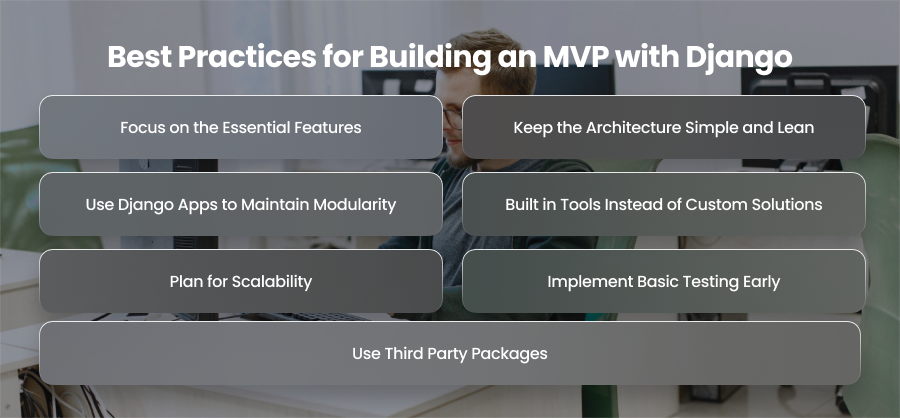
Focus on the Essential Features
An MVP is intended to test theories rather than deliver a final product. First, identify the primary problem your firm is attempting to resolve. Next, create only the features required to validate the solution.
Although Django allows for rapid feature development, introducing too much functionality too soon might hinder progress. Put essential features first and save improvements for subsequent versions.
Keep the Architecture Simple and Lean
Overengineering is one of the most common mistakes in early stage development. For MVPs, Django’s default project structure is frequently more than adequate.
Steer clear of premature performance optimizations and needless abstractions. Faster iteration and more seamless pivots as needs change are made possible by a clear and straightforward design.
Use Django Apps to Maintain Modularity
Django’s app based structure encourages modular development. Each app should represent a distinct piece of functionality, such as authentication or notifications.
This modular approach makes it easier to modify or replace features as the MVP changes. It also supports better collaboration within small teams and keeps the codebase organized as the product grows.
Built in Tools Instead of Custom Solutions
Django offers powerful built in tools for authentication and admin management. Using these tools instead of building custom solutions saves time and reduces bugs.
For MVPs, rely on Django’s defaults whenever possible. Customization can always be introduced later once the product has proven market demand.
Plan for Scalability
Enterprise level infrastructure is not necessary for MVPs, but it’s crucial to select patterns that won’t restrict future expansion. Django supports caching and database optimization when needed.
Design the MVP with scalability in mind, but only implement advanced performance solutions once real user traffic justifies it.
Implement Basic Testing Early
During MVP development, testing is frequently neglected, although even a little amount of test coverage may avert serious problems. Writing simple unit and integration tests is made simple by Django’s testing framework. Simple tests around core business logic ensure stability and allow startups to iterate faster.
Use Third Party Packages
Django’s ecosystem offers thousands of third party packages that can speed development. While these tools are valuable, startups should choose well maintained and widely adopted packages.
Final Words
Django helps startups to build MVPs faster without sacrificing security or code quality. With its built in features and flexible architecture, startups can validate ideas quickly and scale confidently.