




Hero Introduction
AI is becoming a core driver of enterprise growth and efficiency. As organizations invest in AI, a critical question emerges: Should we build capabilities in-house or partner with external partners? The answer shapes speed, cost, and long-term value.
Executive Summary
Choosing between building and partnering for AI is a strategic decision, not just a technical one. Building offers control and differentiation, while partnering enables speed and access to expertise. This blog explores both approaches and practical frameworks to help enterprises make informed AI adoption choices.
Why Build vs Partner Decision Matters in AI?
The build vs partner decision sits at the heart of every successful AI strategy. Unlike traditional software initiatives, AI projects require a unique combination of data readiness, infrastructure, and continuous iteration. Making the wrong choice here doesn’t just slow progress; it can derail the entire initiative.
AI adoption often starts with ambition but quickly runs into execution challenges. Enterprises may underestimate the complexity of developing models, managing data pipelines, or integrating AI into existing systems. On the other hand, over-reliance on external vendors creates long-term dependency and limits innovation.
The stakes are high because AI directly impacts competitive advantage. For some organizations, AI is a supporting tool to improve efficiency. For others, it’s the product itself. This distinction alone can determine whether building or partnering makes more sense.
Another critical factor is time-to-market. Delays in deploying AI solutions can result in lost opportunities. Partnering can accelerate implementation, while building may take longer but provide deeper customization.
Ultimately, the decision affects:
- How quickly can you deploy AI solutions?
- How much control do you retain over data and models?
- The total cost of ownership over time
- Your ability to innovate and scale
What is the Build Approach?
The build approach refers to developing AI capabilities entirely in-house, owning everything from data pipelines and model development to deployment. Instead of relying on external vendors, enterprises invest in internal teams, infrastructure, and processes to create AI systems tailored to their specific needs.
At a high level, building AI is about ownership and control. Organizations define how data is collected, processed, and used. They design models that align closely with business logic and integrate AI deeply into their existing systems.
Components of the Build Approach
Building AI in-house is not just about training models; it involves creating an entire ecosystem. This typically includes:
- Data Infrastructure: Establishing pipelines to collect, clean, and organize data from multiple sources
- Model Development: Designing, training, and validating machine learning or deep learning models
- Deployment Pipelines: Setting up systems for versioning, testing, and deploying models into production
- Monitoring and Maintenance: Continuously tracking model performance, retraining when needed, and ensuring reliability
- Governance and security: Managing data privacy, compliance, and ethical AI practices
This end-to-end ownership allows enterprises to build solutions that are tightly aligned with their operational and strategic goals.
Why Enterprises Choose to Build?
The strongest driver behind building AI is the need for deep customization and competitive differentiation. Off-the-shelf solutions often fall short when dealing with complex workflows, unique datasets, or industry-specific challenges.
For example, a fintech company developing fraud detection models or an eCommerce platform optimizing personalized recommendations may find that pre-built tools cannot capture the nuances of their data. In such cases, building internally enables more precise and effective solutions.
Another key advantage is intellectual property ownership. By building AI systems in-house, enterprises retain full ownership of their models, algorithms, and insights. This not only strengthens their competitive position but also creates long-term strategic assets.
There’s also the benefit of long-term cost efficiency. While the initial investment is high, building can reduce dependency on vendors and recurring licensing costs, especially for large-scale or mission-critical applications.
Operational and Strategic Advantages
- Full Control: Enterprises can fine-tune every aspect of the AI lifecycle
- Customization: Solutions are designed specifically for business needs and workflows
- Data Sovereignty: Sensitive data remains within the organization
- Scalability: Systems can be optimized and scaled without external constraints
When Does the Build Approach Make Sense?
The build approach is most effective in scenarios where:
- AI is a core driver of competitive advantage
- Data is a highly sensitive, regulated, or proprietary
- There is a need for deep integration with existing systems
- The organization has strong AI capabilities
- Long-term value outweighs short-term speed
In these situations, the benefits of control, customization, and ownership often justify the investment.
What is the Partner Approach?
The partner approach refers to adopting AI capabilities through external collaboration instead of building everything internally. In this model, enterprises work with AI vendors, cloud providers, or specialized consulting firms to design, develop, and deploy AI solutions. Rather than owning every layer of the stack, organizations utilize pre-built platforms, APIs, models, and domain expertise to accelerate outcomes.
At its core, partnering is about speed, efficiency, and access. Instead of investing years in building internal capabilities from scratch, enterprises tap into existing ecosystems that already have mature AI offerings.
What Does the Partner Approach Typically Include?
The partner model can take multiple forms depending on the maturity and complexity of the AI initiative:
- AI Platform Providers: Using cloud-based AI services for model training, deployment, and inference
- Pre-trained Models & APIs: Utilizing ready-made models for tasks like NLP, computer vision, or forecasting
- System Integrators: Working with consulting firms to design and implement enterprise-wide AI solutions
- Managed AI Services: Outsourcing parts of the AI lifecycle, such as MLOps, monitoring, or optimization
- Co-Development Models: Collaborating with partners to jointly build and customize solutions
This flexibility makes partnering highly adaptable to different enterprise needs and maturity levels.
Why Enterprises Choose to Partner for AI?
One of the strongest reasons organizations choose the partner approach is speed to value. Building AI systems internally can take months or even years, especially when teams are still developing foundational capabilities. Partnering significantly shortens this timeline by providing access to ready-to-use tools and proven frameworks.
Another major factor is access to specialized expertise. AI is a highly technical and quickly evolving field. Partners often bring deep domain knowledge and exposure to multiple implementations across different clients. This helps enterprises avoid common pitfalls and accelerate learning curves.
From a financial perspective, partnering also reduces upfront investment risk. Instead of building large internal teams and infrastructure immediately, organizations can start small, experiment, and scale based on outcomes.
Advantages of the Partner Approach
- Faster Implementation: Pre-built solutions reduce development cycles significantly
- Lower Initial Costs: No need for large upfront investments in hiring or infrastructure
- Access to Proven Solutions: Partners bring tested frameworks and industry best practices
- Scalability on Demand: Cloud-based solutions allow easy scaling as needs grow
- Reduced Technical Burden: Enterprise can focus on business outcomes rather than technical complexity
- Continuous Innovation: Leading AI vendors regularly update models and tools
When Does the Partner Approach Make the Most Sense?
The partner model is particularly effective in scenarios where:
- AI is not a core differentiator but a supporting capability
- The organization needs to move quickly to market
- Internal AI expertise is limited or still developing
- Use cases are relatively standardized or industry-common
- Enterprises want to test and validate AI use cases before scaling investment
What Decision Factors Must Enterprises Evaluate?
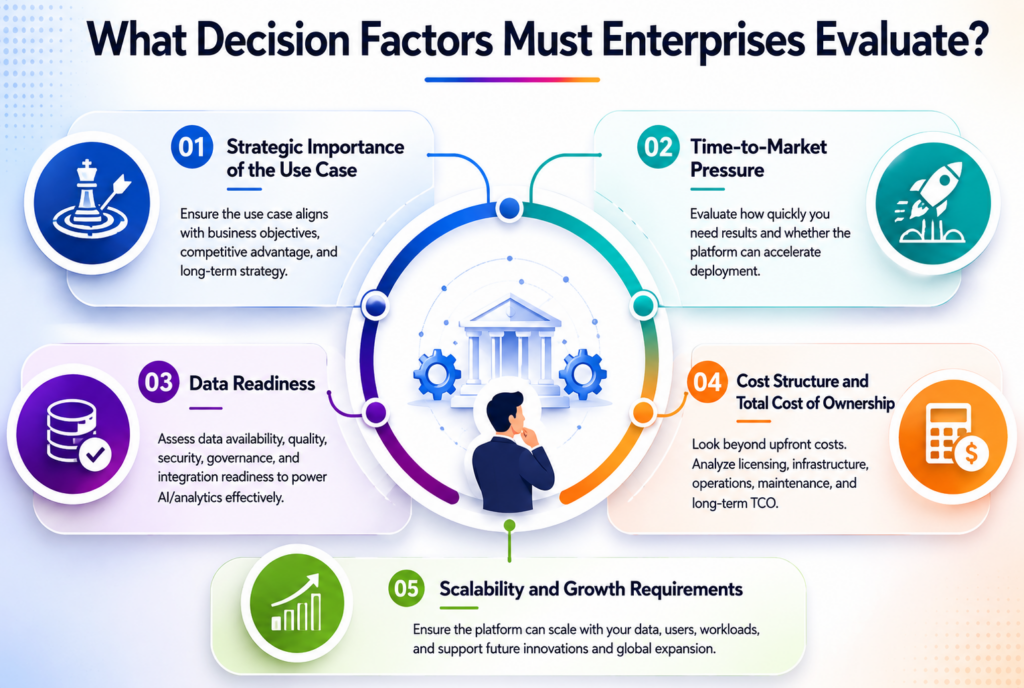
Choosing between building and partnering for AI is rarely a straightforward decision. It requires a structured evaluation of multiple dimensions: business, technical, operational, and strategic. Enterprises that rush this decision often end up with solutions that are either too rigid to scale or too dependent on external vendors.
Strategic Importance of the Use Case
The first and most important question is: How critical is this AI use case to your competitive advantage?
If AI is directly tied to revenue generation, customer experience differentiation, or proprietary product capabilities, then building internally often becomes more attractive. In such cases, control over algorithms, data, and iteration speed becomes a strategic necessity.
On the other hand, if AI is being used to improve operational efficiency, such as automating internal workflows, enhancing reporting, or enabling standard customer support, partnering may be sufficient. These are typically context capabilities rather than core differentiators.
A simple rule of thumb:
Core business value: Lean toward building
Supporting functionality: Lean toward partnering
Time-to-Market Pressure
Speed is often a decisive factor in AI adoption. Markets are quickly changing, and delays in deploying AI solutions can mean missed opportunities.
If an organization needs to launch an AI-driven feature or product within weeks or a few months, partnering provides a clear advantage. Pre-built models, APIs, and platforms significantly reduce development cycles.
However, if the organization can afford a longer timeline and is building for long-term advantage, then investing in internal development becomes more viable. The trade-off is simple: faster execution with partners versus deeper ownership with building.
Internal AI Capability
An honest assessment of internal capabilities is essential. This includes:
- Availability of data scientists and ML engineers
- Experience with model deployment and MLOps
- Strength of data engineering and infrastructure teams
- Familiarity with AI frameworks and tools
Enterprises often overestimate their readiness for building AI systems. Without a strong foundation, internal development can lead to delays, technical debt, and underperforming models.
If capability maturity is low, partnering allows organizations to learn and grow while still delivering outcomes. If maturity is high, building becomes a more realistic and sustainable option.
Data Readiness
AI is fundamentally data-driven. Without high-quality, well-structured, and accessible data, even the most advanced models will fail.
Some key questions include:
- Is data centralized or fragmented across systems?
- Is the data clean, labeled, and usable for training models?
- Are there strong governance and compliance frameworks in place?
Enterprises with mature data ecosystems are better positioned to build in-house AI solutions. Those still struggling with data silos or quality issues may benefit more from partnering, where vendors often provide pre-processed datasets or tools to handle data challenges.
Cost Structure and Total Cost of Ownership
Cost is not just about initial investment; it’s about long-term value.
The build approach typically involves:
- High upfront costs
- Ongoing operational costs
- Potentially lower long-term dependency costs
The partner approach involves:
- Lower upfront costs
- Predictable subscription or usage-based pricing
- Potentially higher long-term costs at scale
Scalability and Growth Requirements
AI systems are not static; they evolve with usage, data volume, and business expansion.
If a use case needs to scale across:
- Multiple regions
- Large customer bases
- Diverse business units
- High-volume real-time processing
Building internally allows greater flexibility to design systems for specific scaling needs. However, it also requires strong infrastructure planning. Partnering offers built-in scalability through cloud platforms but may come with architectural constraints depending on the vendor.
Strategic Decision Models for AI Adoption
Once enterprises understand the build and partner approaches, the next challenge is making consistent, repeatable decisions across multiple AI initiatives. This is where strategic decision models become essential. Instead of treating every use case as a unique debate, these frameworks help organizations standardize how they evaluate options and reduce bias.
Core vs Context Model
The Core vs Context model is one of the most widely used frameworks for AI decision-making because it directly links AI initiatives to business strategy.
- Core AI use cases are those that directly influence competitive advantage, revenue generation, or customer differentiation. These are tightly connected to the organization’s unique value proposition.
- Context AI use cases support business operations but don’t differentiate the company in the market. They improve efficiency or automate standard processes.
How it guides decisions:
- Build for core AI capabilities to maintain ownership, control, and differentiation
- Partner for context capabilities where speed and efficiency matter more than uniqueness
For example, a recommendation engine for a streaming platform may be core, while an AI-powered HR chatbot is context. The model helps enterprises avoid over-investing in non-strategic AI while protecting high-value capabilities.
Speed vs Control Matrix
This model helps organizations balance two competing priorities: how fast they want to move versus how much control they need to retain.
It can be visualized as a simple matrix:
- High speed, low control Partner approach
- Low speed, high controlBuild approach
Capability Maturity Model
AI adoption is not a single decision, it evolves as organizations mature. The Capability Maturity Model helps enterprises align their strategy with their current AI readiness level.
It typically includes two stages:
Low Maturity
- Limited AI talent and infrastructure
- Fragmented data systems
- Minimal production-level AI experience
Recommended approach: Partnering
High Maturity
- Strong in-house AI teams
- Robust data infrastructure
- Proven production AI systems at scale
Recommended approach: Build-first strategy
Cost vs Value Framework
This model shifts the focus from short-term cost to long-term value creation.
At first glance, partnering often appears more cost-effective due to lower upfront investment. However, over time, costs can accumulate through subscriptions and scaling limitations. On the other hand, building requires significant initial investment but may deliver higher long-term returns through ownership and reuse.
Some considerations include:
- Total Cost of Ownership over 3-5 years
- Scalability costs as usage grows
- Value generated from customization and differentiation
- Dependency costs associated with external vendors
This framework helps enterprises avoid the common mistake of choosing based solely on immediate budget constraints rather than long-term strategic value.
Risk-Adjusted Decision Model
AI initiatives carry different levels of business, technical, and regulatory risk. This model evaluates decisions based on risk tolerance rather than just capability or cost.
Some dimensions include:
- Data sensitivity
- Model criticality
- Compliance requirements
- Operational risk
How it influences decisions:
- High-risk environments often favor building, as control and governance are easier to enforce internally
- Lower-risk or experimental use cases can safely leverage partners
Final Words
Choosing between building and partnering for AI requires balancing speed, control, cost, and long-term value. Enterprises that apply structured decision models and align choices with strategic priorities are better positioned to scale AI effectively. In most cases, a hybrid approach provides the flexibility needed to drive sustainable innovation and competitive advantage.