




Hero Introduction
Most MVPs fail not because of bad ideas, but because founders overbuild, undervalidate, and lose focus on what really matters: learning fast with minimal effort.
Executive Summary
Founders often treat MVPs like scaled-down final products instead of learning tools. This leads to overbuilding, weak validation, poor targeting, and unclear success metrics. A strong MVP focuses on one problem, one user group, and fast feedback loops to reach product-market fit efficiently.
What Mistakes Do Founders Make When Building MVPs?
Building an MVP is meant to reduce risk, but many founders accidentally increase it by treating MVPs as scaled-down final products rather than learning tools. The result is slow validation, unclear insights, and products that miss the mark entirely.
Below are the most common mistakes founders make when building MVPs, and why each one can quietly derail your startup.
Building Too Many Features Too Early
One of the most common MVP mistakes is feature inflation.
Founders often start with a broad vision of the “final product” and try to squeeze as much of it as possible into version one. The intention is usually good; they want to make the product feel valuable, complete, and impressive. But in reality, this leads to clutter, confusion, and delayed learning.
An MVP should answer one question: Does this core idea solve a real problem for users? Every additional feature weakens that focus.
When too many features are added early:
- Development time increases significantly
- User onboarding becomes confusing
- It becomes unclear which feature drives value
- Feedback becomes harder to interpret
Instead of learning what works, founders end up guessing what users might like. A lean MVP forces clarity: one problem, one core solution, one measurable outcome.
Skipping Real User Validation
Many founders build first and validate later. This is one of the most expensive mistakes in MVP development.
Instead of talking to real users, they rely on internal assumptions, competitor analysis, or feedback from friends and colleagues who are not actual target users. While this feedback may be encouraging, it’s often misleading.
Without validation:
- You may solve a problem that doesn’t exist
- You may target the wrong audience entirely
- You may prioritize features that users don’t care about
Real validation is not about asking, “Would you use this?” It’s about observing behavior and pain points. Effective methods include:
- Problem-focused user interviews
- Landing page internet tests
- Fake-door experiments
- Prototype testing before development
Choosing the Wrong Tech Stack Too Early
Early-stage founders often overestimate the importance of technology decisions in MVP success.
They invest heavily in scalable architectures, microservices, or complex frameworks before even confirming whether users want the product. While this scalability is important later, it’s rarely necessary at the MVP stage.
This leads to:
- Slower development cycles
- Higher upfront engineering costs
- Difficulty making changes quickly
- Reduced experimentation speed
A better approach is to prioritize speed and flexibility over architectural perfection. The best MVP tech stack is the one that helps you test assumptions fastest, not the one that scales to millions of users you don’t have yet.
Ignoring the Problem-Solution Fit
A strong MVP begins with a well-defined problem, and not a clever idea.
Many founders like a solution before deeply understanding the problem it’s supposed to solve. This creates a dangerous gap between what is built and what users actually need.
Signs of weak problem-solution fit include:
- Users don’t feel urgency to solve the problem
- Users don’t change behavior even after trying the product
If the problem isn’t strong enough, even a well-built product will struggle to gain traction.
Strong MVPs focus on validating:
- Is the problem real?
- Is it painful enough to solve?
- Are users currently using awkward or inefficient workarounds?
Not Thinking About Users
Some MVPs are built in isolation, without a clear understanding of who they are for.
Founders sometimes design products for a vague audience like small businesses or everyone with this problem. This lack of specificity weakens every decision, from feature prioritization to messaging.
When you don’t define users clearly:
- Features become scattered and unfocused
- Messaging becomes generic and ineffective
- Product decisions lack direction
- Adoption becomes inconsistent
Strong MVPs are built for a very specific user profile. The more narrowly you define your early users, the easier it becomes to design something they actually care about.
Not Defining Success Metrics Early
Without clear success metrics, an MVP has no direction.
Many founders launch products without deciding what “success” actually looks like. As a result, they end up tracking vanity metrics like downloads, page views, or signups instead of meaningful engagement signals.
This leads to confusion such as:
- “Wo got users, but they are inactive”
- “People signed up but didn’t convert”
- “We don’t know what to improve next”
A strong MVP define success before development begins.
Useful early metrics include:
- Activation rate
- Retention
- Engagement depth
Without these benchmarks, it becomes impossible to know whether the MVP is working or failing.
Overlooking Speed of Iteration
An MVP is not a one-time release, it’s a continuous learning loop.
Founders often underestimate how important iteration speed is in early product development. Instead of releasing quickly and improving based on feedback, they spend too much time perfecting the first version.
Slow iteration causes:
- Delayed user feedback cycles
- Missed opportunities for improvement
- Slower path to product-market fit
- Reduced adaptability to user needs
Fast iteration allows teams to:
- Test assumptions quickly
- Respond to real user behavior
- Pivot when necessary without heavy cost
The faster you can build, test, and adjust, the higer your chances of finding product-market fit early.
Building Without a Clear Target User
Trying to build for everyone is one of the fastest ways to build for no one.
When founders don’t clearly define a target user, the MVP becomes diluted. Features are added to satisfy different types of users, messaging becomes vague, and product decisions lose focus.
This creates:
- Conflicting feature priorities
- Weak onboarding experience
- Unclear positioning in the market
A well-defined targer user helps simplify everything:
- What features matter
- How the product should feel
- What problem is most important
The goal of an MVP is not broad appeal, it’s strong resonance with a specific group of early adopters.
How to Build a Strong MVP the Right Way?
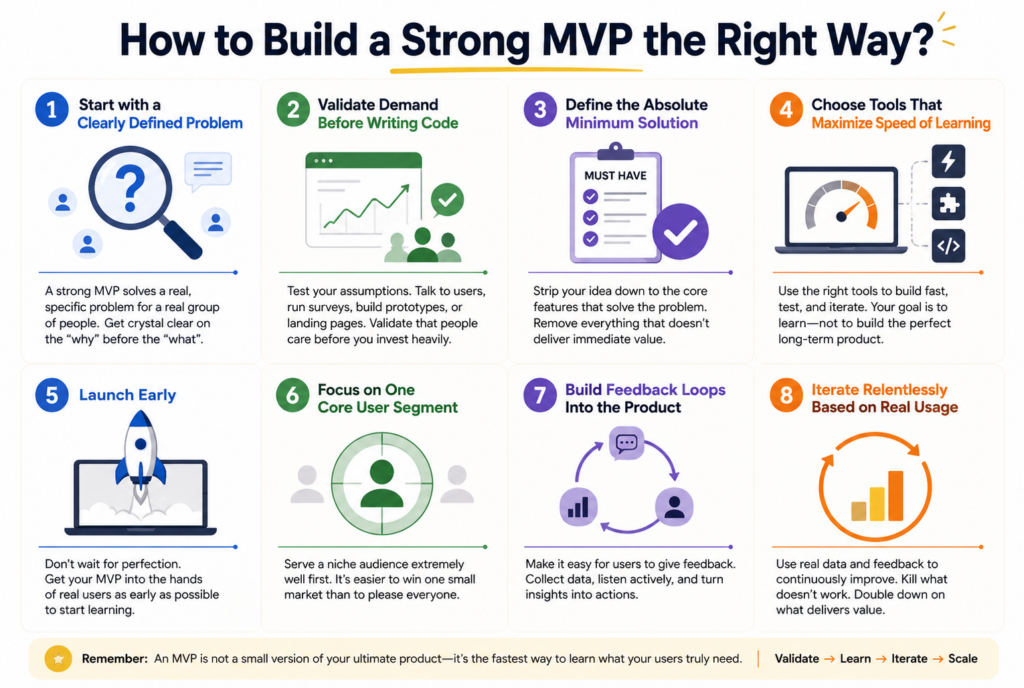
Building a strong MVP is less about speed alone and more about disciplined simplicity. The goal isn’t to launch something impressive, it’s a launch something informative. A good MVP reduce uncertainty, validates assumptions, and shows whether you are solving a real problem for a real user in a meaningful way.
Start with a Clearly Defined Problem
Most weak MVPs start with excitement about a solution. Strong MVPs start with discomfort in the market.
Therefore, before thinking about features or design, you need absolute clarity on:
- What problem are you solving?
- Who experiences this problem most intensely?
- How are they solving it today?
- Why is the current solution insufficient?
If you cannot clearly articulate the problem in a single sentence without mentioning your product, you are not ready to build.
A strong problem statement is specific and painful. For example, instead of “people need better task management tools,” a stronger version should be:
“Remote teams struggle to track async work updates across time zones, leading to duplicated work and missed deadlines.”
Validate Demand Before Writing Code
One of the most overlooked steps in MVP development is validation before development. Many founders assume that validation happens after launch, but by then, significant time and money have already been spent.
Validation should test whether the problem is real and whether users care enough to look for a solution.
Some effective validation methods include:
- User interviews focused on pain points, not features
- Landing pages to test interest and collect signups
- Waitlists to measure intent
- Clickable prototypes to observe user behavior
- Fake-door testing to measure demand for specific features
The goal is not to sell your idea, it’s to confirm that the problem is urgent enough that users would change their behavior to solve it.
Define the Absolute Minimum Solution
Instead of thinking of MVP as the smallest possible experiment that proves your hypothesis, you need to identify:
- The one core action users must take
- The one outcome that represents value
- The simplest way to enable that outcome
Everything is optional.
A strong MVP often:
- Solves only one use case
- Has limited UI complexity
- Avoids secondary features like dashboards, settings, or automation
If a feature doesn’t directly contribute to validation, it shouldn’t exist in the MVP.
Choose Tools That Maximize Speed of Learning
At the MVP stage, technology is not a strategic asset; it’s a speed enabler.
Many founders slow themselves down by overengineering early systems. Instead, the priority should be:
- Fast development
- Easy iteration
- Low maintenance overhead
That often means:
- Using no-code or low-code tools where possible
- Avoiding microservices or complex architecture
- Choosing frameworks your team already knows
- Prioritizing flexibility over scalability
Launch Early
A strong MVP is never finished; it’s simply ready to learn from.
Founders often delay launch because they want the product to feel polished or investor-ready. But polish doesn’t equal validation.
Some early launch benefits include:
- Real user feedback replaces assumptions
- Unexpected use cases emerge
- Product direction becomes clearer
- You avoid overbuilding irrelevant features
The goal isn’t to impress users on day one. The goal is to observe how they behave when given a basic solution.
Focus on One Core User Segment
A common mistake is trying to serve multiple user types in the first version. This leads to diluted messaging and unfocused product design.
Instead, define a very specific early adopter.
- Industry
- Role
- Pain level
- Context of use
For example, instead of targeting small businesses, narrow it down to:
“Independent Shopify store owners managing fewer than 10 orders per day”
Why this matters:
- Their pain points are clearer
- Their behavior is more predictable
- Feedback is easier to interpret
- Product-market fit is easier to detect
Once you succeed with a narrow segment, expansion becomes significantly easier.
Build Feedback Loops Into the Product
A strong MVP is not just a product; it’s a feedback engine.
From day one, you should be capturing:
- What do users do?
- Where do they drop off?
- What do they ignore?
- What do they return for?
This can be done through:
- Basic analytics tools
- In-app feedback prompts
- Usage tracking of key actions
- Direct user conversations
The goal is to replace guesswork with behavior-based insights.
Iterate Relentlessly Based on Real Usage
Once your MVP is live, the real work begins.
At this stage, success depends on how fast you can:
- Identify patterns in user behavior
- Prioritize meaningful improvements
- Remove unused or confusing features
- Double down on what users actually value
Iteration should be:
- Continuous, not occasional
- Data-driven, not opinion-driven
- Focused on one improvement area at a time
The most successful startups don’t get the MVP right on the first try; they get better faster than everyone else.
Final Words
Building a successful MVP is not about launching the most polished product; it’s about validating the right problem with the simplest possible solution. Founders who focus on user needs, fast iteration, clear metrics, and disciplined execution are far more likely to achieve product-market fit and build products that truly gain traction.