




According to HubSpot, there are over 70,000 AI startups operating globally with significant funding and user adoption. Moreover, AI drives 70% of venture capital funding nowadays. Because of this, there is a significant interest in AI native apps. These apps are dynamic and capable of learning from their environment in real time.
As a result, creating AI native apps necessitates more than simply integrating a model as businesses rush to integrate AI across consumer and enterprise applications. It demands careful planning around architecture and governance.
However, poorly designed AI native apps can lead to system vulnerabilities or biased decision making that erodes trust. On the other hand, well architectured AI native applications deliver scalable and secure solutions capable of transforming user experiences and business outcomes.
In this guide, we will discuss what it takes to design AI native apps with reliable architecture and strong security.
What is an AI Native Application?
AI native apps are fundamentally different from AI enhanced applications. AI native apps depend on AI as the base of their logic and function, whereas AI enabled software leverages AI as a component. These apps create systems that are far more intelligent and responsive by continuously learning and making decisions on their own.
Some of the characteristics of AI native apps include:
- Continuous Learning Loops: AI native apps constantly learn from new data and operational feedback. This allows them to improve over time without manual intervention.
- Dynamic Workflows: Instead of following static rules, AI native applications dynamically adapt their workflows based on context or outcomes.
- Multi Agent Interaction: Many AI native apps use multiple AI agents to handle complex tasks. These agents can collaborate or delegate tasks to each other, mimicking a human like workflow.
- Data Driven Decision Making: Decisions are not hard coded; they are driven by predictive models and context aware algorithms.
- Real Time Reasoning: AI native apps frequently function in real time, producing reactions instantly. This is crucial for applications like AI copilots.
Examples of AI native apps include enterprise AI copilots and autonomous process management systems. Some other examples include recommendation engines. These applications are inherently more complex than traditional apps, which is why their design requires meticulous planning in architecture.
What Are the Architectural Principles for AI Native Applications?
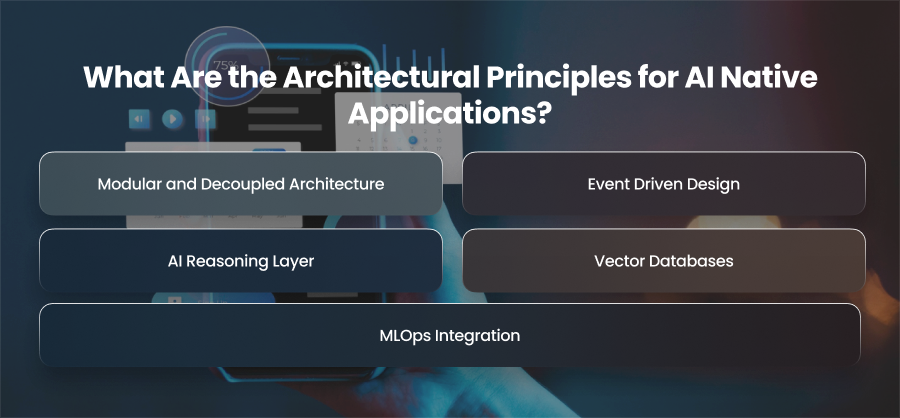
Modular and Decoupled Architecture
AI native apps require a decoupled and flexible architecture. By splitting the system into discrete components, such as data intake pipelines and agent orchestration layers, teams may manage each portion individually. This approach permits autonomous scaling of components based on workload and promotes quicker updates.
Flaws may therefore be identified without jeopardizing the system as a whole. Additionally, by making it simpler to debug certain modules without endangering other program components, modularity enhances maintainability.
Event Driven Design
Event driven architecture is a basic idea for AI native systems, particularly those that function in real time. Instead of depending on batch processing or continuous polling, event driven architecture allows programs to react to triggers such as user activities or system events. This method lowers latency and guarantees quicker prediction response times. For example, an AI agent handling customer interactions can process incoming messages as events and follow up actions without delay.
AI Reasoning Layer
The reasoning layer is at the center of all AI native apps. This layer orchestrates the AI models and context management. This layer ensures that the system can maintain state across interactions and provide contextualized responses. It often handles prompt management for LLMs and task orchestration for multiple AI agents. Implementing a reasoning layer allows the system to coordinate complex operations and maintain coherence across outputs.
Vector Databases
Vector database and RAG patterns are increasingly critical in AI native architectures. Vector databases store numerical embeddings of unstructured data. This enables fast similarity searches for relevant content. Models may extract relevant data from vast knowledge sets in conjunction with RAG procedures to produce well informed results. This pattern boosts the accuracy and contextual relevance of AI replies while guaranteeing that applications can manage enormous amounts of dynamic input effectively. It also allows AI native apps to provide more personalized interactions.
MLOps Integration
Another architectural principle is the integration of model lifecycle management through MLOps practices. The ongoing training and deployment of models must be taken into consideration by AI native applications. MLOps pipelines guarantee that models maintain their performance and that changes may be reliably implemented without interfering with application functionality. Continuous review and automatic retraining pipelines allow AI native apps to adapt to changing data contexts, offering consistency in production scenarios.
Security Considerations in AI Native Applications
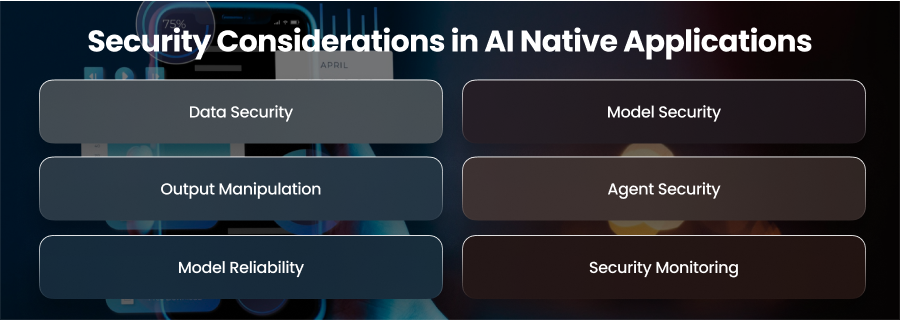
Data Security
Data security is the foundation of any AI native application because data powers every part of an AI system, from training to inference to long term optimization. Encrypting data as well as implementing secure data input pipelines that limit the chance of manipulation, are key components of ensuring trustworthy data security. Because AI systems analyze a variety of inputs, developers need to incorporate strong data validation to prevent harmful payloads from entering the system. Additionally, embeddings kept in vector databases may accidentally divulge hidden patterns if they are exploited. Therefore, preserving such storage levels is equally vital.
Model Security
AI models themselves are prime targets for attackers because they capture insights and intellectual property. Securing models involves protecting them from extraction attacks as well as inversion attacks that attempt to reconstruct training data from outputs. Access to model APIs should be guarded with authentication and rate limiting.
Output Manipulation
Prompt injection is one of the most serious threats to AI native applications, especially those powered by LLMs or autonomous agents. Attackers can influence outputs by crafting malicious or deceptive inputs that override system level instructions or manipulate reasoning steps.
To mitigate this, you should implement strong input sanitization and reliable system prompts, and a defensive prompt design to prevent model override. Developers should also implement guardrails or output validation layers to detect and block unsafe instructions before they reach downstream systems.
Agent Security
AI native applications frequently rely on agents that act autonomously or execute tasks through API calls and integrations. If agents are granted excessive permissions, they might unwittingly execute risky behaviors or be coerced into creating destructive behavior. Following the idea of least privilege is crucial; agents should only be provided access to the exact resources or actions necessary for their job. Developers must implement policy based execution controls and sandboxed execution environments.
Model Reliability
AI native apps must also consider the risk of model poisoning, where adversaries introduce harmful data during training or fine tuning to distort outputs or embed malicious backdoors. This threat is particularly relevant for applications using continuous learning loops and reinforcement learning. Defending against poisoning requires strict data validation and isolation between training and inference pipelines. Regular testing and evaluation against known attack patterns help ensure the model behaves as expected even when exposed to manipulated input.
Security Monitoring
AI native systems require advanced security monitoring capabilities that go beyond traditional observability. Developers must continuously track model outputs, API usage, and agent behaviors to detect anomalies that could indicate an attack. Behavioral monitoring can identify unusual queries or unexpected model predictions before they lead to system compromise. So, implementing automated alerts and incident response workflows ensures that teams can quickly respond to suspicious activity.
Compliance and Governance in AI Native Designs
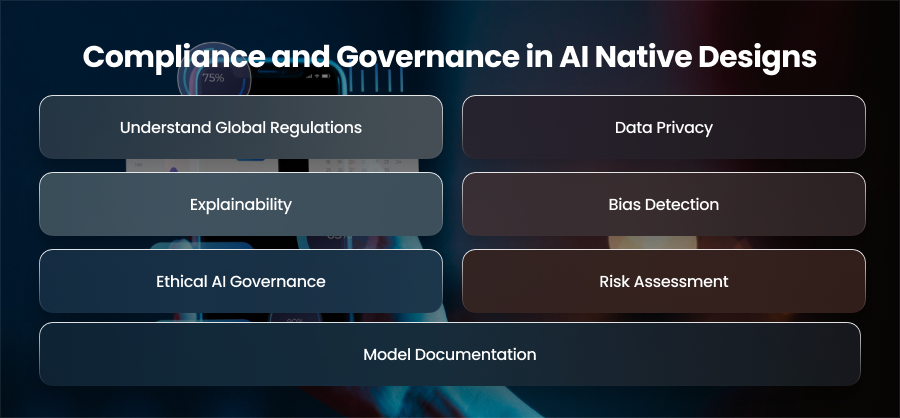
Understand Global Regulations
AI governance begins with understanding the regulatory environment in which an application operates. New frameworks that specify how AI systems must be developed and maintained have been adopted by jurisdictions all over the world. The EU AI Act establishes stringent guidelines for data handling and openness and categorizes AI applications according to risk level. In the USA, evolving regulatory standards stress ethical AI development and algorithmic effect evaluations.
Data Privacy
AI native applications collect and process substantial amounts of user data. This makes compliance with privacy rules vital. Developers are obligated to make sure that information is obtained with express consent and managed in conformity with local residential requirements. Differential privacy protections or anonymization are required for sensitive data. Ensuring that user data is not unintentionally exposed through model outputs or inference logs is equally critical.
Explainability
A major challenge of AI native applications is ensuring that their decisions can be understood and audited. Transparent AI has become a regulatory expectation. Explainability tools allow developers to interpret model predictions and provide users with clear explanations of how outcomes were generated. Logging each prompt and model decision is essential in AI native systems. This produces an auditable trail that may be inspected during compliance inspections or performance assessments.
Bias Detection
AI systems that are prejudiced may deliver unfair or discriminating outcomes, placing firms at risk for ethical and reputational difficulties. Mechanisms for routinely evaluating models and datasets for bias across demographic groupings must be incorporated into AI native applications. This entails assessing training data for representation gaps and setting fairness limits or rebalancing procedures where appropriate. Governance structures should mandate frequent evaluations and retain thorough evidence of how fairness was judged.
Ethical AI Governance
Internal governance policies must be established by organizations to direct the development and application of AI. Fairness and user rights are among the topics covered by ethical AI frameworks. These guidelines specify appropriate data sources and make it clear how AI can be applied inside the organization. Therefore, building governance boards or AI ethics committees assures that choices are scrutinized by cross functional teams.
Risk Assessment
In order to analyze potential damage and unexpected effects, AI native apps must regularly undertake risk assessments. Risks like model drift and security vulnerabilities are identified by these evaluations. Continuous monitoring then assures that the system operates as intented throughout time. This involves monitoring data quality and model performance. Automated alerts and dashboards let teams spot problems early.
Model Documentation
Governance also requires comprehensive documentation of the entire model lifecycle. This includes the datasets used for training and labeling methods. Additionally, version history and ethical issues are included. Transparency and accountability are improved by keeping a model card or system card for every model.
Version control and change logs allow auditors and compliance teams to track how a model has evolved. Lifecycle governance becomes even more important in AI native applications that support continuous learning or multiple interconnected models.
Best Practices for Building Secure AI Native Apps
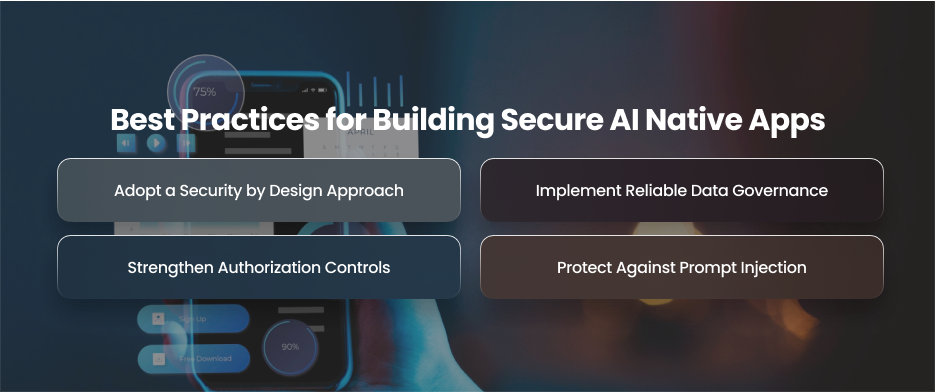
Adopt a Security by Design Approach
Security cannot be an afterthought in AI native systems. Implementing a security by design approach guarantees that safeguards are built into each level of development. This covers threat modeling during early architecture talks and incorporating risk evaluations throughout the machine learning lifecycle. A proactive approach addresses vulnerabilities before they may be serious risks, decreasing downstream security debts and boosting overall resilience.
Implement Reliable Data Governance
Secure AI behavior requires high quality data. Organizations must have stringent metadata management and data governance procedures to avoid unexpected consequences. Data poisoning attacks, in which hostile actors modify training data to affect model outputs, are less likely when data sources are verified and authorized.
Additionally, applying automated validation tools helps detect irregularities and corrupted entries before being input into AI models. In addition to increasing accuracy, trustworthy data governance guarantees that systems adhere to legal standards.
Strengthen Authorization Controls
AI native systems often involve multiple interacting components that need to trust one another. Strong identity and access controls therefore becomes crucial. Implementing role based access control and attribute based access control guarantees that only authorized persons and systems may access critical data or orchestration operations. Multi factor authentication and API token rotation further safeguard identities.
Protect Against Prompt Injection
One of the biggest risks to AI native systems, particularly those employing big language models and autonomous AI agents, is prompt injection. Attackers can modify prompts or compel models to divulge sensitive information. To combat this, developers should require robust input validation and sanitize user provided material.
Techniques such as structured prompting and controlled agent permissions help prevent model misuse. Regular penetration testing focused specifically on AI interactions is also essential for identifying weak points in prompt handling logic.
Final Words
AI native applications demand a thoughtful blend of adventure architecture and strong security practices. Thus, companies may create intelligent systems that are both strong and secure by putting a high priority on data integrity and ongoing monitoring.