


Executive Summary
Choosing between an agency and an engineering partner depends on your SaaS company’s needs. Agencies focus on short-term projects, MVPs, and speed. Engineering partners offer long term collaboration, deep integration, and support for complex, evolving products. Select based on project scope, product complexity, and growth stage.
Introduction
As SaaS companies grow, engineering decisions become business decisions. The speed at which you build and the quality of your product’s architecture directly impact revenue and customer retention. One of the most important decisions leadership teams face is whether to work with an agency or an engineering partner.
Selecting the incorrect model may result in technical debt, disjointed systems, and higher long term expenses. A more robust product foundation and quicker growth are possible with the correct choice, though.
In this guide, we will discuss the differences between agencies and engineering partners. We will also discuss when each model makes sense and how growing SaaS companies should evaluate their options.
What is An Agency?
Generally speaking, an agency is a service provider that offers particular technical results within a predetermined scope and price. Agencies are frequently project-focused, meaning their main objective is to execute the stipulated tasks effectively.
Typically, agencies use hourly billing or fixed price contracts. Their work is frequently organized according to predetermined specifications, such as creating a stand alone program or a feature.
Characteristics of Agencies
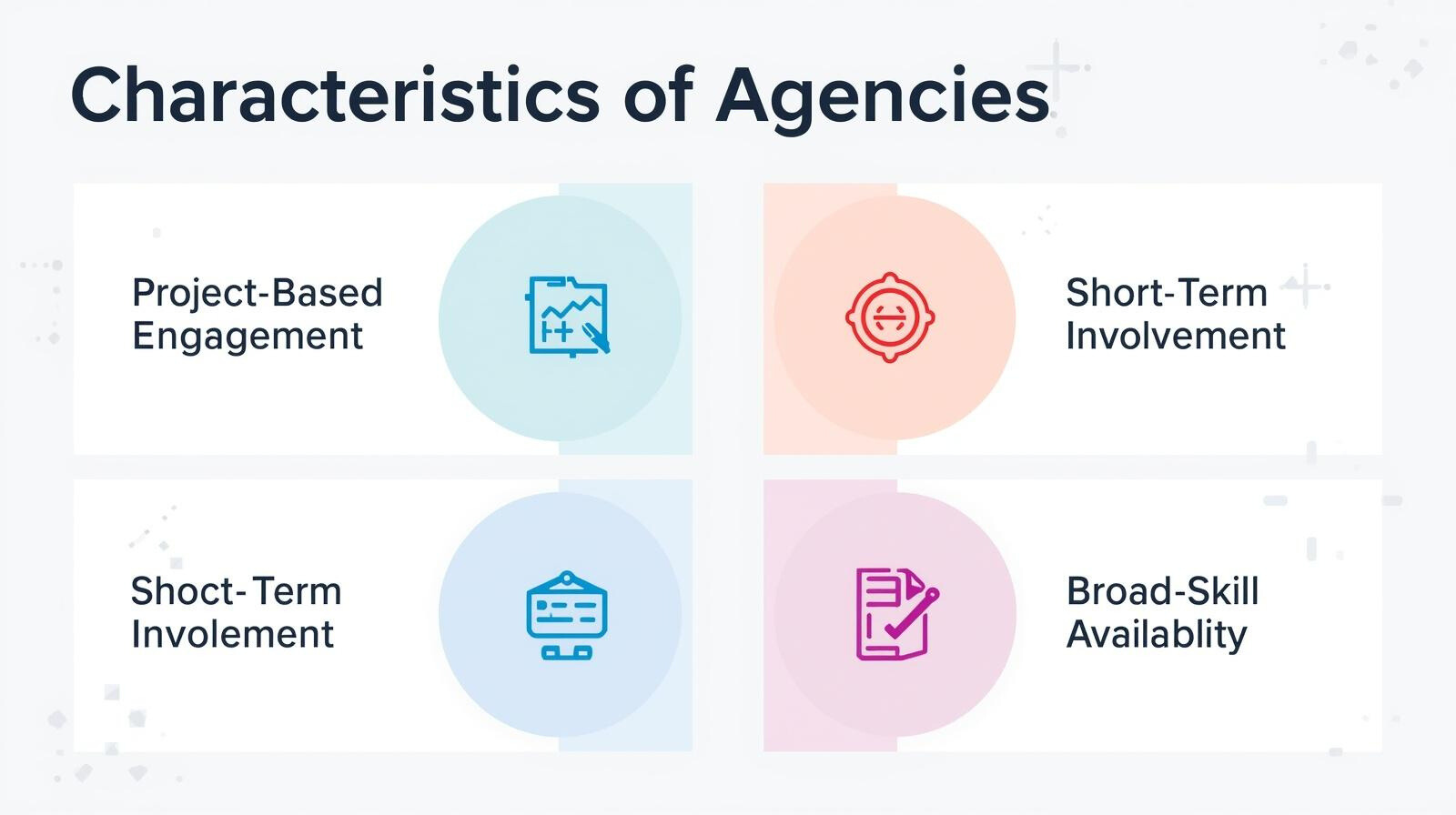
Some characteristics of software development agencies include:
- Project-Based Engagement
Agencies focus on completing clearly defined projects. Once the project ends, the relationship may conclude unless a new scope is defined.
- Execution-Focused Approach
Agencies prioritize implementing requirements provided by the client. Their role is typically to execute, not to deeply influence product strategy or architecture decisions.
- Short Term Involvement
Agencies are often engaged for weeks or months rather than years. Their involvement usually aligns with specific deliverables.
- Broad Skill Availability
Agencies often employ designers, developers, and project managers, allowing them to deliver complete projects.
Advantages of Working with an Agency
There are numerous advantages to working with an agency. Some of these include:
- Rapid Delivery
Agencies are structured to begin quickly. They often have ready teams and established workflows, which help accelerate initial development.
- Lower Commitment
Because agencies operate on defined scopes, companies can engage them without long-term obligations.
- Useful for MVPs
Agencies are well suited for building MVPs, prototypes, landing pages, or clearly scoped features.
- Predictable Cost Structure
Fixed price or milestone based contracts provide clearer short term budget expectations.
Limitations of Agencies
Agencies, despite their advantages, have their limitations as well. These are:
- Limited Strategic Ownership
Agencies typically focus on delivering what is requested, rather than deeply shaping the long term technical direction of the product.
- Knowledge Loss Risk
Once the project ends, valuable product knowledge may leave with the agency team, making future development more difficult.
- Misaligned Incentives
Agencies are often incentivized to complete projects efficiently, but not necessarily to optimize long term scalability.
- Less Integration with Internal Teams
Agency teams usually operate externally rather than functioning as embedded members of your engineering organization.
What is an Engineering Partner?
A long term technical partner who works closely with your business to create, develop, and support your product is known as an engineering partner. Engineering partners function with a higher degree of integration and strategic alignment than agencies.
Rather than simply executing tasks, engineering partners contribute to architectural decisions and long term technical strategy. They are not so much an external provider as they are an extension of your inside technical team.
Characteristics of Engineering Partners
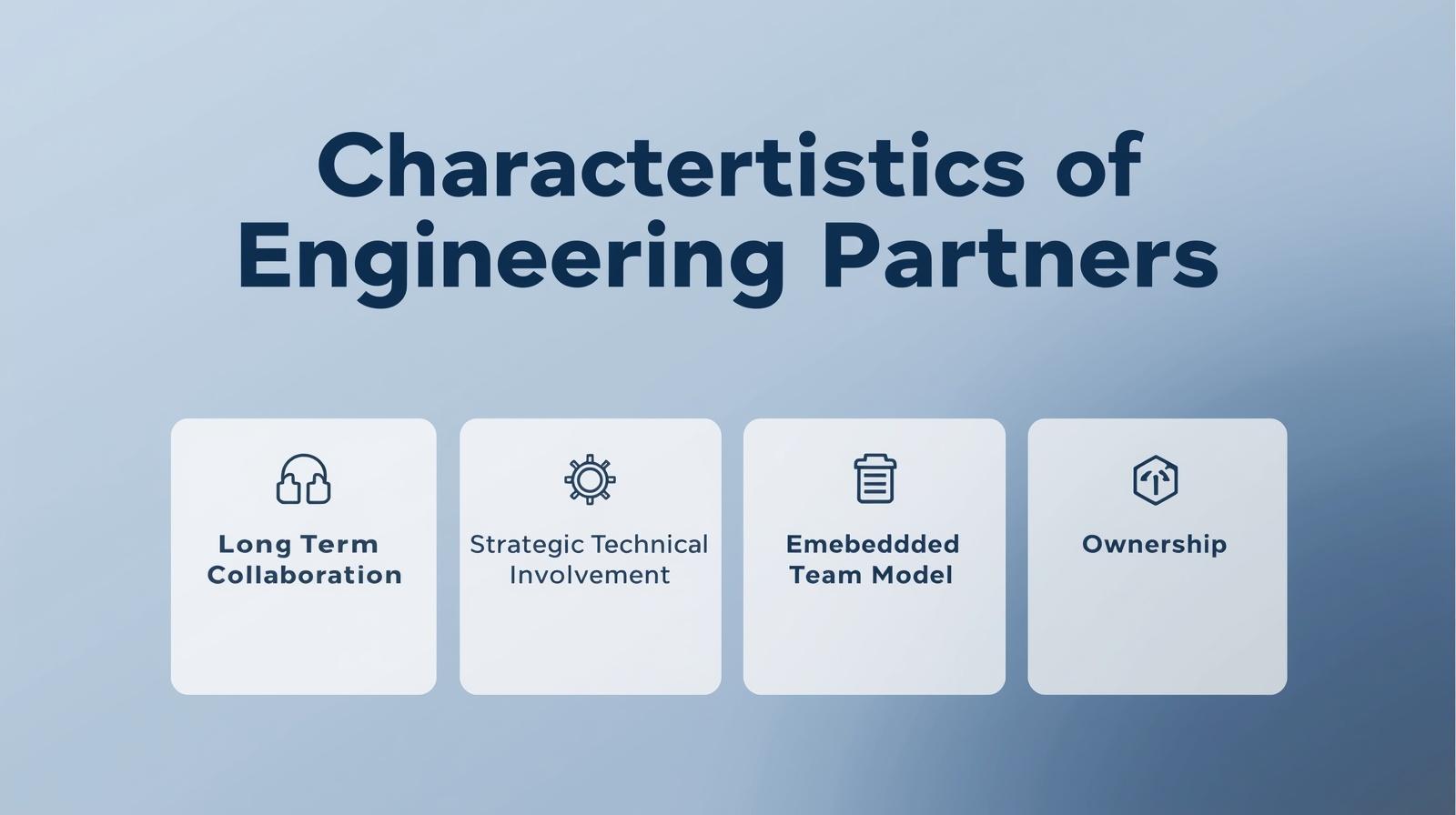
Some defining characteristics of engineering partners are:
- Long Term Collaboration
Engineering partners typically work with companies for extended periods, often months or years.
- Strategic Technical Involvement
They contribute to system design, architecture, and technical roadmap decisions.
- Embedded Team Model
Engineering partner teams often integrate directly into your workflows, tools, and processes.
- Ownership
In addition to providing features, they are accountable for the product’s long term viability and scalability.
Advantages of Working with an Engineering Partner
From deep product understanding to reduces technical debt, engineering partners have a number of advantages. Some of these are:
- Deep Product Understanding
Because engineering partners stay involved long term, they develop a comprehensive understanding of your system and business goals.
- Better Architecture
Engineering partners focus on building systems that can scale as your user base and product complexity grow.
- Consistent Development Velocity
When teams work together for a long time, they may maintain steady momentum without regular onboarding processes.
- Reduced Technical Debt
Engineering partners are incentivized to build maintainable solutions rather than temporary fixes.
- Strategic Contribution
They aid in directing choices that impact security and performance.
Limitations of Engineering Partners
Some limiations of engieering partners include:
- Higher Initial Investment
Engineering partners may require a greater upfront commitment compared to short term agency projects.
- Requires Alignment and Trust
Successful partnerships depend on strong communication and shared goals.
- Not Necessary for Small Projects
For simple and short term tasks, a full engineering partnership may be more than required.
What Should SaaS Companies Consider Before Making A Decision?
Current Growth Stage
Your choice should be greatly influenced by the stage of growth of your business. Speed is sometimes given precedence above quality by early stage firms that are still determining product market fit.
Right now, getting started and iterating fast is more crucial than developing systems that are perfectly efficient. Hiring an agency might be a wise choice in this situation, especially if you have a deadline for creating a certain MVP or prototype.
But objectives change when a SaaS company moves into the growth stage. Customer expectations rise, and product reliability becomes critical. What worked for an MVP may not hold up under scale.
As you move into expansion mode, the need for long term technical stability becomes more important than rapid short term output. In these situations, an engineering partner typically provides stronger continuity.
Architecture Requirements
Not all SaaS products require the same level of architectural depth. It your platform is relatively simple, with limited integrations and moderate traffic, an agency may be able deliver the functionality you need effectively. Clearly scoped development projects can often be handled well in this model.
But if your product involves multi tenant environments or high concurrency usage, you are building more than just features, you are building infrastructure. These systems require careful architectural decisions and technical foresight.
Engineering partners are better positioned to think beyond immediate deliverables and design systems that remain stable and scalable as your user base grows. Poor architectural decisions at this level can create technical debt that becomes expensive and disruptive to fix later.
Long Term Product Vision
Your long term ambition should directly shape your engagement model. If your objective is to launch quickly and test an idea with minimal long term commitment, an agency may be sufficient. The focus in this scenario is speed and output.
However, if you are building a SaaS product intended to evolve continuously or support a growing global customer base. Moreover, sustained growth requires consistent engineering ownership and proactive scalability planning. Together, you and your engineering partner create for the future rather than simply the current sprint. They assist in anticipating infrastructure scaling requirements and performance constraints before they become serious problems.
Internal Technical Leadership
The strength of your internal engineering leadership is one of the most important decision factors. If you have an experienced CTO and senior architects, you may be able to use agencies effectively for execution. In this instance, the agency offers development capability, and your internal leadership provides architectural supervision.
However, depending just on agencies might be risky if your own team has strong technical guidance or scaling experience. Short term development choices might jeopardize the long term health of the system in the absence of robust architectural supervision.
Knowledge Retention
SaaS products are rarely static. They change continuously based on user feedback and strategic priorities. This makes knowledge retention critical. When an agency completes a project and disengages, valuable context about architecture decisions and system limitations may be left with them.
Engineering partners remain embedded over longer periods. They gain product expertise and help with continuous enhancements. This consistency lowers the possibility of uneven development techniques and speeds up the onboarding process for new projects. So, for SaaS companies planning multi year product evolution, retaining institutional knowledge can significantly improve efficiency.
Cost Structure
At first glance, agencies may appear cost effective due to clearly defined project pricing. This predictability can be appealing, particularly for early stage companies managing limited budgets.
However, long term value should be evaluated beyond initial cost. Technical debt and frequent vendor transitions can increase the total cost of ownership over time. Engineering partners may involve a higher upfront investment. However, they often reduce long term costs by building scalable systems and maintaining consistent development velocity.
Agency vs Engineering Partner: A Comparison
Not every external team operates the same way. This comparison shows how a traditional agency model differs from an engineering partner model across ownership, strategy, scalability, and long-term product success.
| Criteria | Agency | Engineering Partner |
|---|---|---|
| Primary Focus | Delivering defined projects within a fixed scope and timeline | Long-term product development |
| Engagement Model | Project-based, milestone-driven | Ongoing collaboration with an embedded team model |
| Strategic Involvement | Limited to executing the provided requirements | Contributes to architecture and long-term technical strategy |
| Ownership Level | Focused on deliverables | Shared responsibility for product success and system health |
| Time Horizon | Short to medium term | Long-term partnership |
| Scalability Planning | Often reactive, based on project scope | Proactive planning for growth and performance |
| Knowledge Retention | Knowledge may leave after project completion | Deep product understanding maintained over time |
| Internal Integration | Operates externally with limited immersion | Functions as an extension of the internal engineering team |
| Flexibility | Flexible for defined tasks or one-off projects | Flexible for evolving roadmaps and continuous development |
| Cost Structure | Typically fixed-price or milestone-based | Usually retainer- or dedicated-team-based pricing |
| Risk Profile | Risk of technical debt if long-term planning is limited | Requires alignment and commitment, but reduces long-term technical risk |
Tip: This version is responsive and will scroll horizontally on smaller screens instead of breaking the layout.
Common Misconceptions About Agencies and Engineering Partners
Agencies and Engineering Partners Are Essentially the Same
At a glance, both agencies and engineering partners offer external development services. They both provide engineers and technical experts. Because of this overlap, many leaders assume the difference is purely a matter of branding.
In reality, the distinction lies in depth of involvement and strategic ownership. Agencies are typically structured around delivering defined outputs within a fixed scope. Their success is measured by the completion of projects. On the other hand, engineering partners measure success by product evolution and long term technical health.
Agencies Are Always the More Affordable Option
Agencies often present clear project pricing, which creates a sense of cost predictability. For early stage companies, this can feel safer than committing to a longer term partnership. However, upfront cost doesn’t equal long term value.
When systems are built without scalability in mind, technical debt accumulates. Performance may deteriorate when more features are introduced. When integrations become fragile, refactoring becomes inevitable.
Even though they may need a higher initial investment, engineering partners often reduce the total cost of ownership by producing maintainable designs and ensuring knowledge continuity.
Agencies Cannot Deliver High Quality Work
It’s incorrect to assume agencies produce inferior work. Many agencies employ highly skilled engineers and deliver excellent results. The issue is not quality, it’s continuity and strategic alignment.
Agencies excel when objectives are clearly defined and limited in scope. They are highly effective for launching MVPs or building standalone features. Problems arise when agencies are expected to function as long term custodians of complex systems without being structured for that role.
An Engineering Will Replace the Need for an Internal Team
Some SaaS leaders fear that working with an engineering partner means losing control or outsourcing their core product entirely. In reality, strong engineering partnerships are collaborative. Instead of replacing inherent capabilities, they enhance them.
By offering specialized knowledge and enhancing architectural planning, an engineering partner may support internal teams. They can raise internal engineering standards over time.
Hiring Internally is the Long Term Solution
Many founders believe the only serious way to scale is by building a fully in house engineering team. While internal hiring is important, it comes with high cost and management overhead.
Recruitment cycles are long. Senior engineers are expensive. Also, onboarding takes months. Scaling quickly through hiring alone can strain budgets and leadership bandwidth.
Engineering partners offer flexibility. They allow SaaS companies to scale development capacity up or down based on roadmap needs without long recruitment cycles.
Final Words
Selecting between an engineering partner and an agency is more than simply a sourcing decision; it’s a strategic growth decision. While technical partners offer long term ownership and scalability, agencies give speed and well defined results. The intricacy of your product and your desire to create sustainability will determine the best option.