


The market for AI in healthcare is predicted to grow to $308 billion over the next five years, according to figures. This is due to the significant movement in healthcare toward digital transformation. Furthermore, prescription drugs are one area where AI is having a significant influence.
Prescription errors have always been a hidden problem in healthcare. Patient data fragmentation causes problems that are easily preventable. These mistakes not only put patients at risk but also put a heavy financial and administrative burden on clinics and hospitals.
AI is intervening to alter all of that, though. AI technologies are assisting medical professionals in prescribing drugs with previously unheard of precision through automated decision support and predictive intelligence. As a result, prescription workflows are becoming smarter and significantly more secure for patients.
In this guide, we’ll discuss how AI powered prescription systems work and how they enhance accuracy.
What Are AI Powered Prescription Systems?
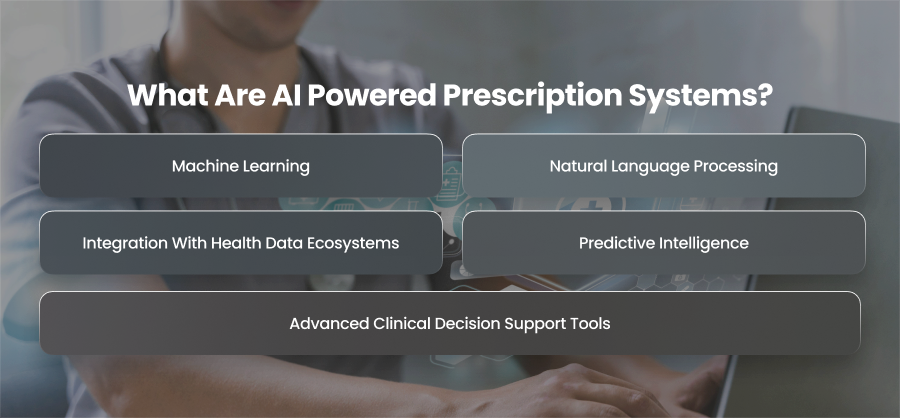
AI powered prescription systems are intelligent and data driven platforms designed to support healthcare professionals throughout the entire medication prescribing process. Unlike traditional electronic health record systems, which simply store and display information, AI systems analyze data and identify patterns. They then recommend the safest and most effective medication options based on real time patient information.
These systems act like a highly knowledgeable medical assistant who never gets tired and makes suggestions supported by millions of data points.
What truly makes these systems transformative is the combination of several advanced technologies working together.
Machine Learning
Machine learning is at the centre of AI prescription systems. To determine which drugs are most effective in certain situations, these algorithms analyze enormous volumes of medical data. Additionally, they improve their forecasts over time by continually learning from new patient outcomes. For instance, the system will start flagging a medicine under similar conditions if thousands of individuals with a given disease react negatively to it.
This implies that instead of depending just on general medical guidelines, healthcare practitioners now receive individualized, data driven insights each time they write a prescription.
Natural Language Processing
Modern AI systems can understand text and speech through NLP. This allows them to read doctor notes and extract critical information from unstructured documents.
With NLP, healthcare professionals can:
- Dictate symptoms or findings and instantly get prescription recommendations
- Ask the AI verbally for dosage options or alternatives
- Scan through years of patient notes without manually searching
This removes the tediousness of documentation and makes prescribing as simple as having a conversation.
Advanced Clinical Decision Support Tools
While older CDS systems functioned more like rigid rule based checklists, AI powered CDS tools are dynamic and context aware. They examine several data layers to comprehend the complete clinical picture rather than only alerting users to clear medication interactions. For instance, they can ascertain whether the suggested drug is compatible with the patient’s renal function and a list of current medications. The technology will notify the practitioner and provide safer options if something raises concerns.
Integration With Health Data Ecosystems
AI systems don’t exist in isolation any longer. They connect to a wide network of real time data sources:
- Electronic Health Records
- Pharmacy Databases
- Insurance Portals
- Lab Systems
- Wearable Health Devices
- Telemedicine Platforms
- Patient Health Apps
This interconnected ecosystem gives the AI a 360 degree view of the patient’s health. As a consequence, prescriptions show the patient’s current health metrics and treatment progress in addition to their medical history.
Predictive Intelligence
One of the most groundbreaking aspects of modern AI prescription systems is predictive intelligence. Instead of simply checking for errors, these systems forecast treatment outcomes based on millions of historical cases and patterns.
They can predict:
- The likelihood of side effects
- Whether the patient will respond postively to a drug
- How long will the medication take to show results
- The chances of the patient discontinuing due to discomfort
- Possible inconsistencies with upcoming therapies
These forecasts enable medical practitioners to select drugs that are safe and effective both now and in the future.
How AI Enhances Prescription Accuracy?
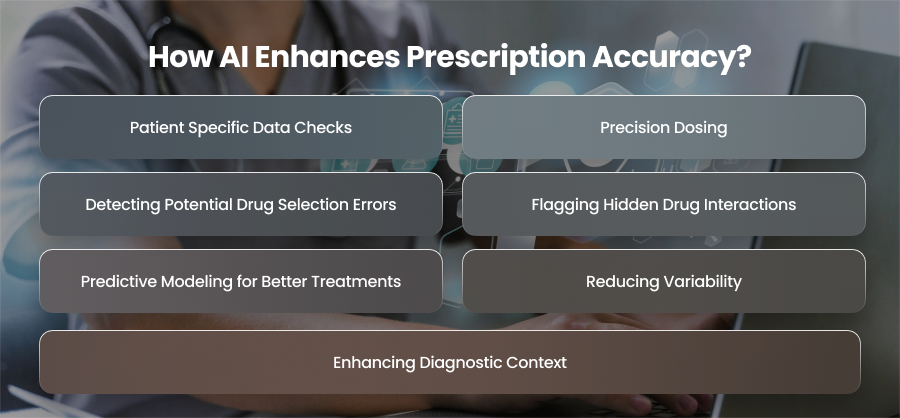
Patient Specific Data Checks
Eliminating human mistake is one of the simplest yet most effective ways AI improves accuracy. Conventional handwritten prescriptions can result in misunderstandings or confusion between names of comparable medications. With AI powered systems, everything is digitally generated and standardized. Even if a doctor uses voice input or types quickly, the system immediately identifies inconsistencies or unusual dose ranges. This ensures that every prescription is clear and easily interpreted by patients.
Precision Dosing
One of the most important components of safe prescription is accurate dose, and AI shines in this area by providing customized calculations. AI examines patient-specific variables like weight and metabolic rate rather than depending just on general dose recommendations. It also reviews similar cases across global datasets to determine the best dosage for a particular individual. AI’s accurate dosage recommendations greatly lower the danger of overdose for drugs with limited therapeutic windows.
Detecting Potential Drug Selection Errors
AI supports healthcare professionals whether the chosen medication is truly the best option for the patient. Sometimes, an alternative medication can offer better results or a stronger safety profile. To identify these possibilities, AI assesses patient specific characteristics and therapy recommendations. The method highlights the problem and recommends safer or more efficient substitutes if the chosen medicine interferes with the patient’s pre existing diseases. Without having to manually search through several databases, these real time recommendations assist healthcare providers in making better decisions.
Flagging Hidden Drug Interactions
Patients often take several medications prescribed by different healthcare providers. This makes drug interactions a major concern. AI dramatically enhances accuracy by scanning drug to drug and even drug to condition interactions. AI systems provide context and practical choices rather than ambiguous warnings. For instance, if a medicine combination raises the risk of cardiac problems, the AI can recommend switching to a different drug that comparable individuals often accept.
Predictive Modeling for Better Treatments
One of the biggest advancements in AI driven accuracy is predictive analytics. Rather than simply checking for immediate issues, AI can forecast how a patient is likely to respond to certain medications based on genetic factors and patterns found in millions of similar cases. This helps health professionals choose treatments that align not just with current symptoms but with long term health outcomes. AI can predict side effects or even hospitalization risks.
Reducing Variability
Prescribing habits can vary between healthcare providers based on experience or training. AI minimizes the variability by offering consistent recommendations. Patients receive the same degree of precise, evidence based care whether they see an experienced physician or a novice. By lowering inequities and enhancing patient outcomes across the healthcare system, this standardization guarantees that the quality of service is maintained at a high level among various providers.
Enhancing Diagnostic Context
AI improves the connection between accurate diagnosis and medicines by looking at patterns between symptoms and previous occurrences. If a prescription does not match the most likely diagnosis, the AI could advise a doctor to change their mind or offer further details. For example, if antibiotics are used to treat a viral disease, the system will detect an abnormality.
How AI Improves Safety in Medication Management?

Automated Drug Interaction Alerts
Drug interactions are the leading cause of preventable medication errors, particularly for patients taking multiple medications prescribed by different healthcare professionals. AI systems can analyze a patient’s complete medication list in seconds, cross referencing it with millions of known interactions. These alerts are far more sophisticated than traditional pharmaceutical software; they incorporate security levels. For instance, AI not only identifies the problem but also suggests safer alternatives or dose modifications when a patient is administered a blood thinner together with a new drug that may raise the risk of bleeding.
Continuous Patient Monitoring
AI integrates data from wearables and Internet of Things health monitors to expand drug safety outside of the clinic. These gadgets offer up to date information on vital signs, including heart rate. AI continually analyzes this data and can notify the the physician if there are indications that a prescription drug is not working as intended or is having negative side effects. For example, the AI system may identify the problem right away if a patient takes a new antihypertensive drug and has abnormally low blood pressure measurements for a few days. This enables medical professionals to modify treatment before issues develop.
Safe Transitions Between Care Teams
Patients regularly transfer between several healthcare environments, like from a hospital to home health services or from an emergency department to an inpatient facility. Transitions like these can introduce errors if medication histories aren’t communicated effectively. AI systems track and update prescription data across all teams in real time. This ensures continuity and reduces the risk of errors.
Minimizing Errors in Complex Cases
Complex medication schedules are frequently necessary for patients with numerous or chronic diseases. Errors are more likely as a result. By easily managing this complexity, AI enhances safety. It assesses interactions between all drugs and ailments. This gives medical professionals precise instructions on what is safe to prescribe. AI reduces the likelihood of oversight by analyzing all factors simultaneously, even in the most complicated circumstances.
Reducing Human Workload
Healthcare professionals often face high workloads. This increases the risk of errors. AI systems reduce administrative burdens. This frees up medical professionals to concentrate on patient care instead of paperwork. This simultaneously increases safety and efficiency. AI makes sure that no crucial safety precaution is missed, even during hectic hospital shifts or emergency situations.
Challenges and Limitations of AI in Prescriptions

Fragmentation Issues
AI systems are totally dependent on the data they are given. AI may provide suggestions that are hazardous or wrong if patient records are fragmented or dispersed across several unrelated systems. Maintaining a single data source is challenging since many healthcare organizations still rely on outdated methods for accurate recording. AI may not be able to detect potentially dangerous interactions if test data or drug histories are insufficient. AI algorithms won’t be able to provide completely trustworthy findings until healthcare data is more standardized.
Bias in AI Models
AI systems are trained on past data, which frequently contains biases that mirror disparities in the actual world. AI algorithms may yield less accurate suggestions for people that are underrepresented in datasets. This includes certain socioeconomic groups or demographics. For instance, a system that was mostly trained on adult data cannot handle younger patients. Similarly, biases in gender or race can lead to unsafe or ineffective prescription suggestions from some individuals. Addressing bias requires diverse data inputs and better model practices.
Reliance on Automated Recommendations
Healthcare workers run the danger of becoming unduly reliant on automated recommendations as AI systems advance. Medical decision making needs human judgment and subtlety. Errors may go undiscovered if healthcare providers depend too much on AI without carefully examining advice. Ensuring patient safety requires striking a balance between healthcare providers and AI advice.
Privacy and Security Concerns
Prescription systems powered by AI require access to sensitive patient data. This raises concerns about privacy and cybersecurity. Because the healthcare sector is one of the most vulnerable to cyberattacks, there is a risk associated with processing and storing these enormous databases. A single hack might reveal private health information, undermining patient confidence and going against the law. Therefore, before using AI prescription technologies at scale, it is crucial to provide dependable encryption and compliance frameworks.
Integration with Existing Healthcare Systems
Most hospitals already rely on various EMR platforms and diagnostic tools. Integrated AI powered prescriptions software into these existing workflows is often challenging. Adoption may be hampered by compatibility problems and lengthy implementation schedules. To properly utilize the new technology, healthcare providers could also need a lot of training.
Final Words
By increasing accuracy and optimizing operations, AI is transforming medical prescriptions. Responsible adoption guarantees that AI becomes a potent ally for healthcare practitioners, even when issues like data quality and integration barriers still exist. AI driven prescription systems will become more and more important to patient care as healthcare evolves.