




According to a survey, distributed teams are 40% more productive than office workers. This is due to the fact that corporate operations have been drastically changed by the growth of global connection and digital transformation. Therefore, distributed teams are no longer a novelty. In fact, they are becoming the preferred model for companies looking to remain competitive.
In this blog, we’ll discuss the factors driving productivity in distributed teams and share best practices for team management. Also, we will provide insights to help companies use the full potential of distributed teams.
Factors Driving Productivity in Distributed Teams
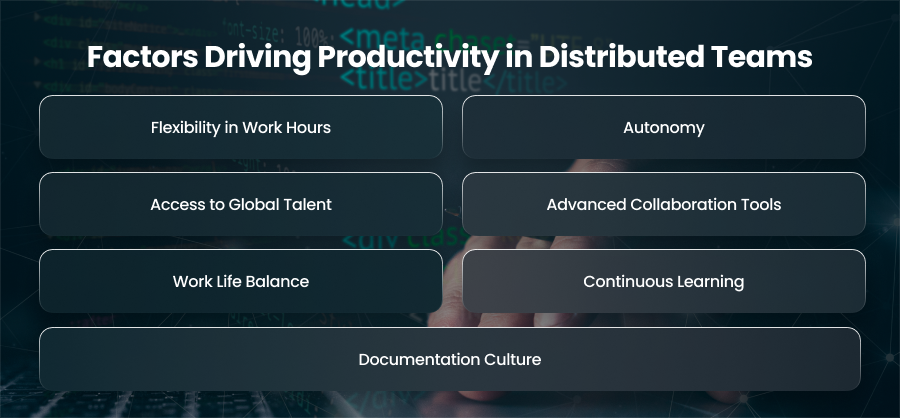
Flexibility in Work Hours
One of the main advantages of remote teams is flexible scheduling. Employees are forced to work during periods when they may not be at their best due to the strict structure established by regular office hours. Distributed teams allow employees to work as efficiently as possible.
A developer in New York could be more productive in the morning. In the afternoon, a team member in San Francisco finds their rhythm. Therefore, businesses gain from increased attention and quicker project completion when team members are able to match work with their productive hours. Additionally, flexibility aids workers in juggling personal obligations. Burnout may be lessened as a result.
Autonomy
Distributed teams rely on autonomy and trust. Hence, this necessitates a culture where individuals take responsibility for their work.
Additionally, autonomy promotes autonomous decision making among team members. Moreover, Gallup reports that highly engaged workers are 14% more productive. Therefore, when developers are trusted, they are more driven to do high quality work.
Access to Global Talent
One of the most transformational aspects of distributed teams is the ability to hire the best talent globally. In office teams are restricted by geographic location, limiting a company’s access to specialized skills. Distributed teams can tap into a worldwide pool of developers.
This facilitates 24/7 development cycles and enables firms to put together teams with complementary talents and various viewpoints. A product, for example, can advance constantly, with one team completing their workdays while another team in a different time zone continues where they left off.
Advanced Collaboration Tools
For augmented teams, technology is a vital source of productivity. Task management and communication are made easy by programs like Slack and GitHub.
Jira helps teams allocate tasks and effectively address bottlenecks. Slack facilitates real time communication. Conversely, technologies like as Notion serve as a central knowledge base.
Additionally, by allowing workers to respond at their own pace, asynchronous communication solutions reduce disruptions that often impair productivity in office setups and do away with the necessity for constant meetings.
Work Life Balance
Although autonomy and flexibility are frequently mentioned as advantages for individuals, they also directly boost team output. Long term employee engagement is enhanced by distributed teams that respect work life boundaries.
A contented worker is naturally more productive. When developers are able to manage their duties, they are more dedicated to reaching deadlines. Businesses that cultivate this kind of culture experience reduced employee turnover. This saves money on recruiting new staff.
Continuous Learning
Distributed teams often adopt a culture of continuous learning. Employees often devote time to studying new technologies or broadening their skill set in order to stay competitive, since they operate autonomously.
Businesses may also offer webinars and virtual training tailored to distant operations. A team that never stops learning finds more effective solutions to issues.
Documentation Culture
Distributed teams rely more heavily on documentation because real time conversations aren’t always possible across time zones. This encourages clarity and gives developers well structured references for tasks. A robust documentation culture reduces knowledge silos and gets rid of repetitive explanations. Because everyone has constant access to information at all times, the team as a whole operates more effectively.
Challenges of Distributed Teams
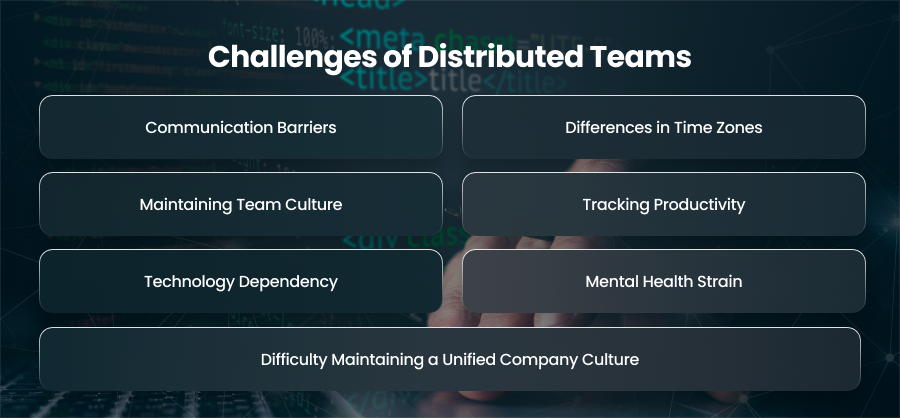
Communication Barriers
For remote teams, communication is frequently the largest obstacle. The problem is made worse by team members’ inconsistent communication styles. This makes it difficult to coordinate tasks or ensure alignment on project goals. For example, a developer can misunderstand a task due to unclear written instructions. This results in rework and delays, problems that could be quickly addressed through in person discussions.
To overcome this, companies need clear communication protocols. Video interactions may preserve tone and context for complex discussions. Confluence and other asynchronous solutions offer a centralized method of sharing changes.
Differences in Time Zones
Scheduling can be challenging for dispersed teams since they frequently work across time zones. Businesses can function almost constantly. However, setting up meetings and quickly resolving problems might be difficult. For example, a Californian project manager may find it difficult to communicate with Illinois developers. Project timeframes may be impacted by this.
Businesses may use project management software like Jira to track progress and develop asynchronous processes to address this. If important discussions are planned within overlapping core hours and meeting times are fairly distributed across time zones, no team will be at a disadvantage. With proper planning, time zone differences can
Maintaining Team Culture
Another major issue for remote teams is creating a cohesive team culture. In the lack of regular touch, employees may feel cut off from the company’s principles. This might lower engagement and loyalty. If social contacts and acknowledgment are lacking, a remote developer could feel like a silent contributor. Businesses must spend money on virtual team building exercises that promote connection in order to combat this. Programs for recognition also support teamwork and preserve a feeling of community.
Tracking Productivity
It is necessary to move away from conventional approaches that depend on hours worked or visual presence in order to monitor performance in remote teams. It’s simple for work to become disjointed or out of step with company objectives in the absence of clear performance indicators. By establishing KPIs and utilizing dashboards to monitor success, businesses may get around this. Furthermore, regular reporting and milestone tracking allow team members to effectively manage their own calendars while ensuring responsibility.
Technology Dependency
Because distributed teams rely so much on technology, any disruptions may have a big effect on output. Work might be stopped by security breaches or connectivity problems. This is especially true when teams are spread throughout many regions. To lower these risks, businesses need to make investments in reliable IT infrastructure and backup solutions. Teaching team members cybersecurity best practices also ensures little downtime.
Mental Health Strain
Although working remotely allows you more freedom, it may frequently make you feel lonely. Long hours spent working alone could make team members feel disengaged, particularly if they don’t contact with people outside of work. Isolation could eventually impact one’s motivation. Without intentional social initiatives and mental health support, distributed teams can experience a drop in morale.
Difficulty Maintaining a Unified Company Culture
In office teams naturally absorbs the company’s culture through interactions and shared experiences. With scattered teams, keeping a strong and united culture demands continual work. Instead than being passively observed, values and actions must be actively articulated. Without it, team cultures may become disjointed and uneven.
Comparing Distributed Teams to In Office Teams
| Aspect | Distributed Teams | In-Office Teams |
| Productivity | Fewer disruptions and more deep work hours. | Frequent interruptions and impromptu meetings. |
| Work Life Balance | Flexible hours | Fixed schedules and limited control over work environment. |
| Collaboration Style | Primarily asynchronous; structured, documented communication via digital tools. | Mostly synchronous; relies on meetings and real time discussions. |
| Communication | Written communication enhances transparency and reduces misunderstandings. | Verbal exchanges can lack structure and can cause misalignment. |
| Talent Access | Global hiring; access to specialized skills anywhere in the world. | Limited to local talent; slower hiring for niche skills. |
| Cost Efficiency | Lower operational costs with minimal to no office overhead. | High expenses for office space, utilities, maintenance, and equipment. |
| Culture Development | Requires intentional virtual culture building efforts. | Culture develops organically through in person interactions. |
| Performance | Output focused peformance measurement with clear deliverables. | Also output based evaluation. |
| Team Bonding | Must be fostered deliberately through remote initiatives. | Occurs naturally through shared physical spaces and interactions. |
Best Practices for Maximizing Distributed Team Productivity
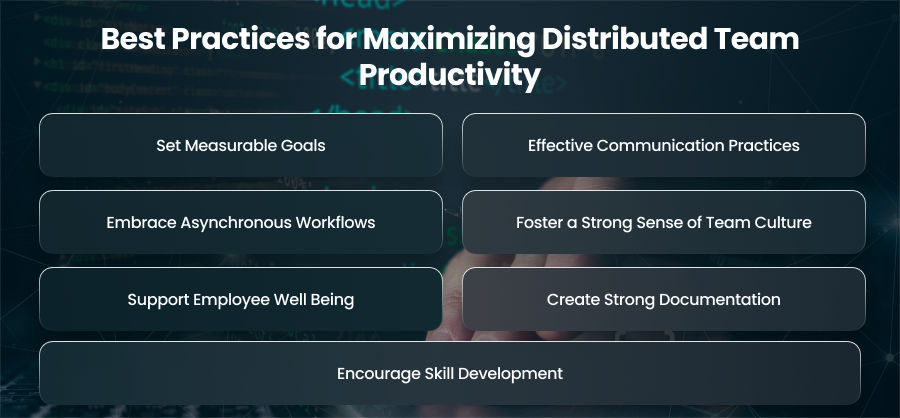
Set Measurable Goals
Setting quantifiable targets early on is one of the most important best practices for remote teams. Because team members may work alone and at various times, remote work needs clarity. Uncertainty is eliminated, and everyone is aware of what success looks like when deliverables are clearly documented.
Using frameworks like OKRs makes it easier to measure team priorities. Instead of keeping track of hours worked, managers should focus on timely delivery.
Effective Communication Practices
Teams must be deliberate about how they provide information and offer feedback because working remotely eliminates impromptu workplace contacts. Businesses should set communication standards. Regular checkups and weekly check ins ensure alignment and transparency across teams.
Embrace Asynchronous Workflows
One of the key benefits of remote teams is their capacity for asynchronous work. Instead than depending on real time information, asynchronous approaches allow teams to focus intensively without constant interruptions. By allowing for prolonged periods of undisturbed work time, this enhances productivity. This is crucial for developers taking on difficult assignments.
Foster a Strong Sense of Team Culture
Even when distributed teams work remotely, long term retention depends on maintaining a strong company culture. Teams’ problem solving methods are influenced by their culture. Companies should purposefully provide opportunities for connection in order to foster this culture. Being approachable is another crucial function that leaders play. When team members have a strong emotional connection to the organization’s goal, they perform better.
Support Employee Well Being
Working remotely makes it harder to distinguish between personal and professional life. This might lead to burnout if uncontrolled. Businesses must support their remote employees by encouraging a healthy work life balance. This entails supporting proper work patterns and providing mental health treatment.
Managers should often inquire about team members’ general well being as well as their job progress. When workers feel motivated in their personal lives, they are more engaged and committed to producing their best work.
Create Strong Documentation
Because information must always be available to everyone, distributed teams rely significantly on documentation. Onboarding time is shortened, and recurring queries are minimized with thorough documentation. Architectural choices and documentation procedures fall within this category. Information sharing and organization are made simple with tools like Notion. Teams are empowered to operate autonomously, and bottlenecks brought on by restricted access to knowledge are removed by a strong documentation first culture.
Encourage Skill Development
To maintain long term productivity, distributed teams should include ongoing learning into their culture. Organizations should provide formal learning opportunities, even though remote workers often take the initiative to improve their abilities. Team competitiveness is maintained by encouraging employees to attempt new things or share knowledge with one another.
Final Words
Distributed teams are proving significantly more productive by utilizing flexibility and modern collaboration tools. While challenges exist, the right processes and culture building practices provide remarkable efficiency. Organizations that embrace distributed work models gain faster execution and stronger long term performance.