




Hero Introduction
The SaaS industry offers massive growth opportunities, but most startups fail before reaching long-term success. From poor product-market fit to weak customer retention and unsustainable scaling, many founders struggle with challenges that could have been avoided. Therefore, understanding these common mistakes is essential for building a SaaS business that can survive and grow in a competitive market.
Executive Summary
This blog explores the key reasons SaaS startups fail, including ineffective go-to-market strategies, pricing mistakes, and customer retention issues. It also highlights warning signs of a struggling SaaS business and provides practical strategies that founders can use to build sustainable, customer-focused SaaS companies.
The Most Common Reasons SaaS Startups Fail
Building a Product Nobody Needs
One of the most fundamental reasons SaaS startups fail is that they build something no one truly wants or is willing to pay for. This usually happens when founders start with a solution first instead of a problem.
In many cases, the idea feels innovative internally, but it has not been validated with real users. Founders invest months or even years building features, only to discover that the market doesn’t feel enough pain to justify adopting a new tool.
This issue is especially common in technical founding teams. Developers often focus on what can be built rather than what should be built. Without early customer discovery, the product becomes a nice-to-have rather than a must-have.
Weak Product-Market Fit
Even if a product solves a real problem, it can still fail if it doesn’t achieve strong product-market fit. This occurs when the solution doesn’t resonate deeply enough with a specific audience.
Weak product-market fit often shows up as low engagement, poor retention, and limited organic growth. Users may try the product but fail to integrate it into their daily workflows. As a result, they churn quickly.
A common mistake startups make is targeting too broad an audience. Instead of focusing on a specific niche, they try to appeal to everyone and end up resonating with no one.
Strong product-market fit requires clarity on:
- Who is the ideal customer?
- What specific problem is being solved?
- Why is the product significantly better than alternatives?
Startups that achieve a strong fit usually see natural growth through word-of-mouth, higher retention rates, and increasing willingness to pay.
Ineffective Go-to-Market Strategy
A great product without a strong go-to-market strategy often fails to gain traction. Many startups underestimate how difficult it’s to reach and convert customers in a crowded SaaS market.
An ineffective GTM strategy typically includes unclear messaging, poor positioning, and a lack of focus on the right customer segment. If users cannot immediately understand the value of the product, they will not adopt it.
Another common issue is relying too heavily on a single acquisition channel, such as paid ads or cold outreach, without building a diversified growth engine.
Successful SaaS companies carefully design their GTM strategy around:
- Clear and compelling messaging
- Well-defined ideal customer profiles
- Multiple acquisition channels
- Strong onboarding and conversion funnels
Ignoring Customer Retention
Many SaaS startups obsess over acquiring new customers while neglecting the ones they already have. This is a critical mistake because SaaS businesses rely on recurring revenue.
High churn rates silently destroy growth. Even if new customers are coming in, losing existing ones at a fast rate makes it difficult to scale revenue.
Retention issues often stem from poor onboarding, lack of product value realization, or insufficient ongoing engagement. If users don’t quickly experience value, they are unlikely to stick around.
Strong SaaS companies prioritize:
- Smooth onboarding experiences
- Continuous product education
- Proactive customer support
- Regular product improvements based on feedback
Retaining customers is often more cost-effective than acquiring new ones and is essential for long-term sustainability.
Scaling Too Early
Premature scaling is one of the most expensive mistakes SaaS startups make. Many founders assume that early growth signals are enough to justify aggressive expansion, hiring, or spending.
However, scaling before achieving stability can lead to serious problems. Operational costs rise quickly, systems become inefficient, and the business may not have enough revenue to support its growth.
Common signs of premature scaling include:
- Hiring large teams before predictable revenue
- Spending heavily on marketing without proven conversion funnels
- Expanding into new markets without validating core demand
Sustainable scaling should only happen after a startup has validated product-market fit, established retention, and developed predictable revenue streams.
Founder and Team Challenges
Behind many failed SaaS startups are internal challenges within the founding team. Even strong ideas can collapse if leadership is misaligned or lacks the necessary skills.
Startups often struggle with:
- Conflicting visions between co-founders
- Lack of technical or business expertise
- Poor decision-making under pressure
- Burnout and fatigue from overwork
- Ineffective communication within the team
In early-stage companies, founders are responsible for everything from product development to sales and strategy. Without clear roles and collaboration, inefficiencies quickly pile up.
Pricing Mistakes
Pricing is one of the most underestimated factors in SaaS success. Many startups either underprice their product or fail to align pricing with the value they provide.
Underpricing may seem like a good strategy to attract early users, but it often leads to unsustainable growth. Low pricing can also signal low value in the eyes of the customers.
On the other hand, overly complex pricing structures can confuse users and reduce conversions.
Common pricing mistakes include:
- Charging too little to compete on price
- Not testing different pricing models
- Failing to link pricing to customer value
- Offering too many unnecessary pricing tiers
Effective SaaS pricing should reflect the value delivered, align with customer expectations, and support long-term profitability.
Lack of Competitive Differentiation
In a saturated SaaS market, differentiation is critical. Without a clear reason to choose one product over another, customers default to established competitors.
Many startups fail because they build products that don’t offer any meaningful advantage. Even if the products work well, it gets losts in a crowded market.
Differentiation can come from several areas:
- Unique features or capabilities
- Better user experience or design
- Industry-specific specialization
- Faster performance or onboarding
- Stronger integrations or ecosystem support
Failure to Adapt to Market Changes
The SaaS industry evolves rapidly, driven by technological innovation, shifting customer expectations, and increasing competition. Startups that fail to adapt quickly often lose relevance.
Markets can change due to:
- New emerging technologies
- Competitors are introducing better solutions
- Changes in customer behavior
- Regulatory or industry shifts
What Are the Warning Signs Your SaaS Startup May Be in Trouble?
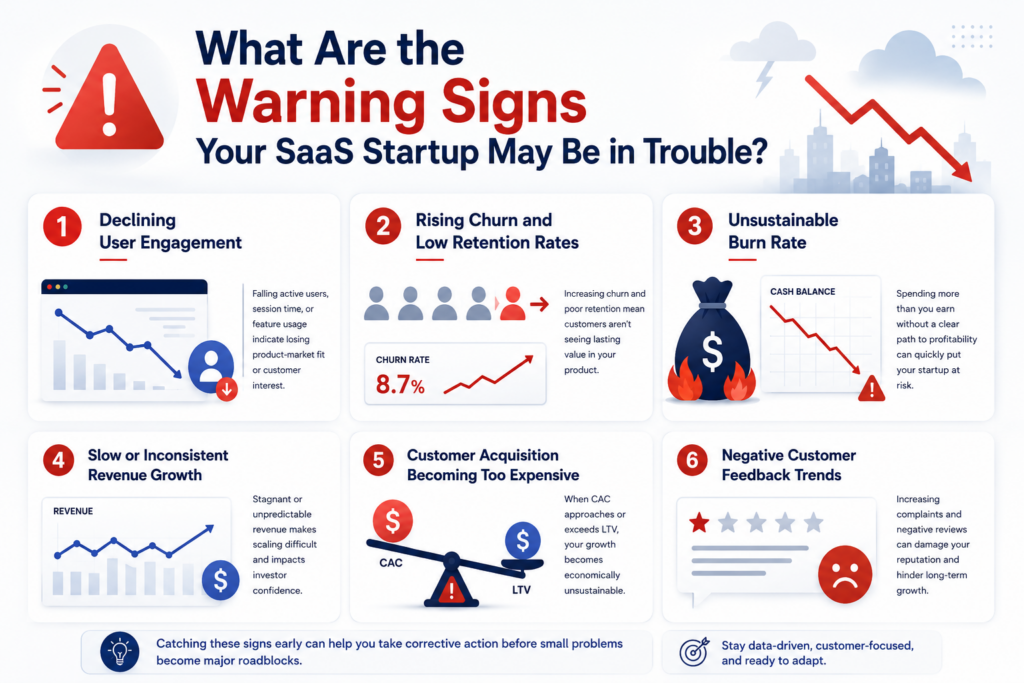
Recognizing early warning signs is critical for SaaS founders. Most startups don’t fail suddenly; they decline gradually, and the signals are usually visible well before things become critical. The challenge is that many teams ignore or rationalize these indicators until it’s too late. Below are the most important red flags that suggest a SaaS business may be heading in the wrong direction.
Declining User Engagement
User engagement is one of the strongest indicators of product health. When users stop actively interacting with your product, it usually means they are not finding enough value to justify continued usage.
This decline can show up in several ways:
- Fewer daily or weekly active users
- Reduced session duration
- Lower feature adoption rates
- Users logging in but not completing meaningful actions
Engagement drops often signal deeper product issues. It may mean the onboarding experience is weak, core features are not intuitive, or the product doesn’t solve the problem as effectively as expected.
Rising Churn and Low Retention Rates
Churn is one of the most direct indicators of SaaS health. If customers are leaving faster than new users are coming in, growth becomes unsustainable regardless of acquisition efforts.
High churn often points to fundamental issues such as:
- Poor product-market fit
- Lack of ongoing value delivery
- Weak onboarding experience
- Better alternatives in the market
- Pricing misalignment
Low retention is even more dangerous than low acquisition because it compounds over time. A SaaS startup can spend heavily on marketing and still fail if customers don’t stay long enough to generate meaningful lifetime value.
Healthy SaaS companies typically focus on improving retention before aggressively scaling acquisition. If churn is rising, it’s a signal that something core needs to be fixed.
Unsustainable Burn Rate
Burn rate refers to how quickly a company is spending its cash reserves. In early-stage SaaS startups, some level of burn is expected, but it becomes dangerous when expenses consistently outpace revenue growth.
An unsustainable burn rate may be caused by:
- Overhiring too early
- Excessive marketing and paid acquisition spend
- High infrastructure or tooling costs
- Inefficient operations and a lack of financial discipline
The problem with high burn is that it reduces runway, the amount of time a startup can survive before needing additional funding or profitability.
Slow or Inconsistent Revenue Growth
Revenue is the ultimate validation of a SaaS business model. When growth is slow or unpredictable, it often indicates deeper structural issues.
Inconsistent revenue growth may appear as:
- Flat or stagnant monthly recurring revenue
- Irregular spikes followed by declines
- Difficulty converting free users into paying customers
- Heavy reliance on a few large customers
This inconsistency often signals weak product-market fit, poor pricing strategy, or ineffective sales processes.
Customer Acquisition Becoming Too Expensive
Customer Acquisition Cost is a key metric for SaaS sustainability. If it becomes too expensive to acquire each new customer, profitability becomes difficult, even if revenue is growing.
Rising acquisition costs often result from:
- Increased competition in the market
- Inefficient marketing campaigns
- Poor targeting of ideal customers
- Weak conversion funnels or landing pages
- Over-reliance on paid advertising channels
When CAC increases without a corresponding increase in Customer Lifetime Value, the business model becomes unsustainable.
Negative Customer Feedback Trends
Customer feedback is one of the most valuable sources of truth in a SaaS business. When feedback trends turn consistently negative, it usually reflects underlying product or service issues.
Warning signs include:
- Increasing support tickets or complaints
- Poor app store or online reviews
- Declining Net Promoter Score
- Repeated criticism of the same issues
- Frustration around usability or missing features
Occasional negative feedback is normal, but patterns matter. If the same issues are repeatedly mentioned across multiple users, it indicates a systematic problem rather than isolated dissatisfaction.
How to Avoid SaaS Startups Failure?
Successful SaaS companies are built through consistent execution, customer-focused decision-making, financial discipline, and the ability to adapt quickly to changing market conditions. While there is no guaranteed formula for success, founders can significantly improve their chances by following proven strategies that reduce risk and create sustainable growth.
Validate Your Idea Before Building
One of the smartest things a founder can do is validate demand before investing heavily in product development. Many SaaS startups fail because they spend months building features only to discover that customers are not interested.
Validation helps confirm:
- Whether the problem is real
- How painful the problem is for users
- Whether customers are willing to pay for a solution
- What features users actually care about
Instead of building a full product immediately, founders should start small. Conduct customer interviews, launch landing pages, or develop a minimum viable product to gather feedback early.
Focus on Solving One Core Problem Exceptionally Well
Many SaaS startups try to become an all-in-one platform too early. They continuously add features in an attempt to appeal to broader audiences, which often results in a cluttered and confusing product.
Successful SaaS companies usually begin by solving one specific problem extremely well. A focused solution is easier to position, easier to market, and easier for customers to understand.
Therefore, founders should prioritize:
- Simplicity and usability
- A clear value proposition
- Features that directly solve the core pain point
- Faster time-to-value for users
When a product becomes known for solving a particular problem effectively, expansion becomes easier later on.
Build Strong Product-Market Fit Before Scaling
Scaling without product-market fit is one of the fastest ways to burn cash and lose momentum. Before increasing marketing budgets or hiring aggressively, startups need evidence that customers genuinely value the product.
Strong product-market fit is usually reflected in:
- High customer retention
- Positive word-of-mouth referrals
- Increasing engagement
- Customers are willing to pay and upgrade
- Organic growth momentum
Founders should continuously monitor customer behavior and feedback to improve alignment between the product and market needs.
Prioritize Customer Retention
Retention is the foundation of a successful SaaS business. Acquiring users is expensive, and long-term profitability depends on keeping customers engaged and satisfied over time.
Startups should not treat retention as an afterthought. Instead, they should build customer success processes early in the business lifecycle.
Effective retention strategies include:
- Smooth onboarding experiences
- Personalized customer support
- Educational resources
- Regular product updates
- Proactive communication with users
The faster customers experience value, the more likely they are to remain loyal. SaaS companies that focus on retention often achieve more stable growth and stronger recurring revenue.
Monitor Metrics
Many SaaS startups fail because decisions are based on assumptions rather than data. Tracking the right metrics allows founders to identify problems early and optimize growth strategies effectively.
Some important SaaS metrics include:
- Monthly Recurring Revenue (MRR)
- Customer Acquisition Cost (CAC)
- Customer Lifetime Value (LTV)
- Churn Rate
- Activation and engagement metrics
- Net Revenue Retention (NRR)
Metrics provide visibility into what is working and what is not. For example, rising churn may indicate onboarding issues, while increasing CAC could signal inefficient marketing campaigns.
Final Words
Building a successful SaaS setup requires more than innovation alone. Founders must validate demand, achieve strong product-market fit, prioritize customer retention, and scale strategically. By recognizing warning signs early and adapting to market changes, SaaS businesses can avoid common pitfalls and improve their chances of long-term success.