



Back in the 90s, the idea of artificial intelligence was just an imagination, limited to sci-fi movies. However, when we look at today’s advancements and innovations, a reel runs in our mind of the things we imagine are a reality now.
According to the given graph, the market size of AI in 2020 was $93.27 billion which is currently at $184.04 billion in 2025. Moreover, in 2030, the size of the AI market worldwide is expected to be at $826.73 billion which is huge.

Today, we are witnessing many practical applications of AI in healthcare, drug discovery, customer service, target advertising, robotics, etc. The one thing that needs to be mentioned is the role of Python in assisting AI in building applications.
Therefore, CodingCops will discuss the role of Python in AI, its benefits, challenges, and future.
Python in Artificial Intelligence
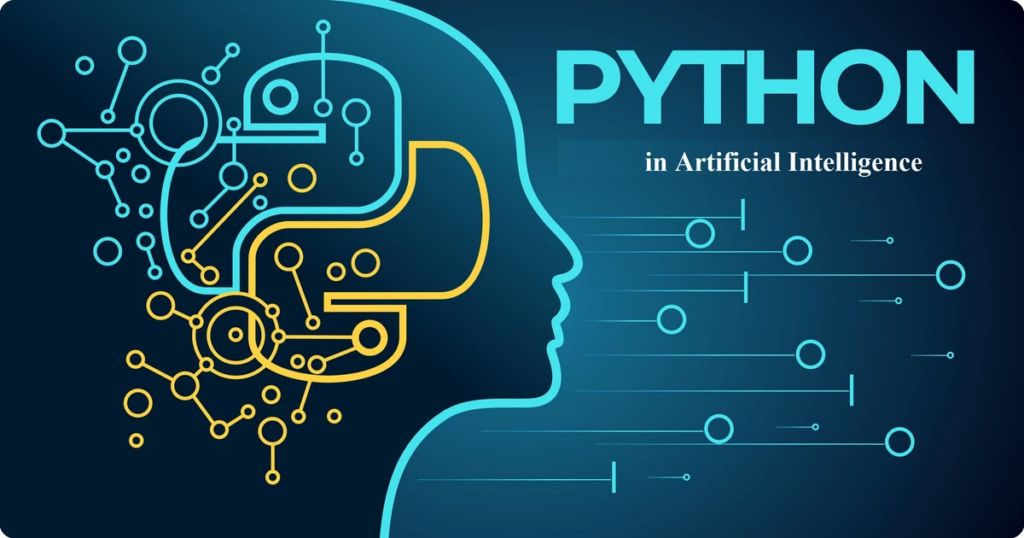
Python is an interpreted programming language with dynamic semantics. It comes with a simple, readable syntax which makes it easy to maintain and understand. Even beginners get familiar with this language easily.
Several developers use Python with AI. Let’s understand why Python is a preferred language for AI.
Python’s Syntax is Simple
The syntax of Python language is very simple and close to the English language. It is a beginner-friendly, easy-to-learn language that allows developers to focus on solving AI problems rather than indulging in complex coding structures.
Python is Platform-Independent
Python is an open-source programming language. It is capable of running on all operating systems. Moreover, it is a flexible language with fewer modifications required in basic coding.
Larger Development Community
Python is a stable language and is widely used around the world. It has professional developers in every corner of the world that boasts a strong and active community. This community, in turn, constantly contributes tools, frameworks, and tutorials to educate beginners and assist the developers.
It is a General Purpose Programming Language
Python is not only limited to developing AI systems but is used in various technologies and domains. Furthermore, it is a high-level programming language capable of dealing with numerous variables, arrays, boolean expressions, and other abstract concepts.
Read More: Learn the difference between high-level and low-level programming languages.
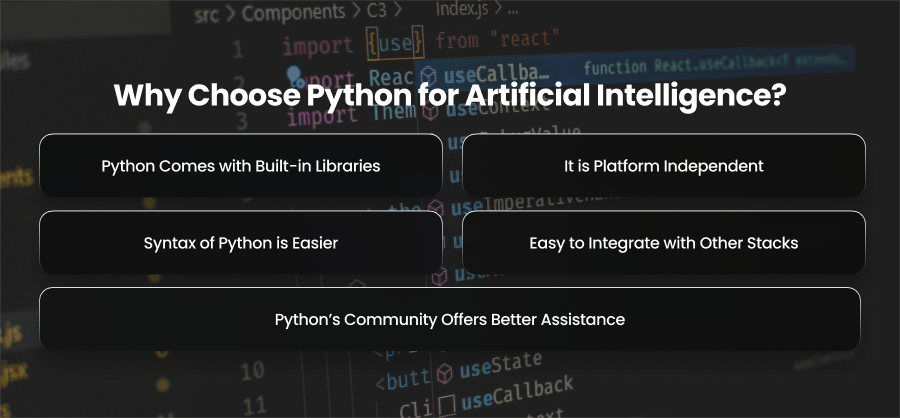
Why Choose Python for Artificial Intelligence?
Python is hugely popular in developing AI systems. A study shows that over 70% adoption rate is of Python for AI and ML projects. With this popularity, why one would opt for a lesser-known programming language?
In this section, we will enlighten you about the top reasons for choosing Python as the programming language for building AI projects.
Python Comes with Built-in Libraries
Python has built-in libraries that sheerly assist developers in building AI systems. NumPy, PyBrain, and SciPy are a few of the built-in libraries that make Python suitable for AI.
It is Platform Independent
The platform-independence of Python makes it a flexible platform that can run on several operating systems. Running Python on any OS just requires you to very less modifications in the basic coding.
Python’s Community Offers Better Assistance
As said earlier, Python is an established framework with millions of developers working on it around the world. These professionals come to rescue the beginners or a Python developer why he’s clueless about any Python matter.
Syntax of Python is Easier
Another top reason for developers choosing Python for AI is its easy and understandable syntax. In fact, it is so intuitive that a person with no prior coding knowledge can easily learn it. This feature of Python eliminates the coding burden on programmers.
Easy to Integrate with Other Stacks
The flexibility of Python is not only limited to platform independence but it allows easy integration with other technologies. Working with Python, you can easily integrate with C++, Java, and R.
Hence, this feature allows developers to utilize the simplicity of Python with the strengths of other low-level programming languages.
Python Vs. Other Programming Languages for Artificial Intelligence
Undoubtedly Python is the favorite programming language for developers to deal with AI projects. However, Java, C++, and R are also popular to deal with AI-powered systems.
To gain better insight, here is the comparison table.
| Feature | Python | Java | R | C++ |
| Learning Curve | Easy to learn due to simple syntax | Moderate learning curve; verbose syntax | Moderate learning curve | Difficult to learn due to complex syntax |
| AI Library Support | Extensive support for AI libraries | Good support | Somehow good support; limited for statistics/ML | Limited support; requires manual setups |
| Performance | Moderate performance | Fast performance | Moderate performance. Slower in large models | Compiles very fast |
| Community Support | Vast community with extensive tools and tutorials | A strong and mature ecosystem | Less support | Smaller community support despite many developers |
| Cross-Platform Support | Excellent | Excellent | Good | Excellent |
Top Python Libraries for AI Projects
- TensorFlow: Popular library for dealing with deep learning tasks.
- PyTorch: It is commonly used by researchers as it is best to work with computational graphs.
- Scikit-learn: Best for data preprocessing and machine learning algorithms.
- Keras: Simplifies the deep learning tasks.
- NumPy and Pandas: Best for numerical operations and data manipulation.
Real-World Examples of Python in AI
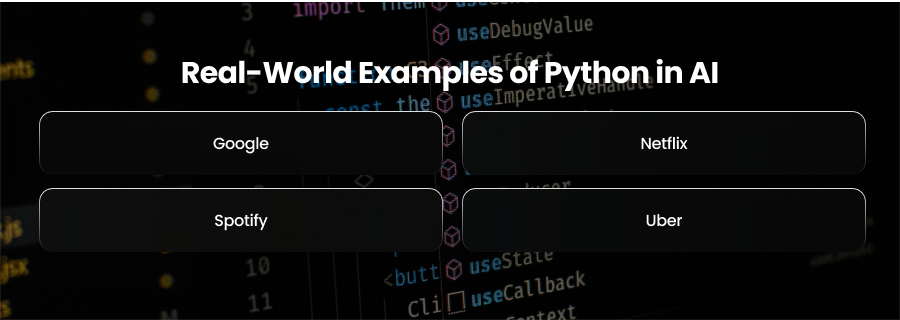
Google created TensorFlow for managing deep learning tasks using Python. Consequently, it helped Google in search algorithms, Google Translate, and Google Assistant.
Netflix
The ML recommendation system at Netflix became more powerful through Python which examines user viewing habits to predict preferences and recommend tailored content. The company achieved these results through the combination of Pandas, NumPy, and TensorFlow tools.
Spotify
Spotify created an AI system through Python analysis to deliver personalized playlists by implementing collaborative filtering approaches. The system allowed Spotify to track user listening patterns alongside trends which enabled predictive analytics to reveal user preferences.
Uber
Lastly, Uber also employed Python to have real-time analytics and AI models capable of predicting ride demand using time and location. Moreover, it also helped drivers by furnishing optimized routes and analyzing traffic conditions in real-time.
Challenges in Using Python for AI
There are a few challenges that need to be addressed before you start building AI using Python.
- Performance Issues
Firstly, Python is slower compared to other programming languages. However, one can overcome this issue by using frameworks like Cython. Moreover, using Python with C++ extensions can also get rid of this issue.
- Dependency Management
Managing libraries and versions is a challenging aspect of working with Python on AI. To avoid this issue, you can use tools like virtual environments and Docker to minimize this issue.
In a Nutshell
So, while we wrap up this comprehensive blog, you must have understood the importance of Python in building AI systems. Python’s simplicity, vast community support, and ecosystem make it an ideal choice for both beginners and experts. Therefore, Python is a top-notch choice for developers and business professionals looking for AI development.