




According to statistics, the worldwide customer relationship management industry is valued at $112.91 billion. This is due to the fact that CRMs aid companies in streamlining their processes.
But when choosing a CRM, businesses usually have to decide whether to spend on building a custom CRM that suits their particular requirements or to adopt a well known platform like Salesforce. The optimal choice will depend on several factors, including operational complexity. Each approach has its own pros and cons of its own.
In this guide, we will compare both Salesforce and custom CRM solutions. We will also discuss their features and ideal use cases.
Salesforce
Salesforce is a leading cloud based Customer Relationship Management platform designed to help businesses manage customer interactions and service operations from a single centralized system.
Businesses may access CRM features via a browser thanks to Salesforce’s SaaS business model. Teams may access data and work together in real time thanks to our cloud-first strategy. Salesforce offers the ability to scale operations without requiring significant infrastructure improvements as organizations expand and consumer needs change.
Salesforce Products and Solutions
Salesforce offers a wide range of specialized products designed to support different business functions. With the help of these solutions, businesses can give all teams a consistent client experience.
Lead tracking and sales process management are the main goals of Sales Cloud. It aids sales teams in streamlining their processes and closing agreements more quickly.
Businesses may manage customer support operations with the help of Service Cloud. Multichannel customer service management, automated support processes, and case management capabilities are all included.
Businesses can manage campaigns and monitor marketing effectiveness across several channels with the help of Marketing Cloud’s sophisticated marketing automation tools.
Commerce Cloud helps companies create and run eCommerce platforms, enabling them to manage orders and provide individualized experiences.
Features of Salesforce
One of the platform’s most powerful features is workflow automation. Businesses can automate repetitive tasks such as lead assignment and approval processes. This reduces manual effort and allows employees to focus on high value activities.
Salesforce also offers advanced reporting and analytics tools. Real time dashboards allow organizations to track performance metrics and identify business opportunities. The platform’s AI, too, Einstein AI, provides predictive analytics, helps businesses forecast outcomes and recommend best actions.
Another important feature is customization. Salesforce allows organizations to modify workflows and design personalized dashboards.
Custom CRM
A customer relationship management system created especially to address the particular requirements of a company is known as a custom CRM. A custom CRM is created from the ground up to fit an organization’s workflows, in contrast to pre-built CRM platforms that provide standardized features. With this method, companies can create a system that perfectly complements their customer management plans.
In order to identify requirements and develop customized functionalities, development teams and business stakeholders typically collaborate on custom CRM development. Depending on the requirements of the company, these systems may be implemented in a cloud architecture. Custom CRM systems, which are designed with particular goals in mind, frequently leave out extraneous features and concentrate solely on providing value through customized processes.
Comparison Between Salesforce and Custom CRM
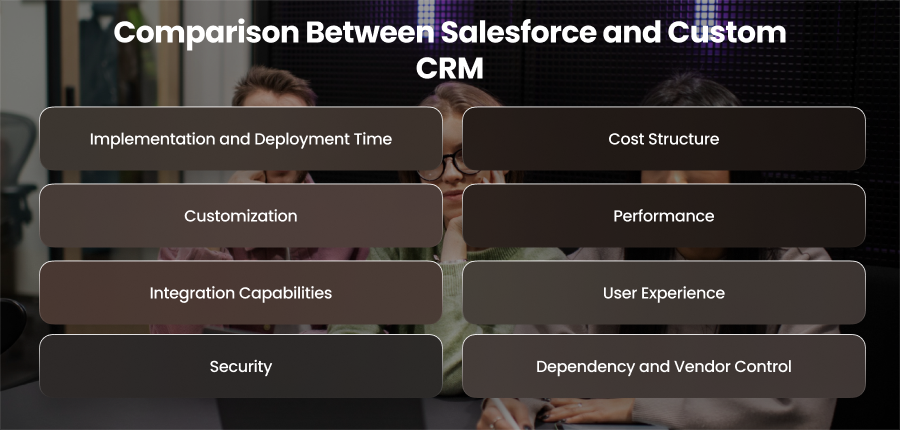
Implementation and Deployment Time
One of the most noticeable differences between Salesforce and a custom CRM is the time required for implementation. Salesforce is a pre built cloud platform with features and modules that are ready to use. Businesses may quickly begin using Salesforce by tailoring it to their requirements. Depending on its complexity, Salesforce implementation often takes a few months.
In contrast, developing a custom CRM requires a full development lifecycle, including requirement analysis and deployment. This process can take several months or even longer for enterprise level solutions. While custom CRM development allows for complete personalization, the extended implementation timeline can delay operational environments.
Cost Structure
When comparing Salesforce versus bespoke CRM solutions, price is a crucial consideration. Businesses pay license costs according to the number of users and services they need, with Salesforce’s subscription based pricing model. This strategy may end up costing more in the long run, even if it saves money up front, particularly for large companies that need highly qualified people.
Custom CRM development involves a higher initial investment because businesses must cover development and system testing costs. Once created, however, businesses may avoid ongoing membership costs and have more control over long term operating costs. Companies need to carefully consider whether they desire upfront investment with long term flexibility or predictable ongoing expenditures.
Customization
Salesforce provides a wide range of customization choices via configuration tools. Nevertheless, platform design continues to restrict modification. Highly specialized business requirements may require additional development or third party applications, which can increase complexity and cost.
Because they are created especially to satisfy corporate needs, custom CRM systems provide limitless flexibility. Without platform restrictions, organizations may design customized workflows and automation procedures. Businesses with intricate or distinctive operating models especially benefit from this degree of personalization.
Performance
Salesforce is made to assist companies of all sizes, from start ups to large corporations. High performance and dependable system availability are guaranteed by its cloud infrastructure. Salesforce enables companies to add users and connectors as they expand without requiring significant system modifications.
System architecture and development quality have a major role in custom CRM scalability. If designed properly, custom CRM systems can scale effectively alongside business growth. However, poorly planned architecture may lead to performance issues and system limitations as data volume and user number increases.
Integration Capabilities
One of the biggest integration ecosystems in the CRM sector is provided by Salesforce. Businesses may access hundreds of third party apps that easily interface with Salesforce via AppExchange. Additionally, Salesforce offers dependable APIs that let businesses integrate the platform with analytics and corporate tools.
Additionally, connections with other business initiatives are supported via custom CRM systems. But integrations have to be created by hand, which takes more effort and technical expertise. Although this offers total freedom, it may also make the project more difficult and require more resources.
User Experience
Salesforce offers a standardized user interface made to accommodate various use cases and businesses. The platform preserves a uniform design structure across modules, even as it permits interface customization. Businesses often need to train employees to adapt to Salesforce workflows and navigation systems.
Custom CRM systems allow organizations to design user interfaces based on employee roles and operational preferences. This customized design frequently promotes quicker acceptance and enhances usefulness. Businesses may increase productivity and lower training costs by matching system functionality with employee duties.
Security
Salesforce provides multi-factor authentication and enterprise grade security capabilities. Furthermore, the platform complies with international regulatory requirements, reducing the risk of noncompliance for businesses operating in regulated industries.
Businesses can implement specific data protection measures, as custom CRM systems provide them with complete control over the security architecture. However, the development and IT teams are solely in charge of security. Businesses must make sure that security updates and vulnerability testing are carried out on a regular basis.
Dependency and Vendor Control
Salesforce is a vendor managed platform, meaning businesses rely on Salesforce for system availability and infrastructure management. While this reduces technical workload, it also creates vendor dependency. Organizations must operate within Salesforce platform limitations and update cycles.
When Should Businesses Choose Salesforce?
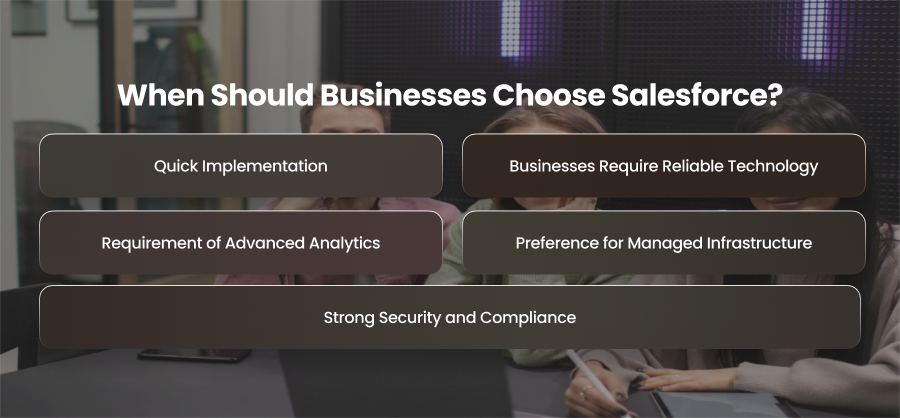
Quick Implementation
Because Salesforce is a pre built cloud platform, companies that need to swiftly implement a CRM system frequently select it. Salesforce offers built in modules that can be modified according to company needs, in contrast to custom CRM systems that involve months of development and testing. This enables businesses to begin managing client data and support procedures immediately.
Businesses undergoing digital transformation or replacing antiquated CRM systems frequently choose Salesforce because it expedites adoption. Businesses may enhance consumer engagement and operational success without lengthy development cycles thanks to faster adoption.
Businesses Require Reliable Technology
Salesforce has a solid track record across sectors and is widely acknowledged as the market leading CRM system. Salesforce is frequently chosen by companies looking for a dependable and thoroughly tested platform in order to lower deployment risks. The platform’s adaptability is demonstrated by the fact that businesses of all sizes, from startups to large corporations, use it.
Requirement of Advanced Analytics
Salesforce’s strong analytics and AI capabilities make it a popular choice for businesses that rely significantly on data driven decision making. Salesforce offers predictive analytics powered by Einstein AI.
Businesses may use these tools to analyze customer behavior and identify potential growth opportunities. Salesforce’s analytics ecosystem has a lot to offer companies trying to improve customer service performance.
Preference for Managed Infrastructure
Salesforce operates as a cloud based SaaS platform, which eliminates the need for businesses to manage servers or system maintenance. Companies that prefer focusing on core business operations rather than technical infrastructure management often find Salesforce highly beneficial.
Salesforce automatically manages security monitoring and system updates. This guarantees that companies always have access to the newest innovations and lessens the effort for internal IT employees.
Strong Security and Compliance
When choosing CRM solutions, businesses that handle sensitive customer data or work in regulated sectors frequently give security and compliance first priority. Salesforce offers enterprise grade security features. This includes encryption and continuous monitoring.
Salesforce is a popular choice for companies that must adhere to international data protection legislation since it satisfies several compliance requirements.
When Should Businesses Choose a Custom CRM?
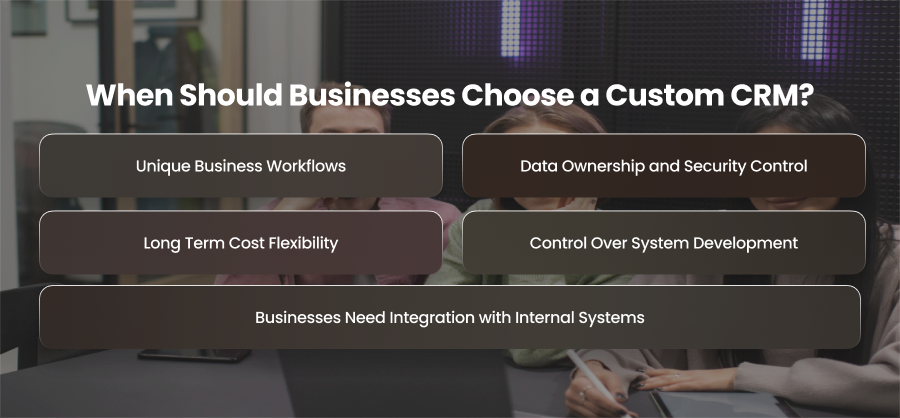
Unique Business Workflows
It is sometimes difficult for companies with particular operational procedures to modify their workflows for conventional CRM platforms. Custom CRM systems enable businesses to create workflows that precisely match their customer management and sales objectives.
Businesses in sectors like healthcare and finance, for instance, may have intricate workflows that call for certain data monitoring or compliance procedures. Businesses may include these particular needs directly into the system with a personalized CRM.
Data Ownership and Security Control
Full data ownership and security control are frequently given top priority by businesses that handle sensitive client data or are subject to stringent regulatory regulations. Businesses may choose how to keep and safeguard client data with bespoke CRM systems.
Customized security procedures and compliance frameworks are often needed in areas like government and banking. Businesses may adopt particular encryption standards and data governance regulations that are suited to their regulatory requirements by using a bespoke CRM.
Long Term Cost Flexibility
Custom CRM systems can save money over time, even if they demand larger initial costs. Custom CRM creation is frequently chosen as a long-term strategic investment by companies who wish to avoid ongoing subscription expenses.
Building a CRM system that changes with their business without raising license costs might be advantageous for companies with steady operational requirements or predictable development patterns. This strategy can eventually improve cost management and lessen reliance on external platform price structures.
Businesses Need Integration with Internal Systems
Numerous internal technologies, including accounting and inventory management software, are used by many businesses. Custom CRM systems allow businesses to create direct links that satisfy their operational needs.
Businesses with highly specialized software environments or older systems can especially benefit from this. Custom CRM development minimizes manual data entry and facilitates smooth data synchronization between platforms.
Control Over System Development
Custom CRM solutions give organizations complete authority over system enhancements and performance optimization. Businesses are not restricted by vendor update cycles or platform limitations. This independence allows companies to implement new features based on changing business requirements.
Organizations that prioritize innovation and continuous system improvement often choose custom CRM development because it enables them to experiment with new technologies or analytics capabilities without relying on third party platform providers.
Final Words
Salesforce and a custom CRM depend on business goals and long term strategy. While customized CRM gives unparalleled customization and control, Salesforce delivers scalability and quick setup. Organizations choose a CRM solution that enhances customer interactions and facilitates sustainable access by evaluating company operations and development strategies.