




Salesforce is used by 90% of Fortune 500 firms, according to statistics. This is because Salesforce is among the most powerful CRM systems available. To increase sales productivity, businesses make significant investments in consultants and licensing. However, a major issue that many businesses have is limited Salesforce adoption.
Sales reps still track deals in spreadsheets. Managers rely on offline reports. Customer service teams bypass workflows. Leadership dashboards remain underutilized.
This disconnect often leads companies to blame Salesforce. They assume the platform is too complex or poorly implemented. In reality, Salesforce adoption failures are rarely a tool problem. They are a leadership and change management problem.
So, in this guide, we will discuss how leaders can make decision for the successful adoption of Salesforce.
Why Salesforce Adoption Fails in Many Organizations?
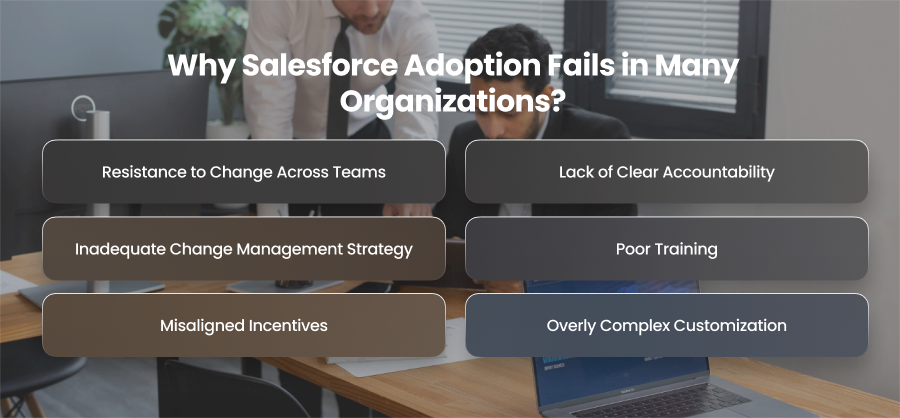
Resistance to Change Across Teams
Human resistance to change is one of the most frequent causes of Salesforce adoption failures. Salesforce is frequently viewed by staff members as an extra burden rather than a tool for efficiency. Sales teams could like using their own CRM software or spreadsheets. While customer service agents might rely on legacy systems they are comfortable with.
This aversion often stems from a concern of responsibility and interruption rather than the instrument itself. Employee discomfort may result from Salesforce’s introduction of performance and customer interaction visibility.
Lack of Clear Accountability
Many organizations treat Salesforce as an IT initiative rather than a business transformation program. IT teams manage implementation and integrations. However, they don’t own revenue growth or customer experience.
Without clear accountability, Salesforce lacks strategic direction. Moreover, decisions become reactive, and adoption initiatives lose momentum.
Inadequate Change Management Strategy
Salesforce implementations frequently ignore organizational change management in favor of technological milestones. Businesses often think that once a platform is installed, consumers will instantly adopt it, but this is rarely the case.
Training and organized communication are all necessary for change management. Employees are left perplexed by new procedures and unsupported during the shift in the absence of a formal plan.
Poor Training
Training is often treated as a one time event during rollout. Users attend a session and are expected to use Salesforce effectively from day one.
In reality, adoption requires continuous learning. To properly use Salesforce, different positions require customized training programs. Over time, utilization may decrease, and skill gaps may grow in the absence of continuous enabling.
Misaligned Incentives
Employees prioritize tasks that affect their pay when Salesforce usage is not linked to performance measures. Sales representatives will deprioritize CRM duties if they are compensated on concluded transactions rather than on data integrity or pipeline updates. If managers are evaluated on revenue but not forecast accuracy, they may not enforce Salesforce reporting.
Aligning incentives with Salesforce usage is critical. Organizations must ensure that CRM data quality and forecasting accuracy are part of performance evaluations.
Overly Complex Customization
Salesforce’s flexibility is both a strength and a risk. Organizations often over customize the platform with excessive fields and integrations. Customization can facilitate special business operations, but too much complexity makes the system difficult to operate.
Uncertain procedures and crowded interfaces frustrate users, which reduces adoption. A poorly constructed Salesforce instance may feel more like a bureaucracy than a useful tool.
What Are the Capabilities of Salesforce?
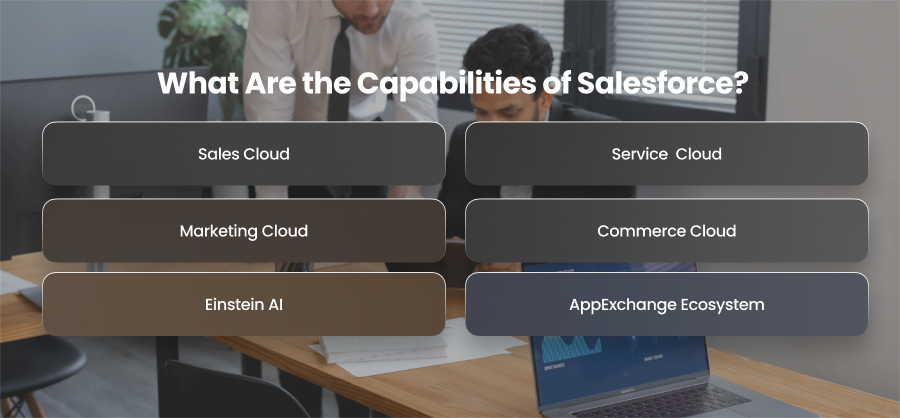
Sales Cloud
Sales Cloud is the core Salesforce product used by sales teams to manage the entire revenue lifecycle. It makes it possible for businesses to monitor leads and actions in a single system. Pipelines may be managed by sales representatives, and managers can see team performance and revenue projections in real time.
Service Cloud
Service Cloud is intended to provide individualized experiences for customer service and support teams. It centralizes contact with customers across several channels.
Case management and automated processes are examples of features that assist teams in effectively resolving problems. Cases are assigned to the appropriate agents thanks to intelligent routing. While service analytics help leaders monitor response times and customer satisfaction scores.
Marketing Cloud
Marketers can create and track campaigns across digital platforms using Marketing Cloud. Additionally, it enables large-scale segmentation and customized messaging.
Marketing Cloud facilitates the team’s timely delivery of pertinent content by combining customer data. Campaign performance is shown by built in analytics. This enables data driven marketing decisions.
Commerce Cloud
Commerce Cloud supports eCommerce operations and personalized shopping experiences. Experience Cloud allows businesses to use low-code technologies to build employee and customer interfaces.
When coupled, these platforms enable organizations to offer seamless digital experiences throughout the whole customer journey, extending Salesforce’s capabilities beyond CRM.
Einstein AI
Salesforce Einstein brings AI into the CRM. It provides predictive lead scoring and automated recommendations.
For sales teams, Einstein can highlight potential leads and suggest next best actions. For service teams, it can predict case resolution times and recommend knowledge articles. For marketing teams, it can optimize campaign targeting and personalization.
AppExchange Ecosystem
Salesforce uses APIs and the AppExchange marketplace to interface with thousands of third party apps. ERP systems, marketing tools, accounting software, and industrial software solutions may all be connected by organizations.
Salesforce can serve as a primary center for corporate operations thanks to this integration ecosystem, which also ensures data integrity across platforms and minimizes silos.
How Leaders Can Drive Successful Salesforce Adoption?
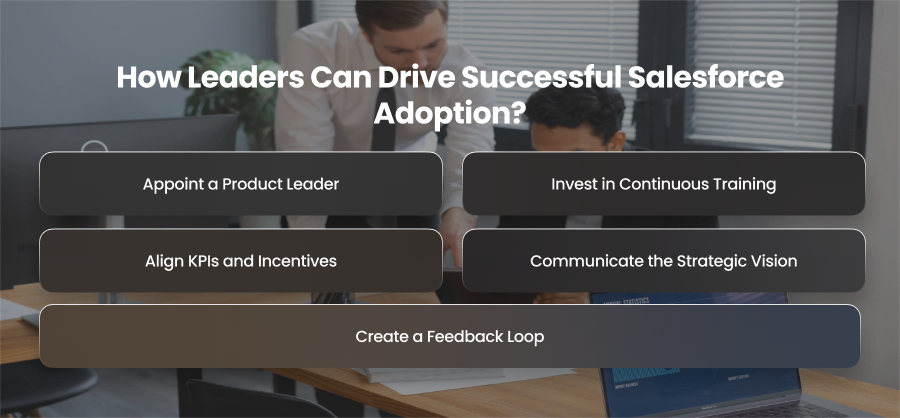
Appoint a Product Leader
Every successful Salesforce implementation has a dedicated individual or team responsible for adoption and continuous improvement. This role often takes the form of a CRM product owner or Salesforce administrator with executive sponsorship.
The Salesforce owner ensures cross functional alignment across sales and operations. They manage the roadmap and prioritize enhancements. Importantly, they also monitor adoption metrics. These include login frequency and data completeness.
Invest in Continuous Training
Salesforce adoption is a journey, not a one time event. Initial training sessions are not enough. Leaders must ensure ongoing enablement programs tailored to different roles and experiences.
Role based training improves relevance: sales reps and service agents all interact differently with the platform. Trailhead modules and internal learning academies help build confidence and expertise.
Continuous support guarantees that experienced users keep current with platform improvements and automation flows.
Align KPIs and Incentives
To encourage adoption, leaders must tie Salesforce usage to performance metrics and rewards. Examples include:
- Requiring opportunity updates in Salesforce for commission eligibility
- Evaluating managers on forecast accuracy and pipeline health
- Measuring customer satisfaction based on logged service cases
Adoption becomes a natural part of everyday work when teams perceive a clear link between using Salesforce and individual team performance.
Communicate the Strategic Vision
Leaders must provide a compelling vision for Salesforce adoption in addition to goals. Employees are more open to new tools when they understand how Salesforce helps the business succeed.
Therefore, good communication from leadership enables employees to understand more than simply what they must do in Salesforce.
Create a Feedback Loop
In addition to goals, executives need to present a compelling vision for Salesforce adoption. Employees are more open to new tools when they understand how Salesforce helps the business succeed.
As a result, effective leadership communication helps staff members comprehend more than just what they need to achieve in Salesforce.
Common Leadership Mistakes in Salesforce Adoption
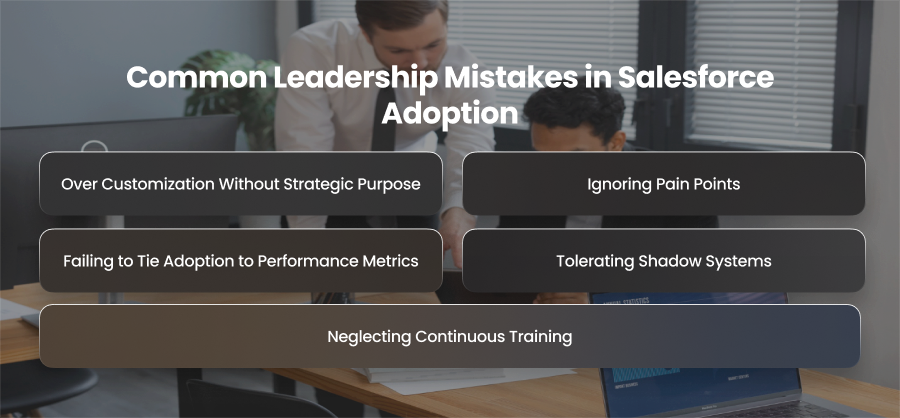
Over Customization Without Strategic Purpose
Salesforce provides unmatched versatility. But if this strength is abused, it may turn into a weakness. Sometimes, without a defined adoption plan, leaders approve excessive customization.
Over customization can make the system difficult to navigate and reduce usability for end users. Workers can have trouble finding relevant fields or navigating complex processes. This might lead to frustration. Leaders must find a balance between simplicity and customization to make sure the platform benefits users rather than overwhelms them.
Ignoring Pain Points
When leaders ignore their feedback, adoption suffers. Workers may face difficulties like complicated dashboards or laborious procedures.
Ignoring these issues might cause irritation and the creation of workarounds. Leadership must thus aggressively seek out feedback and make little changes in order to overcome challenges.
Failing to Tie Adoption to Performance Metrics
When leadership fails to tie system usage to incentives or performance reviews, Salesforce adoption frequently fails. Workers give priority to assignments that have a direct bearing on their pay or professional advancement.
If managers do not incorporate Salesforce analytics into performance evaluations, they become optional rather than necessary. There are gaps in the quality of the data since unaccountable teams rely on antiquated methods.
Tolerating Shadow Systems
Even when Salesforce is implemented, adoption can be undermined if leaders allow alternative systems to persist. Shadow systems fragment data and reduce visibility.
When leadership tolerates these workarounds, employees perceive Salesforce as optional. Fostering a responsible culture requires establishing Salesforce as the exclusive source of truth.
Neglecting Continuous Training
A common leadership mistake is treating Salesforce training as a one off activity. Employees often forget how to use the platform effectively, espeically as features change.
Adoption gradually decreases in the absence of continuous instruction. Leaders that don’t make an investment in ongoing education run the danger of losing the platform’s efficacy.
Best Practices for Sustained Salesforce Adoption
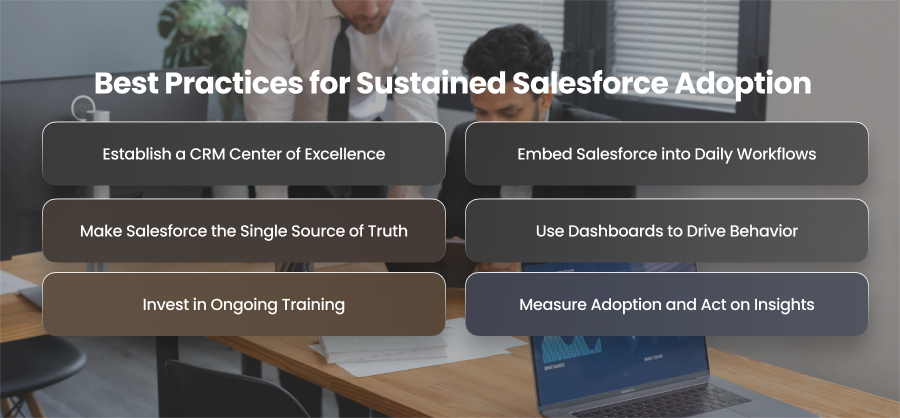
Establish a CRM Center of Excellence
A CRM Center of Excellence is a cross functional governance group responsible for Salesforce strategy and continuous improvement. It typically includes representatives from different teams.
The CoE defines best practices and manages the Salesforce roadmap. It also ensures alignment with business goals. It also standardize processes and training to avoid fragmented implementations across departments.
By centralizing governance, organizations prevent Salesforce from becoming a patchwork of disconnected features.
Embed Salesforce into Daily Workflows
When Salesforce is integrated into regular work rather than being an extra chore, adoption rises. Workflows and procedures should be directly linked into Salesforce, according to leaders.
Lead assignments and service escalations, for instance, have to take place on the platform. Salesforce Flow and other automation solutions help simplify procedures and cut down on human labor.
Make Salesforce the Single Source of Truth
Trust in the facts is essential for long term adoption. Salesforce must be mandated by leaders as the main platform for pipeline tracking and customer data.
This entails getting rid of shadow systems like spreadsheets and private CRMs. Sales meetings should use Salesforce dashboards. Forecast reviews should rely on Salesforce reports. Moreover, customer insights should come from Salesforce analytics.
Use Dashboards to Drive Behavior
Dashboards are powerful tools for reinforcing adoption. Leaders should use Salesforce dashboards in team meetings and performance discussions.
Sales dashboards can track pipeline health and conversion rates. Service dashboards can monitor response times. Marketing dashboards can show campaign ROI and lead quality.
Invest in Ongoing Training
Training should not end after implementation. This is because features change and processes evolve. Leaders must invest in continuous enablement to maintain high adoption levels.
Employee proficiency is maintained through role based training programs and onboarding modules. Internal champions who promote adoption are produced through frequent refresher courses and advanced training for power users.
Measure Adoption and Act on Insights
Sustained adoption requires measurement. Leaders should track adoption metrics such as:
- User login frequency
- Data completeness
- Dashboard and report usage
- Forecast accuracy
- User satisfaction scores
Final Words
Adoption of Salesforce is ultimately a cultural and leadership issue rather than a technical one. Salesforce becomes a real growth engine when executives engage in ongoing development and set clear goals. Organizations may transform CRM adoption into a long-lasting business effect with the correct leadership strategy.