




According to statistics, 72% of startups use the MVP approach. Moreover, an MVP accelerates time to market by 35%. This is because startups often face the challenges of turning innovative ideas into successful products without burning through their budget or losing time in the market. An MVP becomes crucial in this situation.
An MVP is a tactic that enables entrepreneurs to test their concepts with little financial outlay while obtaining insightful user input. Additionally, it concentrates on creating a product with just enough functionality to satisfy early users and prove the business idea. Companies like Airbnb and Spotify all began as MVPs before changing into the successful products we know.
In this guide, we’ll discuss what an MVP is and why it’s essential for startups. We will also discuss a step by step guide to building your own MVP.
What is an MVP?
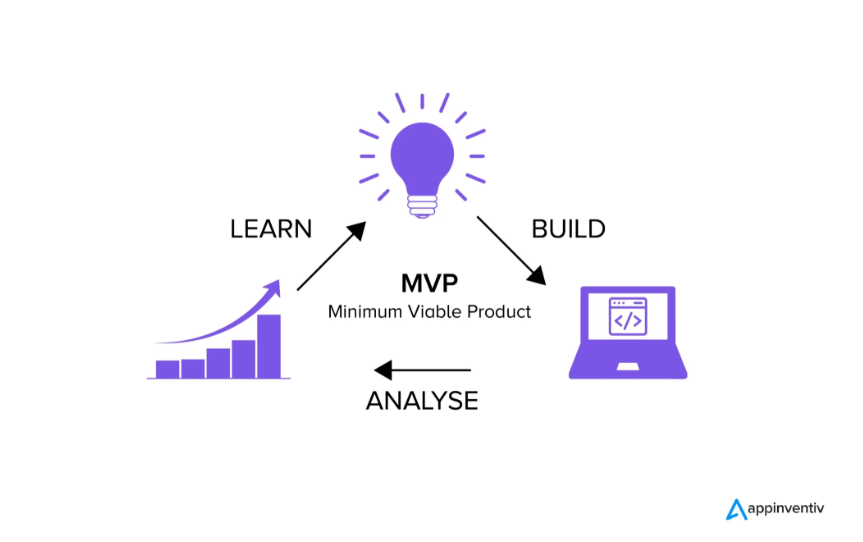
A simplified version of a product intended to test a business idea in the market with the least amount of work and resources is called a Minimum Viable Product. Validating assumptions and figuring out whether there is a real market for your product are the main goals of an MVP.
An MVP concentrates on the key elements that address a particular issue for users rather than being a fully functional solution. Startups may launch more quickly and at a lower cost by creating an MVP.
There are different types of MVPs, including:
- Landing Page MVPs: These are simple websites that explain the product concept and capture interest through email sign ups.
- Concierge MVPs: It manually provides services to early customers to validate demand before automating the process.
Each type serves a different purpose, but ultimately helps startups test their ideas without having to build a fully developed product upfront.
Why Startups Need an MVP?
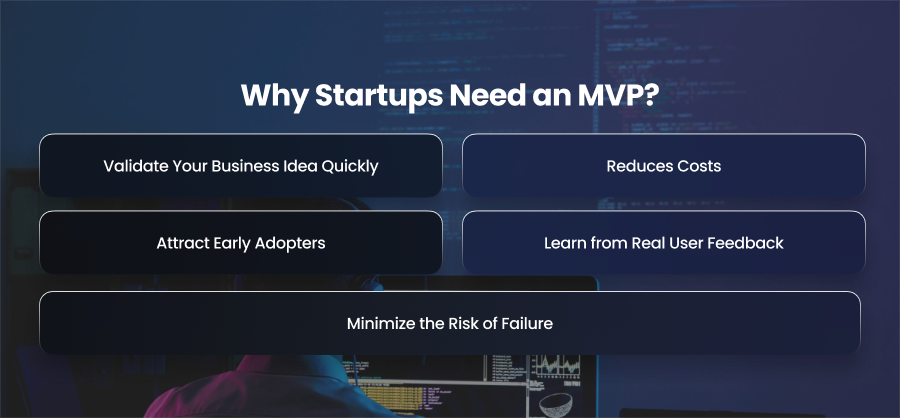
Validate Your Business Idea Quickly
Testing the main concept before investing substantial resources is one of the main reasons startups require an MVP. An MVP assists you in gathering information on whether people truly find value in your solution, as opposed to believing the market would accept your product. The possibility of creating features that are never useful is decreased by this early validation.
Reduces Costs
Creating a completely functional product from the ground up can sometimes require a large financial outlay and take months or even years. An MVP enables companies to launch more quickly and for less money by concentrating just on the essential elements. This lean methodology lowers wasteful costs while creating a product that benefits customers.
Attract Early Adopters
Early adopters may test your product and offer feedback using an MVP. These early adopters can aid in product promotion since they are frequently very engaged. Their recommendations are crucial for improving the product and expanding the customer base.
Learn from Real User Feedback
Startups often make assumptions about what users want. You may test these hypotheses with actual users using an MVP. Feedback gathered from the MVP can help identify aspects that are useful and those that need development. This iterative learning technique ensures that the product adjusts to actual user requests rather than merely depending on supposition.
Minimize the Risk of Failure
It’s a fact of startup existence that not all ideas will be successful. Startups can find possible weaknesses or gaps in the concept early on by creating an MVP first. This greatly lowers the chance of expensive failure by enabling business owners to reverse course or even alter their approach before committing to a full scale product launch.
How to Develop an MVP? Step by Step Guide
Identify Your Problem
A well defined problem is the foundation of any successful MVP. Startups should take the time to learn the problems that their target audience has, rather than immediately concentrating on the solution. Speak with prospective consumers and examine current solutions. A problem is worth solving only if it’s frequent and experienced by a sizeable audience.
Define Your Target Audience
Not everyone is suited for an MVP. Startups need to focus on a certain user group that is most affected by the issue. Making thorough user personas ensures that the proper people are taken into consideration when designing the MVP. Both adoption and feedback quality are enhanced by this approach.
Clearly Define Your Value Proposition
Why users should pick your product above competitors is explained in your value proposition. Startups should now explain what makes their solution special and how it adds value. A strong value proposition guarantees that every feature supports the product’s primary promise and keeps the MVP focused.
List and Prioritize MVP Features
After the value proposition has been established, list every feature that might help it. Then you should set priorities with unwavering determination. Only the elements required to address the main issue should be included in the MVP. It is possible to distinguish between aspects that are required and those that are optional using frameworks such as the Kano Model.
Create User Flow
Make a plan for how people will interact with your product before you start creating any code. Describe the user’s path from objective accomplishment to input. With wireframes, layouts, and interactions are easier to see without becoming distracted by design details. This ensures clarity and team alignment. It also reduces the need for costly revisions.
Build a Prototype for Early Validation
Prototypes let startups to evaluate usability before development starts and give wireframes life. These might be interactive or low-fidelity prototypes made with programs like Figma. Additionally, sharing prototypes with prospective users aids in the early detection of usability problems and improvement of the experience.
Choose the Right Technology Stack
The success of an MVP depends on the choice of technology. Startups should select frameworks and technologies that facilitate future scalability and quick development. The tech stack should represent the team’s budget and skill level. Flutter is preferred for mobile MVPs. Whereas React is a popular choice for web interfaces.
Develop the MVP Using an Agile Approach
Agile approaches are ideal for MVP creation. Divide development into brief sprints and concentrate on making little steps forward. Then you should test continuously. This approach allows startups to adapt quickly and fix issues early without overengineering the product.
Test with Real Users
To verify functioning and user experience, testing is crucial. Internal testing should come first, then a small sample of actual users should participate in beta testing. Feedback on performance and usability should be gathered. Seeing how people engage with the MVP frequently yields information that surveys by themselves are unable to get.
Launch the MVP Strategically
An MVP launch doesn’t need to be a grand event. Many startups opt for a soft launch to a controlled audience. You can use landing pages and email lists to attract early adopters. The primary goal of the launch is learning, not mass adoption.
Measure Performance
You should monitor important metrics like conversion rates and user management after the launch. Additionally, you should integrate user input with quantifiable data. Startups may use this data to identify what is effective and what requires improvement.
Iterate
Based on insights from the MVP, you should decide your next move. If users love the product, you should enhance the features and scale. However, if the feedback reveals issues, iterate and improve. If the idea doesn’t gain traction, a pivot may be necessary. This decision making process is the true value of MVP development.
Common Challenges in MVP Development
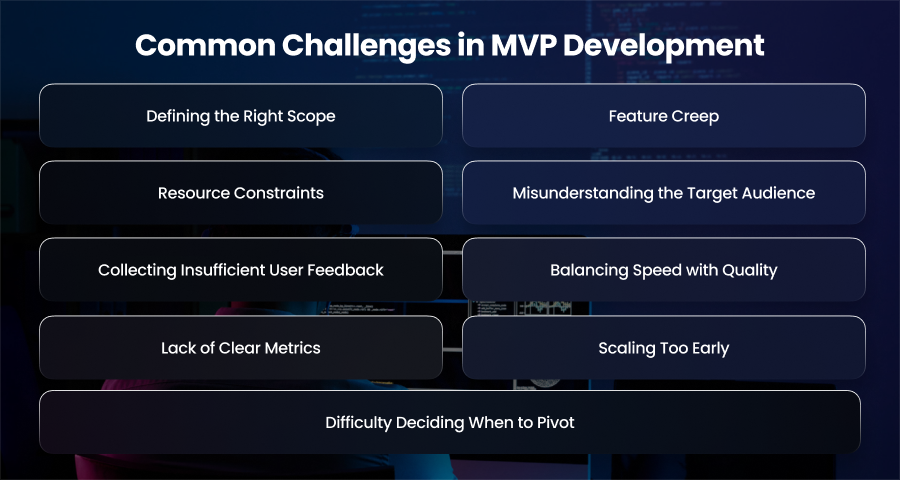
Defining the Right Scope
Determining what minimal genuinely implies is one of the most frequent problems. Finding the ideal balance between too little and too much functionality may be challenging for companies. An MVP may not be able to demonstrate its value if it lacks essential characteristics. On the other hand, an overbuilt MVP raises expenses. The secret is to create only what is required to verify the solution while maintaining a strong focus on the fundamental issue.
Feature Creep
Feature creep occurs when additional features are continuously added during development. This is often due to internal opinions or fear of missing out. Longer development periods and more expenses result from this. Additionally, overengineering makes it more difficult to test and maintain the MVP. Successful MVPs remain lean and resistant to unnecessary complexities.
Resource Constraints
Most startups operate under tight financial and resource limitations. Budgets can be quickly strained by hiring entire teams and maintaining infrastructure. MVP developer expenses can get out of hand if cautious preparation isn’t done. Startups must prioritize their spending and select development strategies in order to maximize value with the least amount of investment.
Misunderstanding the Target Audience
It is risky to build an MVP based on conjecture rather than actual user insights. Feedback becomes deceptive if the product is made for the incorrect market or does not solve their actual problems. This difficulty emphasizes how crucial early market research and ongoing validation are throughout the MVP lifetime.
Collecting Insufficient User Feedback
MVP success is largely dependent on feedback, yet many firms find it difficult to obtain insightful data. Inaccurate findings may result from small or skewed user samples or from depending just on views rather than conduct. Thus, a better understanding of customer demands and product performance may be obtained by integrating qualitative input with analytics and using data.
Balancing Speed with Quality
In MVP development, speed is crucial, yet rushing might lower the quality of the final result. User trust may be adversely affected by bugs or performance problems. The MVP must be reliable and practical enough to fairly represent the product’s worth, even though perfection is not the aim. This ensures core features work reliably.
Lack of Clear Metrics
Startups may find it difficult to assess whether the MVP is successful in the absence of well defined success measures. Vanity metrics that don’t always correctly reflect value include page views and downloads. Instead, businesses may focus on crucial KPIs like conversion rates.
Scaling Too Early
One frequent and expensive error is premature scaling. Before confirming the product’s market fit, several firms try to increase features or marketing initiatives. This can drain resources and distract from learning. MVPs should first prove value to a core user group before scaling efforts begin.
Difficulty Deciding When to Pivot
Interpreting MVP results is not always straightforward. Startups may find it difficult to determine whether to completely change course or enhance the existing solution. Therefore, choosing the best course of action requires data driven decision making and an honest assessment of customer input.
Final Words
Startups may verify concepts and learn from actual users by developing an MVP. Startups may develop products that genuinely resonate and advance toward long term success with clarity by concentrating on key issues and avoiding typical traps.