




Statista projects that during the next five years, the software outsourcing industry will grow to $806.55 billion. However, entrepreneurs are under great pressure to develop and market goods rapidly. But with limited finances, building software in house may frequently become a considerable issue.
In this case, outsourcing software development might be helpful. Businesses can receive specialized technical skills through outsourcing without having to engage a full time internal team.
Outsourcing isn’t an all encompassing strategy, though. Success involves meticulous planning and a grasp of the special hurdles that come with working with other teams.
We’ll look at the benefits of outsourcing for startups in this tutorial. Effective software development outsourcing will also be covered.
Why Startups Should Consider Outsourcing Software Development?
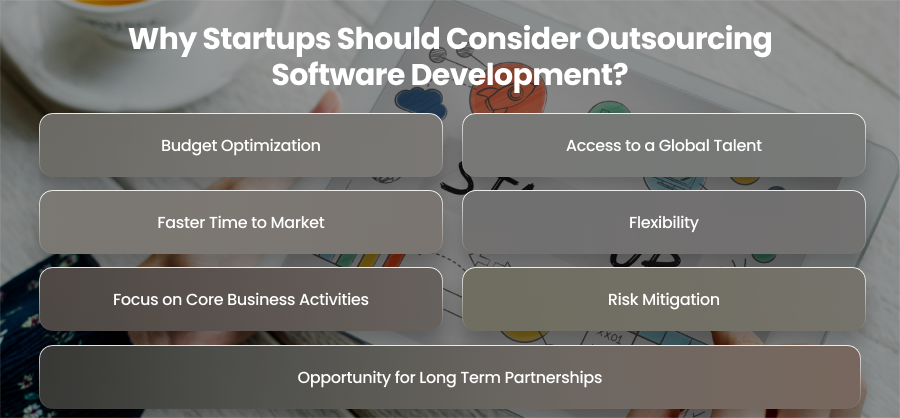
Budget Optimization
One of the most compelling reasons for startups to outsource is cost savings. Hiring a full in house staff requires not just pay but also extra expenditures such as recruiting and employee perks. These expenses might easily become prohibitive for a business with limited finances.
These fixed expenditures become variable charges through outsourcing. Depending on the needs of the project, startups can scale the team and pay for the services they demand. Moreover, outsourcing to countries with lower labor costs allows startups to invest more in customer acquisition.
Access to a Global Talent
Startups sometimes struggle to locate engineers with unique technical knowledge locally. Outsourcing gives access to a worldwide talent pool of experienced individuals in fields like as AI and cloud computing. This makes it possible for startups to work with professionals who have expertise in providing top notch software solutions for a variety of industries.
For instance, a corporation establishing a financial platform may require blockchain understanding, which might be hard to obtain locally. By outsourcing, the corporation can fast bring on board blockchain developers who understand the technology. This assures more effective product development.
Faster Time to Market
For businesses that operate in dynamic marketplaces, time to market is critical. A delayed launch can suggest missed chances and lost cash. Outsourcing development allows firms to accelerate the development process by utilizing teams who already have established methods and expertise with similar projects.
A startup may be able to get from concept to Minimum Viable Product faster by working with an outsourced workforce. Gaining early users and gaining a competitive advantage may depend heavily on this speed.
Flexibility
Startup initiatives are frequently unexpected due to shifting objectives and requirements. This freedom to grow development teams in accordance with project requirements is made possible via outsourcing.
For instance, during the initial development of an MVP, a startup may require a small staff of developers. However, if the product expands and new features are introduced, the team may need to expand fast. Programming outsourcing permits organizations to employ engineers on demand without the long term commitment of recruiting full time professionals.
Focus on Core Business Activities
Startups are often led by small teams that carry numerous roles. The internal team may concentrate on strategic topics like product strategy and marketing by contracting out technical development. While technical experts efficiently oversee software development, this division of labor ensures that the primary business will continue to grow.
Risk Mitigation
Additionally, outsourcing may assist startups with risk management. Well established development partners frequently have startup experience and are aware of typical pitfalls. They contribute quality control procedures and best practices. Additionally, their project management experience lowers the possibility of mistakes or overspending.
Opportunity for Long Term Partnerships
Outsourcing can evolve into a strategic partnership. Startups can benefit from the vendor’s industry insights and technical guidance. Without the limits of an internal team, this cooperation can eventually aid firms in growing goods and even explore overseas markets.
Factors to Consider Before Outsourcing
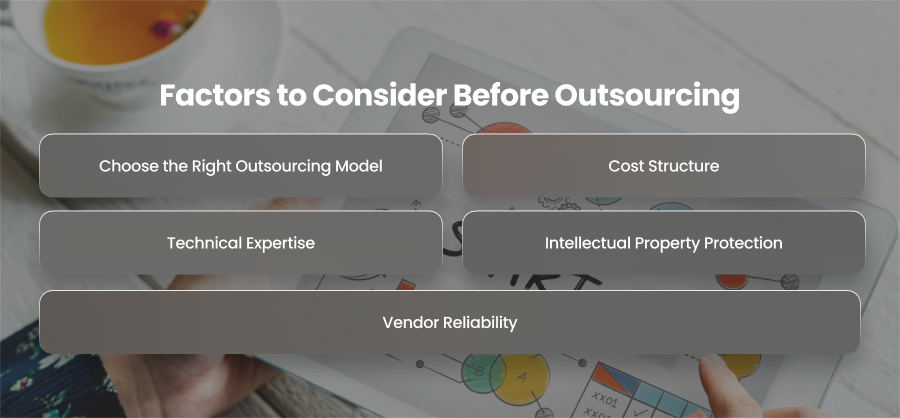
Choose the Right Outsourcing Model
Startups have multiple outsourcing models to choose from, each suited for different scenarios:
- Dedicated Team Model
In this model, an external team works exclusively on your project. It’s ideal for long term projects or when continuous development and support are needed. For instance, a SaaS startup planning ongoing feature releases may benefit from a dedicated team.
- Project Based Model
The outsourcing partner produces a completely completed project according to established requirements and dates. This strategy works effectively for highly defined tasks, such as producing an MVP.
- Staff Augmentation
Startups can temporarily add professional developers to their internal team utilizing this strategy. For example, if your team lacks expertise of React Native, you can bring in outsourced developers to replace that gap.
Cost Structure
Money is a key issue for startups, but quality shouldn’t be compromised. Startups should carefully assess if a fixed price contract or hourly rates are suitable for their firm. Fixed price contracts offer stable pricing for projects with well defined parameters. On the other hand, hourly rates enable flexibility for projects that may develop over time.
Technical Expertise
The level of technical proficiency varies among outsourcing partners. Startups need to make sure the vendor they have chosen is familiar with the particular technology needed for the project. For instance, a firm creating a cloud based AI solution would need Python savvy coders. Reviewing a vendor’s portfolio might give insights into their skills.
Intellectual Property Protection
Startups frequently handle user data and delicate business concepts. This makes security a major priority. It’s crucial to verify the outsourcing partner maintains tight security measures. This covers restricted access to sensitive data and safe development environments. Non disclosure agreements and clearly defined intellectual property clauses in contracts help protect business ideas and ensure that all code and deliverable belong to the startup.
Vendor Reliability
The outsourcing partner’s reputation significantly affects project outcomes. Startups should assess potential vendors based on client reviews and responsiveness during the engagement process. A trusted partner minimzes risks associated to missing deadlines or unethical conduct. Selecting a reliable vendor makes communication easier and gives the team assurance that they can overcome challenges.
Steps to Take to Successfully Outsource Software Development
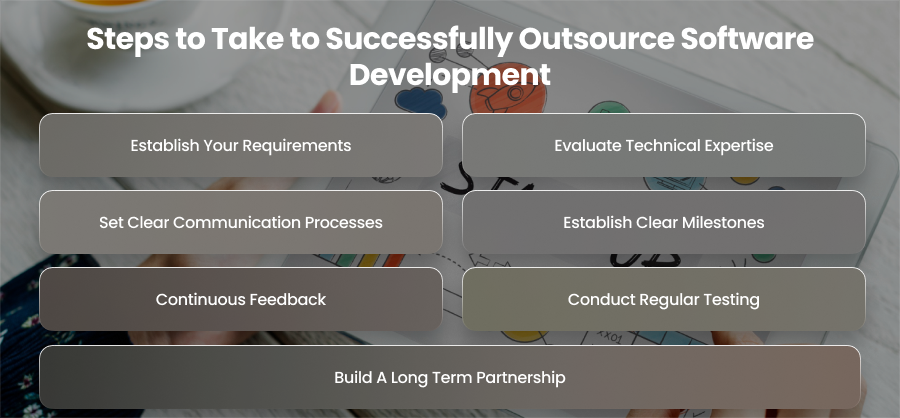
Establish Your Requirements
The first step in effectively outsourcing software development is to clearly define your objectives. Establishing the needs of their target market and their product vision should be the first steps for startups. This clarity helps prevent misunderstandings later in the project and ensures that the outsourced team is aware of the technical standards.
A well written requirements document also lays the groundwork for accurate estimations and superior delivery. Knowing the scope in advance reduces development risks and maintains the project on schedule, regardless of whether you are creating an MVP or a large product.
Evaluate Technical Expertise
After you have shortlisted your vendors you should assess each partner’s technical expertise and work culture. Technical competence can be evaluated through interviews or demos. Request insights into the vendor’s development process and technology stack knowledge.
Cultural compatibility is similarly vital, especially for long term cooperation. The collaboration will be greatly impacted by the vendor’s communication and problem solving techniques.
Set Clear Communication Processes
Startups should establish structured communication channels and tools early. This includes deciding on tools for project management like Jira or asynchronous communication like Slack. Furthermore, it’s important to define how often updates will be shared or milestone reviews.
Establish Clear Milestones
To ensure that progress is monitored and managed, you should break the project up into distinct milestones. There should be clear deliverables for each milestone. In addition to milestones, you should create key performance indicators to evaluate team output.
Continuous Feedback
A successful outsourcing partnership requires ongoing input. Attending reviews is one way for startups to actively participate in the development process. Moreover, allowing open communication helps build trust. It also ensures the team stays unified. Collaboration solutions like documentation platforms make it easy to communicate ideas.
Conduct Regular Testing
Quality assurance is a crucial feature of outsourced development. Instead of merely testing at the conclusion of the development cycle, startups should make sure that testing is done throughout. This comprises unit testing and performance testing. Frequent testing guarantees that the product fulfills customer expectations and finds flaws early. Startups can also use third party testers to test the software independently. A regular testing methodology leads to a more user friendly product.
Build A Long Term Partnership
Building ties with outsourced partners that comprehend their product vision and can help them through future revisions is beneficial for many firms in the long run. A long term cooperation gives consistency and saves onboarding time for future developments. Having a trustworthy technical partner can help you rapidly develop new features as your business grows.
Mistakes to Avoid When Outsourcing Software Development
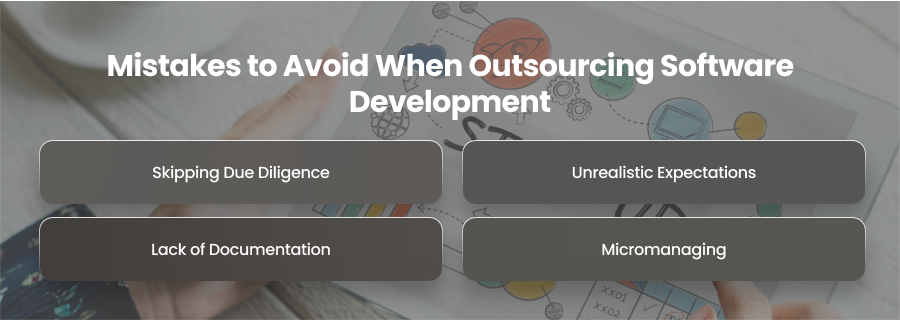
Skipping Due Diligence
It is an outsourcing mistake to rush the vendor selection process. Some companies hire the first vendor they come across without properly verifying their qualifications or checking over their past work. Avoiding untrustworthy partners that might overpromise is made simpler with due diligence. As a result, evaluating portfolios is vital. Evaluating technical proficiency and comprehending the vendor’s development procedures are also crucial. Startups should also evaluate how the vendor handles issues as code quality and security.
Unrealistic Expectations
Another typical error is assuming unreasonable timescales for complicated tasks. Startups may urge providers to offer things quickly than technically viable. This leads to poor quality work or burnout among developers. Additionally, unreasonable expectations undermine morale and generate conflict. You should work with vendors to set acceptable dates based on complexity rather than rushing the process.
Lack of Documentation
Some startups neglect documentation during the outsourcing process with the assumption that the vendor will handle everything. Without proper documentation, the development process becomes chaotic. Poor documentation makes future updates more difficult and creates long term dependency on the original vendor. Startups should insist on thorough documentation at every stage of development and user manuals. This gives startups full control over the product.
Micromanaging
While interaction is vital, excessive micromanagement might restrict growth. Some business owners continually meddle with the software development process. They are terrified of losing control. This slows the team down. Instead, entrepreneurs should focus on setting objectives and assessing their performance at regular intervals.
Best Practices for Managing an Outsourced Software Development Team

Set Clear Expectations
Managing an outsourced staff begins with creating the correct foundation. From the outset, startups should clearly define the project’s goal and delivery objectives. This entails specifying roles and communication guidelines. When expectations are ambiguous, outsourced teams make assumptions or misaligned features. Therefore, it’s important to provide a detailed project brief and examples of similar projects.
Utilizing Agile Methodologies
Because they foster transparency and continual progress, agile development methodologies are particularly successful for projects that are outsourced. Measuring progress and routinely reviewing deliverables is made simple by short development cycles. Moreover, instead of waiting months for a final release, which helps validate ideas faster and adjust requirements.
Maintain Accessible Documentation
Good documentation ensures long term continuity and makes collaboration smoother. Startups should maintain detailed documentation for product requirements and technical architecture. They should also maintain documentation on coding standards and API references. Appropriate documentation facilitates the onboarding of new developers and lessens reliance on humans.
Furthermore, cloud based technologies like Google Workspace assist keep documents consolidated and accessible. Additionally, documentation guarantees that new team members may immediately grasp the system without impeding development in the event of a team turnover.
Invest in Quality Assurance
Instead of being an afterthought, quality assurance should be incorporated throughout the development process. Startups should urge their outsourced workforce to practice test driven development and build automated tests. This guarantees that defects are detected early and the product remains stable.
Final Words
Outsourcing software development may be a huge growth engine for startups when done wisely. By engaging the proper partner and following best practices, organizations can speedily build high quality products. They can also maintain focus on their key business goals.