




Quick Summary
Choosing the right development partner requires more than cost evaluation. Strong engineering due diligence focuses on technical expertise, processes, infrastructure, security, and scalability ensuring reliable delivery, long-term maintainability, and alignment with business outcomes.
Introduction
Companies increasingly rely on external software development partners to build products, accelerate delivery, or scale engineering teams.
However, selecting the wrong partner can create serious risks:
- Delayed product launches
- Unstable systems
- Technical debt accumulation
- Poor code quality
- Operational instability
Many organizations evaluate vendors primarily on price, team size, or speed of hiring. While these factors matter, they rarely predict long-term engineering success.
The most reliable approach is to conduct engineering due diligence.
Engineering due diligence evaluates whether a software development partner has the technical expertise, engineering systems, and operational discipline required to deliver reliable software at scale.
This article presents a structured framework for evaluating a development partner before entering a long-term engagement.
What Is Engineering Due Diligence?
Engineering due diligence is a systematic evaluation process used to assess the technical capabilities, processes, and reliability of a software development partner.
The goal is to answer a critical question:
Can this partner build, scale, and maintain reliable software systems over time?
Engineering due diligence typically examines:
- Technical expertise
- Architecture capability
- Development processes
- Infrastructure maturity
- Security standards
- Team structure
- Delivery reliability
Organizations commonly perform engineering due diligence when:
- Hiring a software development partner
- Outsourcing major product development
- Scaling engineering teams
- Preparing for large platform modernization
This process reduces risk and ensures long-term engineering alignment.
Why Engineering Due Diligence Matters
Software systems are increasingly complex. Modern platforms often involve:
- Distributed cloud architectures
- Microservices
- Real-time data pipelines
- AI and machine learning systems
- DevOps automation
These environments require strong engineering discipline.
Selecting a development partner without proper evaluation can result in:
- Poorly designed architecture
- Scalability limitations
- Security vulnerabilities
- Operational instability
Engineering due diligence helps organizations identify partners who can build maintainable, scalable, and secure systems.
Engineering Due Diligence Framework
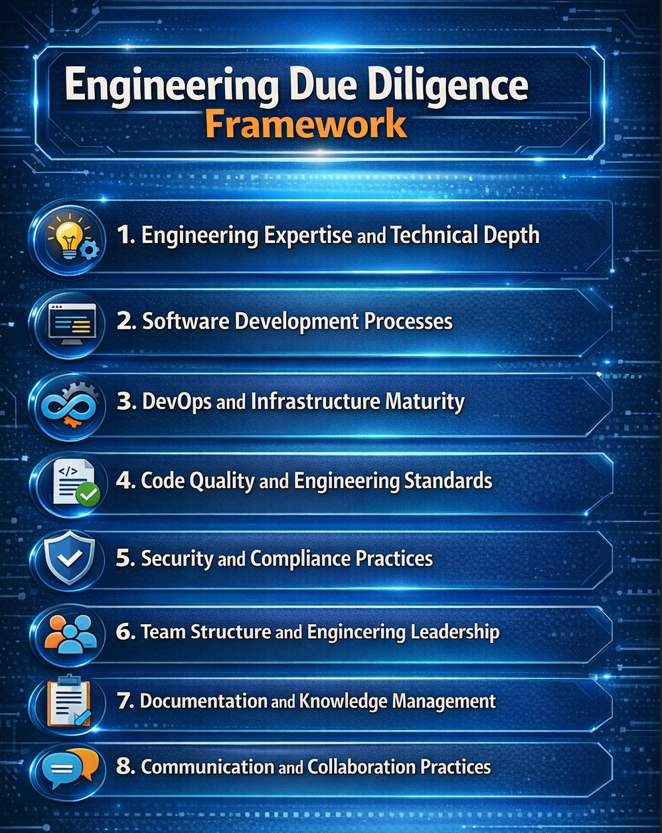
Below is a structured framework used to evaluate software development partners.
1. Engineering Expertise and Technical Depth
The first step is evaluating whether the partner possesses the necessary technical expertise.
Key evaluation criteria include:
- Programming language expertise
- Experience with relevant frameworks
- System architecture capability
- Domain knowledge
- Experience with large-scale systems
Important questions to ask:
- Have they built systems of similar scale or complexity?
- Do their engineers demonstrate architectural thinking?
- Can they explain technical trade-offs clearly?
A strong engineering partner demonstrates both technical depth and practical experience.
2. Software Development Processes
Reliable engineering teams follow structured development processes.
Evaluate whether the partner uses disciplined workflows, such as:
- Agile or iterative development frameworks
- Sprint planning and backlog management
- Peer code reviews
- Structured release cycles
- Testing and QA processes
Mature teams emphasize predictable delivery rather than ad-hoc development.
Red flags include:
- Unclear project planning
- Inconsistent release management
- Lack of QA processes
3. DevOps and Infrastructure Maturity
Modern software delivery depends heavily on DevOps systems.
Evaluate whether the partner has experience with:
- CI/CD pipelines
- Automated testing frameworks
- Infrastructure as code
- Containerization (Docker, Kubernetes)
- Monitoring and observability tools
Strong DevOps practices enable teams to:
- Deploy safely and frequently
- Maintain system reliability
- Reduce operational risks
Without DevOps maturity, scaling software systems becomes difficult.
4. Code Quality and Engineering Standards
Code quality directly impacts system maintainability and reliability.
Key areas to evaluate include:
- Code review processes
- Static analysis tools
- Automated testing coverage
- Coding standards
- Documentation practices
You can assess code quality through:
- Sample code reviews
- Architecture walkthroughs
- Git repository audits
- Engineering case studies
Strong partners emphasize long-term maintainability, not just feature delivery.
5. Security and Compliance Practices
Security is a critical aspect of software development.
Evaluate whether the partner follows modern security practices such as:
- Secure coding standards
- Vulnerability scanning
- Dependency management
- Data protection practices
- Compliance with standards like SOC 2, ISO 27001, or GDPR
Security maturity reduces the risk of breaches and compliance failures.
6. Team Structure and Engineering Leadership
Understanding how the partner structures their teams is essential.
Key roles to evaluate include:
- technical leads
- solution architects
- DevOps engineers
- QA specialists
- Product managers
Well-structured teams typically include cross-functional roles rather than only developers.
Strong engineering partners also provide technical leadership and architectural guidance, not just implementation resources.
7. Documentation and Knowledge Management
Effective documentation systems are essential for long-term maintainability.
Evaluate whether the partner maintains documentation such as:
- Architecture diagrams
- System workflows
- API specifications
- Pperational playbooks
Good documentation ensures knowledge is not locked inside individual engineers.
8. Communication and Collaboration Practices
Successful engineering partnerships depend heavily on communication.
Evaluate the partner’s approach to:
- Project reporting
- Sprint updates
- Risk management
- Stakeholder communication
Effective partners maintain transparency around:
- Delivery progress
- Technical risks
- Architectural decisions
Clear communication prevents misunderstandings and delays.
Engineering Due Diligence Checklist
Below is a simplified checklist organizations can use when evaluating a development partner.
| Evaluation Area | Key Questions |
|---|---|
| Engineering Expertise | Do they have experience building similar systems? |
| Architecture Capability | Can they design scalable architectures? |
| Development Processes | Do they follow structured development workflows? |
| DevOps Maturity | Do they implement CI/CD and automated deployments? |
| Code Quality | Do they enforce code reviews and testing standards? |
| Security Practices | Do they follow modern security frameworks? |
| Team Structure | Do they provide cross-functional engineering teams? |
| Documentation | Do they maintain structured technical documentation? |
| Communication | Do they provide transparent reporting and updates? |
This checklist helps organizations perform structured vendor evaluations.
Step-by-Step Process for Evaluating a Development Partner
Step 1: Define Technical Requirements
Before evaluating partners, define:
- System architecture needs
- Technology stack
- Scalability expectations
- Security requirements
Clear requirements allow meaningful evaluation.
Step 2: Review Engineering Case Studies
Evaluate whether the partner has successfully delivered projects similar to yours.
Focus on:
- Architecture decisions
- Scalability outcomes
- Operational improvements
Case studies often reveal the partner’s engineering maturity.
Step 3: Conduct Technical Interviews
Engage directly with the partner’s engineering leadership.
Discuss topics such as:
- Architecture trade-offs
- DevOps pipelines
- Testing strategies
- Performance optimization
Technical discussions often reveal real expertise.
Step 4: Evaluate Engineering Processes
Request documentation describing:
- Development workflows
- Release management processes
- Quality assurance practices
These processes determine long-term delivery reliability.
Step 5: Start with a Pilot Engagement
Many organizations begin with a small pilot project.
This allows evaluation of:
- Communication quality
- Delivery speed
- Engineering discipline
Pilot projects provide real evidence of how teams work together.
Common Mistakes When Evaluating Development Partners

Many organizations make similar mistakes when selecting engineering partners.
Focusing Only on Cost
Low hourly rates often hide risks such as poor code quality or weak engineering processes.
Evaluating Only Individual Developers
Engineering success depends on systems and processes, not just individual engineers.
Ignoring DevOps and Infrastructure
Delivery reliability depends heavily on infrastructure automation.
Skipping Technical Leadership Evaluation
Architecture decisions made early can affect the system for years.
Industry Trends in Software Development Partnerships
The market for software development partnerships is evolving.
Several trends are shaping how organizations evaluate partners.
AI-Driven Development
AI and machine learning systems require specialized engineering expertise in data pipelines, model deployment, and infrastructure.
Platform Engineering
Companies increasingly invest in platform engineering teams that manage internal developer infrastructure.
DevOps Automation
Continuous delivery pipelines have become standard for modern development teams.
Engineering Partnerships Over Staffing
Organizations increasingly prefer integrated engineering teams with delivery accountability rather than temporary staffing models.
Key Takeaways
Selecting the right software development partner requires more than reviewing resumes or hourly rates.
A proper engineering due diligence framework evaluates:
- Technical expertise
- Development processes
- DevOps maturity
- Security practices
- Communication systems
Organizations that perform structured evaluations reduce delivery risks and build stronger long-term partnerships.
Conclusion
Choosing the right software development partner can determine whether a technology initiative succeeds or fails.
A structured engineering due diligence framework allows organizations to move beyond superficial evaluations and assess real engineering capability.
By evaluating technical expertise, DevOps maturity, development processes, and team structures, companies can identify partners capable of delivering reliable software systems.