



According to Precedence Research, the global software market size is expected to reach $2248.33 billion in the next nine years. This is because the demand for unique and innovative software is sharply increasing. Users expect software to be intelligent and deeply personalized. Whether it’s a mobile app or a web application, the quality of interaction has become a defining factor in user adoption and retention.
As the next phase of digital transformation draws near, experience driven engineering is becoming increasingly common in software development. Instead of merely writing functional code, developers are increasingly building systems that respond to user actions. AI is altering how customers engage with digital goods.
In this guide, we will discuss the most important trends in digital experiences. Also, we will break down how these trends impact software development and what businesses can do to stay ahead.
Trends of Future Digital Experiences
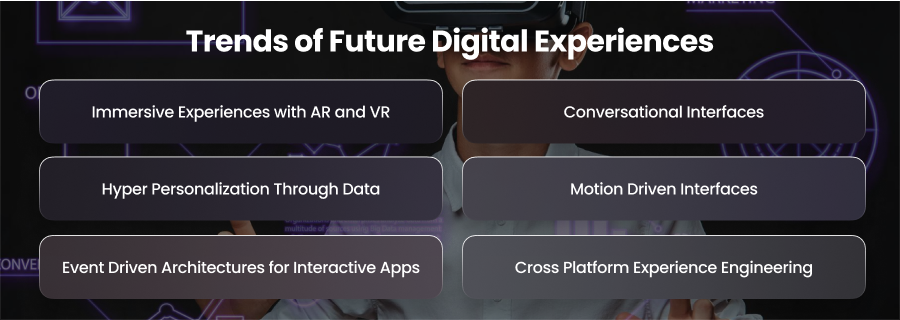
Immersive Experiences with AR and VR
Users’ interactions with software applications are about to be completely transformed by AR and VR. AR superimposes digital stuff on top of the physical environment. Virtual reality creates fully immersive virtual environments. Furthermore, these technologies are becoming useful tools for eCommerce platforms, going beyond gaming.
From a software development perspective, AR and VR require careful planning and specialized frameworks. Developers have to deal with issues like rendering speed and latency. Therefore, integrating AR onto mobile applications may include SDKs like ARKit, whereas VR experiences might employ platforms like Unity.
AR and VR may be used by businesses for simulation platforms or immersive product visualization. For example, an eCommerce app can allow users to visualize furniture in their home. While corporate training applications can simulate complex procedures in a safe virtual environment.
Conversational Interfaces
The way consumers engage with software is changing thanks to conversational interfaces. Users can do tasks or have natural conversations thanks to these technologies. Conversational AI integration in software development necessitates knowledge of contextual memory management and natural language processing. Backend services must orchestrate multi turn conversations and access data through APIs.
The benefits for software users are significant. Workflows are accelerated, and friction is decreased with conversational interfaces. Productivity solutions may incorporate AI agents for job management, SaaS platforms can automate client onboarding, and business software can help users navigate complicated features
These interfaces will advance in sophistication and preserve context over sessions and devices. As a result, developers will have to create clever and responsive systems.
Hyper Personalization Through Data
The advancement of customization, hyper personalization uses artificial intelligence and real time data to customize software experiences for every user. Unlike traditional personalization, which may suggest content based on broad categories and hyper personalization analyzes behavioral patterns and contextual signals to deliver dynamic and adaptive interfaces.
For AI developers, building hyper personalized systems requires reliable data pipelines and scalable architectures. Applications must track user interactions and analyze them in real time. Technologies like predictive analytics and adaptive UI components are core to this trend.
The impact on users is substantial. Hyper personalization creates highly relevant experiences. This improves engagement and retention. A media streaming platform might recommend content based on nuanced viewing patterns. However, an e learning system might modify lessons to fit the user’s comprehension and speed.
Developers must, however, strike a balance between privacy and customization. Strict respect for regulations is necessary while gathering sensitive data. When implemented properly, hyper customization enables companies to provide intelligent and responsive experiences.
Motion Driven Interfaces
A logical development of user interaction is the emergence of motion driven interfaces. Users may now interact with applications using motion sensors and gestures rather than only touchscreens. Smart gadgets are especially affected by this tendency.
Developers working on motion device interfaces need to handle real time sensor data processing and spatial mapping. The software must interpret user movements accurately and respond seamlessly.
Furthermore, motion driven interfaces offer several advantages:
- Accessibility: Providing alternative interaction methods for users with physical limitations.
- Intuitive Control: Natural interactions reduce learning curves.
Motion driven interfaces will become commonplace in software applications as sensors advance and gesture detection becomes more dependable, necessitating the integration of front-end and back end systems that efficiently interpret physical movement.
Event Driven Architectures for Interactive Apps
For contemporary applications, real time interaction is becoming more and more important. Software systems may respond rapidly to human activities or external events thanks to event driven designs. This provides dynamic and responsive experiences.
In this architecture, components communicate through events rather than direct requests. Technologies like WebSockets and serverless functions allow applications to scale efficiently while delivering real time feedback to users.
For developers, event driven systems support features such as:
- Live notifications and updates
- Collaborative editing and multi user interactions
- Dynamic dashboards and analytics in real time
Therefore, developers have the freedom to grow or upgrade certain components of the system on their own by decoupling services. Maintainability is enhanced by this. Event driven designs also reduce latency and enable applications to feel highly responsive.
Cross Platform Experience Engineering
Users now interact with software across multiple devices. Applications that deliver uniform and smooth interactions across all touchpoints are guaranteed by cross platform experience engineering.
From a development perspective, this involves:
- Shared codebases and modular components
- API first design for unified backend services
- State synchronization across devices for continuity
Developers must design systems where actions on one device are instantly reflected on all other devices. This calls for dependable cloud infrastructure as well as close monitoring of latency and performance.
Cross platform experience engineering not only satisfies user expectations for smooth transitions but also helps software appear consistent and user friendly across all platforms. Companies that prioritize this approach will give customers experiences that are simple to integrate into daily life.
How Can Businesses Prepare for These Changes?
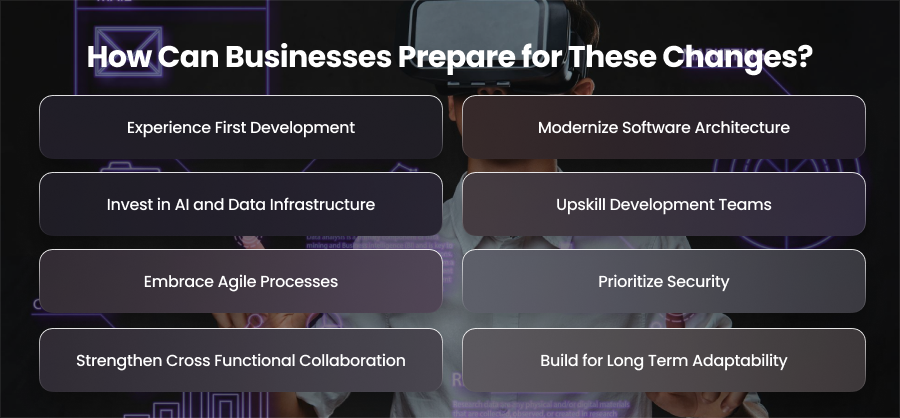
Experience First Development
The foundation of digital experiences lies in prioritizing user experience from the earliest stages of development. Companies should abandon feature-centric planning in favor of concentrating on how consumers engage with software across many touchpoints. In order to match technological choices with user demands, this entails including product managers and UX designers in the early stages of discovery.
Experience first development also motivates teams to create responsive and user friendly solutions. Businesses may make sure that usability and interactivity are essential features of their products rather than afterthoughts by including UX principles in system architecture.
Modernize Software Architecture
Businesses must make investments in modern, scalable infrastructures to enable new trends like real time interactions and immersive technology. Modular and service based architectures are more suited for expansion, as monolithic systems frequently find it difficult to support quick innovation.
Thus, companies may include new capabilities without interfering with current operations by implementing cloud architectures and microservices. Faster experimentation and more seamless scalability as user needs increase are made possible by this flexibility.
Invest in AI and Data Infrastructure
Predictive experiences and AI personalization depend on intelligent algorithms and high quality data. Businesses should place a high premium on developing reliable data pipelines that collect user activity in real time.
Investing in analytics and machine learning tools is necessary for this. Establishing governance structures to guarantee moral data use and legal compliance is equally crucial. Businesses may offer more meaningful and individualized digital experiences when data infrastructure is viewed as a strategic asset.
Upskill Development Teams
The skills needed to create next generation experiences are evolving along with software development. Businesses should work hard to help their development personnel become more proficient in areas like integrating AI.
Continuous learning initiatives help teams keep current with emerging technology. Developers are therefore more equipped to innovate and boldly include complex interactive elements when they feel empowered.
Embrace Agile Processes
Digital experiences will continue to change rapidly. Thus, it will make long and rigid development cycles less effective. Businesses should adopt agile methodologies that support frequent iteration.
Experimentation driven development encourages teams to prototype new interactions and test them with real users. This approach reduces the risk and ensures that new features align with actual user behavior.
Prioritize Security
Trust becomes a crucial distinction as digital interactions become more data driven and individualized. Businesses must ensure that security is included into every tier of their software systems.
This means implementing secure authentication and encrypting sensitive data. Moreover, ethical concerns are as important. Companies that respect user privacy will create stronger, longer lasting relationships.
Strengthen Cross Functional Collaboration
The development and business teams must work closely together to deliver modern digital experiences. Silos can result in disjointed user experiences.
By using collaborative tools and uniting teams around common objectives, businesses can promote cross collaboration. Thus, it is simpler to develop unified and user centered digital experiences when stakeholders collaborate throughout the product lifecycle.
Build for Long Term Adaptability
Perhaps the most important step in preparing for future digital encounters is to design systems with adaptability in mind. Additionally, customer expectations will shift as technology develops. Businesses that develop modular systems will be better able to adopt new trends without requiring major adjustments.
Therefore, by giving flexibility a priority, businesses can ensure that their software can continue to support the next generation of digital experiences.
Challenges of Implementing These Trends
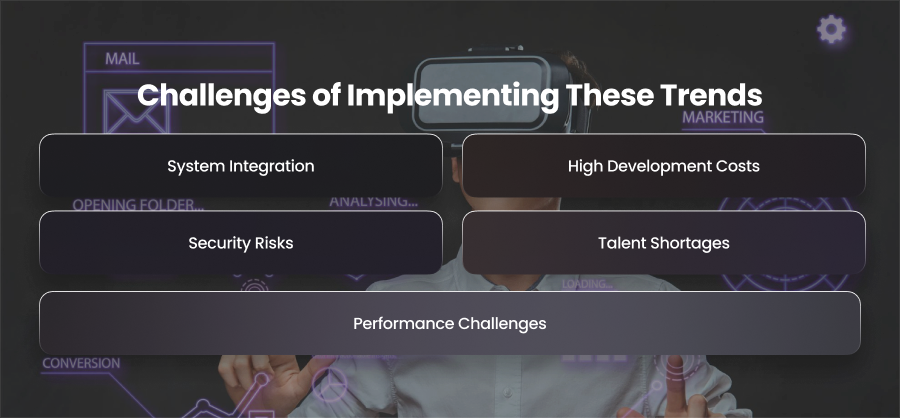
System Integration
The technological difficulty of putting sophisticated digital experience trends into practice is one of the main obstacles. Event driven architectures are examples of technologies that call for specific expertise and frequently need to interface with legacy systems.
Many businesses use tightly connected or monolithic systems that are not intended for modular expansion or real time processing. Also, introducing modern components into these environments can lead to performance bottlenecks and integration failures. Therefore, developers must carefully refactor or gradually modernize systems without disrupting existing operations.
High Development Costs
Immersion experience implementation frequently necessitates a large initial outlay of funds. Performance optimization and specific hardware are necessary for AR and VR development. AI systems require reliable data infrastructure and model training resources.
Additionally, if cross platform frameworks and cloud computing are not properly managed, infrastructure expenses may rise. Finding a balance between innovation and financial restrictions becomes a significant challenge for numerous companies. When return on investment cannot be measured right away, this is very crucial.
Security Risks
Trends like conversational AI and hyper customization depend heavily on the gathering and analysis of user data. This also brings up serious concerns about legal compliance.
Developers are accountable for ensuring that personal data is handled properly and preserved securely. Data processing and system design are made more difficult by regulatory compliance. Any data breach or misuse has the potential to seriously damage user trust and brand reputation.
Talent Shortages
Advanced digital experience technologies require specialized expertise in areas such as machine learning and cross platform engineering. Finding and keeping talent with these talents is a challenge for many organizations.
Additionally, hiring experienced individuals can be expensive and competitive, while upskilling current staff requires time and commitment. Even well thought out digital projects can fail in the absence of the necessary personnel.
Performance Challenges
Interactive and real time experiences place heavy demands on system performance. Features like live updates and immersive environments require low latency and efficient resource management.
Scaling these experiences to support a growing user base can be difficult. Poorly optimized systems may suffer from lag or inconsistent behavior. Therefore, developers must design architectures that scale easily while maintaining responsiveness.
Final Words
The future of digital experiences is driven by intelligent and immersive software. So, by embracing modern architectures and experience first development, businesses can overcome implementation challenges and deliver scalable and user centric applications that adapt to changing expectations.