



According to the U.S Bureau of Labor Statistics, the employment of developers and digital designers is projected to grow 16% in the next seven years. Moreover, LinkedIn reports full stack developer as one of the most in demand jobs with job postings increasing by 35% every year.
This is because full stack development has become the backbone of modern digital products. As businesses move deeper into digital transformation, the expectations from development teams are no longer limited to building functional applications.
Instead of managing multiple vendors or siloed teams, businesses increasingly rely on full stack teams to take ownership of the entire product lifecycle.
In this guide, we will discuss what full stack development services look like and the technologies companies should expect. We will also discuss how businesses can prepare to stay competitive.
Full Stack Development Services
Full stack development services represent an end to end approach to building and maintaining digital products.
At their core, full stack services cover user interface development, server side logic, database management, API integration, and deployment. However, modern full stack teams are also deeply involved in cloud architecture and DevOps practices.
For companies, this means working with teams that understand not just how software works and how businesses operate. It is required of full stack developers to consider long
term maintenance and user journeys. To make sure that the technology is in line with company goals, they work closely with designers and product managers.
As a result, businesses anticipate full stack development services to handle anything from major corporate systems to MVP development for startups. Full stack teams are in charge of producing dependable, production ready solutions that can adjust to changing needs, whether they are developing SaaS platforms or AI powered apps.
Trends Shaping Full Stack Development
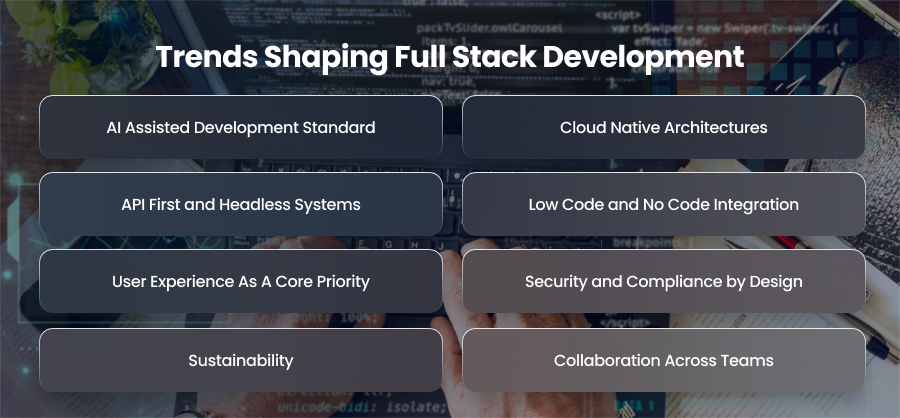
AI Assisted Development Standard
AI is transforming full stack development workflows. Coding, testing, debugging, and deployment procedures will all heavily include AI technologies. AI driven code completion and performance optimization solutions are becoming more and more popular among full stack developers.
AI, for instance, may automatically rework code to increase productivity or recommend more effective database queries to manage big datasets. This lessens the possibility of human mistake and frees developers to concentrate on architecture. Moreover, companies working with AI augmented full stack teams can expect faster releases and higher quality applications.
Cloud Native Architectures
Cloud adoption is now necessary rather than an option. Full stack development relies heavily on cloud native architectures. Microservices and containerized apps fall under this category.
Applications may be divided into smaller, independently deployable components thanks to microservices. They are therefore simpler to scale and manage. Teams may deliver code without maintaining infrastructure thanks to serverless computing, which lowers overhead and increases cost effectiveness. Global accessibility is also guaranteed via cloud first development. This eliminates speed bottlenecks and enables businesses to reach people wherever.
API First and Headless Systems
Applications must provide seamless experiences on third party, mobile, IoT, and online platforms. To satisfy this requirement, full stack developers are increasingly using headless architectures and API first.
Using an API driven approach allows for the separation of the frontend and backend, allowing for the inclusion of new platforms or interface redesigns without impacting the system as a whole. This would be extremely helpful for companies that offer omnichannel experiences, such as eCommerce companies who offer web and mobile applications.
Low Code and No Code Integration
While full stack developers remain essential, low code and no code platforms are becoming part of the modern development toolkit. So, full stack teams utilize these platforms to accelerate propotyping and develop internal tools without compromising quality.
Low code integration allows for rapid MVP development. This gives startups and enterprises the ability to validate ideas quickly. Full stack developers are expected to integrate these solutions strategically. This ensures maintainability and security are not compromised.
User Experience As A Core Priority
User expectations are higher than ever, and performance is a key differentiation. Full stack developers are responsible for creating applications that load fast and provide consistent experiences across devices and network conditions. These days, methods like efficient database searches and server side rendering are commonplace.
Security and Compliance by Design
Cybersecurity and regulatory compliance are no longer afterthoughts; they are foundational requirements. From the very beginning of development, full stack development teams implement security and compliance procedures.
This covers sensitive data encryption, authentication, and authorization management, and secure coding techniques. Companies may depend on their full stack partners to foresee problems and uphold trustworthy security procedures.
Sustainability
Sustainable development is another new subject. Businesses are starting to think about how digital products affect the environment. Applications that maximize resource use and efficiently utilize cloud infrastructure must be created by full stack teams.
Collaboration Across Teams
Full stack developers are now collaborators who fill in the gaps between design and business strategy rather than solitary programmers. To make sure apps satisfy technical needs, they collaborate closely with data scientists.
What Technologies Should Companies Expect Full Stack Teams to Use?
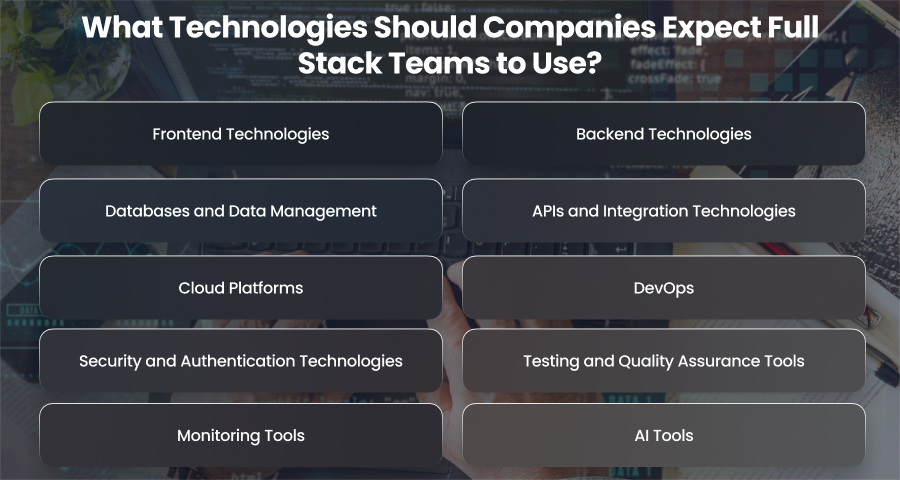
Frontend Technologies
Modern JavaScript frameworks that enable component-based designs and enhanced performance are essential for full stack teams.
Because of its ecosystem and adaptability, React continues to be the most popular frontend library. Frameworks like Next are compared with React to enable server side rendering and static site generation. This significantly improves performance and SEO. Moreover, Vue and Angular continue to be strong choices for projects that require structured frameworks or long term enterprise support.
Companies should anticipate that full stack teams will target accessibility standards and responsive design in addition to frameworks. In addition to their visual attractiveness, frontend technologies are chosen for their ability to deliver consistent experiences across different devices.
Backend Technologies
Node.js is widely used for API driven applications and real time systems due to its event driven architecture. Python frameworks such as Django and Flask are favored for rapid development and AI enabled applications. Java based Spring Boot and Microsoft’s .NET ecosystem remain popular for enterprise grade solutions that require robustness and stability.
Full stack teams are expected to design backend systems that are modular and testable. Companies should also expect backend developers to build clean APIs and ensure seamles integration with third party services.
Databases and Data Management
Modern applications are data driven, making database expertise a critical part of full stack development. Both relational and nonrelational databases are handled with assurance by full stack teams.
Relational databases such as PostgreSQL are used for transactional systems and structured data where integrity is important. Applications that require flexibility or high availability employ NoSQL databases, such as MongoDB.
Businesses should anticipate that full stack teams will create effective data models and safely handle data migrations in addition to choosing a database. Therefore, proper data management ensures applications remain reliable as usage grows.
APIs and Integration Technologies
The foundation of contemporary digital ecosystems is APIs. To ensure that systems are modular, full stack teams use API first principles while creating apps.
GraphQL is growing in popularity for applications that require faster data querying. This is true even if RESTful APIs are still utilized. Developing well documented APIs that enable communication with internal systems is crucial for full stack developers.
Cloud Platforms
Proficiency with key cloud platforms like AWS and Google Cloud is demanded of full stack teams.
Cloud technologies enable scalable infrastructure and cost efficient resource management. Full stack developers designing applications that utilize cloud storage and managed datasets.
DevOps
Deployment and maintenance are part of full stack development. DevOps approaches are fully integrated into development processes to deliver safer releases.
Applications are containerized using tools like Docker, and complicated system orchestration is handled via Kubernetes. Deployment pipelines automate testing and deployments. This lowers downtime and human mistakes.
For businesses, this means faster time to market and earlier rollback in case of issues. Full stack teams are expected to monitor applications and continuously optimize peformance.
Security and Authentication Technologies
Security is embedded into every layer of the technology stack. Full stack teams use modern authentication mechanisms such as OAuth and role based access control to protect user data and system resources.
Tools for vulnerability detection and encryption are routine procedures. Companies should mandate that full stack developers follow secure coding standards. They should also proactively address any security risks rather than reacting to problems after they arise.
Testing and Quality Assurance Tools
Quality is a non negotiable expectation. Full stack teams rely on automated testing frameworks to ensure stability.
While backend testing makes that APIs and business logic operate as intended, frontend testing tools verify user interactions. To identify problems before they are put into production, end to end testing mimics actual user operations.
Monitoring Tools
Modern applications must be continuously monitored. To monitor performance and comprehend user behavior, full stack teams employ analytics and monitoring technologies.
Teams can make data driven choices and maximize application performance with the aid of these insights. Better customer experiences and increased uptime are advantageous to businesses.
AI Tools
AI is increasingly part of the full stack toolkit. Full stack teams employ AI tools to increase system performance and development efficiency, from code analysis to intelligent automation.
Challenges Companies May Face
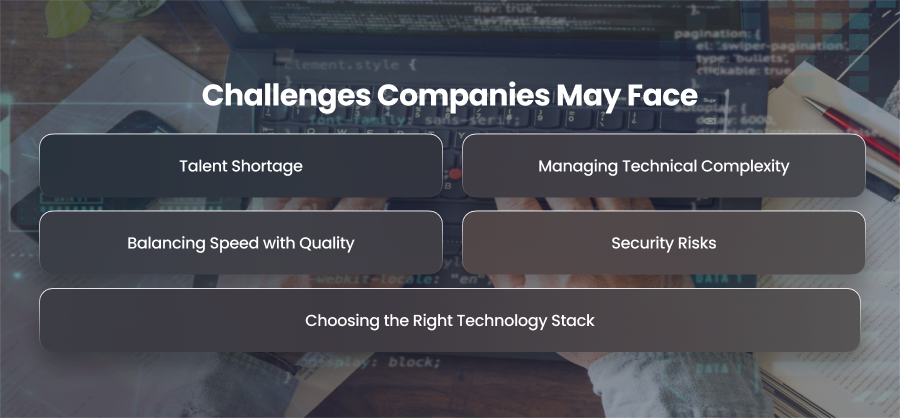
Talent Shortage
The lack of highly qualified full stack developers is one of the largest issues facing businesses. The need for engineers who can manage this complexity is only going to increase as the technology stack grows to encompass cloud platforms and DevOps operations.
Costs rise as a result of this demand. This is particularly true for highly skilled senior full stack developers. On a restricted budget, businesses may find it difficult to draw in or keep talent, especially in highly competitive sectors. Lack of expertise may cause delays in projects.
Managing Technical Complexity
Modern applications are far more complex than those created just a few years ago. The technological load is increased by microservices.
For companies, this complexity can lead to fragmented systems if not managed properly. Poor architectural decisions early on can result in tightly coupled components or excessive techcnical debt. As systems grow, even small changes can become risky and time consuming.
Balancing Speed with Quality
To keep ahead of the competition, businesses frequently strive for rapid development. Although full stack teams are well suited to do work rapidly, the pressure to do so may result in subpar code and documentation.
If you don’t conduct enough testing, you can launch more quickly. On the other hand, it makes errors and performance problems more likely in the future. Businesses need to balance speed with long term stability. This can necessitate strong collaboration across development teams.
Choosing the Right Technology Stack
It might be difficult to choose the best technological stack because there are so many frameworks and platforms accessible. Businesses may be enticed to implement the newest tools without properly accounting for team experience or long-term upkeep.
Overly complicated technology might cause dependence problems and make it harder to hire new engineers. On the other hand, performance and innovation may be constrained by using antiquated stacks.
Security Risks
Security and compliance become critical issues when apps handle more sensitive data. Businesses are seriously threatened by data breaches.
Businesses could underestimate the work needed to have safe authentication processes in place. Without experienced full stack teams, security gaps can remain hidden until they cause significant harm.
Final Words
Full stack development services provide scalable and secure digital goods in addition to writing code. Businesses that comprehend new trends and potential obstacles will be in the greatest position to create dependable systems and maintain long term digital development.