




Quick Summary
Most engineering teams begin reactively, but as systems scale, that approach breaks down. High-performing teams build maturity through clear ownership, automation, predictable delivery, scalable architecture, and data-driven operations.
Introduction
Engineering teams rarely start with structured systems.
Early-stage teams often prioritize speed over process. Decisions are made quickly, systems evolve organically, and delivery is driven by immediate needs.
This approach works initially.
However, as products scale, complexity increases:
- More users
- More features
- More integrations
- More dependencies
Without structured engineering practices, teams become reactive.
They spend more time fixing issues than building new capabilities.
The core challenge is:
How do engineering teams transition from reactive execution to predictable, scalable delivery?
The answer lies in engineering maturity.
What Is Engineering Maturity?
Engineering maturity refers to the level of structure, discipline, and capability within an engineering organization to deliver software reliably and at scale.
It encompasses:
- System architecture
- Development processes
- DevOps and infrastructure
- Team structure and ownership
- Monitoring and reliability
Mature engineering teams are not just faster. They are predictable, reliable, and scalable.
The Engineering Maturity Model (Overview)
The engineering maturity model typically includes four stages:
- Reactive Stage
- Structured Stage
- Scalable Stage
- Predictable Stage
Each stage represents a shift in how teams operate, build systems, and deliver software.
Stage 1: Reactive Engineering
Characteristics
Teams in this stage operate in a constant state of reaction.
Common traits include:
- Frequent production issues
- Minimal documentation
- Ad-hoc development processes
- Manual deployments
- Unclear ownership
Development is driven by urgency rather than planning.
Challenges
- Delivery timelines are unpredictable
- Bugs and incidents are frequent
- Technical debt accumulates rapidly
- Knowledge is siloed within individuals
Example
A startup rapidly building features without defined architecture or processes, relying on individual developers to manage systems.
Stage 2: Structured Engineering
Characteristics
Teams begin introducing basic structure and processes.
Typical improvements include:
- Defined development workflows (Agile/Scrum)
- Basic CI/CD pipelines
- Code review practices
- Initial documentation
Teams move from chaos to controlled execution.
Challenges
- Processes may be inconsistent
- Ownership is still unclear
- Scaling remains difficult
- Coordination overhead increases
Example
A growing company implementing Agile processes and basic DevOps, but still struggling with system complexity.
Stage 3: Scalable Engineering
Characteristics
Teams focus on scalability and system design.
Key capabilities include:
- Domain-based team structures
- Clear system ownership
- Mature DevOps pipelines
- Automated testing and deployments
- Observability systems
Teams begin to scale efficiently.
Challenges
- Maintaining consistency across teams
- Managing cross-team dependencies
- Scaling infrastructure cost-effectively
Example
A mid-sized SaaS company with microservices architecture, dedicated teams per domain, and strong DevOps practices.
Stage 4: Predictable Engineering
Characteristics
This is the highest level of engineering maturity.
Teams operate with:
- Predictable delivery cycles
- Data-driven decision-making
- Highly automated systems
- Strong reliability and uptime
- Continuous optimization
Delivery becomes consistent and measurable.
Outcomes
- Faster time-to-market
- High system reliability
- Reduced operational overhead
- Scalable engineering organization
Example
Enterprise-level organizations with platform engineering, advanced observability, and well-defined engineering standards.
Engineering Maturity Model Comparison
Engineering maturity determines how reliably teams can scale delivery, maintain system quality, and support long-term business growth. As teams mature, ownership, processes, automation, and delivery predictability become stronger across the organization.
| Dimension | Reactive | Structured | Scalable | Predictable |
|---|---|---|---|---|
| Ownership | Unclear | Partial | Defined | Optimized |
| Processes | Ad-hoc | Defined | Standardized | Optimized |
| Deployment | Manual | Semi-automated | Automated | Fully automated |
| Architecture | Unstructured | Improving | Scalable | Optimized |
| Monitoring | Minimal | Basic | Advanced | Proactive |
| Delivery | Unpredictable | Improving | Consistent | Predictable |
What High-Maturity Teams Do Differently
1. Establish Clear Ownership
Systems are divided into domains with defined ownership.
This reduces confusion and accelerates decision-making.
2. Invest in DevOps and Automation
High-maturity teams automate:
- Testing
- Deployments
- Infrastructure provisioning
Automation reduces errors and improves speed.
3. Build Scalable Architecture
Systems are designed for:
- Modularity
- Scalability
- Maintainability
Architecture supports long-term growth.
4. Use Data to Drive Decisions
Teams rely on:
- Performance metrics
- Deployment frequency
- Incident tracking
Data enables continuous improvement.
5. Focus on Reliability and Observability
Mature teams prioritize:
- Monitoring systems
- Logging and tracing
- Incident response processes
Reliability becomes a core engineering function.
Step-by-Step Framework to Improve Engineering Maturity
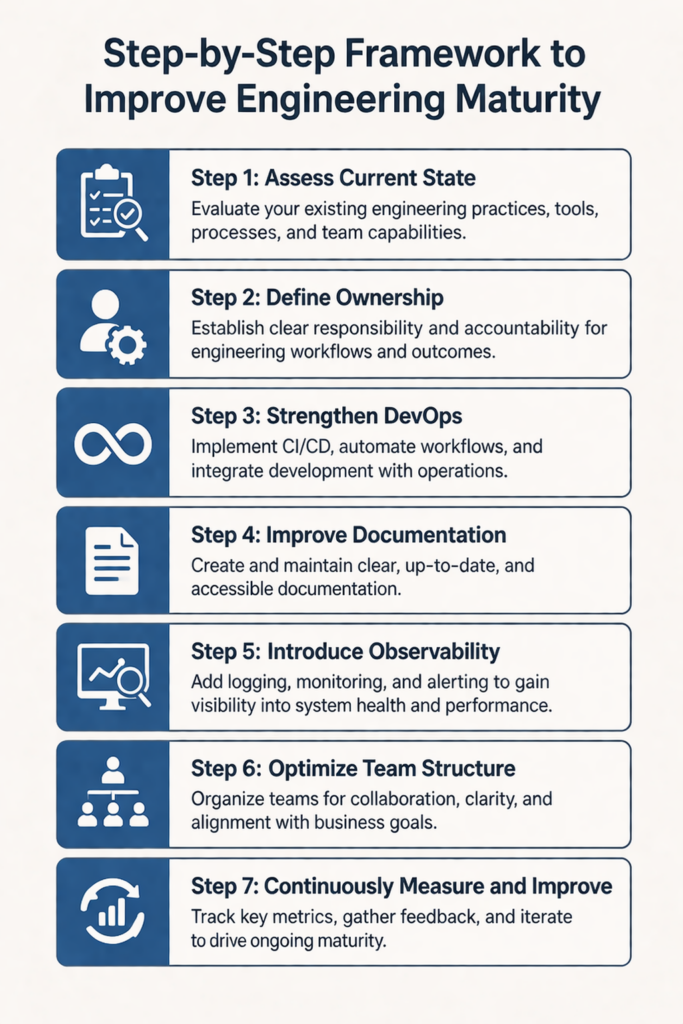
Step 1: Assess Current State
Evaluate:
- Team structure
- Processes
- Infrastructure
- Delivery performance
Identify maturity level.
Step 2: Define Ownership
Assign ownership across:
- Services
- Infrastructure
- Data systems
Clear ownership improves accountability.
Step 3: Strengthen DevOps
Implement:
- CI/CD pipelines
- Automated testing
- Infrastructure as code
Enable reliable deployments.
Step 4: Improve Documentation
Document:
- Architecture
- Workflows
- System dependencies
Reduce knowledge gaps.
Step 5: Introduce Observability
Add:
- Monitoring dashboards
- Alerting systems
- Incident tracking
Improve system visibility.
Step 6: Optimize Team Structure
Organize teams around domains rather than functions.
Reduce coordination overhead.
Step 7: Continuously Measure and Improve
Track:
- Delivery metrics
- System performance
- Team productivity
Use insights to refine processes.
Common Pitfalls When Scaling Engineering Maturity
Over-Engineering Too Early
Introducing complex systems before they are needed can slow teams down.
Ignoring Culture and Ownership
Processes alone do not create maturity. Ownership and accountability are critical.
Focusing Only on Tools
Tools support maturity but do not replace strong engineering practices.
Scaling Headcount Instead of Systems
Adding developers without improving systems increases complexity.
Industry Trends in Engineering Maturity
Rise of Platform Engineering
Organizations are building internal platforms to standardize development workflows.
Increased Focus on Developer Experience
Improving developer productivity is becoming a priority.
Automation as a Core Capability
Automation is essential for scaling engineering teams.
Data-Driven Engineering Management
Teams increasingly rely on metrics to guide decisions.
Conclusion
Engineering maturity is not achieved overnight.
It is the result of deliberate investments in systems, processes, and culture.
Teams that move beyond reactive execution gain the ability to deliver consistently, scale efficiently, and build reliable systems.