




According to statistics, large enterprises generate 59.4% of the revenue in offshore software development. This is because the global software industry has changed in the last decade. Organizations of all sizes may now hire highly qualified engineers. Hiring software engineers from across the world is a strategic advantage because of the growth of remote work and digital transformation.
Offshore employment in software development isn’t just about lowering costs. It’s about expanding your talent pool and speeding up delivery cycles. In this guide, we’ll discuss everything you need to know about offshore development. We will also discuss its advantages and risks.
Offshore Employment in Software Development
Offshore employment refers to hiring software developers located outside your home country to work remotely as part of your engineering operations. These developers may be individuals or members of fully managed offshore teams, depending on your hiring model.
Offshore developers are not freelancers. In most setups, they work as integrated members of your development team. They participate in your daily standups and commit code to your repository. They also follow your workflows.
Some common offshore roles include:
- Backend developers
- Frontend developers
- Full-stack developers
- DevOps engineers
- Cloud engineers
- Mobile developers
- QA testers
- UI/UX designers
- Data engineers
- AI/ML specialists
What makes offshore hiring particularly attractive is how seamlessly these developers integrate into modern engineering environments. With GitHub, Slack, and cloud based workflows, distributed software teams can function with nearly the same efficiency as co located teams.
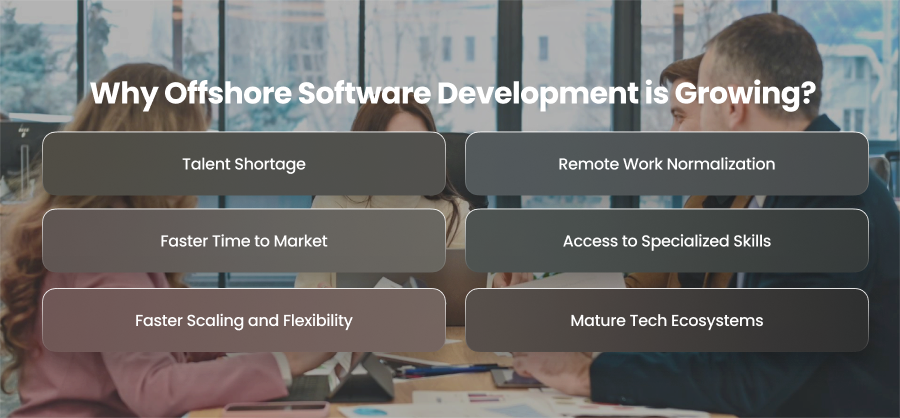
Why Offshore Software Development is Growing?
Talent Shortage
The demand for software developers is still higher than the supply in many affluent nations. Long hiring cycles and intense competition for experienced engineers are common issues for businesses in the US and Europe. Specialized skills in areas like cloud computing and cybersecurity are especially difficult to find. By giving access to a large pool of highly qualified engineers worldwide, offshore development aids in closing this gap. As a result, companies can grow without having to wait months to find the best local people.
Remote Work Normalization
The rise of remote work has removed geographic limits from hiring. Modern collaboration tools and cloud based development environments allow distributed teams to work seamlessly. Businesses now recognize that offshore developers can integrate fully into daily workflows and maintain productivity similar to in house teams. Remote work has made offshore hiring not only feasible but a strategic choice for many tech companies.
Faster Time to Market
Companies must release features and iterate products quickly. Offshore teams enable continuous development by utilizing time zone differences, which allows work to continue even while local teams are offline. This model accelerates development cycles and shortens release cycles.
Access to Specialized Skills
Offshore markets are rich in technical expertise across a variety of modern software stacks. Emerging technologies like microservices, Kubernetes, and cloud platforms are common areas of expertise for engineers in Asia and Eastern Europe. Businesses can obtain developers with special and highly sought after skill sets by hiring abroad.
Faster Scaling and Flexibility
Offshore teams allow organizations to scale their engineering workforce quickly, whether for short term projects or long term initiatives. Unlike traditional local hiring, offshore hiring often provides ready to start talent. Teams can also scale down when projects are completed. This offers flexibility that reduces risk and keeps operational costs aligned with business needs.
Mature Tech Ecosystems
Many offshore regions have invested heavily in technology infrastructure and professional development. This produces developers who are well trained and familiar with global software practices.
Offshore Hiring Models
Staff Augmentation
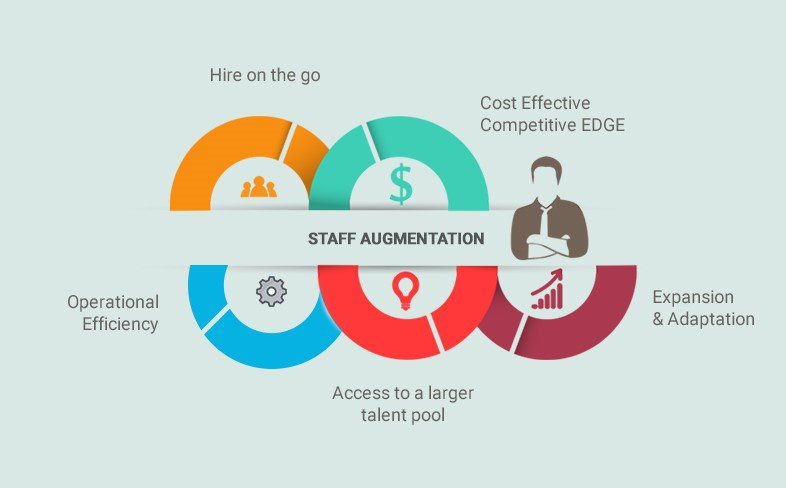
A flexible approach called staff augmentation involves adding offshore developers to an already existing inside team in order to boost capacity or fill skill gaps. Businesses can keep control over project management and development procedures using this strategy. When temporary scaling is required during peak workloads or for projects needing specialized talents that are not available locally, staff augmentation is especially helpful. Since augmented teams work under the guidance of the internal team, integration and communication are relatively straightforward.
Dedicated Offshore Development Team
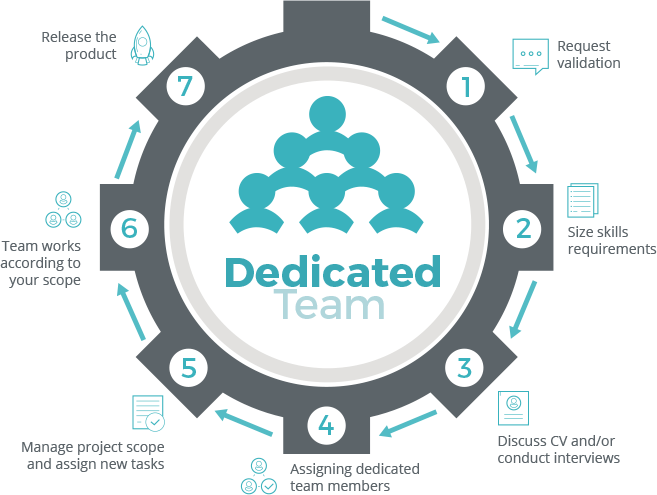
A dedicated offshore development team is a long term and fully managed team that works exclusively on a company’s projects. Unlike staff augmentation, where developers temporarily asist internal teams, a dedicated team operates as an extension of the company’s engineering department. This model is ideal for startups or enterprises looking for continuity and team ownership. Moreover, dedicated teams can handle end to end software development. To ensure consistency and coherence with their product vision, companies frequently keep committed offshore staff for years.
Project Based Outsourcing
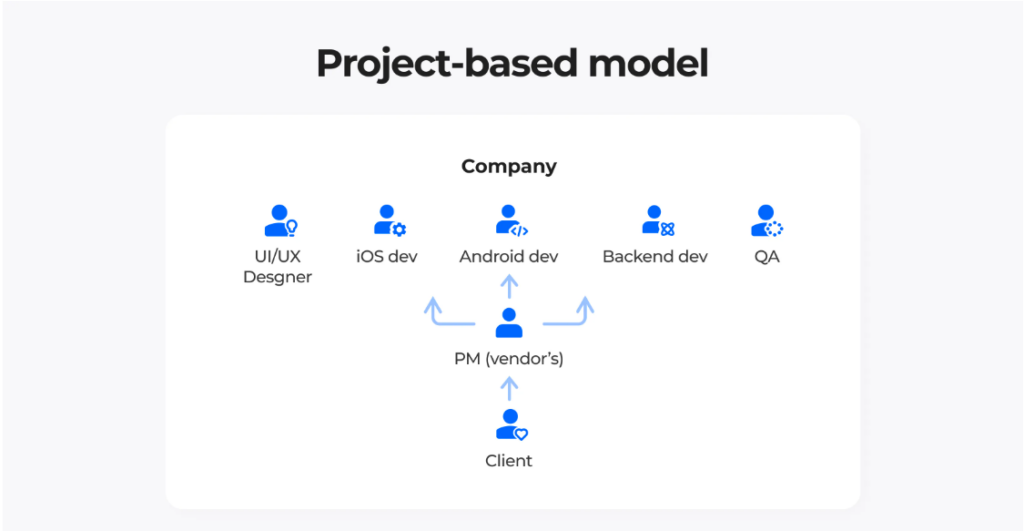
Project based outsourcing is suitable for companies with a clearly defined and fixed scope software project. The offshore team takes full responsibility for delivering the project according to agreed timelines and specifications. This model is often used for developing a minimum viable project or building a single application module. While project based outsourcing reduces managerial responsibilities for the client, it can pose challenges if project requirements change frequently.
Build Operate Transfer
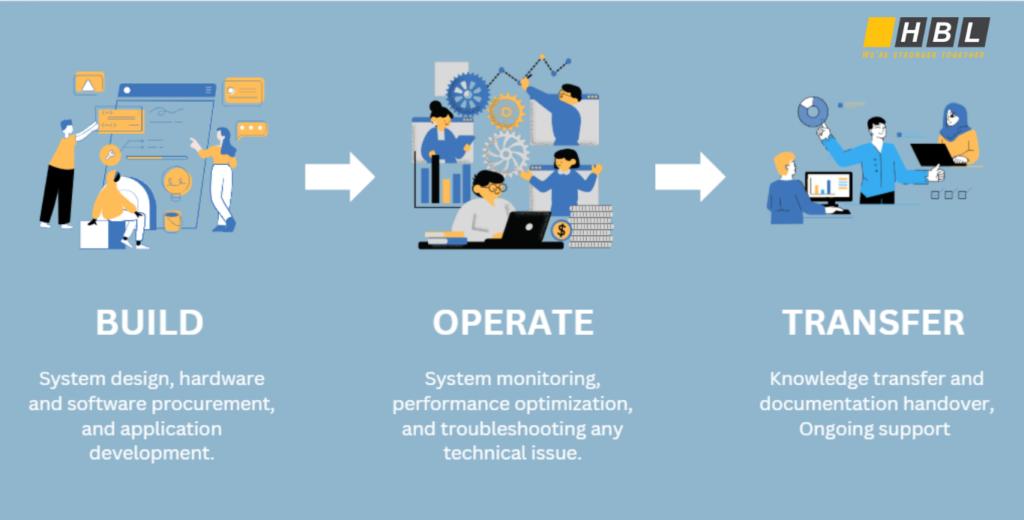
For businesses wishing to set up their own offshore development center abroad, the Build Operate Transfer model is perfect. A vendor hires developers, establishes infrastructure, assembles the team, and oversees operations during the initial stage. During the operate phase, the vendor continues to manage the team while knowledge transfer occurs. Finally, in the transfer phase, the company takes full control of the team and technology stack.
Hybrid Models
To strike a compromise between cost and flexibility, some businesses use hybrid offshore recruiting methods. For instance, a business may use staff augmentation for specialized work or short term projects and a dedicated offshore team for core development. By combining the flexibility of temporary personnel with the stability of dedicated teams, hybrid models enable firms to scale intelligently.
Risks of Offshore Software Development
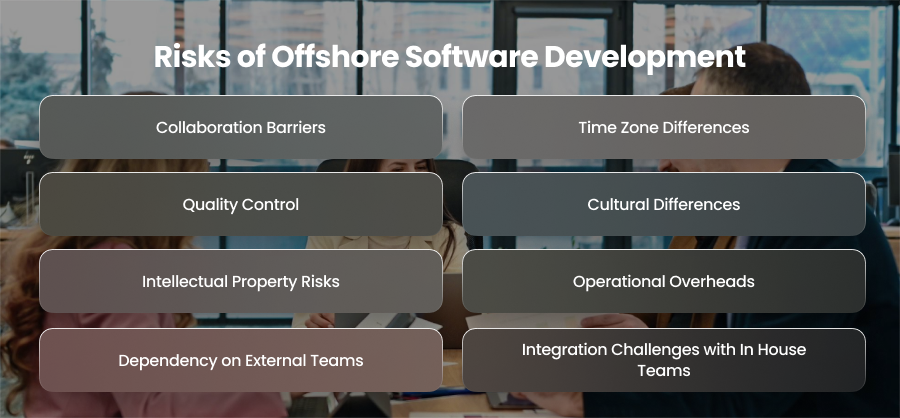
Collaboration Barriers
One of the most common risks in offshore development is communication. Disparities in communication styles and linguistic skills may lead to misunderstandings or inaccurate interpretations of requirements. Evan’s brief communications may cause further rework or delays. These difficulties are exacerbated if the teams only use asynchronous communication or if the documentation is ambiguous. Businesses require precise task documentation and organized communication methods to reduce this risk.
Time Zone Differences
While offshore teams can provide the advantage of continuous development, differing time zones can also create delays in approvals and code reviews. If overlapping hours are limited, teams can experience bottlenecks in collaboration. Critical meetings and daily standups must be carefully scheduled to ensure sufficient overlap. Establishing partial overlap windows or assigning liasons to fill up communication gaps between teams are two common ways that businesses address time zone issues.
Quality Control
Not every offshore team or developer follows the same testing procedures and coding standards. Inconsistent code or even security flaws may arise from this. If a developer’s performance differs from their stated experience, there can also be skill gaps. Maintaining high quality outputs and guaranteeing adherence to project objectives need ongoing monitoring through code reviews and automated testing.
Cultural Differences
Work styles and methods to issue resolution can be influenced by cultural variations. Some developers may be less likely to challenge decisions or provide helpful feedback because of cultural norms, which might lead to misalignment or delay problem solutions. It will take time to create a unified technical culture and establish precise standards. Cross cultural training and team building activities may also help bridge these divides.
Intellectual Property Risks
Sensitive code and project data are frequently shared while building software overseas. Without sufficient protection, businesses face the risk of intellectual property theft. Restrictions on secure access and encryption must also be implemented. Selecting reliable offshore partners with strong security protocols is equally important to lessen such risks.
Operational Overheads
Altough offshore hiring is generally cost effective, there are hidden costs that organizations can underestimate. It may cost more to onboard and educate offshore developers on internal workflows. Rework can also result from poorly specified procedures or ambiguous project specifications. This can extend timelines.
Dependency on External Teams
Dependency concerns might arise when important development activities are mostly dependent on other teams. A vendor’s inability to deliver or an unforeseen disruption in operations might affect project schedules. Businesses can lower this risk by adequately documenting their processes.
Integration Challenges with In House Teams
It can occasionally be difficult to incorporate offshore developers into inside teams. Disparities in development methods and workflows can cause conflict or inefficiency. Therefore, for an integration to go smoothly, teams must create common code standards and make sure that onboarding is done correctly.
Framework for Hiring Offshore Developers
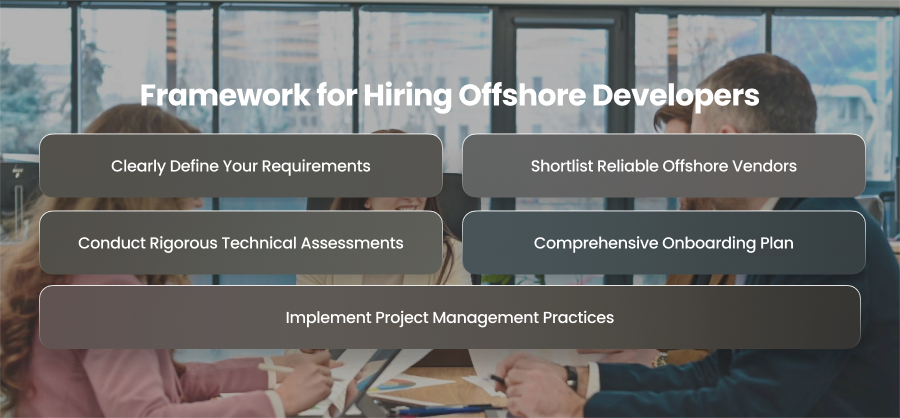
Clearly Define Your Requirements
Having a clear understanding of your needs is the first stage in any offshore employment plan. This entails outlining the goals of your project and the technical expertise needed. Businesses should specify if they require DevOps experts or frontend engineers. To prevent expectations and actual capabilities from being out of sync, experience levels must also be mentioned. It is simpler to find the proper applicants and reduce communication gaps during the employment process when your needs are more specific.
Shortlist Reliable Offshore Vendors
Not all offshore markets offer equal talent quality or language proficiency. The next step is to select regions known for their depth of technical expertise and cost efficiency. Regions like Asia and Latin America offer unique strengths in mobile development and cloud engineering. After that you should evaluate potential offshore vendors or recruitment partners. This includes reviewing their portfolios and communication standards.
Conduct Rigorous Technical Assessments
After narrowing down vendors or candidates, the next priority is assessment. Technical evalutions should go beyond checking knowledge and instead focus on real world problem solving abilities. This can be done through coding challenges os system design discussions for senior roles. Soft skills are equally important for distributed development teams. By combining both technical and behavioral assessments, companies can confidently select developers who are capable and compatible with remote collaboration.
Comprehensive Onboarding Plan
Effective offshore developer onboarding is essential for long term success. New developers are introduced to your product vision and coding standards through a thorough onboarding approach. This includes giving them access to repositories and tools necessary to begin contributing. Providing product demos and clear KPIs helps offshore developers quickly understand their responsibilties.
Implement Project Management Practices
In distributed development settings, quality and consistency are assured by good project management. When agile approaches like Scrum are applied, teamwork is fostered in organized sprints with defined deliverables. Everyone is informed of developments through regular standups and retrospectives. As a result, using procedures like development pipelines and peer reviews guarantees that code quality stays high. Effective project management may help offshore teams achieve deadlines and sustain high productivity.
Final Words
Offshore employment offers many opportunities, but success depends on choosing the right model. It also depends on following a rigorous recruiting procedure. Businesses can build high performing overseas teams that save costs and expedite delivery with clear processes.