




According to statistics, over 1.1 billion people globally are expected to use AI in the next five years. This is because AI is now necessary for enterprises. Both predictive analytics and process automation are impacted.
However, as AI becomes more accessible, leaders will need to respond to an important question:
Should we purchase pre-existing AI solutions or develop AI internally?
The benefits and drawbacks of developing or purchasing AI will be covered in this article. Additionally, we will go over important assessment criteria for making strategic decisions.
Why the Build vs Buy AI Decision Matters?
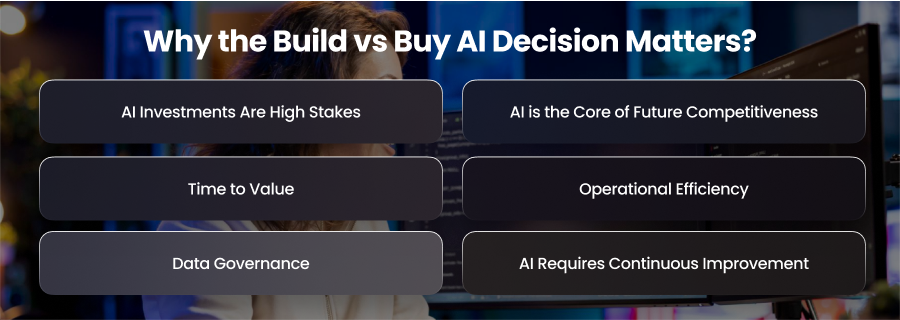
AI Investments Are High Stakes
Implementing AI is quite expensive. This includes infrastructure, continuing maintenance, and software. Every expense a leader makes must directly contribute to the company’s goals. However, sunk costs can quickly arise from overestimating a building’s flexibility or underestimating its complexity. Budgets can be depleted and innovation efforts stalled by a poorly implemented AI strategy.
AI is the Core of Future Competitiveness
AI has transformed from a supporting tool to a key element of competitive advantage across sectors. Companies that properly use AI can improve customer satisfaction and automate procedures. But how much strategic power a company gains depends on the path it takes. A bought solution can level the playing field, but a custom built solution can help businesses lead ahead.
Time to Value
Buying AI usually results in quick deployment and immediate benefits. Conversely, developing AI gives deeper long term alignment but takes more time. Leaders have to balance the time needed to design a tailored solution against the urgency of corporate expectations. It is not practical to develop an AI solution if a business needs it in a few weeks. However, if the goal is to drive large scale and long term differentiation, building might be worth the wait.
Operational Efficiency
AI is only effective if teams actually use it. Buying AI gives organizations access to polished user interfaces and ready made workflows. Building AI means crafting the user experience and integration layers. One method may be more widely adopted than the other, depending on corporate culture and digital development. A bad decision frequently leads to systems that are underutilized or abandoned.
Data Governance
Data privacy regulations and governance standards directly influence the build vs buy strategy. Healthcare and finance often have strict requirements around data locality and security. These constraints can make third party solutions difficult or even impossible to adopt. In such cases, building AI internally provides greater control and compliance assurance.
AI Requires Continuous Improvement
AI doesn’t operate on a set it and forget it model. Models drift new threats emerge. Purchasing AI guarantees vendors’ ongoing upgrades and enhancements, but it also makes you reliant on their plan. Developing AI allows you the flexibility to change the system at your own speed, but it also increases the burden of performance maintenance. Leaders must thus determine if their teams are capable of maintaining an AI system’s long term lifecycle.
Pros and Cons of Building AI
Pros of Building AI
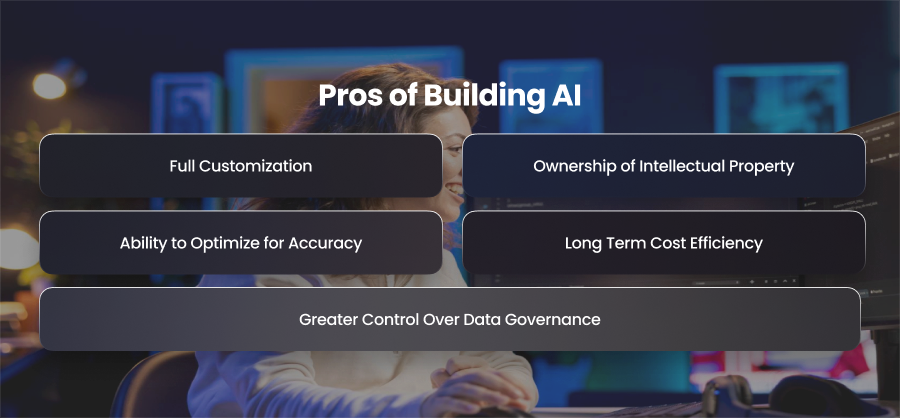
Full Customization
When you build AI internally, you aren’t restricted by present workflows or generic features. Every component can be shaped to fit your exact business needs.
This level of customization is especially crucial for businesses with:
- Unique operational processes
- Specialized data structures
- Domain specific workflows
- Highly regulated workflows
You can make sure AI integrates seamlessly and adds the most value by building the solution around your operations.
Ownership of Intellectual Property
Businesses may fully own the models and data pipelines they develop when they develop AI internally. By allowing innovation that rivals find difficult to imitate, this intellectual property can act as a major competitive difference. Additionally, owning AI gives you the freedom to expand or enhance capabilities without depending on a vendor’s plan. Developing AI internally ensures that private data will create creative solutions that continuously boost performance and strategic value for companies where it is a critical asset.
Ability to Optimize for Accuracy
The performance of generic AI systems in specific applications may be limited since they are frequently trained on large datasets. Organizations may train models using confidential data by developing AI internally. Increased accuracy and dependability are the outcome. Furthermore, this is particularly crucial for financial applications like risk modeling, where precision may directly affect company results. Custom AI guarantees that the solution is tailored to the particular requirements of the company.
Greater Control Over Data Governance
Internal AI developers retain complete control on data access and storage. This control is essential for maintaining data privacy and adhering to legal requirements. Additionally, internal AI development allows teams to set strict security and governance rules that are tailored to company standards. Businesses may also ensure compliance with international and national data protection laws.
Long Term Cost Efficiency
Although the upfront investment in building AI can be significant, organizations with large scale deployment plans may achieve better long term cost efficiency. Scaling AI across several departments or business units is simpler and less expensive than continuously paying for vendor licensing once the required pipelines and infrastructure are in place. Over time, building AI internally allows businesses to reduce dependency on external providers.
Cons of Building AI
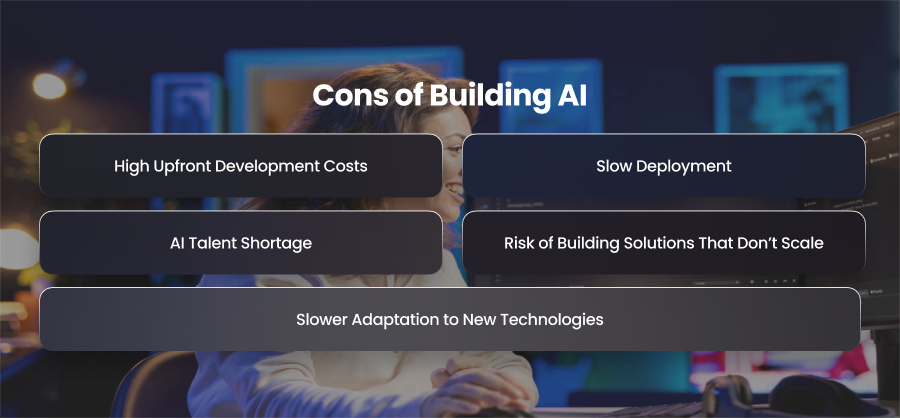
High Upfront Development Costs
Building AI requires a substantial initial investment. Organizations must fund talent acquisition for data scientists and machine learning engineers. They also have to invest in infrastructure costs for cloud computing and data pipelines. In addition, budgets must account for ongoing model training and system integration. For many companies, especially for mid sized businesses, these costs can be a significant barrier.
Slow Deployment
Developing AI internally is a time consuming process. Collecting and training models can take months or even years. This delayed time to value can limit competitive advantage, particularly in fast moving industries where quick deployment is critical. Organizations may find themselves falling behind competitors who can adopt pre built tools and realize business benefits immediately.
AI Talent Shortage
Among the highly qualified people required to develop AI internally are data scientists and DevOps experts. Due to the high demand, hiring and keeping these individuals is getting more difficult, which raises salaries and increases the risk of turnover. Losing key team members can interrupt projects.
Risk of Building Solutions That Don’t Scale
Even when AI gives complete control, its development might result in systems that are not scalable. Inadequate data pipelines, untested models, or poorly planned architectures may work well in trial projects but poorly in production. Reliable infrastructure is necessary for scaling AI.
Slower Adaptation to New Technologies
When an organization develops AI internally, it takes on the duty of keeping up with algorithmic breakthroughs and industry best practices. In contrast, vendors are encouraged to develop quickly and offer regular upgrades. Internal teams can find it difficult to stay up with the advancements in AI.
Pros and Cons of Buying AI
Pros of Buying AI
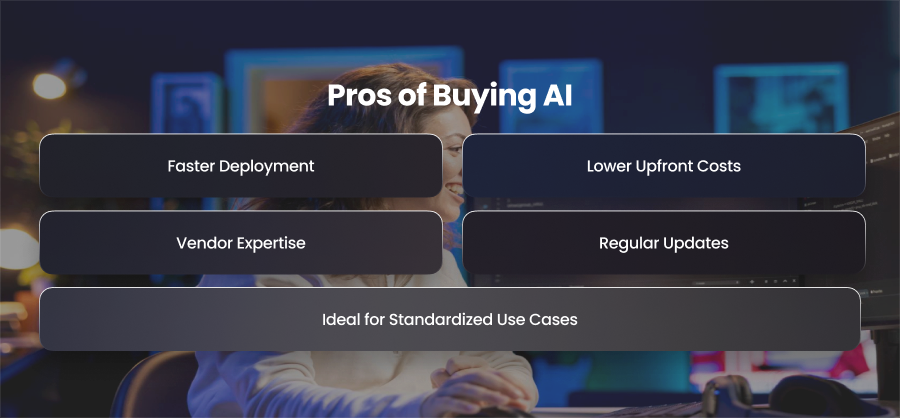
Faster Deployment
One of the most significant advantages of buying AI is the speed at which it can be deployed. Off the shelf AI solutions and SaaS platforms are already built and production ready. In only a few days or weeks, organizations may incorporate them into their operations. Therefore, businesses with pressing business demands or short project deadlines can especially benefit from this quick time to value.
Lower Upfront Costs
Buying AI typically requires significantly less upfront investment compared to building it in house. There’s no need to hire large teams of engineers and MLOps specialists, nor is there an immediate need to invest on extensive computing infrastructure or cloud resources. Subscription or licensing fees are predictable. This makes budgeting simpler. For many startups this lower financial barier allows access to advanced AI capabilities that would otherwise be unaffordable.
Vendor Expertise
Pre built AI solutions come with the advantage of vendor expertise. Teams of AI experts with extensive understanding of algorithms and performance optimization frequently create and maintain these solutions. Usually, vendors provide training materials and technical assistance. This helps organizations overcome common implementation challenges.
Regular Updates
One key benefit of buying AI is that the solution evolves automatically. Based on user input and market changes, vendors regularly optimize performance and update models. Businesses profit from this ongoing development without having to commit internal resources to AI upkeep or advancement. This continuous improvement guarantees that the AI stays efficient and compliant with modern norms.
Ideal for Standardized Use Cases
Buying AI is particulary effective for widely applicable and standardized tasks where innovation or customization is less critical. Examples include chatbots for customer service, sales forecasting, and demand planning. These tools solve common business problems efficiently and reliability. For companies that need a proven solution without the complexity of customization, buying AI allows them to focus on operations.
Cons of Buying AI
Limited Customization
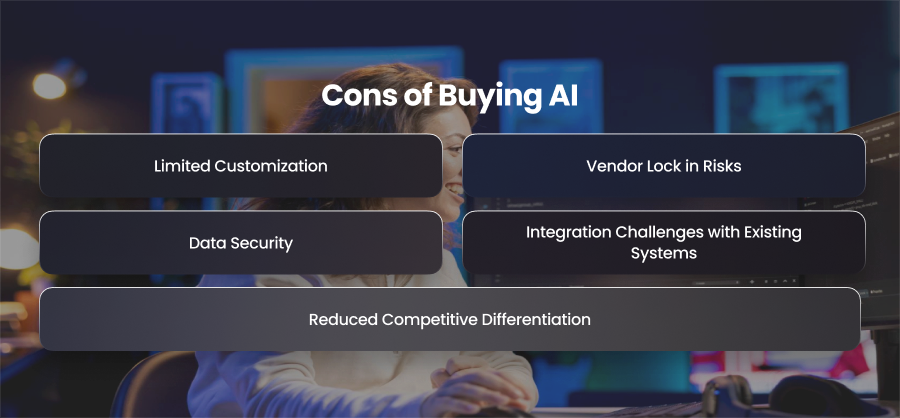
The main drawback of purchasing AI is that it provides no personalization. The features and workflows of pre built solutions may not exactly match your specific processes because they are designed to accommodate a wide range of businesses. In order to use the technology, businesses often have to change their procedures, which may reduce productivity. This restriction may be particularly burdensome for companies with particular needs.
Vendor Lock in Risks
Relying on an external AI provider introduces the risk of vendor lock in. Once systems and procedures are linked with a certain vendor’s platform, switching to a different solution can be expensive and technically difficult. Long term viability may also be impacted by modifications to vendor support guidelines or licensing restrictions.
Data Security
Using third party AI solutions may raise concerns data security. This is especially crucial for businesses that deal with sensitive data. Following industry standards may become more difficult once data has left the company’s environment. Organizations are nonetheless somewhat dependent on other parties to preserve their sensitive data, even if trustworthy vendors employ dependable security procedures.
Integration Challenges with Existing Systems
Altough buying AI speeds up deployment, it can introduce integration challenges. Pre built tools may not seamlessly fit into existing software or workflows, requiring additional work to connect systems effectively. Integration gaps can lead to inefficiences or incomplete adoption.
Reduced Competitive Differentiation
Buying AI can limit differentiation in highly competitive industries. When multiple companies adopt the same third party tools, everyone gains similar capabilities. While this may standardize operations and improve efficiency, it reduces the opportunity to create a unique advantage through proprietary AI.
What Factors Business Leaders Must Evaluate?
Strategic Alignment
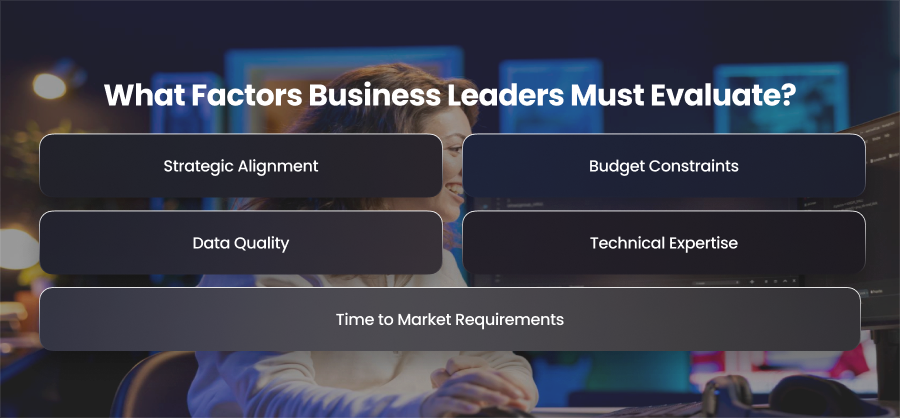
Leadership should begin by analyzing how the AI solution aligns with broader business goals. If AI is inteneded to drive core competitive advantages, building may offer more strategic control and differentiation. Conversely, if AI simply enhances supporting functions like HR automation or customer support, buying may make more sense.
Budget Constraints
When deciding whether to construct or purchase, financial factors are crucial. It takes a significant initial investment in skill as well as continuous upkeep to build AI. Smaller businesses or teams with less resources may find this challenging. Even while buying AI is initially less expensive, there are recurring subscription fees that eventually mount up. Executives must thus carefully consider the potential return on investment and total cost of ownership before making a decision.
Data Quality
AI solutions depend on data and also on it’s volume and structure. If a company has rich proprietary datasets that can be utilized for tailored AI models, building can yield more customized outcomes. However, if data is limited or siloed across teams, pre built solutions may provide better baseline performance. Therefore, leaders must evaluate whether their data infrastructure is mature enough to support internal model development or whether a vendor solution is more practical.
Technical Expertise
The availability of in house talent is a major determinant. Building AI requires specialized roles. Many organizations struggle to hire and retain such talent. By purchasing AI, businesses may avoid these difficulties and instead depend on vendor knowledge. Leaders need to determine if their current teams are capable of creating AI solutions.
Time to Market Requirements
Speed is another critical factor. Building AI is time consuming. It involves research, experimentation, training, validation, and deployment. For organizations operating in fast moving environments, delays can result in missed opportunities. Buying AI significantly accelerates deployment, making it ideal when rapid implementation is necessary.
Final Words
Therefore, deciding whether to develop or purchase AI requires comprehensive strategic analysis and long term adaptability. There is just one solution that best suits your company’s objectives. Leaders who evaluate these aspects comprehensively also make better choices.