



According to Edge Delta, 97.2% of companies invest in big data solutions. This is due to the fact that data is now a strategic asset that can support expansion and operational effectiveness rather than only a result of operations. Additionally, the emergence of big data has made it possible for businesses to get and use vast volumes of data to make more informed decisions.
Even while many companies have invested heavily in analytics and data infrastructure, not all of them are getting results. As a result, businesses are switching from descriptive analytics and simple reporting to predictive and prescriptive models that actively influence business results.
In this guide, we will discuss big data consulting and why businesses often struggle to extract value, and how to select the right consulting partner to ensure real business ROI.
Big Data Consulting
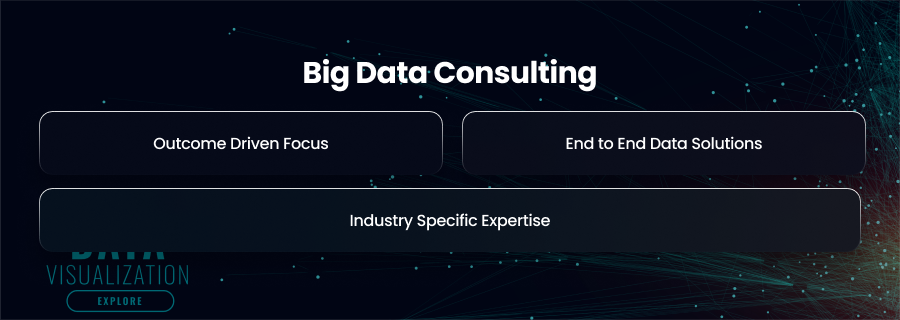
Big data consulting is the practice of guiding organizations in utilizing their data assets to achieve strategic business objectives. Moreover, it goes beyond the technical implementation of analytics platforms and includes business strategy and architecture design.
Outcome Driven Focus
Consultants now make sure that every data project is in line with quantifiable business results, in addition to assisting companies with data collection and storage. Consulting services are built on return on investment, whether the objective is more revenue or client retention.
End to End Data Solutions
Data strategy formulation, infrastructure optimization, AI integration, and continuous support are just a few of the complete services offered by contemporary big data consultants. This strategy guarantees that companies may consistently reap the benefits of their data investments.
Industry Specific Expertise
Prominent consulting organizations are aware of the subtle differences across various businesses. Consultants can offer answers specific to certain company difficulties in a variety of industries, such as manufacturing and banking.
Why Businesses Struggle to Achieve ROI From Big Data?
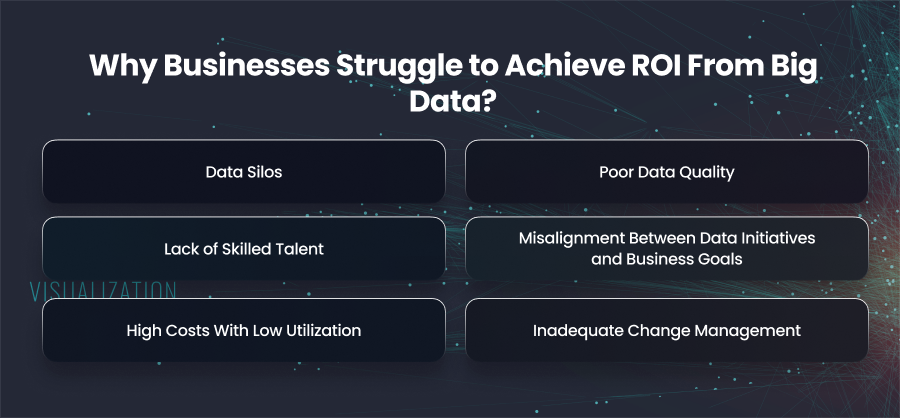
Data Silos
Data silos, which make it challenging to combine or analyze important insights when data is scattered across several departments in various systems, are among the most prevalent problems. For instance, even while sales data is stored on a different ERP platform, a marketing team may have customer interaction data on a CRM system. Patterns and connections are overlooked in the absence of integrations. This makes it impossible to see client behavior in its entirety.
Decision making is also slowed down by fragmented data. Database cleansing takes up more time for analysts than real analysis. Establishing centralized or integrated data ecosystems, which are essential for producing trustworthy insights, is something that businesses frequently ignore.
Poor Data Quality
Poor data quality can hinder analytics attempts even in cases when data is centralized. Inaccurate data entries are frequent problems. Making judgments based on inaccurate information might result in costly mistakes.
For instance, a company may overstock low demand items while understocking high-demand ones if it employs erroneous inventory data, which would lower sales. High quality data must be preserved through validation in order to ensure the usefulness of analytics outputs.
Lack of Skilled Talent
Technical knowledge and analytical reasoning are necessary for big data analytics. Hiring and retraining qualified data specialists, such as data engineers and AI developers, is a challenge for many firms.
Even the most advanced analytics solutions are underused in the absence of qualified personnel. Teams may find it difficult to develop predictive models or convert findings into workable business plans. Companies are frequently forced by this talent gap to rely on generic dashboards rather than using their data to derive actual strategic value.
Misalignment Between Data Initiatives and Business Goals
A common mistake is a lack of communication between business stakeholders and data teams. Sometimes, rather than having specific business goals, analytics projects are motivated by the use of technology. Businesses could concentrate on creating visually appealing dashboards or technical reports that don’t address urgent business issues.
For instance, a business may spend months examining internet traffic trends without realizing how those findings affect conversion rates. Data activities must be closely linked to business KPIs like cost reduction or process efficiency in order to get ROI.
High Costs With Low Utilization
Cloud storage and data infrastructure are major investments made by many companies. However, these investments may become ineffective or underused if they are not well planned.
For instance, a company may purchase corporate AI technologies but utilize just a small portion of their potential. As a result, the company has a high cost-benefit ratio and spends millions without seeing appreciable improvements. Therefore, increasing ROI requires maximizing the use of technology and coordinating spending with value generation.
Inadequate Change Management
Big data solution implementation presents organizational change management challenges in addition to technical ones. Managers and staff must comprehend how to apply insights to their operations. Analytics projects are unable to impact decision-making in the absence of training and adoption methods.
For example, if production teams do not modify maintenance plans based on the new knowledge, a predictive maintenance model in manufacturing is worthless. Converting data into quantifiable business outcomes requires fostering a data driven culture where team members actively use analytics.
Big Data Trends Shaping Consulting Strategies
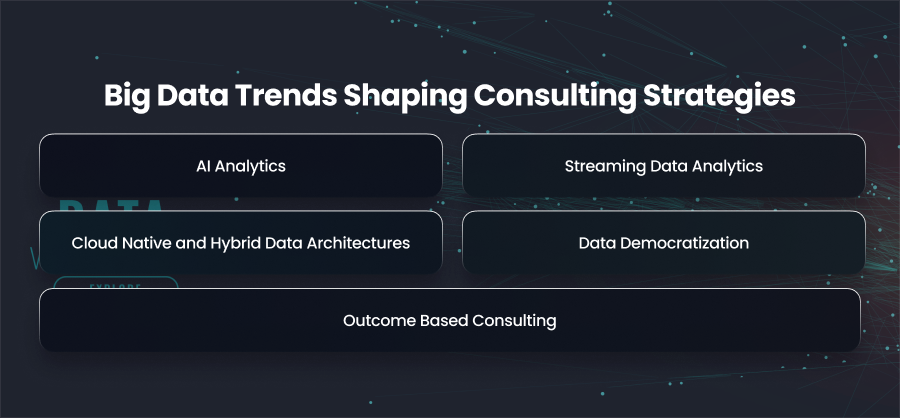
AI Analytics
Consultants rely heavily on AI analytics to help organizations move beyond historical reporting and toward forward looking decision making. While prescriptive analytics suggests certain measures to maximize results, predictive models are used to forecast consumer behavior and operational hazards.
Automation is another critical element in this trend. These days, AI manages time consuming and repetitive operations like anomaly detection and data purification. Organizations may drastically reduce the time it takes to produce insights by minimizing manual labor. ROI is directly impacted by this acceleration as it frees up data teams to concentrate on high value strategic projects while enabling decision makers to react to opportunities and problems more quickly.
Streaming Data Analytics
Real time analytics is now essential rather than a competitive advantage. Businesses want immediate insight into what is occurring throughout their systems as operating circumstances and consumer demands become more dynamic. Big data consulting strategies now prioritize streaming data architectures that process information the moment it’s generated.
Organizations are able to make more informed decisions because of this real time capacity. Logistics firms may improve routes in reaction to shifting conditions, and retailers can instantaneously modify prices or promotions based on demand signals.
Cloud Native and Hybrid Data Architectures
Cloud usage is still changing how businesses handle and analyze data. Additionally, cloud native and hybrid architectures that strike a balance between scalability and cost effectiveness are becoming more and more important in big data consulting strategies. Cloud solutions reduce the requirement for significant upfront infrastructure expenses since they enable enterprises to create analytical workloads on demand.
Many companies use hybrid models to use the cloud for advanced analytics while keeping control over sensitive or regulated data. Businesses may store and analyze data in one location with the help of contemporary solutions like data lakes.
Consultants are crucial to the design of these systems in order to ensure optimal performance and cost control as well as to ensure that technology expenditures properly support business objectives.
Data Democratization
The drive for data democratization is another significant trend influencing consulting practices. Businesses are increasingly realizing that data driven decision making shouldn’t be limited to analysts and technical teams. Consequently, consultants focus on implementing self service analytics solutions that allow employees from different departments to access data.
Outcome Based Consulting
The most significant shift in big data consulting is the move toward engagement models. Moreover, businesses expect consultants to take accountability for delivering real results and not just technical implementations. A growing number of consulting techniques are organized around specific corporate objectives, such as increased productivity.
How to Choose the Right Big Data Consulting Partner?
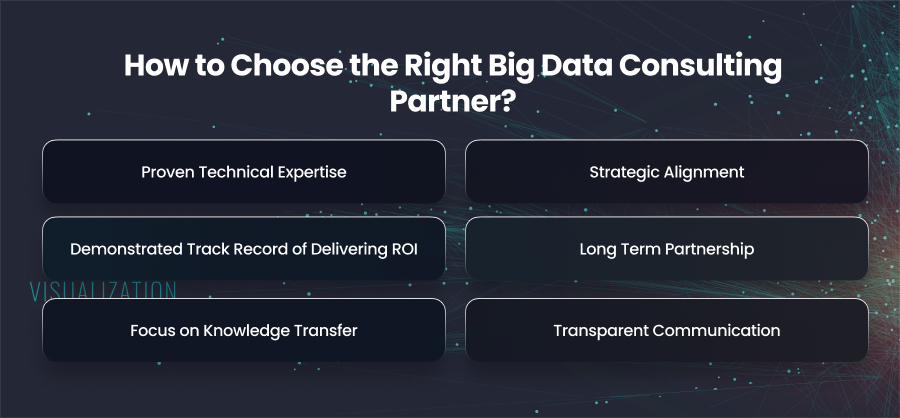
Proven Technical Expertise
A reliable big data consulting partner must demonstrate strong technical expertise across the modern data ecosystem. This includes experience with data engineering, advanced analytics, artificial intelligence, machine learning, and cloud based platforms. Additionally, consultants should be at ease dealing with contemporary systems like data lakes and large-scale data environments.
But being adept with technology is insufficient. The ideal partner understands how to select and implement technologies that fit your unique business environment rather than imposing a generic solution. Their proposals should prioritize cost effectiveness and performance. This ensures that long term technological investments will be profitable.
Strategic Alignment
One of the most overlooked qualities in a consulting partner is business understanding. A competent big data consultant concentrates on resolving actual business issues rather than just producing dashboards or models. This requires a deep understanding of business goals and market conditions.
At the start of an interaction, the appropriate partner poses the appropriate questions. In order to establish success indicators and guarantee that data efforts are in line with strategic targets like revenue development or operational efficiency, they collaborate closely with stakeholders. In order to turn data into practical insights that produce measurable return on investment, this business first approach is essential.
Demonstrated Track Record of Delivering ROI
Organizations should seek unambiguous proof of outcomes when assessing a big data consulting partner. Included are case studies and examples of projects that had measurable results, such as lower costs or higher production.
A reputable consulting firm is able to explain how its work has a business effect in addition to technical achievement. They should be able to explain how analytics influenced decision making or improved processes. This results oriented mindset ensures that your investment in consulting services leads to measurable value.
Long Term Partnership
Data strategies must change as businesses do. Flexibility in approach and engagement model is provided by the ideal consulting partner. They should be able to accommodate shifting business objectives and expand solutions as data volumes increase without experiencing significant interruptions.
Moreover, big consulting is no longer a one time project but an ongoing partnership. A strong consultant acts as a long term advisor, continuously optimizing data strategies and identifying new opportunities for improvement. This adaptability ensures sustained ROI rather than short term gains.
Focus on Knowledge Transfer
A truly effective consulting partner empowers your internal teams rather than creating long term dependency. Training and the transfer of knowledge are crucial elements of a successful engagement. In order to develop internal skills, consultants should collaborate closely with your data and business departments.
Organizations may continue to create value even after the consulting assignment is over by empowering staff members to comprehend and utilize analytics technologies. This emphasis on enablement guarantees that big data projects continue to have an impact over time and promotes data adoption.
Transparent Communication
It takes transparency and open communication to build trust in a consulting relationship. The perfect partner maintains open channels of communication and provides regular updates on progress and outcomes. From the beginning, they should specify deliverables and success measures precisely.
Final Words
Big data consulting is about turning insight into impact. Organizations that align data strategies with business goals and adopt modern analytics trends can provide them measurable ROI and build a sustainable competitive advantage through data.