




According to Vegma AI, 70% of global organizations have adopted structured automation. This indicates a 250% increase in adoption rate. This is because automation has become a core part of modern businesses. But one question still creates confusion: should you use a rule based or an AI system?
While both approaches aim to automate decision making, they work differently and serve different purposes. Moreover, rule based systems follow pre defined logic, while AI systems learn from data and adapt over time. Also, choosing the wrong approach can lead to unnecessary costs or systems that are difficult to scale.
In this guide, we will discuss rule based systems and AI systems and how they differ. Moreover, we will also discuss their strengths and limitations.
Rule-Based Systems
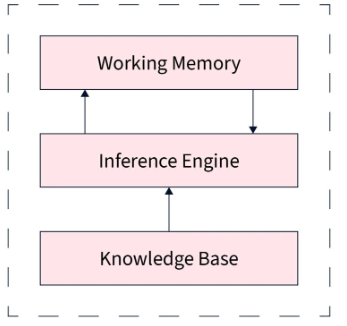
Rule based systems are a traditional approach to automation where decisions are made using explicitly defined logic created by humans. These systems operate on simple pre defined conditions. This means that when a specific condition is met then a predetermined action is triggered. Because the logic is fixed and clearly written, rule based systems behave in a consistent manner.
Components of Rule Based Systems
A rule based system is built around three essential components. The rule set contains all the business logic written as conditions and actions. The rules rely on structured data, including reference values or thresholds, which are stored in the knowledge base. As the decision maker, the inference engine compares incoming data to the rules to determine the best course of action. These components work together to ensure the traceability of the system’s decision making process.
How Rule-Based Systems Make Decisions?
Decision making in rule based systems is deterministic and doesn’t involve learning or prediction. The system applies the first matching condition after checking each pertinent rule either sequentially or according to priority. This method provides results easily auditable and completely explicable, which is crucial in regulated sectors where it is required to comprehend the decision making process.
AI Systems
AI systems are advanced software solutions designed to simulate human like intelligence by learning from data rather than relying on fixed instructions. To make judgments or forecasts, these systems examine patterns and trends in huge datasets rather than according to predetermined rules. AI systems can handle complicated and unpredictable situations that conventional rule based systems are unable to handle successfully because of their capacity to learn and adapt.
How AI Systems Work?
Algorithms that enhance performance via experience are commonly used in the construction of AI systems. During training, the system examines historical data to identify patterns and correlations. This knowledge yields outcomes based on probabilities rather than absolute certainty when applied to fresh inputs. The system may be retrained over time to increase accuracy as additional data becomes available.
Types of AI Used in Modern Applications
Many forms of AI are often employed. Systems can forecast and decide based on data patterns thanks to machine learning. Neural networks are used in deep learning to analyze speech and recognize images. Additionally, NLP enables robots to comprehend and produce human language. Systems can understand visual data with the use of computer vision.
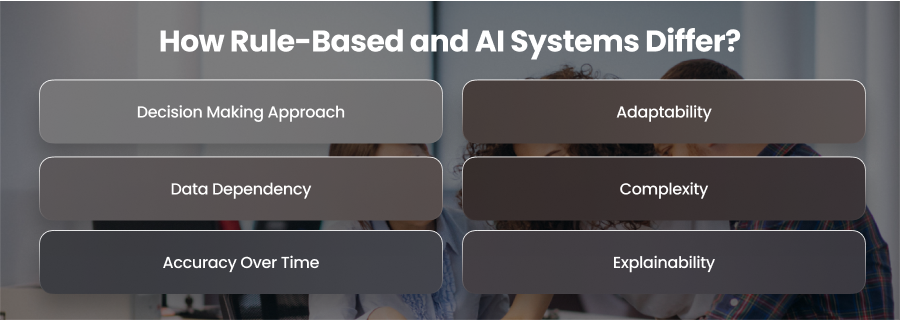
How Rule-Based and AI Systems Differ?
Decision Making Approach
The most fundamental difference between rule based systems and AI systems lies in how they make decisions. Rule based systems operate on fixed logic. This means every possible scenario must be anticipated and manually encoded as rules. Without the capacity to adjust or learn from novel circumstances, the system follows these rules precisely as specified. AI systems, on the other hand, base their choices on data and patterns. Without direct human interaction, they use previous data analysis to forecast results and get better over time.
Adaptability
Rule based systems are rigid. The system may malfunction or yield erroneous results if a scenario emerges that was not taken into account when the rules were developed. The rules must be manually changed if business logic changes, which may be laborious and prone to mistakes.
On the other hand, AI systems are very adaptable. They have the ability to autonomously adapt their behavior to changing conditions. AI functions well in dynamic environments where conditions are constantly changing because of its adaptability.
Data Dependency
Another key difference is the reliance on data. Rule based systems can operate with very little data because they follow deterministic logic. They don’t require historical records to function and often work perfectly with clearly defined input parameters.
However, AI systems are data driven. The amount and quality of data utilized for training determine how effective they are. An AI system’s ability to see patterns and make optimal judgments increases with the amount of high quality data it has. AI systems may perform poorly or generate untrustworthy findings in the absence of enough data.
Complexity
Rule based systems become increasingly difficult to manage as complexity grows. Each new rule introduces potential conflicts and dependencies. Scaling these systems for large or intricate operations often leads to cumbersome rule sets that are hard to debug and maintain.
AI systems, on the other hand, are very good at managing complexity. Without requiring a lot of manual interaction, they are able to scale their decision making and handle enormous volumes of both organized and unstructured data.
Accuracy Over Time
Rule based systems provide consistent outputs, but their accuracy remains static unless rules are updated manually. They cannot improve automatically or adapt to changes in patterns. AI systems are capable of learning and developing over time. Their ability to make decisions and make accurate predictions tends to increase as they are exposed to more scenarios and data. This makes AI particularly effective in applications like fraud detection systems.
Explainability
One area where rule based systems outperform AI is explainability. Since each phase of the decision-making process is guided by a defined rule, it is simple to monitor. It may be challenging to comprehend the reasoning behind some results since AI systems sometimes operate as black boxes. This may be an essential element in industries where compliance and responsibility are critical.
Advantages and Limitations of Rule Based Systems
Advantages of AI Systems
Rule based systems offer several clear benefits, especially for organizations seeking simplicity and predictability in their processes. Clarity and explainability are two of the key benefits. Every decision is governed by explicit criteria, making it easy to ascertain how and why a certain outcome was achieved. Rules based systems are therefore ideal for situations where accountability and compliance are essential.
Another key advantage is ease of development and implementation for straight forward tasks. Because the logic is predefined, developers can quickly encode rules without the need for large sets or advanced modeling techniques. This reduces the time and cost required to deploy a functional system.
Furthermore, rule based systems are deterministic, which means that they consistently provide the same output for the same input. In procedures where mistakes cannot be accepted, this predictability guarantees dependability.
Rule based systems are also low cost to maintain for simple operations. Updating a rule is often as straightforward as adding a line of logic. This makes them practical for organizations with limited resources or small scale automation. Furthermore, these systems are highly auditable and testable. Since all logic is explicit, testing for errors is straightforward.
Limitations of Rule Based Systems
Despite their advantages, rule based systems have inherent limitations that can make them less effective in complex environments. One major drawback is limited flexibility. Rule based systems cannot adapt to new situations. They are inappropriate for jobs involving ambiguity or dynamic inputs because of their rigidity.
Rule based systems may also have trouble with edge cases or situations that the rule does not specifically address. Failures or insufficient management of realworld events may arise from this. For businesses that need to process unstructured data or make predictive decisions, rule based systems often fall short.
Advantages and Limitations of AI Systems
AI systems bring a high level of adaptability to modern software applications, making them especially valuable for complex problem solving. The capacity of AI systems to learn from data is one of their biggest advantages. AI models examine past and present data to find trends rather than depending on predetermined instructions. AI systems can perform better over time because of this learning capability.
The capacity to deal with ambiguity is another significant advantage. AI systems can process multiple variables simultaneously and make decisions even when inputs are incomplete. This makes them ideal for use cases such as risk assessment.
Limitations of AI Systems
Despite their benefits, AI systems have a number of drawbacks that businesses need to carefully weigh. High data reliance is one of the most prevalent restrictions. For AI models to work well, large volumes of relevant, high quality data are required. If the data is inadequate or skewed, the system’s predictions might become erroneous.
Another limitation is development and maintenance complexity. Developing AI systems frequently calls for specific knowledge in infrastructure management and data science. AI systems require continuous monitoring and performance assessment in addition to the original development work to guarantee their accuracy.
When Should You Use Rule-Based Systems?
Clear Business Logic
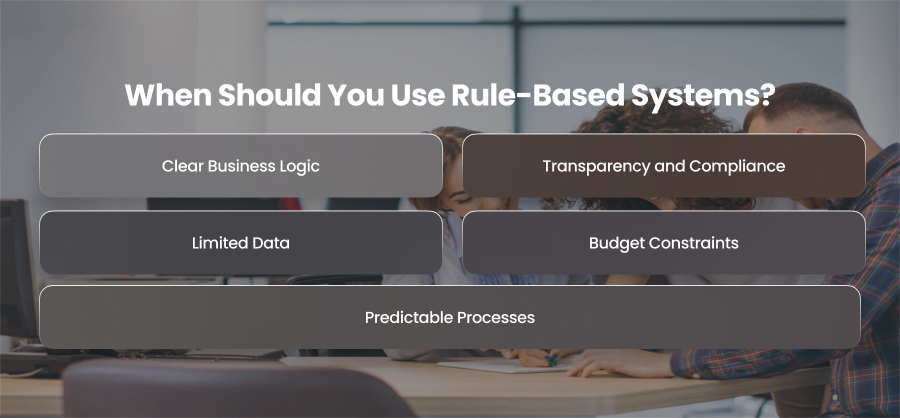
Rule based systems are most effective when the decision making logic is well defined and unlikely to change frequently. If your process follows straightforward conditions and outcomes, rule based systems provide a simple and reliable solution. Once the rules are implemented, the system consistently applies them without ambiguity.
Transparency and Compliance
In industries where regulatory compliance is mandatory, rule based systems offer a major advantage. Every decision can be traced back to a specific rule. This makes audits straightforward. This level of explainability is particularly important in sectors such as healthcare and government.
Limited Data
Rule based systems don’t depend on large volumes of historical data to function effectively. This makes them ideal for situations where data is scarce or difficult to collect. Early stage businesses or legacy systems often benefit from rule based automation because it doesn’t require data heavy training or complex analytics.
Budget Constraints
If cost efficiency is a top priority, rule based systems are often the better choice. They are quicker to develop and involve lower infrastructure costs compared to AI systems. For organizations looking to automate simple processes with minimal investment, rule based solutions can deliver immediate value.
Predictable Processes
Rule based systems work best in predictable environments where outcome remain consistent over time. This method works well for tasks like workflow routing and form validation. A deterministic system guarantees dependability in certain situations and lowers the possibility of unexpected behavior.
When Should You Use AI Systems?
Complex Problems
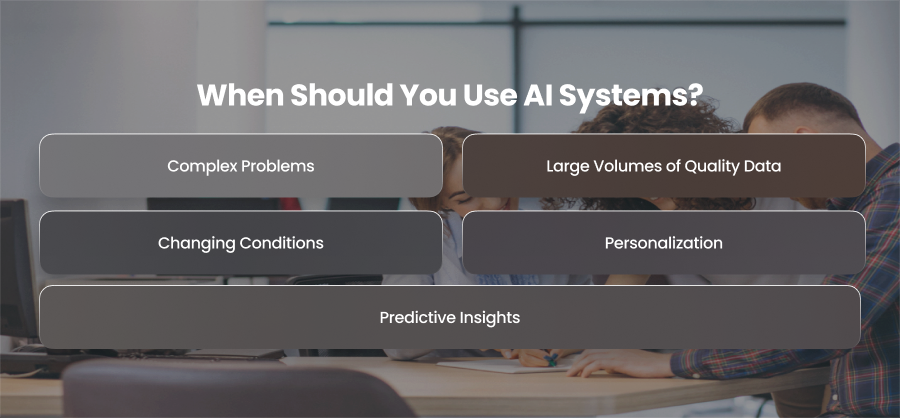
AI systems are the right choice when decision making involves complexity that cannot be easily captured through fixed rules. If outcomes depend on multiple variables or interactions that are difficult to predict in advance, AI can analyze these relationships more effectively. Use cases such as fraud detection and customer behavior analysis benefit from AI’s ability to evaluate numerous factors simultaneously.
Large Volumes of Quality Data
AI systems perform best in data rich environments. When your organization has access to large amounts of historical and real time data, AI models can learn meaningful patterns and generate accurate predictions. The availability of quality data enables AI systems to improve continuously, making them far more effective than static rule based solutions in dynamic scenarios.
Changing Conditions
If your business operates in a changing environment, AI systems offer a clear advantage. Unlike rule based systems, AI can adapt to changing trends or user behaviors through retraining. This makes AI ideal for industries such as eCommerce.
Personalization
When customization is crucial to user experience or commercial results, AI technologies are very beneficial. AI can provide tailored offers or suggestions at scale by examining user preferences and previous behavior.
Predictive Insights
AI is better at forecasting results than it is at responding to the situation as it is. AI systems can offer data driven insights that facilitate proactive decision making if your company wants to predict trends or anticipate requests.
Final Words
Rule based and AI systems each serve different purposes. Rule based systems offer clarity and control. While AI systems provide adaptability and intelligence. The right choice depends on your problem’s complexity and business goals.