



According to a McKinsey & Company study, 92% of companies want to invest in next-generation AI within the next three years. As a measure of maturity, only 1% of companies believe they have fully integrated AI into their operations.
This is because data is being generated at unprecedented rates. Every click and interaction contributes to an ever growing ocean of information. But raw data by itself doesn’t bring value. The process of converting this massive amount of data into useful insights that support company expansion is where AI transformation holds the real promise.
We will go over the technology that enables AI transformation as well as how it operates in this guide.
AI Transformation
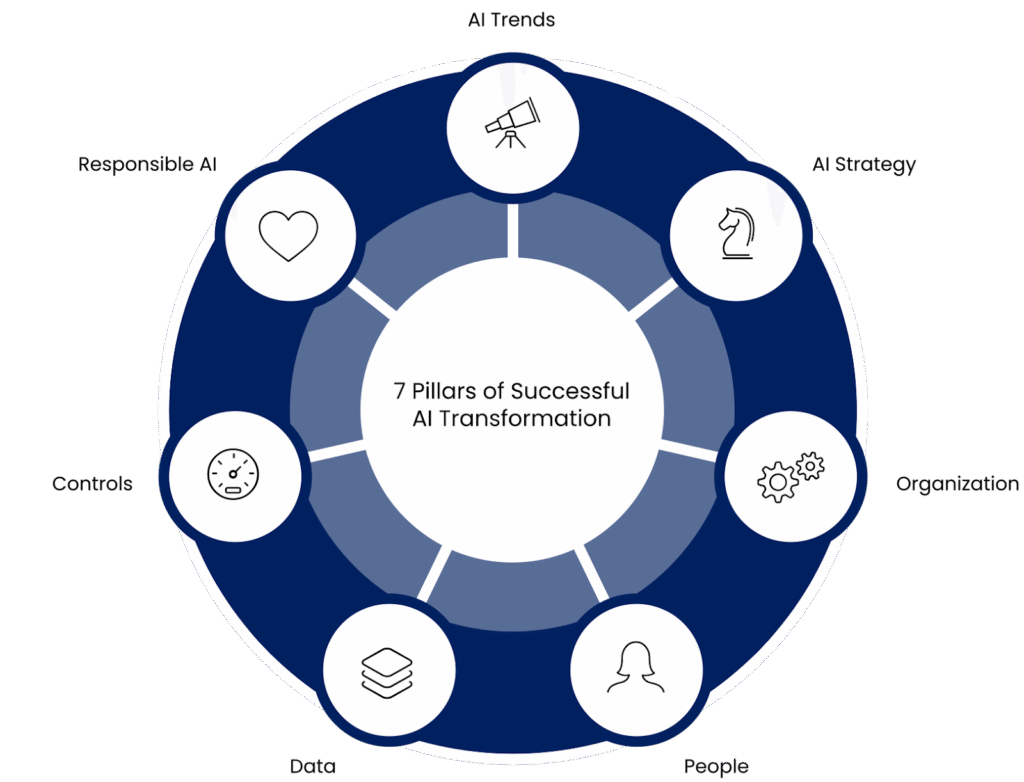
AI transformation refers to the comprehensive integration of AI technologies into every layer of a business, from operations and marketing to customer engagement. Moreover, it’s not merely about deploying AI tools but about fundamentally rethinking processes and culture around data driven intelligence.
Decision making in conventional businesses frequently depends on antiquated data models or human intuition. This is altered by AI transformation, which produces self governing systems capable of processing massive information and instantly delivering insights. This makes it possible for leaders to make well informed, proactive judgments as opposed to reactive ones.
A successful AI transformation typically involves:
- Automating monotonous processes to increase productivity.
- Using predictive intelligence to foresee client requirements.
- Customization to improve the customer experience.
- Optimization of supply chains.
Take, for instance, companies like Netflix and Amazon. Their AI recommendation systems increase client loyalty and sales while also improving user pleasure. In the industrial sector, AI predictive maintenance lowers downtime and saves millions of dollars in operational costs.
Instead than replacing human intelligence, the ultimate aim of AI transformation is to enhance it. As AI manages data intensive tasks, teams can concentrate on strategic work.
What is the Value of Data in the Age of AI?
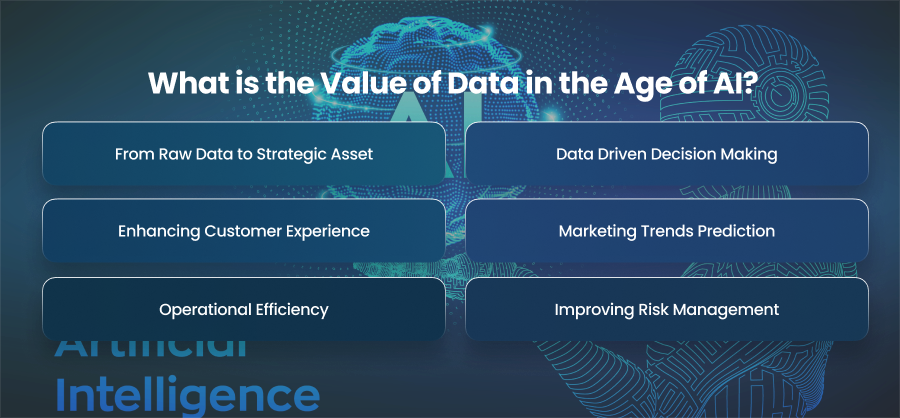
From Raw Data to Strategic Asset
In its raw form, data is chaotic. It will just be a mix of numbers and unstructured inputs spread across multiple platforms. Without the right systems, this information is difficult to analyze or act upon. But AI changes this dynamic. AI systems clean and analyze data at scales and rates that are beyond human capabilities through the use of machine learning and data modeling.
For example, a retail company may collect millions of data points from customer transactions per day. This data may be used by AI to identify patterns.
Data Driven Decision Making
Precision is crucial while making choices. AI systems can also evaluate massive amounts of data in milliseconds, giving decision makers access to previously unattainable real time insights.
For instance, financial firms use AI algorithms to evaluate dozens of data elements in order to determine credit risks. Because these algorithms identify dangers faster and more accurately than traditional methods, losses are decreased.
In a similar vein, logistics companies estimate supply chain interruptions or spikes in demand using predictive analytics. They may proactively change paths by transforming historical and present data into predicted knowledge.
Enhancing Customer Experience
Customers of today demand that businesses comprehend and anticipate their demands. AI provides this degree of customization at scale by utilizing data. Every customer connection turns into a knowledge base that helps businesses rapidly personalize experiences.
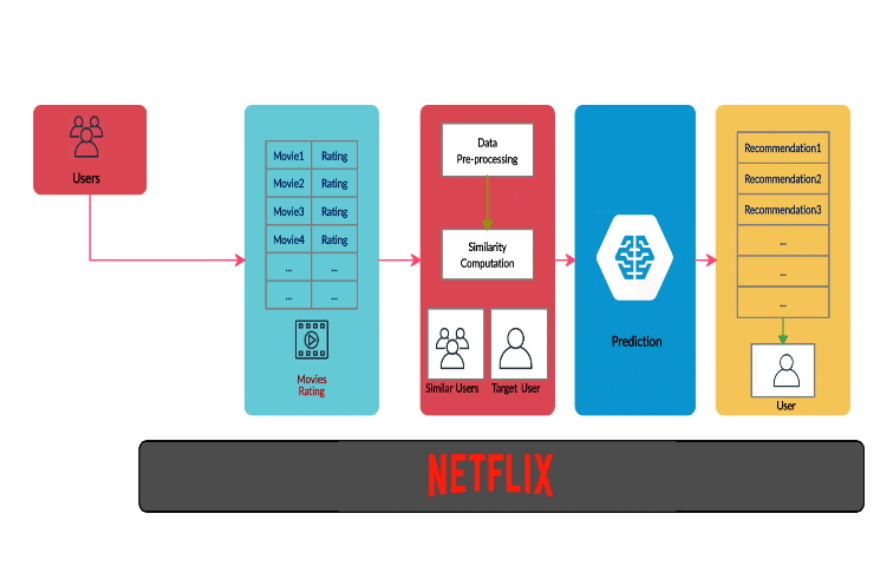
Consider Netflix. By looking at user ratings and watching habits, its recommendation algorithm suggests movies. These personalized interactions foster enduring client loyalty in addition to maintaining user interest.
AI is being used by eCommerce organizations such as Amazon to provide product recommendations and forecast what customers would desire next. As a result, this data driven tailoring converts infrequent browsers into loyal customers.
Marketing Trends Prediction
The capacity of data to predict future trends is another crucial advantage in the era of artificial intelligence. Predictive analytics systems compute shifts in market demand using previous data.
For example, fashion retailers examine seasonal purchasing trends using AI models. As a result, they might create collections that anticipate emerging trends before consumers are aware of what they desire.
AI predicts power demand in the energy industry by using consumption data and weather trends. This makes grid management more effective. Early detection of patients who are at risk can be achieved in the healthcare industry through the use of predictive analytics. This enables the provision of preventative care as an alternative to costly emergency treatments.
Operational Efficiency
Operational excellence is driven by data in addition to client involvement. Workflows and supply chain procedures may be analyzed by AI to find inefficiencies and provide fixes.
For example, manufacturers collect machine performance data using AI sensors. Early wear and tear detection is aided by this knowledge. Predictive maintenance also helps companies prevent prolonged downtime. Additionally, logistics firms analyze transportation data using AI. It reduces fuel consumption and expedites delivery.
Organizations may improve processes and address problems before they affect performance by using AI to continually monitor and evaluate internal operations.
Improving Risk Management
AI systems that are data driven are also essential for risk identification and mitigation. AI routinely monitors banking transactions, spotting anomalies that might indicate security flaws.
AI systems also develop and change throughout time. Every data input they analyze makes them wiser, lowering false positives and identifying risks that rule-based systems would overlook.
Banks, for instance, employ AI systems to identify anomalous account activity. AI forecasts potential manufacturing safety hazards using sensor data from production lines. So, combining automation and predictive analytics significantly boosts organizational resilience.
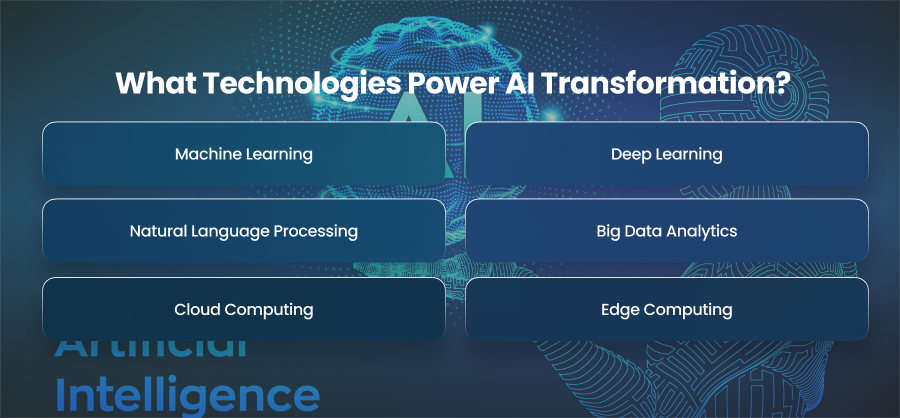
What Technologies Power AI Transformation?
Machine Learning
Machine learning, which allows computers to learn from experience without explicit programming, is the cornerstone of the AI transformation. Large datasets are analyzed by ML algorithms, which then use past data to provide forecasts or suggestions. Businesses may automate intricate processes with a high degree of precision because to this capabilities.
Furthermore, data is a major component in machine learning. Organizations’ machine learning models become increasingly intricate as they gather more data. They can also uncover insights that people would overlook. Also, machine learning is used by financial firms to detect fraud in real time.
Deep Learning
A more advanced subset of machine learning, deep learning mimics the human brain’s neural networks to process complex and unstructured data such as images and text. Furthermore, it drives a lot of the current AI capabilities.
In large datasets, deep learning models are excellent at finding minute patterns that conventional algorithms are unable to detect. For example, DL is used by automakers for autonomous driving, in which AI systems analyze sensor data to make prompt choices.
Moreover, in marketing, deep learning algorithms analyze consumer sentiment across social media. This helps brands adapt their messaging.
Natural Language Processing
NLP is one of the game changing technologies in the AI ecosystem. Additionally, NLP enables robots to produce and comprehend human language. This closes the gap between machine intelligence and human communication. Moreover, it serves as the basis for chatbots.
With NLP, businesses can automate customer interactions though intelligent chatbots that provide personalized. NLP tools also help companies analyze customer feedback.
Big Data Analytics
In the era of artificial intelligence, data is being produced at a never-before-seen pace. Businesses use big data analytics to make sense of this information overload. In order to find patterns and trends that inform strategic choices, this technology gathers and analyzes enormous information.
Businesses can effectively handle both structured and unstructured data with the help of big data systems like Apache Hadoop. Predictive and perspective insights are made possible when combined with AI. Additionally, healthcare providers can predict illness outbreaks, and businesses may predict changes in demand.
Cloud Computing
The scalability and accessibility of AI transformation largely depends on cloud computing. The cloud offers the processing capacity required for AI and ML algorithms as well as the infrastructure required to store and handle large datasets. It makes AI accessible to companies of all sizes without requiring costly on site technology.
Reliable AI and data management solutions are offered by platforms like as Amazon Web Services, which speed up and lower the cost of innovation. Real-time collaboration is another benefit of cloud computing. This guarantees that companies may easily implement AI models in various geographical areas.
Edge Computing
Edge computing brings intelligence closer to the location where data is created, but cloud computing has a worldwide reach. Instead of transferring all data to a centralized data center, this technology processes data locally. The results include improved data privacy.
Additionally, edge computing is especially useful in sectors like manufacturing where making decisions fast is crucial.
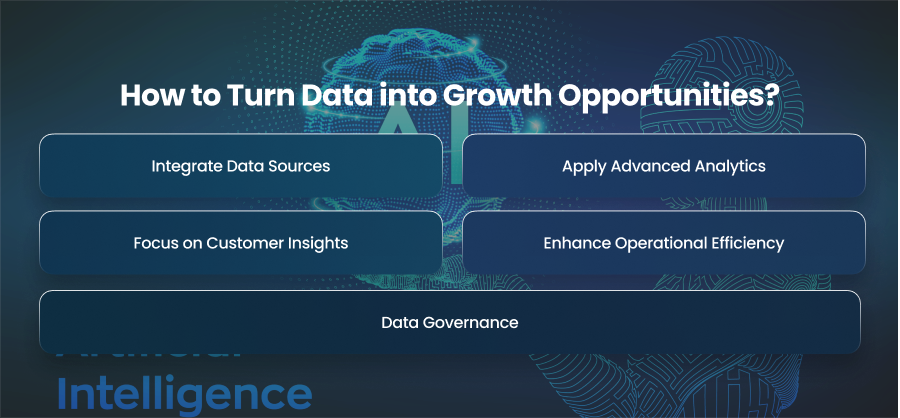
How to Turn Data into Growth Opportunities?
Integrate Data Sources
Data frequently exists in silos across systems and departments. It is difficult to have a comprehensive understanding of business performance due to these dispersed data sources. Organizations must make investments in data consolidation and integration to get around this.
Information from several sources, including CRM systems, is consolidated via a single data architecture. Businesses may guarantee data integrity throughout the company by establishing a single source of truth.
To have a thorough grasp of customer behavior, for example, a retail company may integrate data from its physical and online sites. This unified image enables cross functional teams to collaborate effectively and make choices based on shared insights rather than conflicting inputs.
Apply Advanced Analytics
Meaningful insights are extracted using advanced analytics and artificial intelligence skills once data has been centralized and organized. While conventional analytics can explain what has actually happened, AI can predict what is likely to happen next.
By employing machine learning algorithms to reveal abnormalities in datasets, organizations may discover new opportunities. Businesses may foresee market demand and customize client experiences with the use of predictive analytics.
Focus on Customer Insights
Using data to better understand and service consumers is one of the finest ways to transform it into growth. AI customer analytics may help businesses better segment their client base and forecast their behavior with remarkable accuracy.
Enhance Operational Efficiency
Growth is the outcome of streamlining current operations as well as gaining new clients. Additionally, data is essential for locating inefficiencies and raising departmental production.
Real time manufacturing line and logistics network monitoring is possible with AI analytics. It can point up places where performance needs to be enhanced or bottlenecks. For example, predictive maintenance uses sensor data to find early warning indicators of equipment problems so that teams may take action before expensive malfunctions happen.
In addition, data insights help organizations optimize resource allocation. By analyzing energy consumption or material usage, companies can make data backed adjustments that reduce waste and enhance outputs.
Data Governance
Verifying the accuracy of data is crucial as organizations depend more and more on it. While meeting legal standards, robust data governance solutions aid in preserving data integrity.
Companies need to set up explicit policies on data ownership. Transparency in data processing is crucial because AI systems that employ inaccurate data may produce poor outcomes.
Investing in cybersecurity solutions driven by AI also aids in preventing breaches. A brand’s reputation is improved when customers feel confident knowing that their data is protected.
Final Words
Businesses’ use of data to spur growth is changing due to AI. Therefore, companies may transform unstructured data into strategic intelligence by using AI technology and adopting ethical governance. Opportunities for better performance and wiser choices may arise from this.