


88% of participants in a McKinsey & Company survey stated that they routinely use AI in at least one business function. This is due to the fact that AI is no longer an experimental technology. Instead, businesses across several industries are automating procedures with AI. AI is beginning to have a significant impact on digital transformation.
But the majority of businesses aren’t developing AI systems. Rather, they are attempting to incorporate AI capabilities into their current software systems, many of which were created with very different presumptions years ago.
It is difficult and frequently overlooked to incorporate AI into current software systems. An ambitious AI project may become unpleasant due to legacy infrastructures and low quality data.
We will go over how AI integration functions in legacy contexts in this guide, along with the best ways to get around these challenges.
AI Integration in Legacy Systems
Legacy systems are applications or platforms built using older technologies that are still critical to business operations. These systems can operate on on premise infrastructure or monolithic architectures. They were never intended to handle contemporary AI workloads, despite the fact that they are frequently reliable.
What AI Integration Really Means?
Adding a machine learning model to an application is not the only aspect of AI integration. It entails allowing systems to learn from data. It also means integrating intelligence into workflows. This could include:
- Adding predictive analytics to ERP systems
- Integrating chatbots into customer support platforms
- Using AI for fraud detection in banking software
- Implementing recommendation engines in eCommerce platforms
AI systems rely on data pipelines and real time inference, in contrast to conventional software characteristics. Software’s behavior and maintenance requirements are drastically altered as a result.
Why Businesses Choose Integration Over Rebuilding?
Despite these challenges, most companies would like to integrate AI into their existing systems rather than create new ones. The reasons are practical:
- Legacy systems hold years of business logic and data
- Rebuilding core platforms is costly and risky
- Downtime isn’t acceptable for mission critical systems
- Gradual AI adoption allows faster time to value
AI Integration Challenges in Existing Software Systems
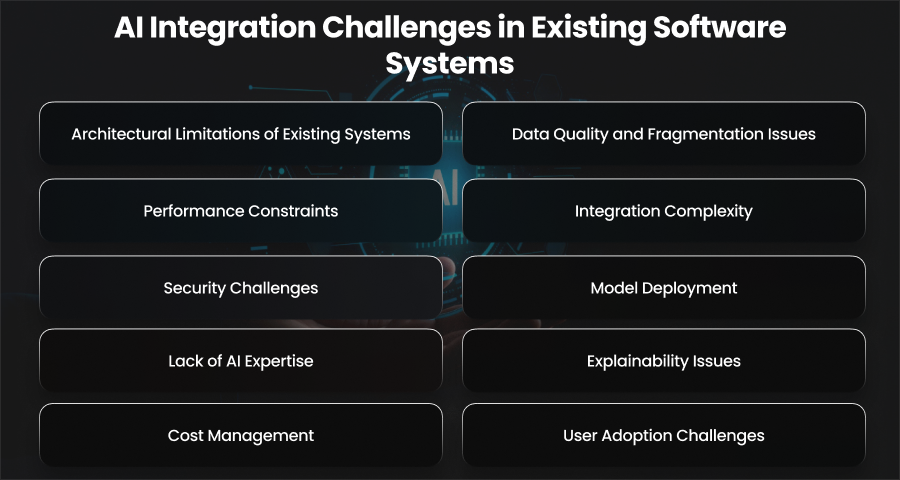
Architectural Limitations of Existing Systems
Many existing software systems are built on monolithic or tightly coupled architectures that make change difficult. These systems are designed to execute predefined business rules rather than support dynamic learning models.
Furthermore, traditional systems find it difficult to deliver the modular components and asynchronous processing that are frequently needed for AI integration. Organizations are thus compelled to put in place solutions that complicate things and make long term maintenance challenging.
Data Quality and Fragmentation Issues
AI systems depend heavily on large volumes of accurate and well structured data. However, existing software systems often contain fragmented or outdated data. Over time, data gets stored across multiple databases with each following different formats and standards. It becomes extremely difficult to clean and prepare this data for an AI application. AI algorithms provide inaccurate predictions in the absence of trustworthy data, which reduces user adoption.
Performance Constraints
Traditional software systems are typically optimized for transactional operations rather than compute intensive AI workloads. System performance may deteriorate with the introduction of AI models. Moreover, infrastructure constraints and higher latency become frequent problems. AI features may have a detrimental effect on the overall application’s performance in the absence of workload segregation.
Integration Complexity
AI outputs such as predictions or recommendations must fit seamlessly into existing workflows. However, many software systems are not designed to consume or act on probabilistic outcomes. Integrating AI decisions into approval processes or automated actions often requires significant workflow redesign. Moreover, conflicts can also arise between traditional rule based logic and AI driven insights.
Security Challenges
AI integration frequently involves access to sensitive business or customer data. This raise serious security concerns. The limitations required to control data access for AI inference and training may not be present in contemporary systems. Strict access control and safe data transfer are essential for businesses. Any security issues might lead to data breaches and a drop in customer confidence.
Model Deployment
AI models require ongoing maintenance. Once deployed, models can lose accuracy over time as data patterns changes. Managing model versions and scheduling retraining without disrupting production systems, especially when existing software release cycles are not designed to accomodate frequent model updates.
Lack of AI Expertise
For AI integration to be effective, data scientists and business stakeholders must collaborate. Many businesses lack the knowledge needed to create AI systems. Misalignment between teams can impede development even in cases when expertise is present. Also, differences in priorities and understanding of AI capabilities often result in delays.
Explainability Issues
In many business environments, users need to understand how and why AI systems make decisions. Current software systems were not designed to explain probabilistic outcomes and model reasoning. Users may be reluctant to accept AI’s advice if it acts like a black box. Adoption may be hampered by this lack of transparency. This is particularly important in regulated areas where explainability is crucial.
Cost Management
The costs of model training and infrastructure related to AI integration are novel and occasionally unanticipated. Current systems may need to be improved or given additional resources in order to handle AI workloads. Without clear performance metrics and connection with business goals, organizations struggle to determine return on investment.
User Adoption Challenges
AI adoption has an impact on how consumers interact with software. Because they are worried about automation or disturbance to their routines, workers may be against AI results. Even technically sound AI implementations may not provide benefit without adequate training and change management.
Examples of AI Integration Challenges
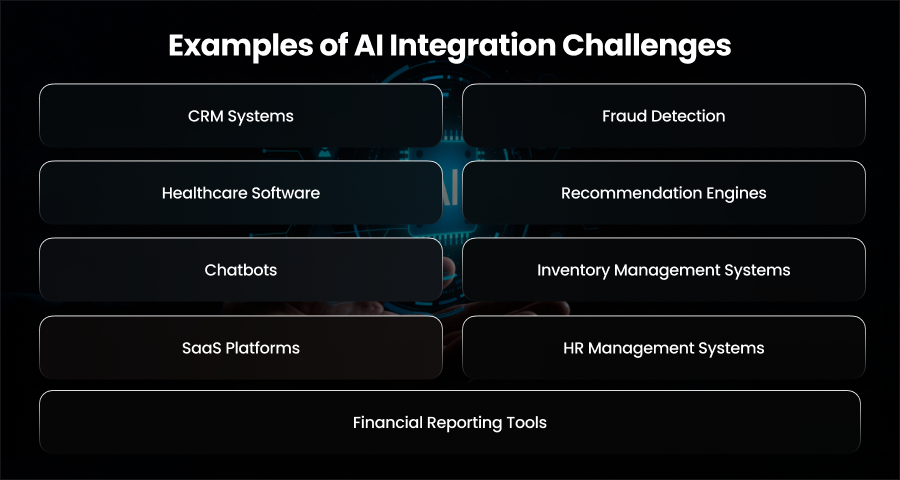
CRM Systems
Many organizations integrate AI into CRM platforms to improve lead scoring and customer engagement. In reality, these systems frequently include inconsistent or insufficient client data that was gathered over many years from many sources. Predictions become untrustworthy when AI algorithms depend on this fragmented data. Low adoption rates result from sales teams’ rapid loss of faith in AI advice. Integrating AI insights into existing sales procedures might also be difficult. This is especially important if traditional CRM does not support APIs.
Fraud Detection
Banks frequently adopt AI to detect fraudulent transactions in real time. While AI models significantly improve detection accuracy, integrating them into legacy transaction processing systems presents major challenges. Fast inference is necessary for fraud detection models; however, transaction approvals may be slowed down by latency in older systems. Finding a balance between security and performance becomes difficult, particularly when transaction volumes are at their peak.
Healthcare Software
AI is used by healthcare professionals to help with diagnosis and therapy suggestions. Strict compliance regulations and antiquated infrastructure make it difficult to integrate AI into traditional electronic health record systems. AI accuracy may also be limited by problems with data quality. Additionally, healthcare professionals often demand transparency in AI recommendations. This makes explainability a critical but difficult requirement to meet with existing systems.
Recommendation Engines
eCommerce platforms leverage AI recommendation systems to improve client experiences. However, there may be difficulties with merging new technology with current systems. Older systems might not be able to effectively supply the real-time access to behavior data that AI models need. Therefore, the site load speeds might be negatively impacted if the AI service fails.
Chatbots
In order to lower response times and support expenses, several businesses include AI chatbots in customer care software. Common inquiries can be answered by chatbots, but integrating them with knowledge bases and older systems might be difficult.
Inventory Management Systems
Supply chain systems use AI to forecast demand and predict disruptions. Integrating AI into existing ERP and inventory management platforms is challenging due to rigid workflows and batch data processing. AI models require real time data to make accurate predictions. However, legacy systems often update data at fixed intervals.
SaaS Platforms
AI is used by SaaS organizations to personalize user experiences and onboarding procedures. However, existing SaaS frameworks may not allow real time customization at scale. Rethinking feature delivery methods and data pipelines is necessary for integrating AI. AI customization elements may feel detached from the main product experience if they are not properly aligned.
HR Management Systems
AI is used by HR systems to analyze employee performance and filter resumes. Concerns of prejudice and compliance arise when AI is incorporated into outdated HR systems. AI results might be skewed by the absence of standardized data in current systems. In order to prevent ethical and legal problems, it is also essential to explain AI driven employment choices.
Financial Reporting Tools
Financial systems use AI to automate reporting and anomaly detection. Integrating AI into legacy accounting and reporting software is challenging due to rigid data structures and strict accuracy requirements. Any errors or unexplained predictions can reduce trust among finance teams. By ensuring the auditability and traceability of AI results, this complicates integration efforts.
Best Practices to Overcome AI Integration Challenges
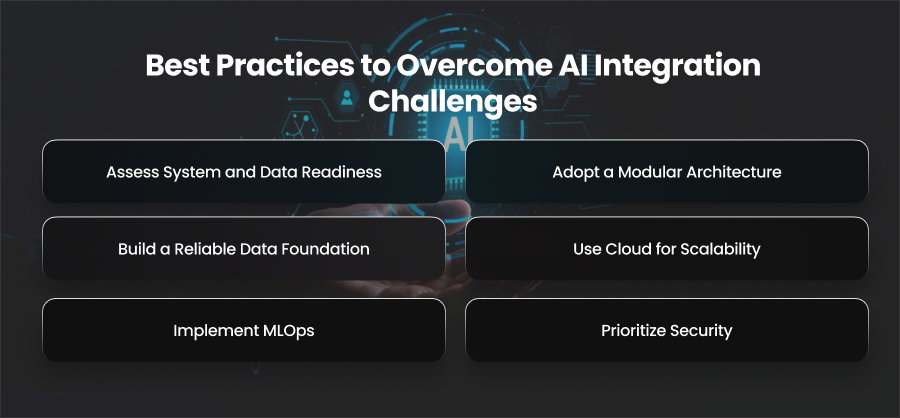
Assess System and Data Readiness
It’s crucial to assess the present condition of data assets and software systems before incorporating AI. This involves evaluating security safeguards and architectural flexibility. A readiness assessment helps identify gaps that can block AI adoption. This includes missing APIs or insufficient compute resources.
Adopt a Modular Architecture
Modularity is key to successful AI integration. By exposing core system functions through well defined APIs, organizations can integrate AI models as independent services rather than tightly coupling them with existing systems. This approach allows AI components to scale and be replaced without disrupting the core application. An API first strategy also improves maintainability.
Build a Reliable Data Foundation
The foundation of successful AI is high quality data. To guarantee consistency, organizations must make investments in data governance. AI models may access both historical and current data by establishing dependable data pipelines. Moreover, proper data management not only improves model performance but also increases trust in AI driven insights across the organization.
Use Cloud for Scalability
AI workloads frequently need for elastic computing resources, which are difficult for conventional on-premise systems to supply. Scalable computation and AI services that adjust to shifting needs are made possible by cloud infrastructures. Organizations may strike a balance between security and performance by shifting AI functions to the cloud while retaining sensitive data on site when needed.
Implement MLOps
MLOps procedures are crucial for overseeing AI models during their entire lifespan. Version control and automated deployment are examples of this. Early detection of model drift and performance deterioration is made possible by ongoing monitoring. Thus, companies may guarantee the accuracy and dependability of AI systems by including MLOps into current DevOps procedures.
Prioritize Security
Instead of being considered afterthoughts, security and compliance should be integrated into AI integration initiatives from the start. Strict access restrictions and thorough audit trails are requirements for organizations. For regulated companies, explainable AI and compliance ready infrastructures are crucial. Proactively addressing security demands reduces legal risks.
Final Words
Beyond technology, integrating AI into current software systems is a strategic problem. Businesses may successfully integrate AI into legacy settings by solving data readiness and architectural constraints.