




84% of developers now use or want to employ AI technology in their development process, according to Stack Overflow’s Annual Developer Survey. This is the outcome of decades of manual coding and repeated testing cycles used by developers. Developers have to write each component from the ground up and address issues by making mistakes.
These days, AI systems may automatically create documentation and automate repetitive coding processes. They also optimize deployments and even predict failures before they occur.
The influence of AI on software development and how developers may incorporate it into their processes will be covered in this guide.
How AI is Changing the Software Development Lifecycle?
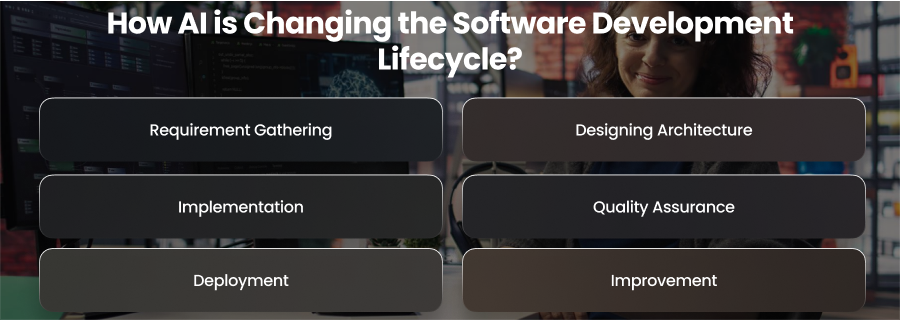
Requirement Gathering
AI is rewriting how teams collect and analyze requirements before development even starts. Traditionally, requirements gathering relied heavily on manual documentation and business analysis. This often left room for misunderstanding. AI based natural language processing tools now analyze product briefs and documentation to automatically extract key functionalities and convert them into structured technical requirements.
Based on past data or patterns in user behavior, these tools assist in identifying user pain areas and even provide recommendations for new features. AI improves planning in addition to requirement analysis by forecasting development schedules and spotting possible hazards early on.
In order to produce more precise project estimates, machine learning models may also assess previous project performance and examine task complexity. This lessens planning mistakes, which usually result in delays or lost labor, and helps teams avoid setting unreasonable deadlines.
Designing Architecture
AI helps development teams make more intelligent architectural decisions by analyzing enormous amounts of historical project data. It also recommends the best design patterns for new systems. AI insights that recommend whether a project should use a microservice architecture or not are now available to teams.
Additionally, AI may automatically generate system diagrams such as data models, API flows, and architectural maps based on specifications or even pre-existing code. This guarantees that architectural drawings are current throughout the course of the project and does away with the necessity for manual documentation.
Another significant advantage is AI’s ability to simulate system performance under different conditions. Before developers build a single component, AI models can predict how the application will respond under heavy traffic.
Implementation
AI has the most notable effect during this stage, radically altering how programmers write and work with code. These days, GitHub and other AI coding helpers may generate whole code blocks and provide context specific recommendations in real time. Instead of spending hours writing boilerplate code, developers may rapidly construct the fundamental structure and concentrate on solving the real problem.
AI also contributes to the maintenance of uniformity in code standards by enforcing best practices throughout the team. Large teams with engineers with varying degrees of skill will find this particularly helpful.
Quality Assurance
AI greatly enhances testing, which has traditionally been one of the most challenging aspects of software development. Development teams may automatically create thorough test cases based on code changes by using AI testing technologies. Additionally, this guarantees more extensive test coverage and lowers the possibility of overlooking important instances. Machine learning models can also analyze code behavior. This allows teams to resolve issues before they reach production.
Debugging time and total development expenses are both decreased by this proactive strategy. Additionally, AI test execution systems may maintain automated test scripts without human involvement and adjust to changes in application behavior. Additionally, these tools keep an eye on UI modifications and API responses to guarantee that tests don’t change as the program does.
Deployment
AI is enhancing deployment processes by making deployment pipelines more intelligent and proactive. Instead of relying on fixed scripts and manual checks, AI enabled pipelines analyze build performance and optimize deployment sequences automatically. AI, for instance, may identify the best construction sequence and identify any deployment roadblocks before they cause problems.
AI is still essential for tracking an application’s performance even after it has been launched. Systems that use machine learning driven anomaly detection may quickly identify anomalous behavior, such as traffic spikes.
Instead of waiting for customer complaints or system failures, this enables technical teams to address problems immediately. AI can initiate autonomous rollbacks in more sophisticated configurations if performance metrics drop below a certain level. This guarantees less downtime and a better user experience. AI also supports predictive maintenance by analyzing long term performance trends and forecasting when servers could fail or when configuration changes would save costs.
Improvement
AI ensures that software development continues after deployment and that enhancements are made throughout the product’s existence. By system performance data, AI provides insights that help teams improve their development processes.
By providing automated code reworking recommendations, AI also assists teams in maintaining tidy, manageable codebases over time. AI models improve in accuracy and alignment with team procedures by learning from each release cycle. This ultimately helps the organization deliver better software with each iteration.
In What Areas Does AI Improve Developer Productivity?
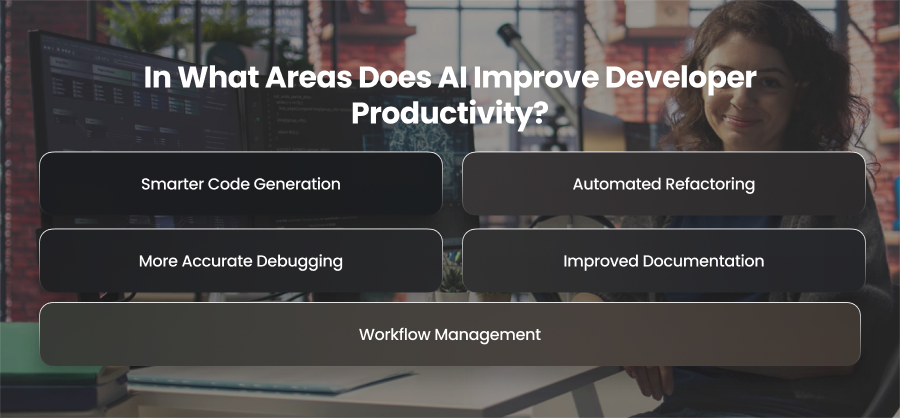
Smarter Code Generation
AI coding assistants have become game changers for modern developers. These technologies provide precise code recommendations in real time and comprehend context. Developers may utilize AI to quickly create common functions and class structures rather than wasting time creating repeated boilerplate code.
This guarantees that every generated code complies with best standards while also accelerating workflow. AI can also translate logic from one language to another or explain unfamiliar code segments, which greatly improves learning and exploration. Without becoming mired down in the specifics of the syntax, developers may prototype features more quickly and iterate on ideas.
Automated Refactoring
AI enhances code quality by analyzing patterns and recommending improvements.It could also spot superfluous loops or too complex logic and then provide easier, more efficient fixes. Additionally, refactoring becomes more reliable as AI can examine large codebases in a couple of seconds. In addition to lowering technological debt, this keeps the design clear and scalable. Instead of cleaning up dirty code by hand, AI handles mechanical improvements, freeing engineers to concentrate on addressing actual problems and creating value driven enhancements.
More Accurate Debugging
Debugging has historically taken up a large portion of development time, especially in complex systems. AI greatly improves this process by examining code execution and identifying error patterns. Instead of manually combing through logs, developers receive guided suggestions that point them directly to problematic areas. AI can recreate certain bugs automatically by simulating user behavior or system conditions. This makes it easier to reproduce issues consistently.
Improved Documentation
One of the most overlooked chores in development is documentation, but AI greatly simplifies it. By examining the source, AI tools may automatically provide documentation for APIs, classes, functions, and processes. Additionally, they are able to describe system behavior and condense intricate reasoning into language that is understandable to humans. When onboarding new developers who must rapidly grasp the code, this is very helpful. Additionally, AI powered search and Q&A tools assist teams in quickly retrieving information by responding to inquiries concerning the architecture and code.
Workflow Management
AI improves productivity by optimizing developer workflows and project management processes. It can analyze historical data to forecast delivery timelines and highlight risks early. AI technologies assist in setting job priorities according to resource availability or complexity. As a consequence, teams may focus on the most crucial tasks. These technologies also automate standard project management chores, such as status reporting and sprint forecasting.
Limitations of AI in Software Development
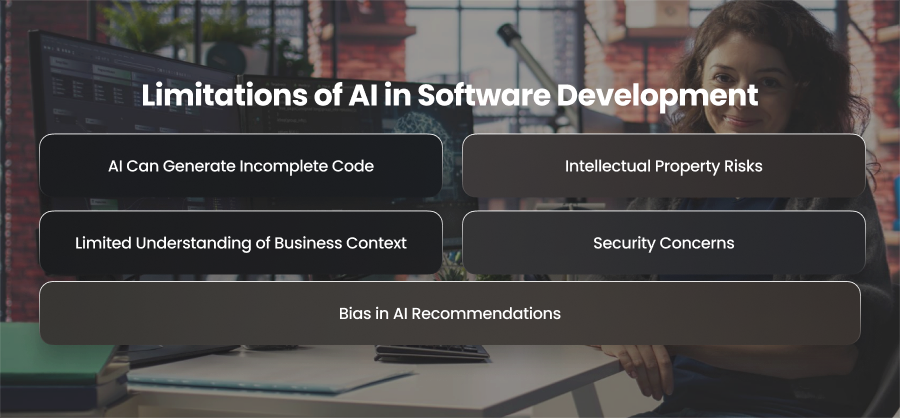
AI Can Generate Incomplete Code
One of the most significant limitations of AI in software development is that it can generate incomplete code. AI models rely on patterns learned from vast datasets and past code examples. They don’t understand logic or business context. This implies that a function or algorithm created by AI may seem syntactically accurate but have minor logical flaws or security flaws.
An AI may, for example, create a function that functions well in a test scenario but fails in heavy load or edge circumstances. As a result, developers must constantly check and evaluate AI code to make sure it satisfies performance requirements.
Intellectual Property Risks
Since many AI models are trained on publicly available open source code, intellectual property issues may come up. AI may inadvertently generate code that looks like copyrighted works. This presents legal or compliance challenges for companies who use it in commercial products. Organizations need to be careful when using AI generated code, especially for proprietary projects.
Limited Understanding of Business Context
AI can analyze syntax and system behavior, but it cannot fully comprehend the business or strategic context behind a project. Human judgment is required for decisions like architectural trade-offs and user experience concerns. For example, an AI can recommend a technically sound solution that contradicts the demands of the consumer or the product strategy. Therefore, developers and architects must evaluate AI recommendations in the context of broader business goals to ensure that they align with organizational strategy.
Security Concerns
In order to provide suggestions, AI systems frequently need access to codebases or project repositories. These cloud based technologies may disclose sensitive or private data. Because regulatory compliance is crucial in sectors that handle personal or healthcare data, this is especially troubling. Sensitive data shouldn’t be placed into AI models that may keep it, and organizations must have stringent data control procedures.
Bias in AI Recommendations
AI models may inherit biases from the original datasets since they are trained on past code data. As a result, recommendations might become skewed. AI could, for example, regularly favor some libraries or coding styles over others, which might not be in line with the requirements of the project. Testing and security recommendations may be impacted by biases, which might lead to problems going ignored in some situations.
Best Practices for Using AI Tools Effectively
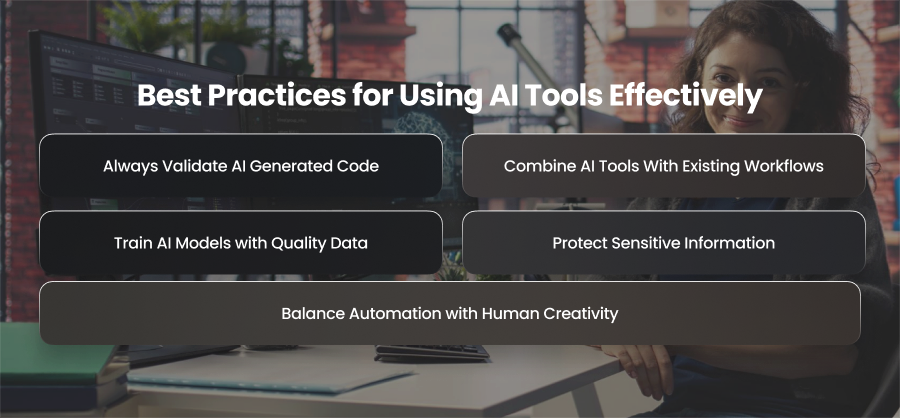
Always Validate AI Generated Code
Although AI is capable of producing code fast, speed does not necessarily equate to dependability. All produced code should be carefully examined by developers to make sure it complies with architectural requirements. Because AI often generates solutions that are effective in the short term but not ideal in the long run, code reviews also aid in preventing technological debt. Also, manual oversight ensures the final output is functional.
Combine AI Tools With Existing Workflows
Adopting AI shouldn’t interfere with your team’s current process. Rather, AI technologies ought to supplement current methods like agile development. For example, AI can automate test case generation or help analyze pull requests, but the team should retain its standard review and approval process.
Train AI Models with Quality Data
When using custom AI models or enterprise level AI tools, the quality of the data used for training is critical. Poor or outdated data leads to inaccurate predictions or flawed code suggestions. Organizations should ensure datasets are clean and representative of real development environments.
Protect Sensitive Information
Security must remain a top priority when adopting AI tools. Developers should avoid pasting confidential code or sensitive user data into third party AI platforms. Instead, organizations should use secure AI tools for handling sensitive workloads.
Balance Automation with Human Creativity
Even though AI is excellent at automation, developers provide creative ideas. Teams should let AI handle tedious tasks like formatting or early scaffolding while humans focus on high value tasks like system design and product strategy.
Final Words
AI is changing software development by increasing productivity and speeding up procedures. However, when paired with human skill, it becomes much more successful. Developers may create more intelligent and dependable software while keeping control by being aware of its limitations and using best practices.