




According to Web Technology Serve, over 50,000 websites use Django for their backends. Moreover, it’s hugely popular in the USA. This is because building a modern web application requires more than just clean code; it requires security and long term maintainability. Django can assist in this situation. Developers can produce reliable and secure apps faster using Django, a high level Python web framework, than with many other solutions.
From startups launching MVPs to enterprises managing large systems, Django has shown its value in a number of industries. Additionally, companies like Instagram and Pinterest were founded with Django.
We’ll go over why Django is an excellent option for developing web apps in this article. We will also examine the development process of a web application step by step.
Why Choose Django for Web Application Development?
Development Speed
Django comes with ready to use components like an admin panel and authentication system since it was created with a battries included mentality. Without having to start from scratch, developers may swiftly integrate essential functionality thanks to these built-in capabilities.
Startups and companies that need to quickly deliver new features or publish an MVP will find this rapid development cycle especially helpful. For instance, compared to starting from scratch with lower level frameworks, a firm wishing to launch an eCommerce platform may have user registration and checkout features operating in a fraction of the time.
Higher Level of Security
Django was created with security in mind since it is an important aspect of web development. SQL injection is one of the common online vulnerabilities that the framework automatically protects against.
Therefore, this built-in security significantly lowers the chance of breaches for companies managing sensitive data and safeguards both the business and its consumers. Additionally, developers may establish secure login and permissions without requiring a lot of additional coding thanks to Django’s robust authentication mechanism.
Scalability
Django’s capacity to manage expansion is one of its greatest advantages. When your company grows, Django built apps can effectively scale to accommodate additional users and sophisticated features.
Django’s modular architecture allows teams to implement horizontal scaling or scaling without major rewrites. Many high traffic problems rely on Django to manage millions of concurrent users while maintaining fast performance.
Maintainable Architecture
The MVT design pattern is followed by Django. This guarantees that data models and user interfaces have different concerns. The codebase is therefore easier to understand and more organized.
This maintainability is a major benefit for long-term projects. Teams can add new features or upgrade functionality without disrupting other parts of the application. This ensures smooth and continuous development and reduced technical debt.
Versatile Ecosystem
Because of Django’s active international community, developers have access to thousands of reusable components and third party libraries. By using pre built solutions instead of starting from scratch, this ecosystem speeds up development and lowers expenses.
Moreover, Django is well supported by official documentation and regular updates. This ensures frameworks stay compatible with modern web standards and changing security requirements.
Django Web App Development Process: Step by Step
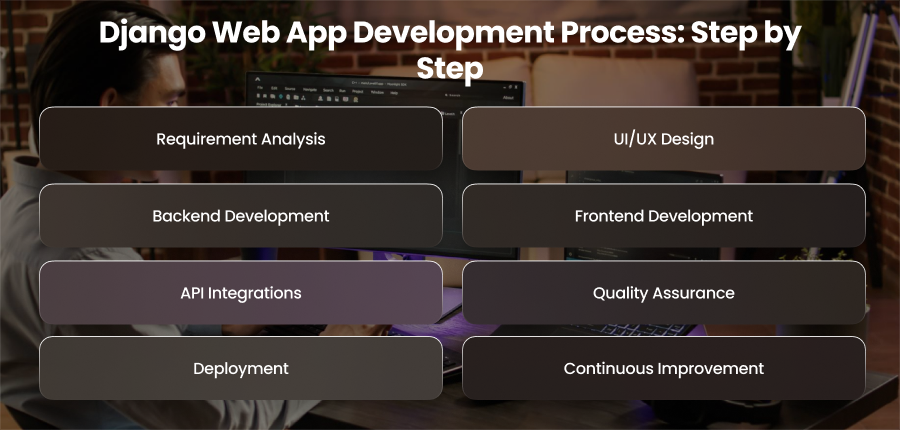
Requirement Analysis
Requirement analysis is the cornerstone of any successful Django project. At this point, developers work to comprehend the application’s anticipated features. Establishing specific goals guarantees that the program will benefit the clients.
In this case, it’s critical to prioritize features necessary to the app. When an eCommerce platform is initially used, for example, user authentication and a checkout procedure could occur first. To make sure the project continues on course, budget planning and technical feasibility studies are also conducted. Effective planning minimizes delays and establishes the foundation for a fruitful growth cycle.
UI/UX Design
Once the criteria are met, the focus shifts to user experience design. In order to create an interface that enhances user experience, this step is essential. It is also essential for developing visually appealing and user friendly applications. Designers create wireframes to show the layout of the program. Before development starts, they use tools like Figma to generate interactive prototypes that let stakeholders see functionality.
Therefore, teams may reduce expensive coding modifications by obtaining design approvals at this time. This guarantees that the app satisfies user expectations as well as brand requirements.
Backend Development
The web application’s essential functionality is developed during the backend development stage. Django’s modular design makes this procedure easier. The first step for developers is to set up the project and configure the server environment and database, among other important settings. They create models to efficiently manage and communicate with the database using Django’s ORM.
Views and URL routing are implemented to handle client requests and responses. Business logic is integrated during this stage. Data consistency is another duty of the backend. Because of Django’s modularity, developers can create reusable apps.
Frontend Development
The frontend development determines how users interact with the program, while the backend powers it. Django can easily interact with frontend frameworks like Angular for dynamic experiences and offers template based rendering for server-side content. Responsive templates that function on many devices are created by developers.
Additionally, they incorporate APIs to retrieve data in real time from the backend, guaranteeing seamless server client connection. Additionally, to improve user engagement, client side interaction is implemented utilizing JavaScript or framework specific components.
API Integrations
Modern web applications rarely operate in isolation. Django apps have more functionality thanks to third-party connectors and APIs. Payment gateways like Stripe, cloud storage and notification services, and authentication services like Google OAuth or business single sign-on are examples of common connections. The program will continue to be dependable and safe if these integrations are properly managed. To avoid downtime, developers must carefully construct and verify every API connection.
Quality Assurance
To guarantee a stable and dependable result, developers employ Djangor’s automated testing tools in conjunction with manual quality assurance procedures. Unit tests confirm that each component works as intended. While integration tests confirm that different modules work seamlessly together.
Performance tests measure how quickly pages load and how quickly servers respond. Potential weaknesses like cross site scripting are found during security testing. To make sure the program fulfills expectations, user acceptability testing gathers input from users.
Deployment
The application proceeds to deployment when development and testing are finished. Cloud systems such as AWS are among the settings in which Django programs may be deployed. Additionally, deployment entails setting up application servers like Gunicorn and web servers like Apache.
Database migrations provide the proper implementation of all models and data in production.
Many teams implement development pipelines to automate deployments and reduce downtime. Additionally, monitoring and logging tools track performance and potential issues in real time. A smooth deployment ensures that the application performs efficiently.
Continuous Improvement
Maintaining the application’s functionality and security is essential. Performance optimization and the application of security fixes are part of this step. Frequent server performance and error log monitoring help avoid downtime and guarantee a seamless user experience. Additionally, scalability enhancements can be required as the user base expands. This includes database optimization or microservices integration.
How Long Does It Take to Build a Django Web App?
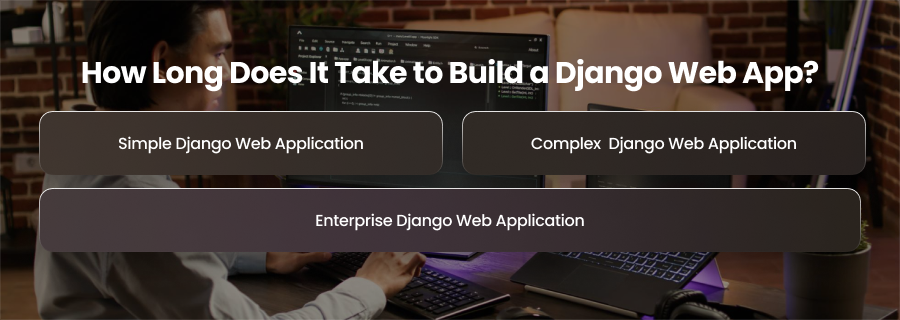
Simple Django Web Application
A simple Django web application typically includes basic features such as user authentication and minimal third party intergations. Examples include internal tools or early stage MVPs. These applications often have a simple development approach with little room for user experience customization.
A basic Django web application may be created in four to six weeks on average. Requirement analysis, development, testing, and deployment are all included in this schedule. At this point, Django’s integrated admin panel and login mechanism greatly speed up development. Teams are able to concentrate on essential features instead of boilerplate code as a result.
Complex Django Web Application
Complex applications involve more advanced features. These features can be custom workflows and data analytics dashboards. It also includes multiple user roles and integrations with third party APIs. These apps often require more polished user experience and extensive frontend-backend interaction.
For such projects, the development timelines typically ranges from eight to twelve weeks. This includes time for detailed planning, design iterations, and API integrations. Moreover, at this level, the emphasis is on stability and performance, which naturally extends the development cycle.
Enterprise Django Web Application
Django applications at the enterprise level are made to manage heavy traffic and stringent security regulations. Features like microservices architecture, sophisticated authentication, real time data processing, and multilingual assistance are frequently included in these projects.
Large-scale or business Django web programs usually take six months or more to construct. These projects are usually built in phases, starting with a basic release and continuing to improve. More time is required for comprehensive testing to ensure the application operates reliably under severe workloads.
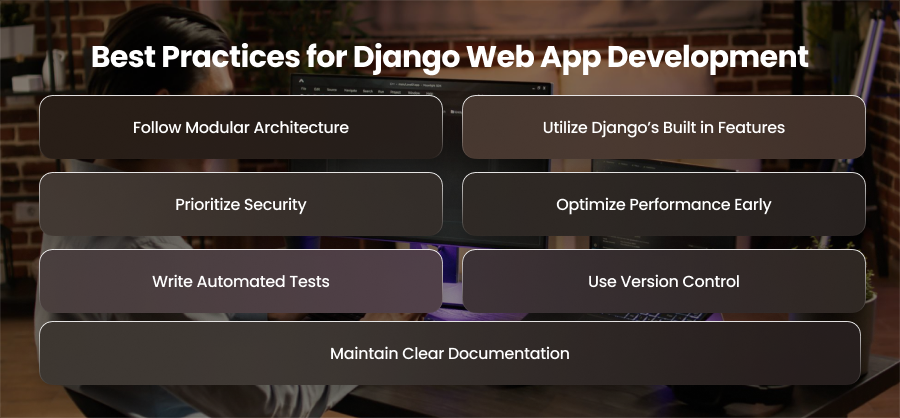
Best Practices for Django Web App Development
Follow Modular Architecture
A good Django application starts with a clean, modular codebase. The project’s modular, reusable Django apps should each be in charge of a specific task, like user administration. This division of duties facilitates debugging and improves readability.
Utilize Django’s Built in Features
One of Django’s biggest strengths is its batteries-included framework. Best practice dictates using Django’s built in authentication system and ORM wherever possible instead of building custom solutions. These parts have undergone extensive testing and performance optimization. Using native Django functionality minimizes the chance of introducing security flaws.
Prioritize Security
When developing a Django online application, security should be taken into account at every stage. Django’s security guidelines, which include configuring appropriate user authentication and turning on CSRF protection, must be followed by developers. Environment variables should be used to hold sensitive data, like API keys. Regular security evaluations also aid in shielding the goods from new dangers.
Optimize Performance Early
Performance optimization should never be an afterthought. From the start, Django developers should concentrate on effective database queries and query optimization. Redis and other tools can be used to implement caching schemes that greatly reduce server load and speed up response times. A quicker and more responsive user experience can also be achieved by utilizing content delivery networks and allowing lazy loading.
Write Automated Tests
Automated testing is crucial to Django development. Unit testing guarantees that each component performs as intended. Furthermore, adding more characteristics lowers the probability of regressions. Model testing is made simpler by Django’s integrated testing framework. A robust testing approach increases application stability, confidence and code dependability.
Use Version Control
Effective version control using tools like Git is essential for collaborative Django development. Maintaining clean commit histories and using feature branches help teams manage changes efficiently. So, implementing development pipelines automates testing and deployment processes, which can reduce downtime. This practice ensures faster releases and consistent application performance across environments.
Maintain Clear Documentation
Long term success depends on accurate and up to date documentation, even though it is often ignored. Faster maintenance and a smoother onboarding process for new developers are ensured by documenting configuration settings and APIs. Well documented Django projects facilitate smooth knowledge transfer and lessen reliance on specific team members.
Final Words
Django web application development provides a potent blend of security and speed. Businesses may create dependable apps that expand with user demand and changing digital requirements if they have a defined development process and reasonable deadlines.