



According to Cirrus Insight, 50% of Fortune 100 companies have adopted Salesforce’s AI offerings. However, many companies that aim to implement Salesforce into their workflows aren’t successful. This is because companies treat Salesforce implementation as a finish line. Once the system goes live, they move on, only to realize months later that their CRM is slow and poorly adopted by users.
The truth is, going live is not success. It’s just the beginning.
Salesforce is a great platform designed to grow with your business. But without a scalable implementation strategy, organizations often end up with technical debt and limited ROI.
In this guide, we’ll discuss common Salesforce implementation mistakes and what organizations should consider to build a future proof CRM ecosystem.
Common Mistakes Companies Make During Salesforce Implementation
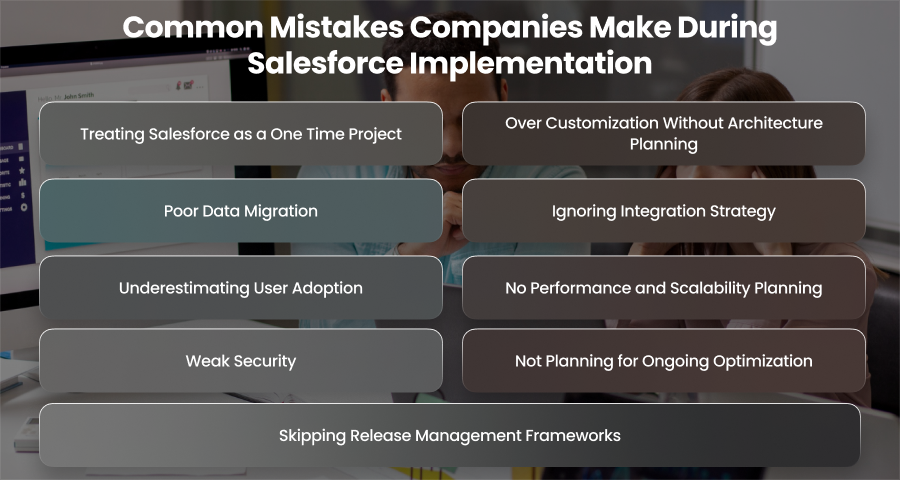
Treating Salesforce as a One Time Project
Considering Salesforce adoption as a short-term IT project with a set finish date is one of the most common errors. Businesses frequently prioritize technical deliverables above long term business objectives when using Salesforce.
This approach results in systems that technically function but fail to support evolving sales and marketing processes. Salesforce should be treated as a living business platform that continuously changes with organizational strategy, not just a system that goes live.
Over Customization Without Architecture Planning
Salesforce’s flexibility is both its strength and its biggest risk. Many organizations heavily customize Salesforce early on without a clear architecture strategy.
Over customization leads to:
- Complex dependencies that are hard to maintain
- Performance bottlenecks
- Higher costs for upgrades
- Difficulty onboarding new developers
Without governance frameworks, every department may request custom features. This results in a fragmented system. A scalable implementation balances configuration first design with strategic customization. This ensures maintainability and performance over time.
Poor Data Migration
Data migration is often underestimated. Many companies migrate legacy data into Salesforce without cleaning or defining data standards. As a result, Salesforce becomes filled with inconsistent or duplicate records.
Poor data quality impacts:
- Reporting accuracy
- Sales and marketing effectiveness
- User trust in the system
- AI and analytics outcomes
A scalable implementation requires a data governance strategy that defines ownership and ongoing data quality monitoring.
Ignoring Integration Strategy
Salesforce rarely operates in isolation. It must integrate with ERP systems and customer support software. Many organizations delay integration planning until after going live. This can lead to manual processes and data silos.
Without a defined integration architecture, companies end up with:
- Duplicate data entry
- Inconsistent customer views
- Limited automation potential
A scalable Salesforce implementation should be integration ready from day one with middleware and even driven architecture.
Underestimating User Adoption
One of the most important—yet often ignored—aspects of Salesforce deployment is user acceptance. Many companies believe that once Salesforce is implemented, employees will accept it on their own. However, users may reject new technology if there is insufficient change management and training.
Inadequate training and poor communication also contribute to low participation and reliance on outdated equipment. In order to promote long term adoption, successful implementations make investments in organized training programs and ongoing support.
No Performance and Scalability Planning
As Salesforce usage increases, performance problems frequently appear, but many businesses neglect to account for scalability during deployment. Large, unoptimized reports and ineffective queries might produce governor limit issues and slow down the system. Without data archiving and indexing strategies, performance degrades as data volume increases.
Weak Security
When implementing Salesforce, security is sometimes overlooked in favor of convenient access. Data breaches and noncompliance with regulations are more likely as a result. Many organizations neglect role based access control and exposing sensitive customer and business data. A scalable Salesforce implementation must embed security and compliance frameworks from day one to protect data.
Skipping Release Management Frameworks
Without governance, Salesforce environments quickly become chaotic. Organizations sometimes make direct changes in production without documentation or approval processes. Unpredictable behavior and system instability result from this. Changes are performed methodically thanks to a defined governance strategy that includes version control and regulated release cycles.
Not Planning for Ongoing Optimization
After going live and neglecting to monitor adoption, many businesses cease assessing Salesforce success. Without quantifiable KPIs, businesses struggle to justify more expenditure and lose out on optimization possibilities. To guarantee that Salesforce continues to provide company value over time, a scalable deployment incorporates ROI evaluation and ongoing monitoring.
Designing a Scalable Salesforce Architecture
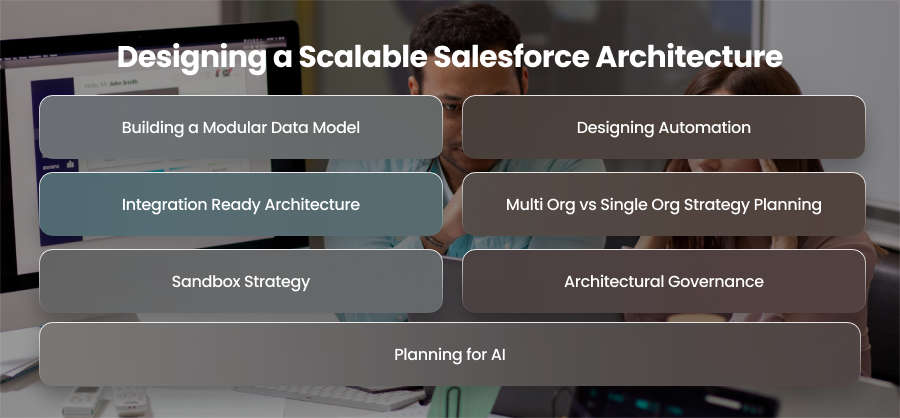
Building a Modular Data Model
The data model is the foundation of any Salesforce implementation, and poor data architecture can limit scalability from the start. In order to prevent needless complexity, organizations must create a modular data structure that represents essential business entities like accounts and custom objects. To ensure uniformity across teams, naming conventions should be standardized and relationships between items should be precisely established.
A scalable data model also accounts for future expansion. Businesses may introduce new products, and the data structure must change to accommodate these changes without requiring major redesigns.
Designing Automation
One of Salesforce’s most potent features is automation, however as the system grows, poorly implemented automation may lead to disputes and performance problems. Declarative solutions like Salesforce Flow should be given priority in an organization’s structured automation plan, with Apex reserved for intricate business logic.
As automation increases, dependencies between workflows and integrations can become difficult to manage. Developers and administrators may preserve clarity by using naming standards and documenting automation logic. Organizations should also assess how automation affects user experience to make sure the system is effective even as complexity increases.
Integration Ready Architecture
Many platforms are used by modern enterprises, and Salesforce needs to function as a component of a larger digital ecosystem. Connections should be considered from the start rather than as an afterthought when designing a scalable Salesforce architecture.
This involves choosing middleware platforms and developing an API strategy. Furthermore, it includes architectures for real time data synchronization. Integration patterns should be standardized to avoid fragile connections that become difficult to maintain.
Multi Org vs Single Org Strategy Planning
Organizations must choose whether to use a multi-org approach or operate under a single Salesforce organization as they expand. While a single organization streamlines reporting and governance, it may not be scalable in large, international businesses. Regional or business unit autonomy is permitted by multi organization systems, although data synchronization and governance become more complicated.
A scalable implementation requires evaluating organizational structure and data regulations to determine the optimal org strategy. Planning this early prevents architectural constraints that could limit operational efficiency.
Sandbox Strategy
A clear development and production environment plan is part of a scalable Salesforce architecture. Multiple sandboxes lower risks and enhance deployment quality when used for development and user acceptance testing.
To guarantee uniformity across environments, organizations should specify environment responsibilities and testing protocols. This methodical technique minimizes production interruptions, preserves system stability, and permits ongoing innovation.
Architectural Governance
Scalable architecture isn’t just about technical design, it also requires documentation and governance frameworks. Architectural decisions should be documented, and standards should be established for data modeling.
Centers of Excellence assist in preventing unchecked alterations and enforcing architectural standards. This guarantees that Salesforce does not become fragmented over time, but rather develops in a controlled manner.
Planning for AI
Salesforce architecture must also consider advanced capabilities such as AI and personalization. Salesforce Einstein and data cloud integrations require structured data and reliable integrations.
Organizations may guarantee they can use data driven insights and automation at scale without significant rework by building an architecture with analytics and AI in mind. Salesforce is now positioned as a platform for strategic insight rather than only an operational CRM.
What to Consider When Implementing Salesforce?
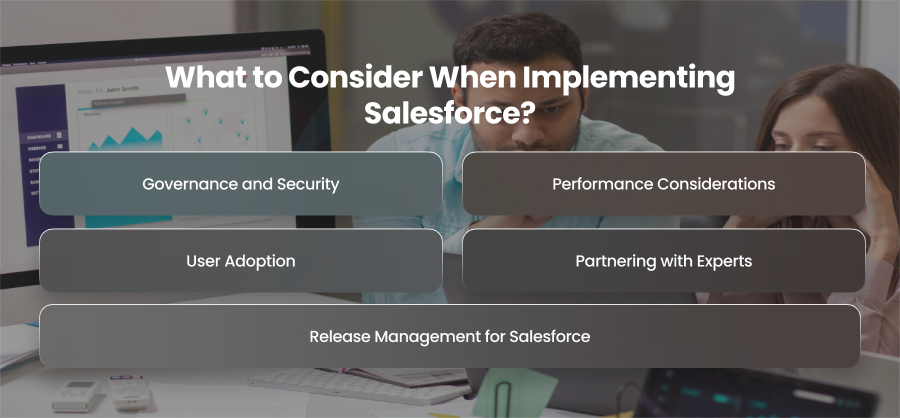
Governance and Security
A scalable Salesforce solution requires both security and governance. Organizations should use audit logging and real-time monitoring to track access and modifications in addition to designing role hierarchies and permission settings. Setting up data ownership guidelines guarantees responsibility and upholds excellent data quality. Security is strengthened by multi-factor authentication and encryption of critical areas.
Governance also requires release management policies and documentation standards. This guarantees that every modification complies with IT and commercial requirements. To find weaknesses and holes in compliance, organizations should regularly audit their operations.
Performance Considerations
To prevent bottlenecks and keep a responsive Salesforce instance, performance planning is crucial. Organizations should anticipate data expansion and make plans for storing old information or use Big Objects for large volumes of data, in addition to optimizing searches and indexing fields. Additionally, by examining planned jobs and triggers to reduce redundant procedures, automation efficiency may be improved.
User Adoption
To avoid system slowdowns, organizations should also account for concurrent users and API constraints. Multinational firms should consider how latency and regional server placement may impact performance. Teams are able to proactively discover problems through regular performance testing and monitoring. This ensures Salesforce remains reliable as business complexity increases.
The key to a successful Salesforce deployment is user acceptance. Companies should provide interactive seminars and gamification in addition to role specific training to boost engagement. Additionally, companies should employ beta testing and pilot programs to include consumers early in the design process.
Dashboard personalization and task specific automation boost relevance and promote utilization. Additionally, leadership support is essential. Managers and executives can demonstrate how to use the system and promote adoption in order to reinforce behaviors. Administrators can find problems and make platform changes with the use of surveys and continuous feedback.
Release Management for Salesforce
Effective release management enables organizations to innovate without compromising stability. In addition to version control, businesses should have staged deployment plans and release schedules to manage several changes and minimize interruption. Regression testing that is automated makes ensuring that new additions don’t interfere with already existing functionality. While sandbox seeding and data cloning allow realistic testing scenarios.
Moreover, teams should also implement rollback plans and post release monitoring to address unexpected issues quickly. A mature release management process combines Agile planning, documentation, communication, and testing. This ensures Salesforce evolves reliably and consistently with business demands.
Partnering with Experts
One of the best strategies to guarantee scalability and ROI is to collaborate with seasoned Salesforce specialists. In addition to consultants and developers, businesses may use industry specific knowledge to create solutions that are customized to meet certain needs. In order to preserve system integrity over time, seasoned partners assist in establishing Centers of Excellence and best practices.
Additionally, they lower implementation risks by helping to design integrations and educate internal staff. As a result, early expert engagement speeds up adoption and establishes Salesforce as a strategic platform—rather than merely a transactional CRM—capable of fostering long term development and efficiency.
Final Words
Salesforce success depends on building for scale and not just launching features. By planning architecture and release processes, organizations create a resiliant CRM that grows with the business. Also, partnering with experts and measuring outcomes ensures Salesforce delivers sustained value after going live.