



According to statistics, 77% of companies are either using or contemplating the use of AI in their businesses. This is because AI is changing the way businesses operate. Moreover, what once required massive human effort can now be accomplished in seconds due to machine learning and NLP processing.
Additionally, AI improves corporate efficiency. Businesses that use AI early will spearhead the next wave of digital transformation as it becomes more widely available.
The post will go over several trends that are changing industries, as well as the essential elements of contemporary AI. We will also talk about application cases and how companies can be ready for a future driven by AI.
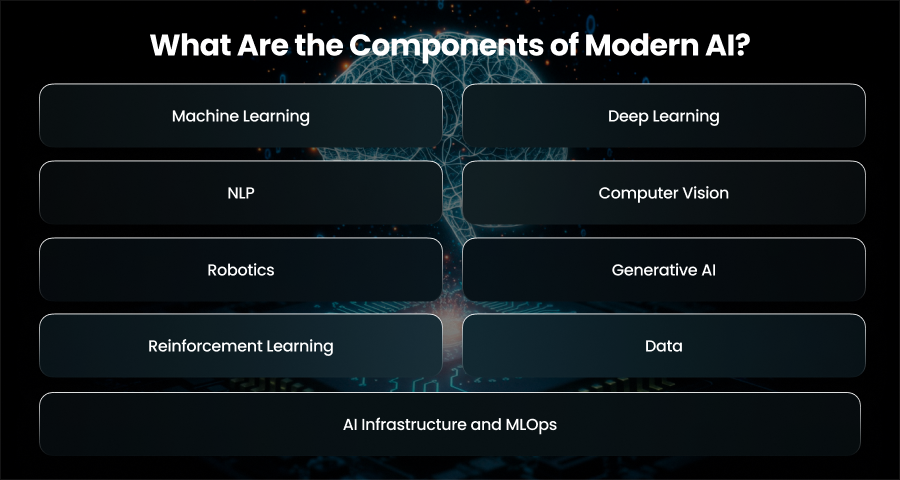
What Are the Components of Modern AI?
Machine Learning
AI systems are taught how to learn from data using machine learning. Rather of being coded with strict instructions, machine learning models examine massive databases and use that data to create predictions or judgments.
There are several popular types of ML:
- Supervised Learning: Models learn from labeled training data and predict outcomes. This is used in email spam detection and sales forecasting.
- Unsupervised Learning: Models identify hidden patterns and relationships in unlabeled data. It’s useful for market segmentation and anomaly detection.
- Reinforcement Learning: Algorithms learn through trial and error by receiving rewards or penalties. It’s used in autonomous systems.
For companies looking to use consumer segmentation and predictive analytics, machine learning is crucial.
Deep Learning
Deep learning raises the bar for machine learning. It is based on artificial neural networks that are meant to resemble the human brain. These networks can handle incredibly difficult jobs because they are made up of several layers that analyze input in more abstract ways.
Deep learning excels at:
- Identifying objects in images
- Understanding speech meaning and tone
- Recognizing language patterns
- Making autonomous driving decisions
It’s very helpful for handling large amounts of data, such sensor or medical scan data. Deep learning models perform better with large datasets, and in complicated settings, their accuracy frequently outperforms that of conventional machine learning techniques.
NLP
Machines can comprehend and produce human language thanks to natural language processing. NLP transforms routine jobs like content analysis and customer service.
Key areas of NLP include:
- Text Classification
- Sentiment Analysis
- Named Entity Recognition
- Language Translation
- Conversational AI
NLP is now crucial for evaluating customer feedback and developing more individualized user experiences as companies depend more and more on digital communication.
Computer Vision
Computers can now comprehend and analyze visual data much like people do thanks to computer vision. It entails evaluating pictures and comprehending the environment.
Moreover, computer vision algorithms combine image processing with deep learning models. They can identify defects or even track human movements.
Robotics
AI powered robotics merges intelligent software with mechnical systems. AI equipped robots are able to sense their surroundings and operate either fully or partially on their own.
Furthermore, unlike conventional robots that obey preprogrammed orders, AI driven robots adjust to their surroundings. They learn from data and operate more safely and efficiently.
Generative AI
Generative AI is one of the most innovative developments in AI. It enables systems to generate new knowledge by learning from old data.
Furthermore, generative AI methods can speed up procedures and improve inventiveness.
Companies utilize it to generate concepts and create preliminary drafts. It is essential for marketing and product teams because to its capacity to scale content development.
Reinforcement Learning
A particular AI technique called reinforcement learning emphasizes learning by interaction with an environment. In order to optimize long term benefits, the system acts and improves its approach.
AI Infrastructure and MLOps
AI cannot operate without the right infrastructure. Modern AI depends on a range of tools and pipelines that let developers create and maintain models.
Important elements include:
- Cloud computing
- GPUs and accelerated hardware
- Data pipelines and data lakes
- Model training frameworks
- Optimizing workflows
Data
Data is the most critical component of modern AI. Quality data fuels model training and performance improvement.
AI relies on:
- Structured Data
- Large and Diverse Datasets
- Continuous Data Collection
- Real time data streams
- Secure storage and governance practices
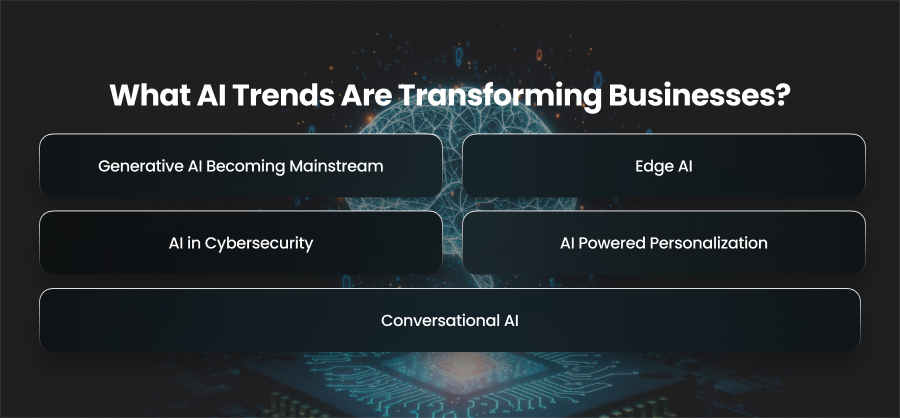
What AI Trends Are Transforming Businesses?
Generative AI Becoming Mainstream
One of the most significant developments in technology is generative AI. It is becoming an essential component of regular corporate operations rather than just an experimental tool. Its capacity to provide original material has made it indispensable in a variety of fields.
The speed and scalability it provides are its greatest advantages. Things that used to take hours of human labor may now be completed in a matter of seconds. This frees up teams to focus on creativity and decision making.
Edge AI
Edge AI brings computing power directly to devices instead of relying solely on cloud based systems. This implies that data may be processed and analyzed in real time by sensors and autonomous systems. Businesses benefit from lower latency and bandwidth use. Additionally, industries like manufacturing and healthcare rely on edge AI since many decisions need to be made rapidly.
AI in Cybersecurity
Cybersecurity threats are becoming more frequent and sophisticated. For this reason, traditional security methods are insufficient. AI enhances security capabilities by continually monitoring activity. Additionally, it may detect unwanted access attempts and examine trends in user activity. AI is used by companies in all industries to improve their security posture and safeguard confidential information.
AI Powered Personalization
Consumers desire personalized experiences. AI makes this possible on a massive scale. In order to provide highly customized product recommendations, sophisticated algorithms monitor user behavior. In eCommerce and retail platforms, where this tendency is most apparent, customization increases client loyalty and profitability.
Conversational AI
Conversational AI has advanced significantly from rule based chatbots to intelligent virtual assistants. Businesses may use these technologies to help employee with repetitive work. By giving precise and timely information, they enhance the whole customer experience and react more quickly than human representatives.
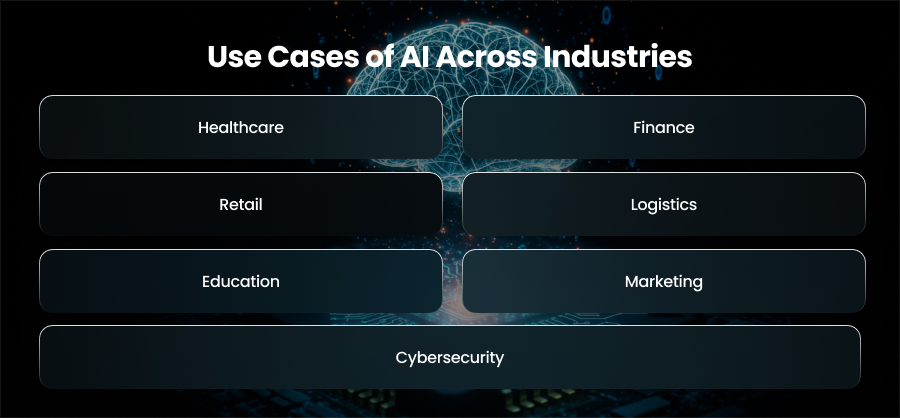
Use Cases of AI Across Industries
Healthcare
AI is drastically changing healthcare by increasing the precision of diagnoses and customizing treatment regimens. Additionally, machine learning models are capable of analyzing medical pictures with accuracy that frequently equals or surpasses that of human specialists. Additionally, long before symptoms manifest, AI powered analytics assist in identifying people at risk for illnesses like diabetes or heart disease.
Finance
AI is crucial to the financial industry’s ability to increase operational effectiveness and facilitate more intelligent investing choices. Machine learning-driven fraud detection systems continually examine transaction patterns to identify questionable transactions in real time. Banks may analyze creditworthiness more precisely with the use of AI driven risk assessment tools. This reduces loan defaults and enables more personalized financial products.
Retail
AI is being used by retail businesses to improve supply chain efficiency and provide more individualized shopping experiences. Product suggestions are generated by recommendation engines based on the interests and browsing behaviors of users. AI also enhances inventory management by forecasting demand. Virtual assistants also provide prompt customer support and respond to inquiries.
Logistics
AI is changing the logistics industry by reducing operational costs and enhancing safety. Route optimization technology allow delivery companies to plan the best routes. Fuel usage is reduced and delivery times are shortened. AI also powers warehouse automation and inventory movement with unmatched accuracy.
Education
By offering individualized learning experiences based on each student’s choices, artificial intelligence is enhancing academic outcomes. In order to fill in knowledge gaps, intelligent tutoring systems evaluate student replies and adjust the course in real time. AI technology is used by educational institutions to automate administrative activities, such as monitoring student progress.
Marketing
AI is used by marketing organizations to automate tedious processes and comprehend consumer behavior. Large amounts of data are processed by AI analytics technologies to reveal information about consumer interaction and preferences. AI is used by marketers to enhance ad performance in real time and personalize content. Throughout the buyer experience, chatbots help with lead creation and prospect nurturing.
Cybersecurity
With the increasing sophistication of cyber threats, artificial intelligence is increasingly essential for enhancing security. Machine learning models continuously examine networks for potential attacks. By automating threat reactions, AI systems minimize harm and speed up reaction times. AI is used by security teams to identify malware.
Challenges and Limitations of AI
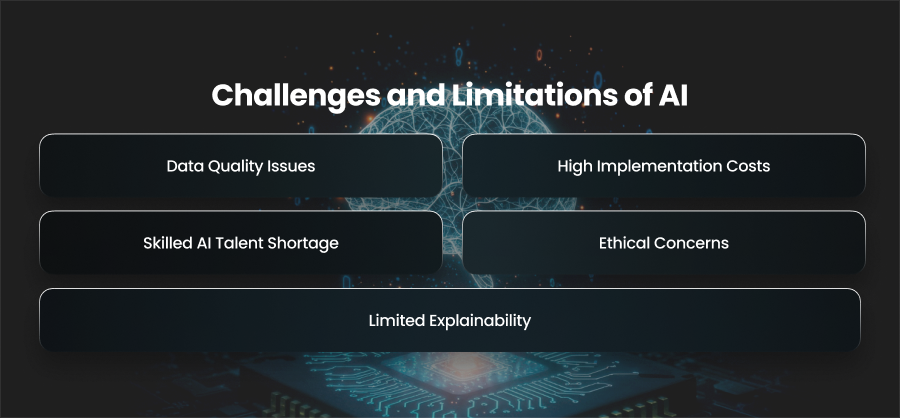
Data Quality Issues
AI systems rely heavily on data. Their performance deteriorates without it. Data is disorganized or dispersed across several platforms in many sectors. Inaccurate data can deceive AI algorithms. This may result in unreliable results. Additionally, some companies simply do not have access to the datasets required to train algorithms.
High Implementation Costs
While cloud based AI tools have reduced entry barriers, implementing enterprise level AI solutions can still be expensive. Infrastructure and recruiting experts are among the expenses. Large models demand powerful gear for training, which might increase costs. It is sometimes challenging for smaller businesses to justify these expenses. This is particularly true when ROI is unclear.
Skilled AI Talent Shortage
There is a far greater need for AI specialists than there are workers. Among the most in demand occupations are data scientists and model trainers. Businesses find it difficult to develop efficient AI systems because of this skill scarcity.
Ethical Concerns
The quality of the data utilized to train AI systems determines how unbiased they are. It is possible for AI systems to unintentionally replicate historical biases present in training datasets. Unfair judgments are made as a result in fields like healthcare and hiring. Data misuse and privacy also provide ethical issues.
Limited Explainability
A lot of AI models are unclear. Therefore, understanding how individuals make decisions is difficult. Confidence is damaged by this lack of openness. Additionally, it makes it difficult for companies to apply AI in delicate industries. Rules become increasingly challenging to follow when stakeholders are unable to understand AI judgments.
How Businesses Can Prepare for the AI Future?
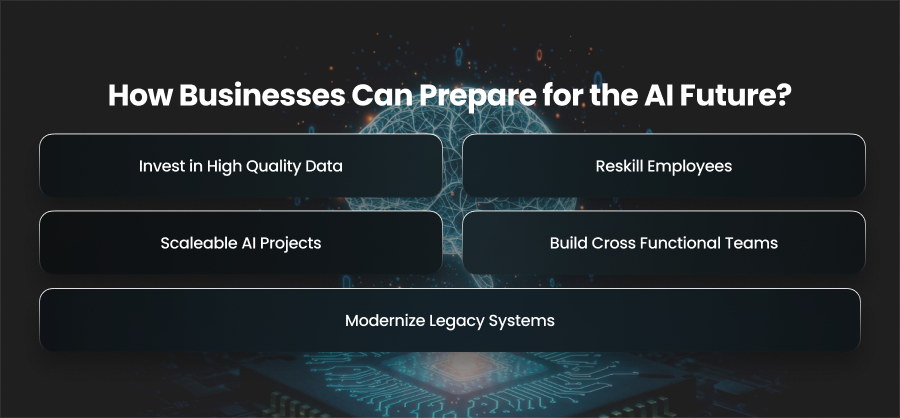
Invest in High Quality Data
To effectively use AI, businesses must ensure that their data systems are reliable. The initial steps in this process are establishing data governance principles and implementing tools that standardize data. The precision and effectiveness of AI models may be greatly increased by making investments in cloud platforms and data warehouses. Additionally, businesses have to think about setting up specialized data teams in charge of ongoing data quality checking.
Reskill Employees
Employees must be equipped with the abilities necessary to collaborate with AI in order to prepare for the AI future. This involves offering training in data literacy. AI developers are more adept at interacting with AI technologies. Additionally, businesses should focus on developing hybrid jobs.
Scaleable AI Projects
Businesses should concentrate on small and manageable pilot initiatives rather than starting with large scale AI developments. These initiatives can act as proof of concept. This demonstrates instant benefits and teaches teams how to incorporate AI into current systems. The approach can be progressively expanded across processes after a successful pilot.
Build Cross Functional Teams
AI projects necessitate cooperation across several teams. Cross functional teams make sure that AI initiatives are not compartmentalized and that all viewpoints are taken into account while they are being implemented. This strategy facilitates more seamless integration.
Modernize Legacy Systems
The performance needed to enable AI technology is frequently lacking in legacy systems. Businesses must progressively update their infrastructure by implementing cloud computing and APIs in order to be ready for the future. Speed can be greatly increased by updating legacy software and integration automation tools.
Final Words
AI is transforming sectors and increasing productivity. But it also presents difficulties that require preparation. Businesses that invest in scalable AI projects will be in the best position to thrive in a world that is changing quickly.